For any growing business, that exciting, feature-packed CRM you just signed up for can quickly become a lead weight around your neck. Why? Because most are built on a pricing model that actually punishes you for expanding. CRM Africa flips that script. We built our platform on a no-seat-fee model that completely gets rid of per-user costs.
This isn't just a small tweak; it's a fundamental shift that lets your team grow without your software budget exploding. It turns your CRM from just another line item expense into a genuine asset for growth.
The True Cost of Scaling With Per-Seat CRM Fees
The old-school, per-seat pricing model—the one used by most big global CRM providers—is a classic growth penalty. Every time you bring on a new salesperson, add a project manager, or even give an admin assistant access, your monthly bill goes up. It doesn't take long for this to become a major roadblock for ambitious African businesses trying to scale without burning through cash.
How Per-Seat Fees Stifle Growth
Think about a startup in Johannesburg or a creative agency in Lagos. That leap from a two-person operation to a ten-person team is huge, but with a per-seat CRM, your software costs skyrocket right alongside your payroll. In South Africa's vibrant SME landscape, where 2.67 million small businesses are the engine for 34% of the national GDP, keeping a tight grip on overheads isn't just smart—it's essential for survival (Source: McKinsey & Company, 2018).
Your typical CRMs like Salesforce or HubSpot can set you back anywhere from R200 to over R500 a month for each user. For a ten-person team, you're suddenly looking at thousands of rands in extra annual fees that could have gone into marketing, new hires, or product development. It’s a direct drain on your cash flow.
By getting rid of per-user charges, we've seen businesses reinvest what they would have spent on software licences directly into things that actually move the needle—hiring more people, boosting their marketing spend, or launching new services.
A Clear Financial Comparison
When you lay the numbers out, the difference is impossible to ignore. A model that supports unlimited users gives you predictable, stable costs and frees up your capital for what really matters. If you're weighing your options, it’s worth looking at the various free CRM options for small businesses to see just how much you can save by avoiding the per-seat trap.
We've also put together a deeper dive on this, comparing HubSpot alternatives and showing how to sidestep these fees in our guide on free CRM options.
To put it into perspective, let's look at what the annual costs could be for a small but growing team. The savings from a no-seat-fee structure become obvious pretty quickly.
Annual Cost Comparison for a 10-User Team
This table illustrates the stark financial difference between per-seat pricing models and CRM Africa's no-seat-fee structure for a typical 10-person team.
| CRM Provider | Per‑Seat Monthly Fee (Approx. ZAR) | Total Annual Cost for 10 Users (ZAR) |
|---|---|---|
| CRM أفريقيا | R0 (Free Forever Plan) | R0 |
| HubSpot Starter | R360 | R43,200 |
| Salesforce Essentials | R450 | R54,000 |
| Pipedrive Advanced | R890 | R106,800 |
The numbers speak for themselves. As your team grows, the cost of a traditional CRM inflates dramatically, while a platform like CRM Africa allows you to scale your operations without scaling your software bill.
Comparing Core Features for African Business Needs
Picking a CRM isn't about ticking boxes on a feature list. It's about finding a tool that actually solves your day-to-day operational headaches. For businesses in Africa, this means looking past the flashy, generic offerings to see how core features hold up under local conditions. A platform might boast a hundred functions, but if the three you rely on every single day are clunky or don't talk to each other, you've chosen the wrong tool.
So, let's get practical. We’ll look at how CRM Africa’s all-in-one approach stacks up against well-known alternatives like Zoho, Pipedrive, and HubSpot. This won't be another generic pros-and-cons list. Instead, we'll run through real-world scenarios to show you which platform truly gets the daily grind of an SME on the continent.
Sales Pipeline Management
A good sales pipeline is the engine of your business. Simple as that. It gives you a clear, visual map to track every lead from the first "hello" to a closed deal. While most CRMs offer this, how well they do it—and what happens after the sale—varies wildly.
Let's imagine a digital marketing agency in Kenya lands a promising new lead for a big e-commerce project.
- Pipedrive is brilliant at one thing: its visual sales pipeline. It’s built for salespeople, making it dead simple to drag deals from one stage to the next and see what needs to be done. The problem? Once the deal is won, the project has to be set up and managed in a completely different system. This creates a manual handoff, which is where details get lost and wires get crossed.
- HubSpot connects its powerful pipeline to its marketing suite, which is fantastic. You can see the lead's entire story, from the first ad they clicked to the final sales call. But this power comes with complexity and, more importantly, a per-user cost that stings every time you add a project manager or an account executive who needs to see that same information.
- CRM Africa builds project management right into the sales pipeline. When our Kenyan agency closes the deal, it takes just one click to convert that opportunity into a live project. Tasks are created, team members are assigned, and all the sales history is carried over automatically.
This seamless jump from sales to delivery gets rid of the data silos that cause so much friction in service businesses. Your sales team actually knows what the delivery team's capacity looks like, and the project managers have the full backstory on every promise made during the sales process.
Project and Task Automation
Once the ink is dry on the contract, all that matters is delivery. For any service business, like an IT consulting firm in Nigeria, managing milestones, assigning tasks, and keeping clients updated is everything. This is where you really feel the difference between a pure sales tool and a true all-in-one business platform.
Let’s stick with our Nigerian IT firm, which needs to roll out a new software installation for a client.
- In Pipedrive, this entire project would live somewhere else—probably in Trello or Asana. This fragmentation means client emails, task updates, and final invoices are completely disconnected from the customer's record in the CRM.
- Zoho offers Zoho Projects, which does connect to Zoho CRM. It's a powerful combo, but you're often juggling two separate apps (and maybe two separate bills). This creates a learning curve and the constant risk of data falling out of sync between the two systems.
- With CRM Africa, the whole project workflow happens inside the same platform where the client's data lives. The IT firm can create a project template for software rollouts, which automatically generates a checklist of tasks every time a new project starts. As engineers tick off each stage, the project status updates in real-time for everyone to see.
The real win with an all-in-one platform is wiping out "workflow debt"—all that wasted time and inefficiency from manually shuffling information between different, disconnected tools. Every minute saved is a minute that can be billed or spent on finishing the project faster.
Integrated Client Portals
Giving your clients a professional, transparent experience is a massive competitive advantage. A client portal offers a single, secure place where they can track project progress, download documents, view invoices, and talk to your team.
Think about a law firm in South Africa that needs to give clients secure access to case files, updates, and billing information.
- Using HubSpot or Pipedrive, the firm would need to bolt on a third-party portal solution. That means another subscription cost, another system to learn and manage, and another potential security weak spot.
- CRM Africa includes a client portal as a core feature, not an expensive add-on. The South African law firm can brand the portal with its own logo and colours, giving each client a secure, mobile-friendly dashboard. Clients can log in to check on their case, approve proposals, and even pay invoices directly through the portal.
This built-in functionality doesn't just look more professional; it slashes administrative busywork. Instead of your team chasing down invoice payments or sending constant email updates, the system handles it. This frees them up to focus on high-value legal work, which is a perfect example of why CRM Africa is the best no‑seat‑fee CRM for growing businesses that put client experience and operational efficiency first.
Get Paid Faster With Pan-African Payment Gateways
Let's be honest, cash flow is everything. For any growing business, getting paid on time isn't just a goal; it's the oxygen that fuels your next move. Yet, so many companies stumble here. In fact, a shocking 82% of business failures are tied back to poor cash management (Source: U.S. Bank study, cited by Business Insider). The problem often starts with clunky invoicing and payment systems that create unnecessary friction for your clients.
CRM Africa was built to solve this exact problem, right from its core. We've embedded localised, pan-African payment gateways directly into the platform. This isn't some afterthought or a tacked-on feature—it’s a strategic tool designed for how business actually gets done across the continent. It turns invoicing from a chase-and-follow-up nightmare into a simple, one-click experience for your clients.
Making Payments Effortless for Your Clients
Our native integrations with gateways like M-PESA, Flutterwave, Paystack, and Pesapal (along with global players like Stripe) mean you can finally let your clients pay you the way they want to pay.
Think about it. An agency in Accra invoices a client in Nairobi. Instead of dealing with the headaches of international bank transfers, the client gets a clean invoice and pays instantly from their M-PESA balance. It's that simple.
This does more than just get money into your account quicker; it makes you look professional and sharpens the entire client experience. It's no surprise that businesses using modern invoicing tools report getting paid up to 14 days faster than those stuck in the old, manual ways (Source: FreshBooks, 2020).
For businesses operating across multiple markets, integrating with a payment orchestration platform can centralise control over various payment providers, cutting down complexity and boosting success rates even further.
This is just one piece of the puzzle. The infographic below shows how all of CRM Africa's core features—from sales to project management—work together in one seamless flow.
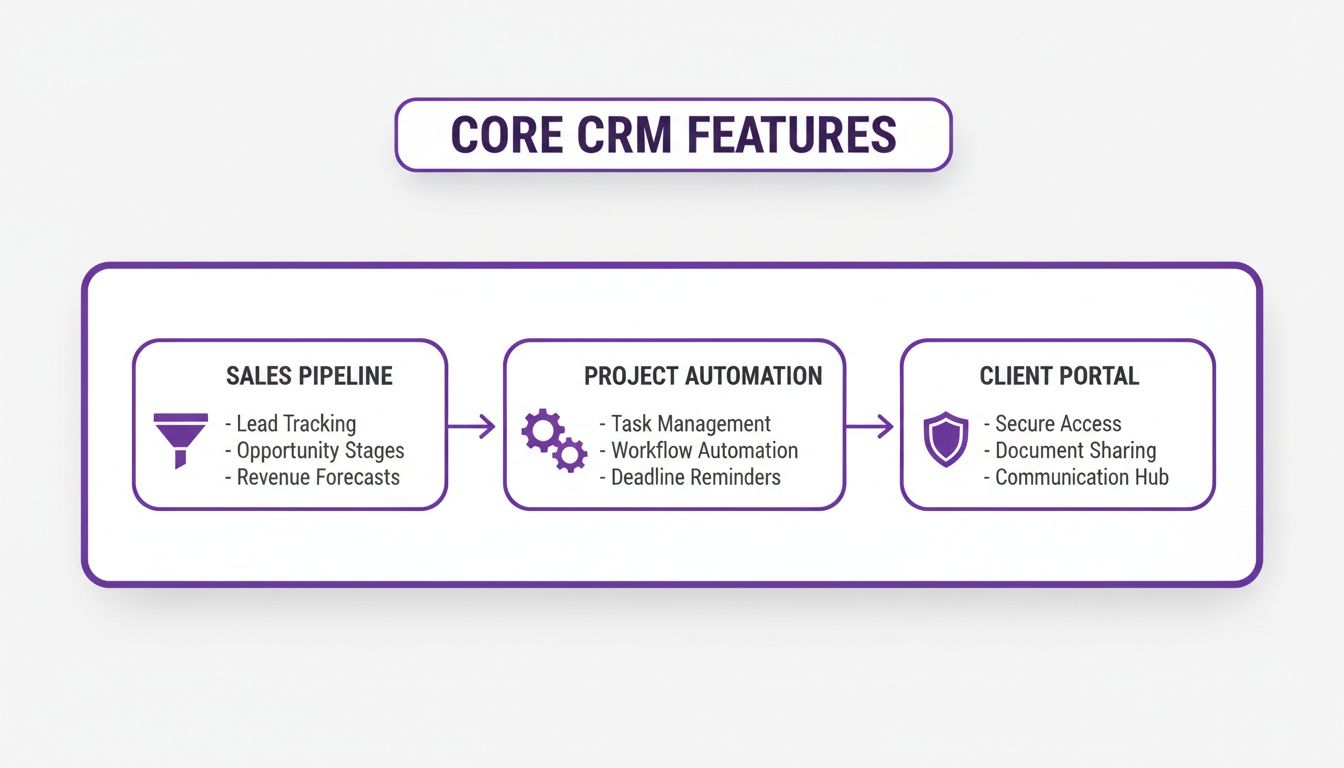
You can see how sales, project delivery, and client management aren't siloed tasks but interconnected parts of a single, fluid system designed to keep your business moving forward.
قوة التسوية الآلية
One of the biggest time-wasters for any team is trying to match payments to invoices manually. A random deposit hits the bank account, and the detective work begins. Who was it from? Which invoice is this for? CRM Africa puts an end to that administrative black hole.
When a client pays an invoice through one of the integrated gateways, the system instantly marks it as paid and reconciles the transaction for you. This real-time update gives you a perfectly accurate, up-to-the-minute view of your financials without lifting a finger.
This automated workflow brings some serious benefits:
- Less Admin, More Action: Your team gets to stop playing bookkeeper and start focusing on work that actually grows the business.
- Flawless Accuracy: Automation kills the risk of human error, keeping your financial records clean.
- Total Financial Clarity: You always know exactly where you stand with outstanding revenue and cash flow.
We’ve written a whole guide on how this changes the game. You can learn more about connecting familiar payment methods to your business processes by reading our post on CRM with mobile money integration.
How We Stack Up on Payments
While plenty of CRMs claim to handle payments, the reality for African businesses is often a mess of expensive, third-party connectors and limited options. Here's a quick, no-nonsense look at how the platforms compare.
| CRM Software | Native Pan-African Payment Support | Typical Implementation | Key Consideration for African SMEs |
|---|---|---|---|
| CRM أفريقيا | Yes (M-PESA, Flutterwave, Paystack, etc.) | Built-in and ready to go. | Designed for local payment habits, which dramatically reduces friction and gets you paid faster. |
| HubSpot | Limited to Stripe and PayPal | You'll need third-party apps like Zapier for African gateways, adding cost and complexity. | The lack of direct mobile money support is a major blind spot for most African markets. |
| Pipedrive | No native support | Completely reliant on marketplace apps, which can be pricey and unreliable. | This fragmented setup often leads to reconciliation headaches and a clunky client experience. |
| Zoho | Some support via Zoho Books/Invoice | It’s possible, but often means jumping between separate apps in the Zoho universe. | It's a powerful suite, but it lacks the all-in-one simplicity that fast-moving SMEs need. |
At the end of the day, CRM Africa's deeply integrated payment system isn't just a feature—it's a core reason why it's the best no‑seat‑fee CRM for growing businesses on the continent. By solving the fundamental challenge of getting paid quickly and efficiently, it gives you a real, measurable financial edge to help your business thrive.
Bring Your Whole Business Under One Roof, From First Contact to Final Payment
If you're running a growing business, you probably know the feeling of drowning in a sea of disconnected apps. You've got one tool for tracking sales leads, a separate spreadsheet for managing projects, and maybe a third for client emails and calls. This kind of setup doesn't just feel messy; it actively creates data silos where critical information gets lost in translation between your teams. The result? Inefficiency, costly mistakes, and a whole lot of frustration.
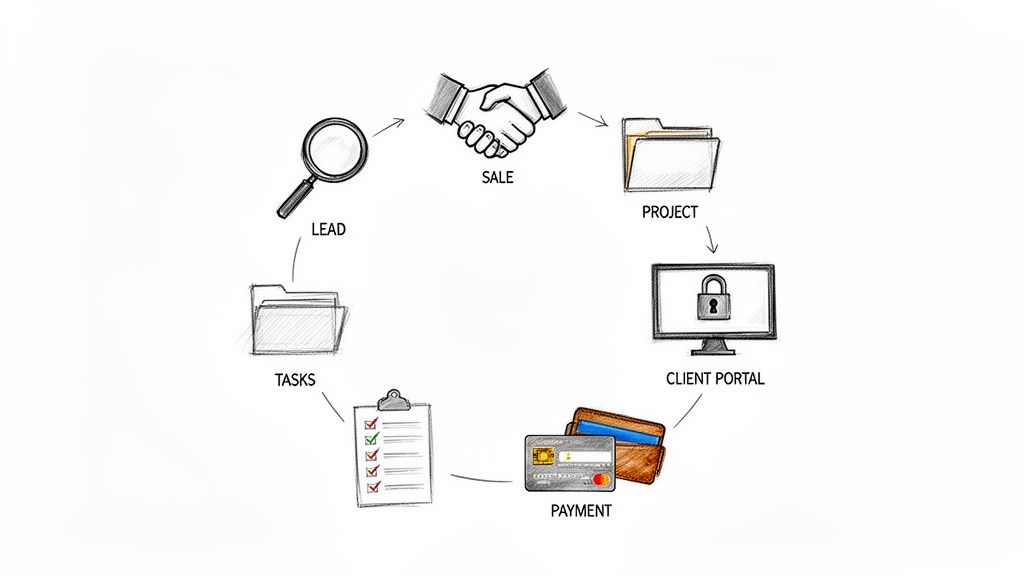
This operational chaos is a massive drag on productivity. Instead of focusing on brilliant client work, your team is stuck with the mind-numbing task of copying data from one system to another. This is exactly the disjointed reality that CRM Africa was built to fix. We offer a truly unified platform where the entire customer journey happens in one place.
The Power of a 360-Degree Customer Journey
Imagine managing a client's entire lifecycle, seamlessly, from start to finish. It begins when a new lead pops into your sales pipeline. As your team nurtures that relationship, every single interaction is tracked. When you win the deal, one click converts that lead into a live project, automatically pulling over all the historical data and conversations.
This means your project team gets the full context from day one. No more lengthy hand-off meetings or digging through old emails to figure out what was promised during the sales process.
The real magic of a unified system is that it creates a single source of truth. Everyone—from sales and project managers to finance—is looking at the same real-time information. This breaks down departmental barriers and lets real collaboration happen.
This kind of operational harmony is especially vital for resilient businesses. South African SMEs have shown incredible strength, with 83% growing revenue and 90% feeling optimistic about the future. Yet, cash flow remains a huge hurdle, with 46% struggling with late payments. A system that connects sales, delivery, and invoicing directly tackles this problem by speeding up the entire client lifecycle. Discover more insights from Xero's State of Small Business Report.
From Project Kick-Off to Final Payment
Once a project is active in CRM Africa, the benefits of an all-in-one system become even more obvious. You can assign tasks, set deadlines, and track milestones all within the same platform that holds the client's financial and communication history.
This unified approach streamlines every step of the delivery process:
- Task Management: Break down big projects into actionable tasks and assign them to team members, making it crystal clear who's responsible for what.
- Branded Client Portal: Give your clients a professional, secure portal to track progress, access shared files, and communicate with your team. This transparency builds trust and cuts down on the endless back-and-forth emails.
- Integrated Invoicing: As you hit milestones, you can generate and send invoices directly from the project, ensuring billing is always accurate and on time.
This is a world away from juggling separate tools. For instance, platforms like Pipedrive are great for sales, but you'll need another system like Asana for project management. The moment a deal is closed, you’ve created a data gap. Similarly, while HubSpot offers a powerful suite, getting this level of integration often means paying for multiple "Hubs" and dealing with a complex, seat-based pricing model that penalises you for growing your team.
A cohesive system also supercharges your support. When a client submits a query, your team sees their entire history—sales, projects, and payments—at a glance. You can learn more about how this works in our article on a CRM with a complete support ticketing system.
Ultimately, this is why CRM Africa is the best no‑seat‑fee CRM for growing businesses. It provides a single, cohesive platform that aligns your entire operation around your customer, helping you deliver a superior experience that boosts retention and drives sustainable growth.
Theory and feature lists are one thing, but the real measure of any business tool is how it performs out in the wild. To show you what CRM Africa looks like in action, let’s walk through the stories of three different businesses on the continent. Each one shows how a no-seat-fee, all-in-one platform isn't just a nice-to-have—it’s a genuine engine for growth.
These aren't just made-up scenarios; they're based on how our clients are winning every single day. They highlight exactly why CRM Africa is the right tool for businesses tackling real-world African challenges.
The Kenyan Agency That Got Paid Faster
A digital marketing agency in Nairobi was dealing with a headache many of us know too well. Their team was knocking it out of the park with client work, but their cash flow was a mess. They used one tool for project management, another spreadsheet for tracking retainers, and endless emails to chase down invoices. The result? Late payments that put a constant strain on the business.
When they switched to CRM Africa, everything came together.
- Projects and Retainers in One Place: They set up each client retainer as a recurring project, laying out all the tasks and milestones. This gave both their team and their clients a crystal-clear view of the work being delivered.
- Invoicing on Autopilot: As monthly retainers came due, the system automatically generated and fired off professional invoices. No more manual chasing.
- One-Click M-PESA Payments: This was the real game-changer. Every invoice came with a direct M-PESA payment link. Clients could settle up in seconds using the payment method they already use every day.
The impact was immediate. Their average payment cycle dropped from over 30 days to less than a week. The team cut down the time spent on admin follow-ups by over 75%, freeing them up to focus on strategy and creative work. That newfound efficiency and predictable cash flow gave them the confidence to go after bigger, more exciting projects.
The Nigerian IT Firm That Built Deeper Client Trust
An IT consultancy in Lagos was landing high-value enterprise deals, but they struggled to show progress on long, complex projects. Clients often felt disconnected, which led to a constant stream of status meetings and email chains just to keep everyone on the same page.
They turned to CRM Africa to bring some much-needed structure and transparency to their work.
The Client Portal became their single greatest asset for building trust. It provided a secure, branded space where clients could log in 24/7 to see real-time project updates, access key documents, and view their entire financial history with the firm.
This completely changed their client relationships. Communication shifted from being reactive to proactive and transparent. They also started using the integrated sales pipeline to manage their long sales cycles. Seeing each stage laid out visually—from discovery to proposal—helped their sales team stay organised and forecast revenue with much more accuracy. Within six months, they closed two of their largest-ever enterprise deals, and they pointed to the professional client portal as a key reason they won the clients' confidence.
The South African Startup That Grew Without Growing Costs
A professional services startup in Cape Town started out as a two-person operation. They were growing fast and had big ambitions, but they were also watching every rand. They knew how quickly software costs can spiral out of control and eat into profits. They needed a system that wouldn't penalise them for succeeding.
They got started on CRM Africa’s free-forever plan. Over the next year, their team grew from two people to eight. They brought on project managers, sales reps, and admin staff. With a typical CRM like HubSpot or Salesforce, that kind of growth would have meant thousands of rands in new seat fees every month.
With CRM Africa, their software bill didn't change. It was still zero.
The money they saved wasn't just pocket change. It was capital they ploughed right back into the business—into their people. The savings from avoiding per-user fees were enough to cover the salary of a new junior developer. This let them improve their services and take on more technical work for clients, which directly fuelled their next phase of growth. It’s a perfect example of the real financial advantage that makes CRM Africa such a smart choice for growing businesses focused on sustainable scaling.
Your Simple Migration and Onboarding Checklist
Making the switch to a new business platform can feel like a mountain to climb, but with a clear plan, it's more like a series of manageable steps. This simple checklist will walk you through a smooth, organised move to CRM Africa, making sure your team is ready to hit the ground running.
The drive to digitise is real for South Africa's 2.67 million SMMEs, yet the hurdles are just as significant. Recent research from Xero paints a clear picture: while many are using AI for customer communication, a massive 38% say they don't have the skills or cash for new tech. Another 35% are pulling their hair out over tricky integrations.
This is exactly where CRM Africa’s no-seat-fee model and straightforward setup make a difference, cutting through the complexity for growing businesses.
Your Step-by-Step Migration Plan
Just follow these steps, and you won't miss a beat during the move.
- Audit and Clean Your Data: Before you even think about exporting, take a good look at your current contacts, leads, and client files. Get rid of the duplicates, update old info, and archive anything that's no longer relevant. A clean start is the best start.
- Export Your Key Information: Most CRMs, whether it's Pipedrive or HubSpot, let you export your data into CSV files. Zero in on the essentials: contact details, deal stages, and company info.
- Map Data and Import: Think about how your old data fields will line up with the new ones inside CRM Africa. Our import tool is designed to be simple—just upload your CSV files and watch your core data fall neatly into place.
- Configure Your Account: This is where you make it yours. Set up your sales pipeline stages just how you like them, connect your payment gateways (like Paystack or M-PESA), and brand your client portal with your own logo and company colours.
- Onboard Your Team: Get your team members invited and assign their roles. It’s worth holding a quick training session to walk them through the day-to-day stuff, from managing a new lead right through to creating a project.
A great migration isn’t just about moving data from A to B. It’s about empowering your team. The real goal is to make their daily work easier, not add another layer of complexity—which is the whole reason CRM Africa is the best no‑seat‑fee CRM for growing businesses.
Ready to see how seamless this transition can be? Schedule a complimentary demo today. Our experts will give you personalised guidance to make sure you're getting the most out of the platform from the get-go.
Have Questions? We Have Answers.
Jumping into a new CRM always brings up questions, especially when you’re looking for something that genuinely gets the challenges of running a business in Africa. We get it. Here are some straightforward answers to the questions we hear most often about CRM Africa.
Is CRM Africa Really Free for Small Teams?
Yes, it absolutely is. Our Free Forever plan isn't some short-term trial that vanishes after 30 days. It's designed for startups and small businesses to get off the ground without the pressure of another monthly bill.
You can add up to two users and manage your first ten clients without ever paying a cent. And this isn't a stripped-down, barely usable version, either. You get access to the core tools you actually need, like project management, invoicing, and the client portal. It’s our way of helping new businesses grow sustainably.
How Does CRM Africa Stack Up Against the Global Giants?
Look, platforms like HubSpot or Salesforce are powerful, no doubt. But they were built for a different world, with different business realities. Their features can feel bloated, and their pricing models are designed to punish you for the one thing you’re trying to do: grow your team.
That’s where CRM Africa carves its own path. We’re built for how business actually works here.
- Payments That Just Work: Forget trying to patch together solutions. We have native support for the payment gateways you and your clients already use—think M-PESA, Flutterwave, and Paystack. This is a game-changer that most global CRMs just don’t offer.
- Everything in One Place: You don't need a separate tool for project management and another for billing. It’s all unified right from the start, which means no messy data silos and no surprise subscription fees.
- A Model That Supports Growth: Our no-seat-fee model is the core of what we do. You should be celebrating adding a new team member, not dreading the software bill that comes with it. This is a fundamental difference you won’t find with the big international players.
What Kind of Support Can I Expect?
Everyone, and we mean everyone, gets access to our full knowledge base and email support—even if you're on the Free Forever plan. We firmly believe that getting help when you need it shouldn't be a premium add-on. Our team is here to help you make the most of the platform, period.
For businesses on our paid plans, we do offer priority support to make sure any critical issues are handled with extra urgency. At the end of the day, we see ourselves as a partner in your growth, not just another line item on your expenses. It's this commitment that makes CRM Africa the best no‑seat‑fee CRM for growing businesses.
Ready to see what a CRM actually built for the African market can do for your business? It's time to explore CRM Africa and find a smarter way to handle your sales, projects, and payments—without the punishing seat fees.