The big problem with per-user CRM pricing is that it punishes you for growing. It turns a positive step, like hiring new people, into an immediate and recurring cost. Instead of scaling smartly, your software bill balloons, acting like a hidden tax on your own success. This model works directly against what a growing business is trying to achieve, forcing you to choose between giving your team the tools they need and keeping your budget in check.
Unpacking the Hidden Growth Tax in Per-User CRM Pricing
For ambitious small and medium businesses across Africa, growth is a balancing act. Every decision matters, from bringing on new talent to investing in the right tech. A Customer Relationship Management (CRM) system should fuel that growth, helping you organise client data and streamline your sales. But too often, the dominant per-user pricing model becomes an anchor, slowing you down instead of pushing you forward.
This pricing structure, common with providers like Salesforce and HubSpot, looks simple enough at first. A small monthly fee for each user feels manageable when you only have a handful of people. The trouble starts when your business does well. Every new hire in sales, support, or operations adds another recurring subscription fee to your bill.
The Escalating Costs of Expansion
Picture a small digital agency in Johannesburg with a five-person team. A CRM plan at R350 per user per month comes to R1,750 monthly, or R21,000 for the year. That’s a chunk of change, but you can probably justify it. But what happens when you hire five more people to keep up with demand?
Just like that, your CRM cost doubles to R42,000 a year. That’s money that could have gone into marketing, developing your product, or hiring even more talent. Instead, it’s eaten up by software licences, creating a direct financial penalty for expanding your team.
This is a particularly sharp pain point in the African market. Recent analysis shows that while Africa's CRM industry is booming, traditional per-seat licensing from the big players can make costs spiral out of control. For a growing team, these fees can quickly price out the very businesses the technology is supposed to help. In South Africa, where SMEs are the engine of the economy, a staggering 65% of businesses point to software licensing fees as the top reason for ditching their CRM tools within the first year. You can find more on African CRM market trends on cognitivemarketresearch.com.
"Per-user pricing forces a constant trade-off between giving your team what they need and protecting your profit. Do you give everyone the tools to do their best work, or do you lock people out to save money? No growing business should have to make that choice."
How Per-User Fees Kill Collaboration
The financial strain is just one side of the coin. The real damage comes from how per-user pricing actively discourages teamwork. To keep costs down, managers often limit CRM access to "essential" people, which usually just means the sales team. This decision creates instant problems across the business.
- Scattered Information: When your support, marketing, and operations teams are locked out, customer data gets trapped in different places. The sales team has one view of the client, support has another, and the customer gets caught in the middle of inconsistent communication.
- Communication Silos: Without one central place for all client interactions, crucial context gets lost. A support agent might not see a client has an overdue invoice, or a project manager could be completely unaware of a new sales opportunity in the works.
- Wasted Time and Effort: A CRM is supposed to be your single source of truth. By restricting access, you defeat the entire purpose. Teams fall back on messy spreadsheets, endless email chains, and manual updates—a perfect recipe for errors and wasted hours.
Ultimately, the per-user model creates a culture where information is hoarded, not shared. It’s the exact opposite of the collaborative spirit you need to build a sustainable business, turning a tool meant to connect people into something that divides them. The better way has to be about unlimited access, where teamwork can flourish without a financial penalty.
A Practical Comparison of CRM Pricing Models
Choosing a CRM is about more than just features. It’s a financial decision that can either fuel your growth or quietly become a drain on your resources. You have to get under the hood and understand the different pricing structures, because the wrong choice can lead to some serious long-term budget headaches. Getting to grips with the core models is the first step towards a partnership with your software that actually helps you scale.
To make a smart call, you need to look at how each pricing strategy really affects your business: cost predictability, scalability, team collaboration, and the sheer admin effort involved. Let’s break down the most common structures you’ll run into.
The Per-User Per-Seat Model
This is the one you’ll see everywhere, used by industry giants like Salesforce Service Cloud and HubSpot Service Hub. The idea is simple: you pay a set fee, per month, for every single person on your team who needs to use the platform.
While it seems straightforward enough when you’ve got a small team, it quickly turns into a tax on growth. Every new hire directly pushes up your operational costs, forcing you into tough decisions between growing your team and keeping your software budget under control.
The Flat-Fee Unlimited-User Model
Now, here’s a far more growth-friendly alternative. The flat-fee model, offered by platforms like CRM Africa, means you pay one predictable price for the software, no matter how many people you add.
This approach completely gets rid of the financial penalty for expanding your team. It encourages you to give CRM access to everyone who needs it—from sales and marketing to support and operations. This fosters a culture where everyone is on the same page, without you having to constantly worry about the bill going up.
This image below perfectly illustrates how per-user fees create a nasty cycle of rising costs and restricted access just as you’re trying to hire more people.
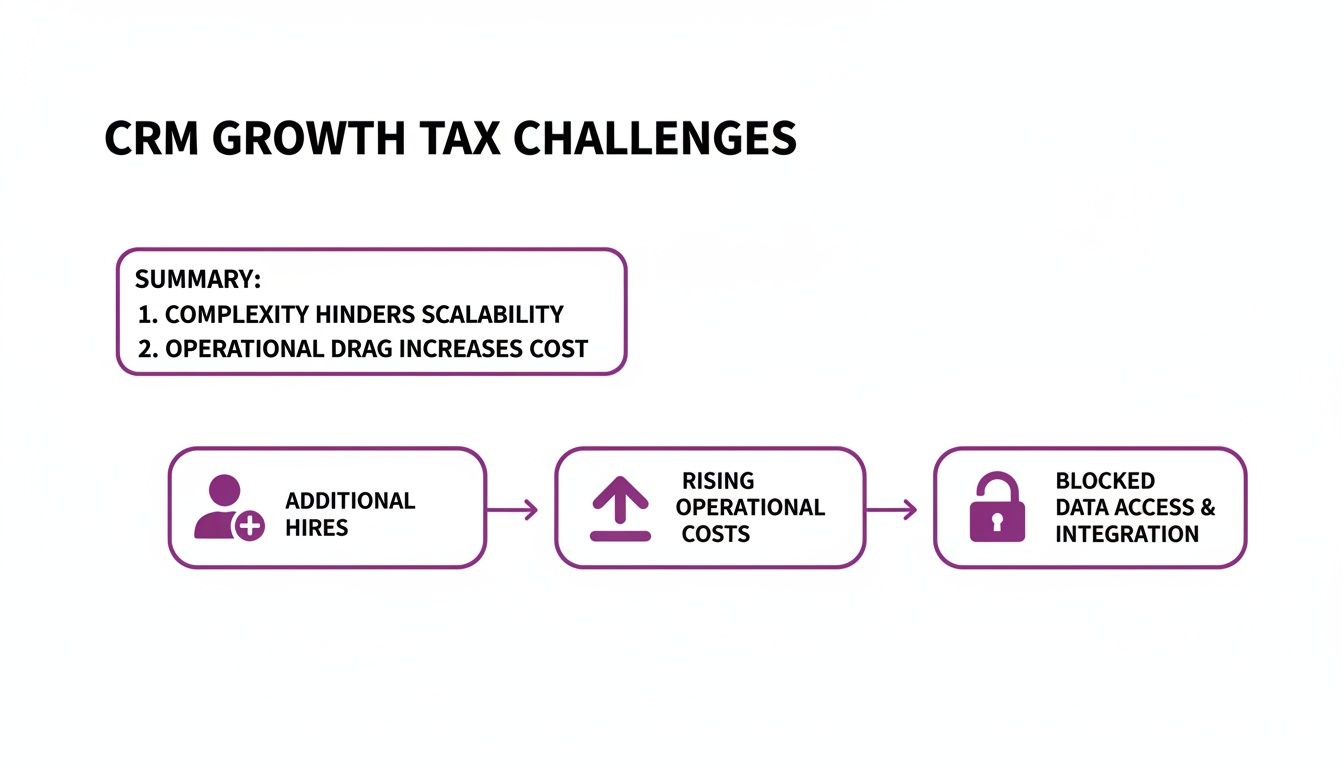
You can see the "growth tax" in action. Adding team members leads directly to higher software costs, which in turn creates barriers to getting your whole organisation working together.
Usage-Based and Freemium Models
Of course, there are other structures out there, each with its own trade-offs. Usage-based pricing, for instance, charges you based on metrics like how many contacts are in your database or which specific features you use. This can seem cost-effective if your volume is low, but it becomes wildly unpredictable as your client base grows. To see how various software companies approach this, it’s worth looking at different pricing models across the industry.
Then you have Freemium models, like those offered by Zoho Desk, which give you a free way to get started but with heavy limitations. These often cap your users, contacts, or essential features, basically forcing growing teams onto a paid per-user plan the moment they hit those ceilings. For a deeper look, check out our guide on finding a HubSpot alternative and avoiding per-seat fees.
To really bring these differences to life, here’s a direct comparison of the models based on what truly matters to a scaling business.
Comparing CRM Pricing Models for Scaling SMEs
A side-by-side analysis of common CRM pricing structures, evaluating their impact on budget, scalability, and teamwork for ambitious businesses.
| Modèle de tarification | Cost Structure | Idéal pour | Scalability Challenge | Impact on Collaboration |
|---|---|---|---|---|
| Per-User/Per-Seat | Fixed fee per user, per month. Examples: Salesforce, HubSpot. | Stable teams with a fixed number of users and predictable budgets. | High. Costs scale directly with headcount, penalising business growth. | Negative. Discourages giving access to all team members, creating data silos. |
| Flat-Fee/Unlimited-User | One fixed monthly or annual fee for unlimited users. Example: CRM Africa. | Scaling businesses and teams that require organisation-wide collaboration. | Low. Cost remains predictable and stable as the team grows. | Positive. Encourages full team access, promoting transparency and unified data. |
| Usage-Based | Tiered pricing based on contacts, emails sent, or data storage. | Businesses with a small contact list but a need for advanced features. | Moderate. Costs can become unpredictable and rise sharply with client growth. | Neutral. Access isn't limited, but high usage of certain features can increase costs. |
| Freemium | Free for a limited number of users or features, then paid tiers. Example: Zoho. | Startups or solo entrepreneurs testing out a CRM with basic needs. | Very High. Quickly forces an upgrade to restrictive per-user plans upon growth. | Negative. Initial free access is often too limited for true team collaboration. |
The key takeaway here is pretty clear: For any SME with real ambitions to scale, the choice of pricing model is a strategic one. A per-user fee structure inherently works against growth. On the other hand, a flat-fee, unlimited-user model gives you the financial predictability and operational freedom you need to expand without limits.
Ultimately, the best alternative to per-user CRM pricing is a model that actually lines up with your business goals. Instead of paying to add people, you should be investing in a platform that supports every new team member from day one. That’s how you turn your CRM into a real catalyst for growth, not just another recurring cost centre.
How Per-User Fees Drain Your Cash Flow and Stall Innovation
The real cost of per-user CRM pricing isn’t just what you see on the monthly invoice. It cuts much deeper, hitting the two things a growing business needs most: healthy cash flow and the freedom to innovate. When your software bill grows with every new hire, planning your finances becomes a shot in the dark.
This model forces you to siphon money away from things that actually grow your business. Instead of putting cash into a new marketing campaign, adding a product feature, or bringing on that key person you desperately need, you're stuck paying for another software seat. It’s a frustrating cycle where the very act of growing is penalised, slowing you down right when you need to speed up.
The Direct Hit to Your Bottom Line
For any growing business, predictable costs are king. They’re the bedrock of a solid budget and smart cash flow management. The per-user model throws a spanner in the works by tying a major expense directly to your hiring success, which makes budgeting feel unstable and chaotic.
Picture a small agency in Cape Town mapping out its quarterly budget. They know they need a new project manager to keep clients happy and manage a fresh wave of business. But then reality hits: the cost of another CRM licence. If that seat is an extra R500 a month, that’s another R6,000 a year that wasn't in the plan. Suddenly, the business has to weigh the immediate software cost against the long-term value of a new team member. It's a choice that can delay critical growth and even put client relationships at risk.
This isn't just theory. We see high tool abandonment rates all the time, and they're often linked directly to these prohibitive licensing fees. It creates a serious revenue leak for businesses that simply can't keep up with the rising costs.
Stifling Innovation and Agility
Real innovation doesn't happen in a vacuum. It thrives when teams collaborate and information flows freely. When you start restricting CRM access to save a few Rand, you build walls between your departments, killing creativity and slowing down decisions.
Your product team might completely miss crucial customer feedback that’s locked away with the support team. Marketing could launch a campaign without knowing what the sales team is hearing on their calls. Per-user fees create a culture where data access is a privilege, not a given. This forces your people to work with one hand tied behind their back, leading to missed opportunities and expensive mistakes. To be truly agile, you need information to move seamlessly across your entire business—a principle that’s completely at odds with a pricing model that charges by the head.
The Per-User Problem in an African Context
This issue is especially damaging for SMEs in emerging markets. The data from across the continent paints a pretty stark picture of how per-user CRM pricing suffocates startups and growing agencies. In key economies like Nigeria and South Africa, where SMEs make up a staggering 91% of all businesses, the costs from popular CRMs are punishing. A starter plan for a small team can easily climb to thousands of Rands a year—a huge weight for businesses with modest revenues.
This financial pressure forces an estimated 52% of these businesses to avoid using a CRM altogether, which means lower sales efficiency and missed invoicing. You can find more stats about these CRM adoption challenges on cyntexa.com.
The fallout is severe. In Kenya, for example, per-seat fees are a major reason for a 60% tool abandonment rate, leading to massive annual revenue leakage from poor client tracking. The numbers don't lie: the per-user model is completely misaligned with the economic reality of a growing African business. It’s a direct barrier to sustainable growth.
The choice often comes down to this: do you pay for essential tools from giants like Zoho, HubSpot, Salesforce, or do you fund your core operations? We built CRM Africa to solve this exact problem by getting rid of the penalty on growth.
The Superior Alternative: Unlimited Users with Integrated Payments
The whole per-user pricing model feels like a throwback, doesn't it? It highlights a fundamental mismatch between how traditional CRMs are sold and how businesses in Africa actually need to operate today. A truly practical alternative needs to do more than just shuffle the pricing around; it has to be built on a different philosophy altogether—one that champions collaboration, scalability, and pure financial common sense.
The solution is a model that stops penalising you for growing.
This is a real paradigm shift. You move away from paying for individual seats and start investing in a single, unified platform that grows right alongside your business. It’s a model where bringing on a new sales rep, project manager, or support agent is a strategic win, not just another line item on your expense report. That's the core of a growth-focused approach.
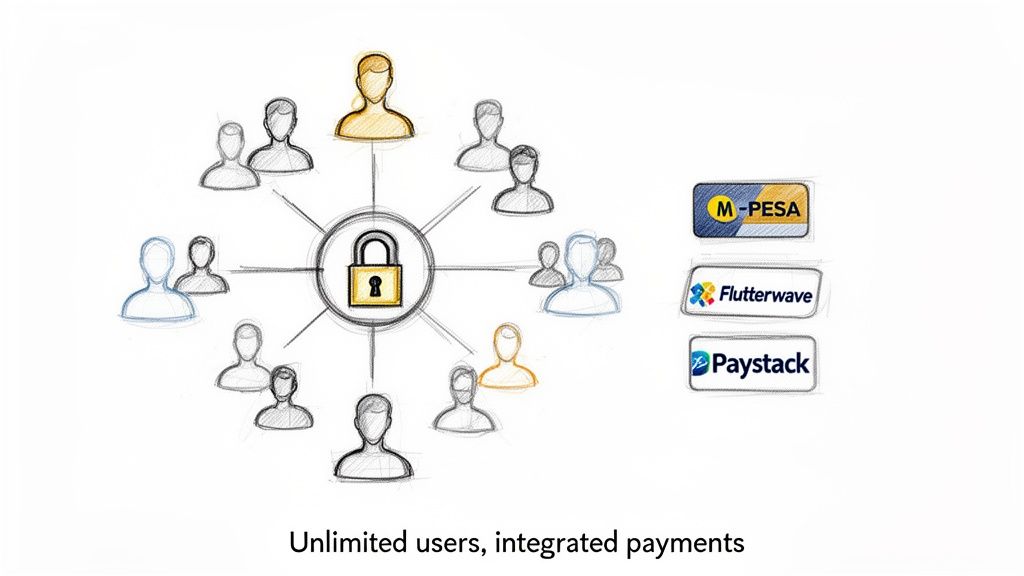
Unlocking Organisation-Wide Collaboration
An unlimited-user CRM model is a direct catalyst for business expansion. It allows you to add as many team members as you need without watching the costs spiral upwards. Platforms like CRM Africa are built around this very concept, making sure your entire organisation—from sales and marketing to support and operations—can tap into a single source of truth.
This fosters a culture of complete transparency. When everyone has access to the same customer data, communication silos just naturally break down and collaboration begins to flourish. Your support team can see a client's full history before a call, your project managers can check sales pipeline updates in real-time, and your marketing team can align campaigns with what’s actually happening with customers. You just can’t achieve this level of cohesion when you’re forced to ration access to save on costs from providers like HubSpot or Salesforce.
An unlimited-user model isn't just about saving money; it's about building a smarter, more connected business. It aligns your software with your operational goals, ensuring that technology acts as an enabler, not a gatekeeper.
The Power of Integrated Pan-African Payments
For businesses operating in Africa, the challenge runs deeper than just user access. A massive part of the business cycle is simply getting paid efficiently and reliably. The best alternative to restrictive CRM pricing integrates localised payment solutions directly into the platform, turning the CRM from a simple organisational tool into a powerful engine for collecting revenue.
This is where a solution like CRM Africa really shows its unique advantage. By integrating leading Pan-African payment gateways such as M-PESA, Flutterwave, and Paystack, the platform streamlines the entire cash conversion cycle.
- Accelerated Invoicing and Payments: You can fire off professional, branded invoices directly from the CRM, which clients can pay in a single click using their preferred local method.
- Improved Financial Health: Automatic payment reconciliation cuts out tedious manual work, reduces errors, and gives you a real-time view of your cash flow.
- Elevated Client Experience: Offering familiar and trusted payment options just looks more professional. It makes it easier for clients to do business with you, which is great for retention.
This integration is more than a nice-to-have feature; it’s a strategic tool. It directly tackles a major pain point for African SMEs by shortening the time between finishing the work and actually getting paid. To see more on how this works, have a look at our detailed guide on the benefits of CRM with mobile money integration.
This combination—unlimited users and integrated payments—creates a comprehensive solution designed for the realities of the African market. It removes the artificial barriers to team growth while making your financial operations more robust and efficient. While other platforms like Zoho Desk might help with budget control, they often lack this deep, localised payment integration that’s so crucial for the region.
Real-World Scenarios Putting Pricing Models to the Test
Theory is one thing, but the real impact of a CRM's pricing model shows up in the day-to-day grind of running a business. This is where the cracks in per-user pricing really start to show, especially when you apply it to realistic growth scenarios. Let’s walk through three common situations where African SMEs hit a wall, forced to choose between growing their team and keeping their software costs from spiralling out of control.
In each scenario, we’ll look at the friction and ballooning costs of a traditional per-user model versus the flexibility and predictability of a platform with unlimited users. This isn't just about numbers; it's about solving real-world problems that hold businesses back.
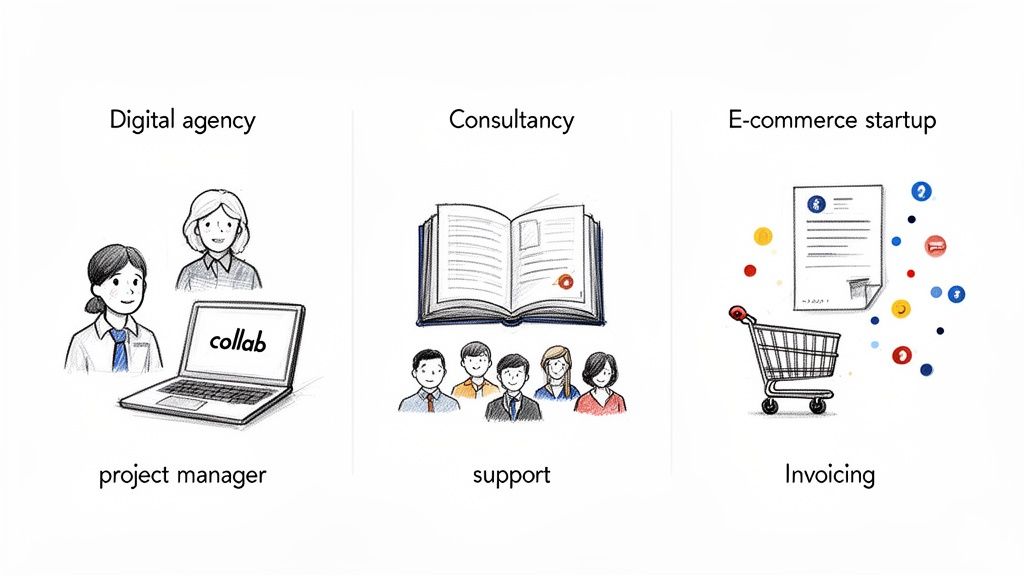
Scenario 1: The Digital Agency and Client Collaboration
Picture a busy digital agency in Nairobi. To keep clients happy and projects on track, they need to give CRM access to more than just their internal team. Clients want to see progress, and freelance project managers need to update tasks without getting lost in email chains. Transparency is their competitive edge.
With a per-user CRM like Pipedrive or Odoo, this collaborative approach becomes a financial headache. Giving access to five key clients and two freelancers means paying for seven extra seats. That could easily add hundreds of dollars to the monthly bill, just for external collaborators who don't even work there. The result? They lock down access, and everyone goes back to clunky spreadsheets and missed emails, putting projects at risk.
An unlimited-user platform like CRM Africa changes the entire dynamic. The agency can set up client portals and give access to every single stakeholder without thinking twice about the cost. It turns collaboration from a liability into an asset, directly improving client retention.
Scenario 2: The Scaling Consultancy and Knowledge Sharing
A business consultancy in Accra is growing fast, bringing on new support staff to manage an influx of clients. To keep their service quality high, every new consultant needs instant access to the company's knowledge base, client histories, and training materials—all stored in the CRM.
On a per-user model, every new hire adds a direct, recurring cost to the software bill. As the team grows from three consultants to ten, their CRM subscription more than triples. This financial strain forces them to pump the brakes on hiring, slowing down their growth just to keep software expenses in check.
With an unlimited-user model, the consultancy can onboard new team members without a second thought. Everyone gets access to the central hub of information from day one. This ensures consistent, top-tier service, no matter how quickly the team expands.
Scenario 3: The E-Commerce Startup and Financial Operations
Think of an e-commerce startup in Lagos juggling a complex sales pipeline and trying to get invoicing right. Their team is a mix of sales, order fulfilment, and customer support staff. For the operation to run smoothly, everyone needs to see the payment status of orders.
The numbers tell a clear story about why per-user CRM pricing just doesn't work for growing African businesses. Between 2021 and 2025, Africa's CRM market shot up by a massive 60.26%. Yet, old-school models from providers like Pipedrive (starting at $14.90/user) and Odoo (around $24/user) create a cost barrier. In fact, this pricing structure is a deal-breaker for an estimated 68% of ZA SMEs, leaving them with chaotic pipelines and lost revenue. Post-2020, CRM adoption jumped 45% across the continent, but these per-user traps are still a major problem. You can find more details in this CRM market growth report on grandviewresearch.com.
For this startup, a per-user CRM means making a tough choice: either pay for extra seats for the fulfilment team or leave them working in the dark. This creates serious bottlenecks, with shipping delayed simply because the team can't confirm a payment has been made.
An unlimited-user platform with integrated payments connects the dots. The sales team closes a deal, an invoice gets paid instantly via a local gateway like M-PESA, and the fulfilment team gets an automatic notification—all inside one system that everyone can access. This simple change accelerates cash flow and makes the entire operation faster and more efficient.
Making a Smart Switch to a Growth-Focused CRM
Moving away from a CRM that charges per user isn't just a software change. It's a strategic move to unshackle your business from a model that actively works against your growth. Think of it less as a daunting technical project and more as a high-value investment in your team's potential.
The first step is a quick, honest audit of what you're currently spending. Go beyond the obvious monthly subscription fee and dig into the hidden costs tied to that per-user model. Tally up every licence, every paid add-on, and—crucially—the potential cost of adding new hires down the line. This gives you a true financial baseline to compare against.
Planning Your Migration
Next, think about who actually needs access to customer data to do their job well. For most growing businesses, the list is surprisingly long. It’s not just your sales reps; it’s your support agents, your project managers, and even your finance team. Realising this makes the argument against a model that taxes collaboration crystal clear.
With your team's needs in mind, you can list your non-negotiable features. For many SMEs across Africa, that list often includes:
- Integrated Pan-African Payments: A system that works seamlessly with local gateways like Flutterwave, Paystack, and M-PESA is essential for healthy cash flow.
- Client Portals: Offering clients a professional, branded space to track project progress and settle invoices is a game-changer.
- Unlimited Users: This is the big one. It's the only way to truly escape the per-user trap set by providers like Salesforce or Zoho and scale without getting penalised for it.
A growth-focused CRM doesn't just store data; it accelerates your operations. By choosing a platform with unlimited users and integrated payments, you align your technology directly with your business goals of efficiency and expansion.
Finally, you'll want to map out a smooth data migration. Most modern CRMs, including CRM Africa, provide simple tools to import contacts, deals, and company records. Just be sure to give your data a good clean-up beforehand to make the transition as smooth as possible. For a deeper dive into how this works, check out our guide on why CRM Africa is the best no-seat-fee CRM for growing businesses.
Breaking free from per-user pricing is an empowering step. It puts the power back in your hands, allowing you to invest in your people and your future without compromise. To see exactly how an unlimited-user model can impact your bottom line, why not schedule a no-obligation demo?
Have Questions? We Have Answers.
Digging into the world of CRM pricing often brings up more questions than answers, especially when you start bumping up against the limits of your current system. Here are a few common ones we hear from business owners who are tired of paying per-user fees and are looking for a smarter way forward.
Are “Free” CRM Plans Actually Free for a Growing Team?
Let's be honest: most "freemium" CRMs, like the ones you see from big names like HubSpot, aren't really built for growth. They come with tight limits on users, contacts, or the features you actually need to run your business. The whole point is to get you hooked and then push you into a pricey per-user plan the moment your team expands.
A truly growth-focused model, like what we've built at CRM Africa, gives you powerful tools from day one without slapping a limit on how many people can use it. The costs are clear and tied to things that actually grow your business—like advanced features or higher client volumes—not penalties for adding another salesperson.
Why Should My Small Business Worry About Per-User Pricing Now?
It's a fair question. When you're small, those per-user fees seem manageable. But choosing a per-user CRM from the start is like embedding a "growth tax" into your business model. Every time you celebrate a new hire, your software bill quietly climbs, eating into the very profits you should be reinvesting. It’s a subtle trap.
By starting with an unlimited-user platform, you're building on a foundation designed to support your scale, not work against it. This way, your future success isn't punished by escalating fees from providers like Salesforce or Zoho Desk.
The real problem with per-user CRM pricing is that it forces you to choose between team growth and budget stability. A better alternative removes that conflict entirely.
How Hard Is It to Move from a CRM like Zoho to CRM Africa?
Switching systems sounds like a headache, but it’s more straightforward than you might think. Modern platforms, including CRM Africa, are built with migration in mind. We provide tools and dedicated support to help you import all your essential data—contacts, deals, company records—usually through standard CSV files.
The secret to a smooth move is a little bit of planning. Take some time to clean up your data before you start and map your old fields to the new system. A quick, guided demo can show you exactly how the import process works and give you expert advice to make the switch seamless.
Ready to escape the per-user pricing trap and build on a platform designed for growth? CRM Africa offers unlimited users and integrated Pan-African payments to help you scale without limits. Schedule your free demo today to see how it works.