As your team expands, the cost of adding users to your Customer Relationship Management (CRM) system can quickly spiral out of control. This per-seat licensing model, common with platforms like Zoho, often penalises growth by making it expensive to give your entire team the tools they need. This predictable expense can eat directly into your profits and hinder collaboration, forcing you to make difficult decisions about who gets access. Research indicates that CRM market adoption continues to grow, with projected revenues reaching $113.46 billion by 2027, underscoring the importance of finding a cost-effective solution (Fortune Business Insights, 2021). For a growing business, especially in dynamic African markets, this is a significant barrier to scaling efficiently.
This guide is built for businesses looking to break free from that constraint. We are exploring a powerful Zoho alternative: best free CRM with unlimited users. We will dive deep into a curated list of platforms that eliminate per-user fees, allowing you to grow your headcount without a corresponding explosion in your software budget. Whether you need a self-hosted open-source powerhouse for total data control or a user-friendly, all-in-one SaaS platform designed for rapid growth, this list has a solution. We will analyse each option with a focus on practical implementation, ideal use cases for SMEs, and crucial features like regional payment processing. As your business handles more client data and transactions, understanding security standards like PCI DSS compliance also becomes vital for protecting that information.
This resource provides an honest assessment of each CRM's strengths and limitations, complete with screenshots and direct links to help you make an informed decision. We cut straight to the point, showing you how to find the right platform to manage customer relationships, streamline operations, and scale your business intelligently without the burden of escalating software costs.
1. Bitrix24
Bitrix24 positions itself not just as a CRM but as a complete "work OS", making it a powerful Zoho alternative for businesses wanting to consolidate tools. Its free-forever plan is its most significant advantage, offering access to an unlimited number of users, a feature almost unheard of in the industry. This makes it an ideal starting point for startups and large, distributed teams needing a unified platform without immediate per-seat costs. According to PCMag's 2023 review, Bitrix24 is a "jack-of-all-trades" platform that excels in providing a wide array of tools in one package.
The platform integrates a robust contact centre with live chat and web forms, project management tools, and even a website builder. For a small business, this means you can manage sales pipelines, assign tasks, and communicate with customers from one central hub. It provides a solid foundation for understanding what client relationship management is by offering practical, interconnected tools.
Key Features & Limitations
While the breadth of features is impressive, the free plan has constraints. You get 5 GB of online storage, and more advanced automation and marketing features are reserved for paid tiers. The user interface can also feel overwhelming for teams that only need basic CRM functionality. However, if your business requires an all-in-one solution that can scale with your team size from day one, Bitrix24's free offering is hard to beat.
Pros & Cons
- Avantages :
- Genuinely unlimited users on the Free plan.
- Extensive feature set beyond CRM (projects, communication, website builder).
- Quick cloud setup with no server administration required.
- Inconvénients :
- Limited to 5 GB storage on the free tier.
- The interface can feel cluttered for new users.
- Advanced telephony and marketing tools require paid upgrades.
Learn more at: bitrix24.com/prices/
2. SuiteCRM
SuiteCRM stands out as a powerful, open-source Zoho alternative for businesses that require complete control over their data and customisation. As a self-hosted platform, its core software is entirely free to download and use for an unlimited number of users, making it ideal for organisations with strict data sovereignty requirements or those wanting to avoid per-seat licensing costs altogether. It provides a mature, enterprise-grade feature set that covers sales, service, and marketing automation from a single platform. A 2022 analysis by TechRadar praised SuiteCRM for its "incredible customizability," noting it as a top choice for businesses with development resources.
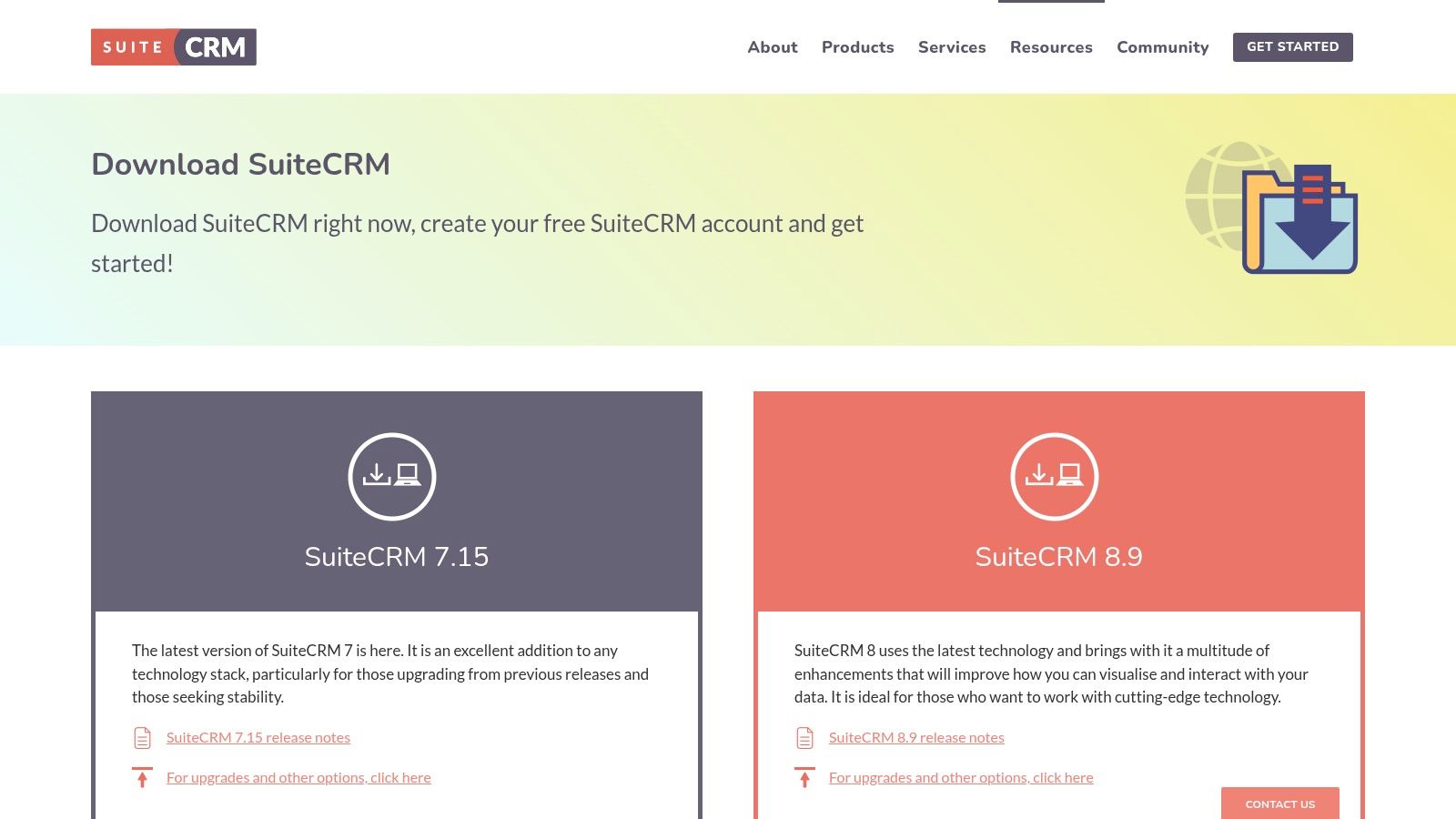
This CRM is built for deep configuration. Using the built-in Studio, businesses can modify modules, fields, and layouts to perfectly match their internal processes. This level of control is essential for teams looking to centralise client data and move beyond disorganised communication methods, addressing a common issue detailed in the WhatsApp trap for businesses. For companies with technical resources, SuiteCRM offers unparalleled flexibility and long-term value without user-based fees.
Key Features & Limitations
While the platform is free, the total cost of ownership includes server hosting and the technical expertise needed for setup, maintenance, and updates. The user interface, while highly functional, can feel less modern than its SaaS counterparts out of the box. However, its powerful workflow automation, reporting engine, and extensive third-party extension marketplace allow it to be tailored into a highly specific and effective business tool that grows with your organisation.
Pros & Cons
- Avantages :
- Completely free with no user limits for the self-hosted version.
- Highly customisable to match specific business workflows.
- Strong community support and extensive documentation.
- Inconvénients :
- Requires technical knowledge for installation and maintenance.
- The user interface feels dated compared to modern SaaS CRMs.
- Total cost of ownership includes hosting and IT administration.
Learn more at: suitecrm.com/download/
3. Odoo Community
Odoo Community offers a powerful open-source framework, making it a compelling Zoho alternative for businesses that need more than just a CRM. Its free, self-hosted version removes user limits entirely, positioning it as a uniquely scalable solution for organisations with technical resources or a local implementation partner. This approach allows a company to build a completely integrated business management system, starting with CRM and adding other applications like accounting, inventory, and project management as needed. Forbes Advisor (2023) highlighted Odoo's all-in-one nature as its primary strength for businesses looking to consolidate their software stack.
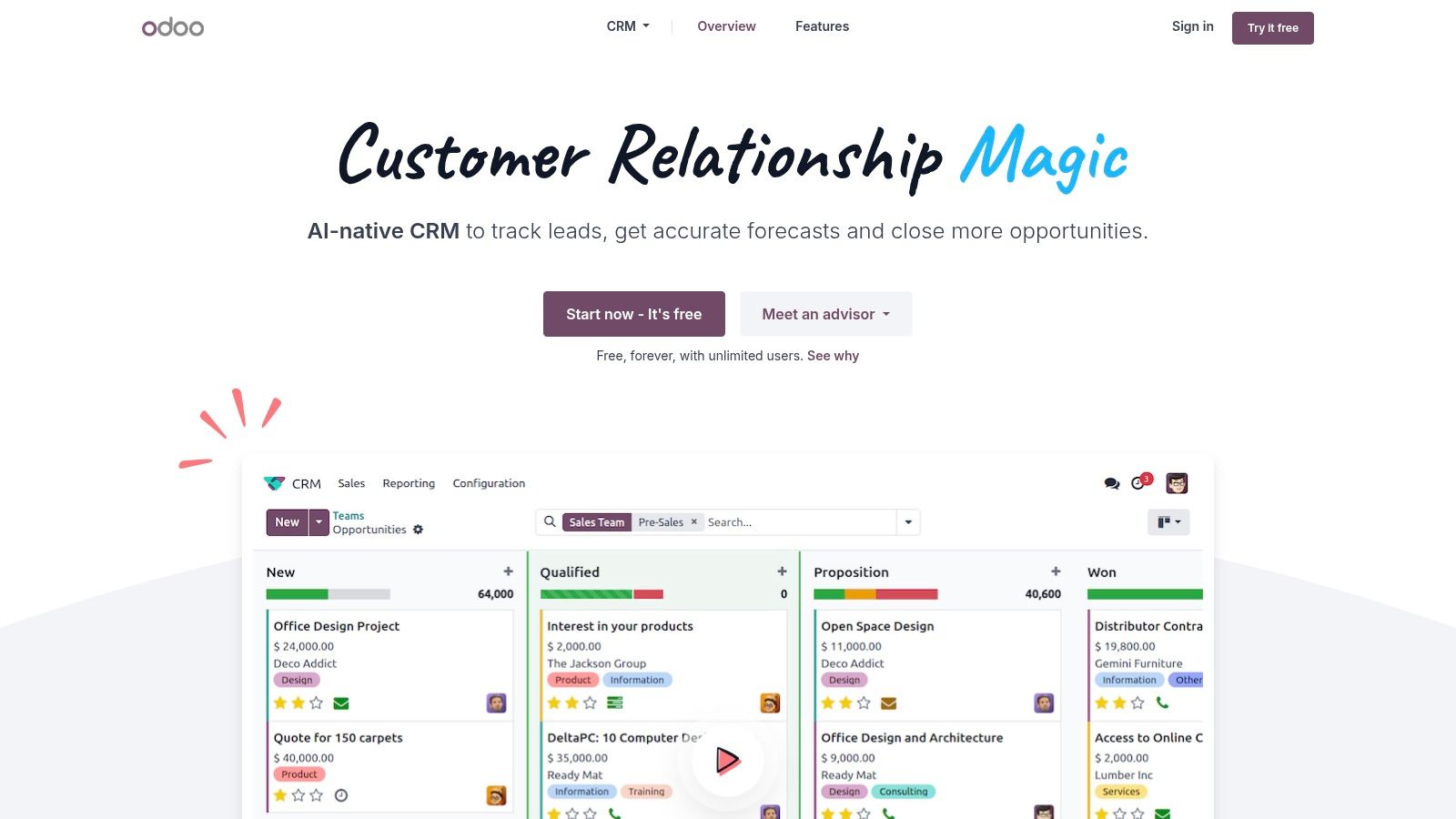
The platform’s strength lies in its modularity. The free CRM application provides Kanban pipelines, activity scheduling, and even AI-powered lead scoring. Businesses can then connect this to a sales module for creating quotations, an inventory app for stock management, or an accounting module for invoicing. With a vast ecosystem of over 40,000 community-developed apps and strong multi-currency support, Odoo can be customised to fit highly specific workflows, a significant advantage for growing businesses with unique operational needs.
Key Features & Limitations
While the self-hosted Community edition offers unlimited users and extensive customisation, it comes with a trade-off. Implementation can be complex and may require technical expertise or the help of a certified partner. Furthermore, some of the more advanced CRM and marketing automation features, such as marketing automation workflows, are reserved for the paid Enterprise edition. However, for a business seeking a fully integrated and customisable suite that grows with them, Odoo provides an unmatched foundation.
Pros & Cons
- Avantages :
- Genuinely unlimited users when self-hosted.
- A broad suite of integrated business apps beyond CRM.
- Extensive customisation options through community apps and the Studio module.
- Inconvénients :
- Self-hosting and implementation can be technically complex.
- Advanced CRM and marketing features require the paid Enterprise version.
- Requires ongoing maintenance and updates if self-hosted.
Learn more at: https://www.odoo.com/app/crm
4. Frappe CRM
Frappe CRM emerges as a modern, open-source Zoho alternative built by the team behind the popular ERPNext. Its core appeal lies in its deployment flexibility; businesses can self-host the platform for free with truly unlimited users, or opt for a managed cloud service where pricing is based on computing resources, not per-seat licences. This makes it an incredibly cost-effective solution for technically inclined teams preparing for rapid growth. The Frappe framework is known for its "batteries included" philosophy, providing a comprehensive toolset for building web applications (Frappe Framework Documentation).
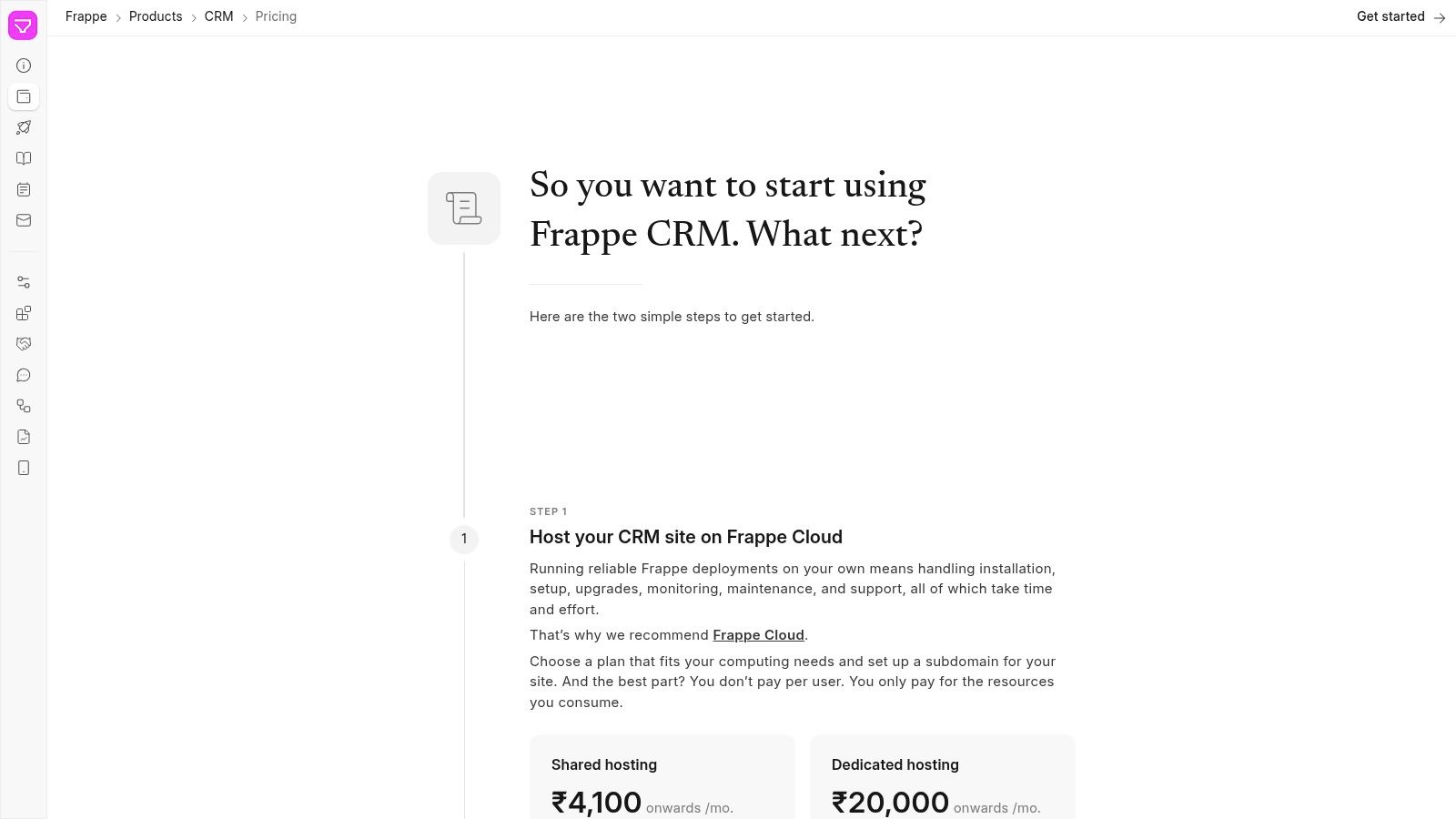
The platform offers a clean, lightweight interface for managing sales pipelines, tasks, and communications through email and WhatsApp integrations. Its API-first design and tight integration with ERPNext mean it can be extended to handle complex business processes, from lead generation to final accounting. For organisations wanting complete control over their data and customisation, Frappe CRM provides a powerful and transparent framework.
Key Features & Limitations
While the no-per-user-fee model is compelling, the self-hosted version demands a certain level of technical expertise, specifically with Linux servers and Docker. The managed cloud option simplifies this but introduces a hosting cost. Frappe’s app marketplace is also smaller compared to more established players, so teams reliant on extensive third-party integrations may find it limiting. However, its active open-source community provides robust support and continuous development.
Pros & Cons
- Avantages :
- Genuinely no per-user limits on the self-hosted version.
- Lightweight, fast, and highly customisable.
- Predictable hosting costs that don't penalise team growth.
- Strong open-source community support.
- Inconvénients :
- Self-hosting requires significant Linux/server administration skills.
- The ecosystem of third-party apps is still growing.
- Less feature-rich out-of-the-box than all-in-one suites.
Learn more at: frappe.io/crm/pricing
5. ERPNext
ERPNext offers a fundamentally different approach, presenting itself as a full, open-source Enterprise Resource Planning (ERP) system with a powerful, integrated CRM module. This makes it an excellent Zoho alternative for businesses that need to manage their entire operations, from sales and leads to accounting, inventory, and projects, within a single unified system. The platform is completely free with no user cap when self-hosted, offering unparalleled control and scalability for technically proficient teams. Gartner Peer Insights reviews frequently praise ERPNext for its comprehensive feature set and value as a free ERP solution (Gartner, 2023).
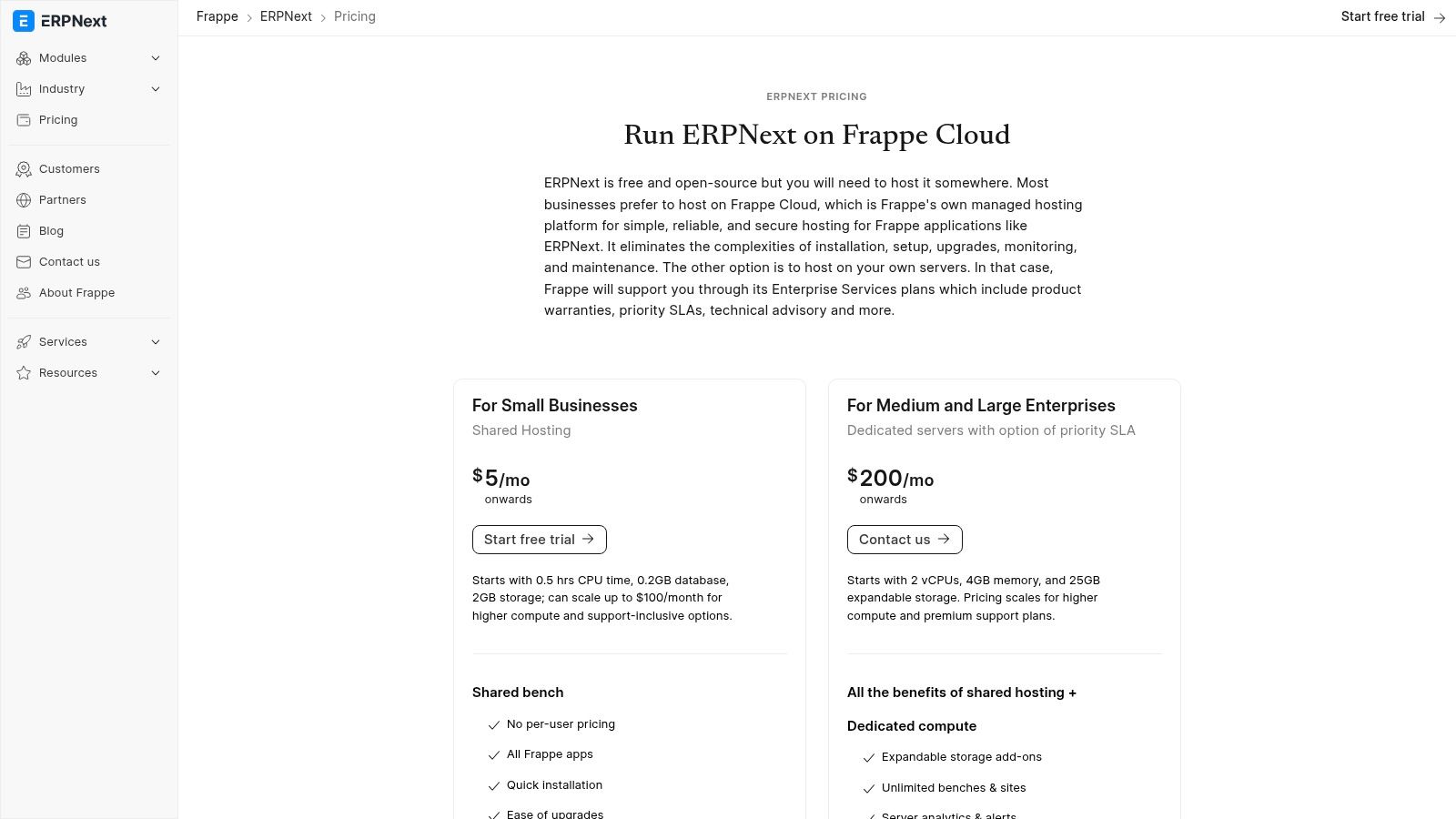
The system’s strength lies in its end-to-end functionality. You can track leads and opportunities, convert them into quotations, and manage subscriptions and projects all from one place. Because it integrates accounting and inventory, businesses gain a holistic view of customer value and operational efficiency. For those seeking an all-in-one solution, this comprehensive approach is explored further in various CRM comparison guides. Its multi-currency and localisation support are particularly beneficial for businesses operating across Africa.
Key Features & Limitations
While the self-hosted version offers unlimited users and complete customisation, it demands technical expertise for setup, maintenance, and upgrades. The scope of an ERP can also introduce complexity for teams that only require straightforward CRM functions. For those who prefer a managed solution, Frappe Cloud offers resource-based pricing, but this moves away from the free model. However, for a business aiming to eliminate data silos between departments, ERPNext provides a robust, no-licence-fee foundation.
Pros & Cons
- Avantages :
- End-to-end platform reduces the need for multiple integrations.
- Genuinely free for unlimited users when self-hosted.
- Strong community support and extensive documentation.
- Inconvénients :
- Broader ERP scope can add complexity for CRM-only needs.
- Upgrades and customisation require administrative skills.
- Managed hosting on Frappe Cloud is not free.
Learn more at: frappe.io/erpnext/pricing
6. EspoCRM
EspoCRM offers a compelling Zoho alternative for businesses that prefer control and customisation through an open-source, self-hosted solution. Its core offering is completely free to download and deploy on your own server, with no restrictions on the number of users. This makes it an excellent choice for tech-savvy SMEs wanting a powerful, flexible CRM without recurring subscription fees or per-seat licensing costs. SourceForge reviews often commend EspoCRM for its lightweight nature and modern user interface compared to other open-source options.
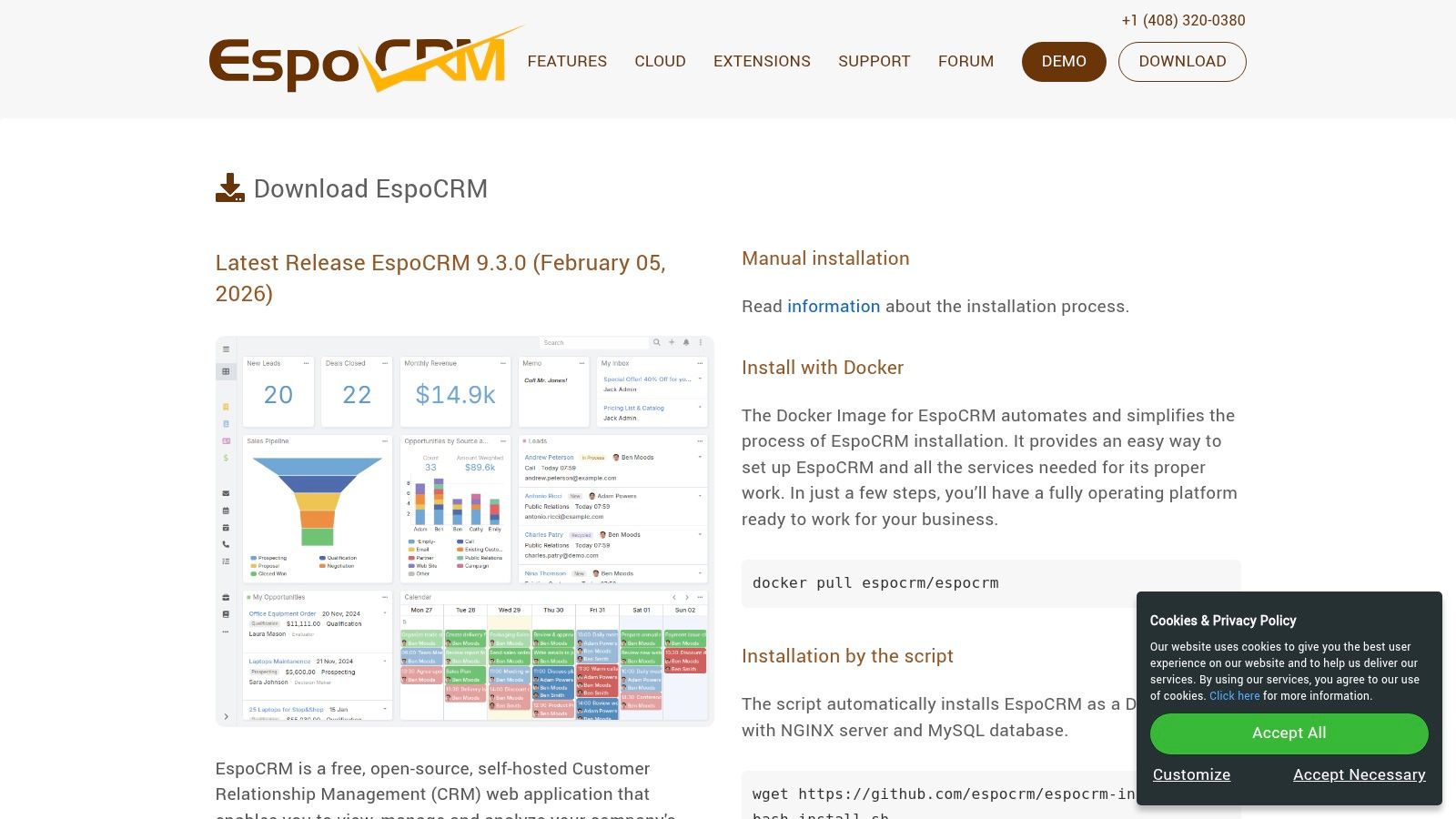
The platform is surprisingly robust, covering everything from leads and opportunities to quotes and invoices. It boasts a modern, clean interface and a modular structure, allowing businesses to activate only the features they need. With built-in workflow automation (BPM), role-based access controls, and integrations for tools like Mailchimp and Stripe, it provides a solid foundation for streamlining sales and business operations.
Key Features & Limitations
While the self-hosted version is free forever, it requires technical expertise for initial setup, maintenance, and security. EspoCRM also offers a paid cloud-hosted version, but this is priced per user, negating the unlimited user benefit. The true value lies in its AGPLv3 licence, which grants you the freedom to modify and extend the platform to fit your unique business processes, a level of customisation proprietary solutions cannot match.
Pros & Cons
- Avantages :
- Genuinely free forever with unlimited users on the self-hosted version.
- Lightweight and modular, offering a faster experience than larger ERP suites.
- Active community forum and frequent, up-to-date releases.
- Inconvénients :
- Requires technical knowledge for server setup and ongoing maintenance.
- The official cloud-hosted plan is priced per user.
- Advanced functionality often relies on paid extensions or custom development.
Learn more at: www.espocrm.com/download/
7. CRM Africa
CRM Africa presents a unique SaaS (Software as a Service) proposition as a Zoho alternative, specifically tailored for the African market. Its core value is providing an all-in-one platform with a generous free tier that supports unlimited users, directly addressing the barrier of per-seat licensing for growing businesses. This model allows startups and SMEs to onboard their entire team—from sales and marketing to operations—without incurring incremental software costs, fostering company-wide collaboration from day one. The platform's mission, as stated on its website, is to empower African businesses with affordable, accessible technology.
The system integrates essential business tools, including project management, invoicing, and support ticketing, alongside a robust CRM. A key differentiator is its focus on the local ecosystem, offering built-in integrations with popular Pan-African payment gateways like Paystack and Flutterwave. This feature simplifies revenue collection and is critical for businesses operating in Nigeria, Kenya, South Africa, and across the continent. By combining unlimited user access with localized functionality, CRM Africa provides a practical, ready-to-use solution that bypasses the technical hurdles of self-hosting.
Key Features & Limitations
The primary appeal of CRM Africa is its all-inclusive, cloud-based model that eliminates the need for server management, updates, or technical expertise. The free plan is comprehensive, but advanced features such as workflow automation and custom reporting may be reserved for paid tiers. While it may not offer the limitless code-level customisation of open-source platforms like SuiteCRM, its strength lies in providing a secure, maintained, and feature-rich environment that is immediately deployable.
Pros & Cons
- Avantages :
- Truly unlimited users on the free plan, a rarity for SaaS CRMs.
- Integrated with key African payment gateways.
- No server setup or maintenance required (fully cloud-based).
- Inconvénients :
- Less code-level customisation than open-source alternatives.
- Advanced automation features may require upgrading to a paid plan.
- Being a newer platform, the third-party app marketplace is still developing.
Learn more at: CRM Africa
8. YetiForce CRM
YetiForce CRM stands out as a powerful open-source Zoho alternative for businesses that require deep customisation and full control over their data. As a hybrid CRM/ERP system, it offers an extensive suite of over 80 modules covering everything from sales to inventory. The vendor guarantees the free, downloadable version has no limits on users, records, or installations, making it an excellent choice for large teams with the technical capacity to manage their own software. The project's documentation emphasizes its commitment to open standards and data security.
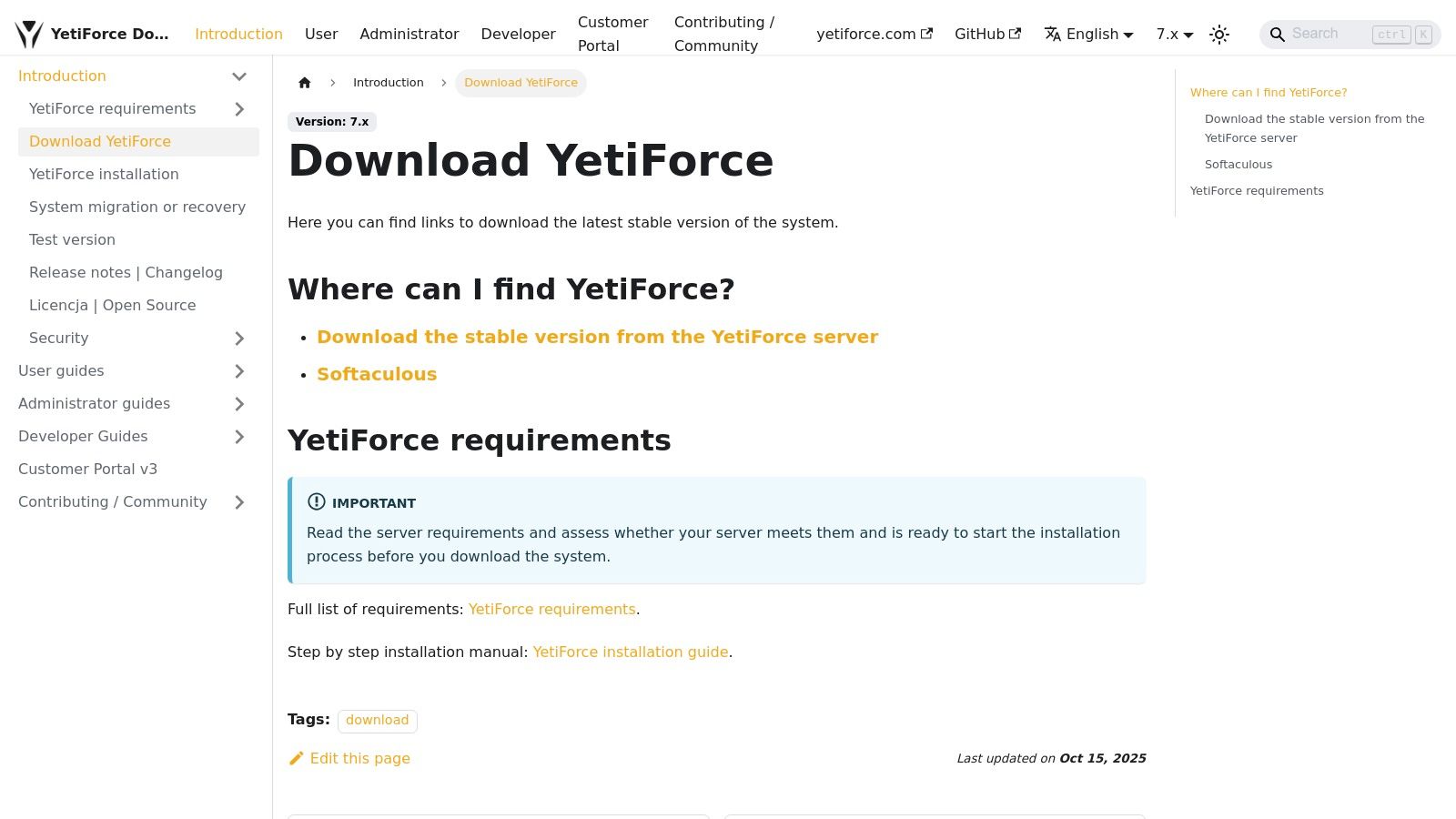
This platform is ideal for companies wanting an on-premises solution to comply with data sovereignty regulations or those who prefer not to rely on cloud vendors. Its functionality extends far beyond a typical CRM, including project management, a help desk, and inventory management. The high degree of configurability, down to very granular permissions, allows businesses to mould the system precisely to their operational workflows.
Key Features & Limitations
While the freedom from user limits and the breadth of features are compelling, the trade-off is the complexity of setup and maintenance. Unlike cloud-based solutions like CRM Africa, YetiForce requires self-hosting, which involves server administration, security hardening, and manual updates. While documentation is available, its depth can vary between modules, potentially creating a learning curve for administrators. However, for a tech-savvy business needing a no-cost, endlessly scalable platform, YetiForce is a formidable contender.
Pros & Cons
- Avantages :
- Completely free with no user, record, or installation limits.
- Highly configurable with a vast number of modules.
- Full data control with on-premises or private cloud hosting.
- Inconvénients :
- Requires technical expertise for setup, security, and maintenance.
- The user interface can feel less modern than SaaS competitors.
- Documentation depth varies, which can complicate troubleshooting.
Learn more at: doc.yetiforce.com/en/introduction/download/
9. Dolibarr ERP & CRM
Dolibarr offers a completely different approach as a Zoho alternative, positioning itself as a free, open-source ERP and CRM suite. Because it's self-hosted or available through third-party providers, it imposes no user limits, making it a genuinely free CRM for unlimited users. Its modular design allows businesses to activate only the functions they need, such as CRM, invoicing, inventory, or project management, keeping the interface lean and focused. The Dolibarr Association actively maintains the project, ensuring regular updates and a strong community focus (Dolibarr.org).
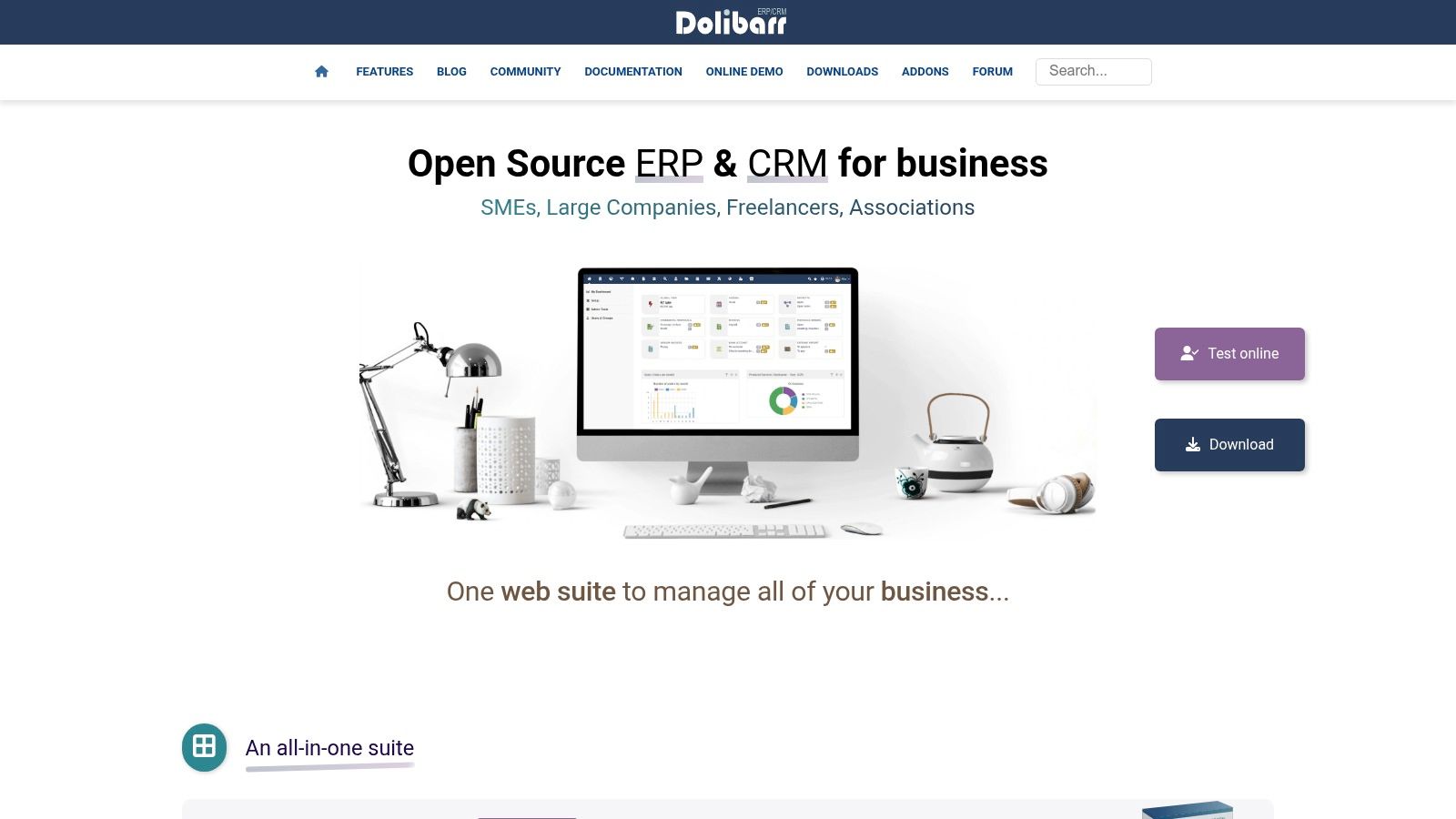
The platform is particularly well-suited for trading or service-based SMEs that need strong control over quotes, orders, and financial documents. Its customisable PDF and ODT templates are a standout feature, allowing for highly professional, branded document generation. While it requires more technical setup than a SaaS solution, it offers unparalleled flexibility and data ownership, a crucial consideration for many businesses.
Key Features & Limitations
Dolibarr’s strength lies in its modularity and cost-free core. You can build a comprehensive business management system without paying for licences. However, the user interface can feel dated compared to modern cloud CRMs, and achieving advanced functionality often depends on installing community-developed add-ons, which may come with their own costs or support challenges. It is ideal for organisations with some technical expertise in-house or a willingness to learn.
Pros & Cons
- Avantages :
- Completely free and open-source with no user limits.
- Modular design lets you activate only the features you need.
- Strong community support and a large marketplace for add-ons.
- Full data ownership and control through self-hosting.
- Inconvénients :
- Requires technical knowledge for setup and maintenance.
- The user interface is less modern than many SaaS competitors.
- Advanced features and support often rely on third-party modules.
Learn more at: www.dolibarr.org
10. CiviCRM
CiviCRM is a highly specialised, open-source Zoho alternative designed specifically for the needs of non-profit organisations, advocacy groups, and civic sector entities. Instead of sales pipelines, its core focus is on managing relationships with donors, members, and volunteers. It is completely free to download and use for an unlimited number of users, provided you have the technical capacity to host and maintain it yourself. According to its official site, CiviCRM is used by over 11,000 non-profits worldwide.
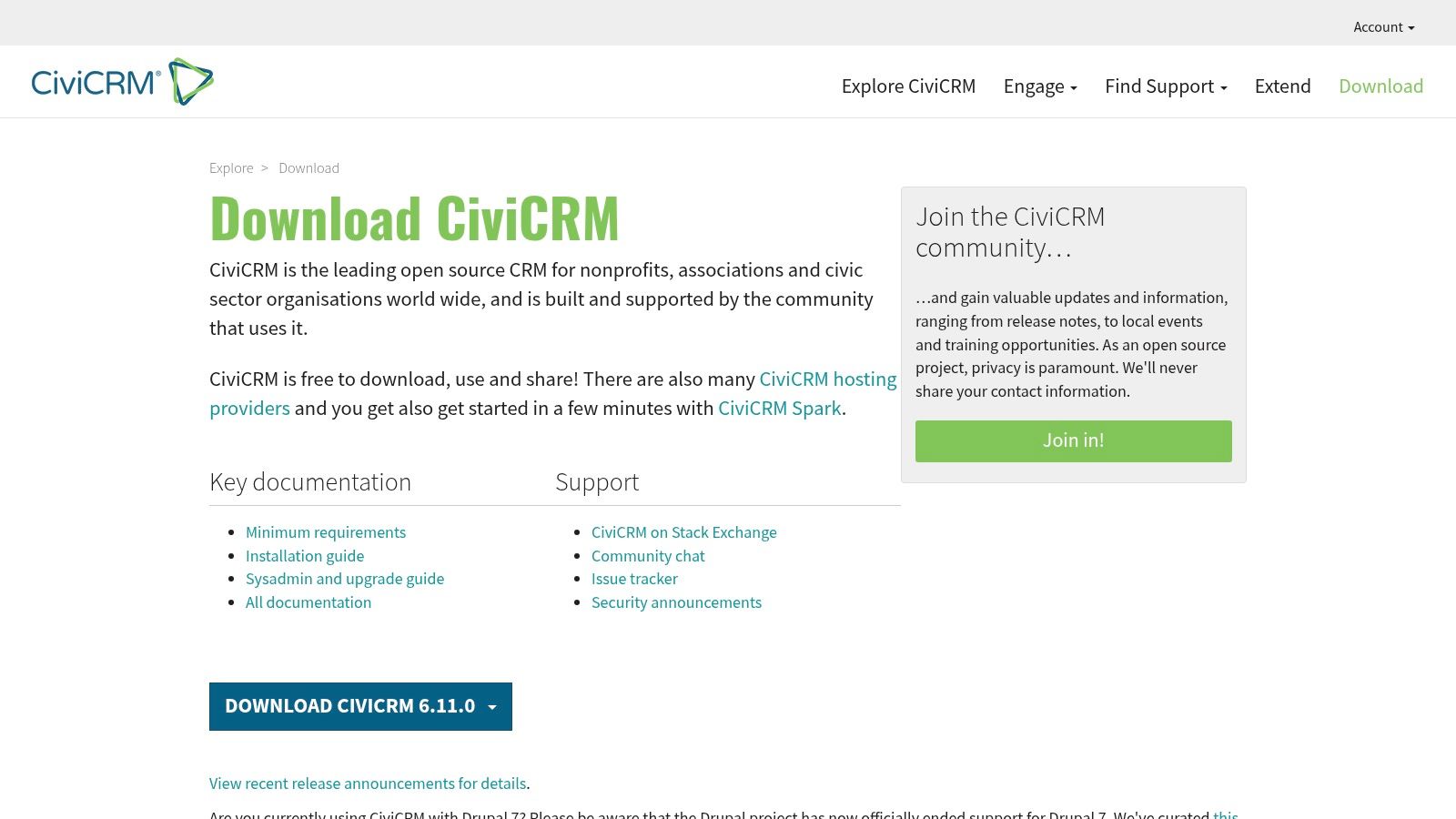
The platform excels at managing contributions, event registrations, memberships, and advocacy campaigns. It integrates directly with popular Content Management Systems (CMS) like WordPress, Drupal, and Joomla, allowing organisations to build a powerful, unified web presence. For non-profits needing a purpose-built system without per-user licence fees, CiviCRM is a uniquely powerful choice, though it requires more technical effort than typical SaaS solutions.
Key Features & Limitations
While CiviCRM is feature-rich for its niche, its strength is also its main limitation for traditional businesses. It lacks the standard sales-focused tools like lead scoring and pipeline management found in platforms like CRM Africa. The user interface is functional but can feel dated and utilitarian compared to modern CRMs. Self-hosting demands server management skills, although paid hosting services are available through a network of partners for those who prefer a managed solution.
Pros & Cons
- Avantages :
- Completely free for unlimited users (self-hosted).
- Specialised features for donor, event, and membership management.
- Highly extensible and customisable for specific non-profit needs.
- Inconvénients :
- Not designed for traditional sales and marketing workflows.
- Requires technical expertise to install, configure, and maintain.
- The user interface can be complex and is less intuitive than modern SaaS platforms.
Learn more at: civicrm.org/download
11. Corteza
Corteza offers a radically different approach, positioning itself as a 100% open-source, low-code platform for building entirely custom business applications, including CRM systems. As a genuine Zoho alternative, its main appeal lies in its complete freedom from per-user licensing fees. This makes it a powerful option for organisations with in-house development capacity who need a tailored solution without the recurring costs associated with proprietary software. Corteza is governed by the CNCF (Cloud Native Computing Foundation), ensuring its vendor-neutrality and long-term open-source commitment.
The platform provides a flexible, API-first foundation with drag-and-drop tools for creating data models, workflows, and role-based access controls. You can build a CRM that precisely matches your unique business processes, rather than adapting your processes to an off-the-shelf product. Because it's open-source, you have the choice to self-host on your own infrastructure (using Docker or Kubernetes) or deploy it on any cloud provider, giving you full control over your data and environment.
Key Features & Limitations
While the potential for customisation is limitless, Corteza is not a plug-and-play CRM. It requires significant technical expertise to configure, build, and maintain. Unlike dedicated products, it has fewer out-of-the-box CRM features, as you are expected to build them yourself. However, for a business that needs to integrate complex data sources or create highly specific automation rules, Corteza provides an unmatched level of control and scalability at zero licensing cost.
Pros & Cons
- Avantages :
- Absolutely no license or per-user fees.
- Extreme flexibility to build bespoke CRM applications.
- Strong governance with a community-governed open codebase.
- Full control over data and hosting environment.
- Inconvénients :
- Requires significant development and configuration to build a functional CRM.
- Lacks the ready-made features of dedicated CRM products.
- Ongoing maintenance falls on your internal team.
Learn more at: cortezaproject.org/
12. OroCRM Community Edition
OroCRM positions itself as an enterprise-grade, B2B-focused Zoho alternative for businesses that require deep customisation and eCommerce integration. Built on the robust Symfony PHP framework, its free, self-hosted Community Edition removes all per-user license fees, making it an excellent choice for technically proficient companies wanting to build a highly tailored sales and marketing platform without recurring costs. The Symfony framework itself is lauded for its performance and modularity, providing a solid technical foundation (Symfony.com).
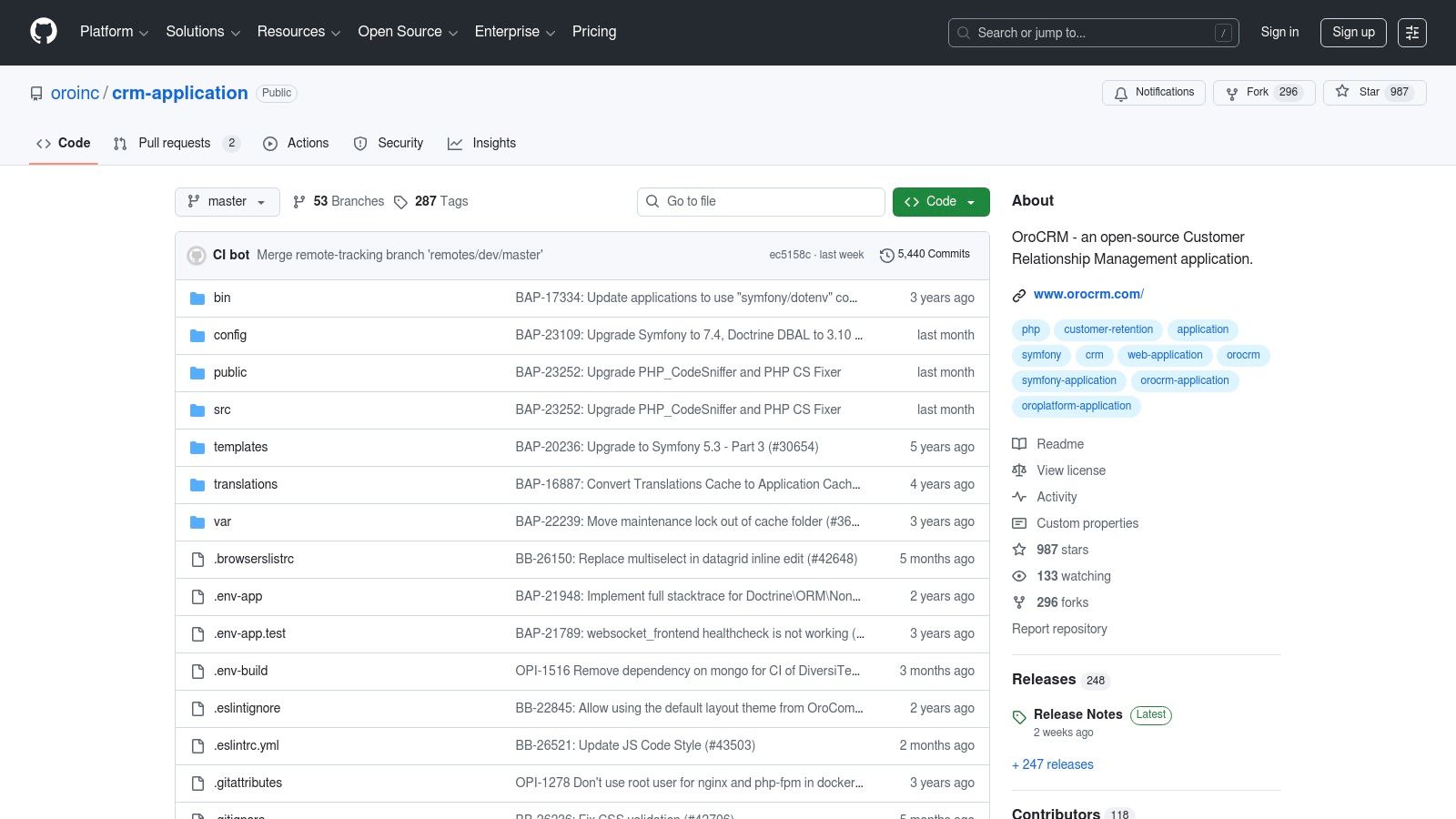
The platform is engineered for complex sales cycles, offering powerful account and contact management, lead and opportunity tracking, and flexible reporting dashboards. Its primary strength lies in its native integration with the OroCommerce platform, providing a unified view of customer interactions across sales, marketing, and online purchasing channels. This makes it ideal for manufacturers, distributors, and B2B eCommerce businesses.
Key Features & Limitations
As an open-source solution, the Community Edition is completely free to download and modify, but it requires you to manage your own hosting, security, and maintenance. This technical overhead is a significant consideration. While the core CRM features are robust, the user community is smaller than that of platforms like SuiteCRM, meaning support is more reliant on internal expertise or paid consultants. However, for a business with development resources, OroCRM offers unparalleled flexibility to build a bespoke system.
Pros & Cons
- Avantages :
- No license or per-user fees for the self-hosted Community Edition.
- Enterprise-grade technology stack designed for extensibility and customisation.
- Excellent for complex B2B sales operations and deep commerce integration.
- Inconvénients :
- Requires significant technical expertise for installation, hosting, and maintenance.
- Heavier infrastructure requirements than cloud-based CRMs.
- Smaller user community can make finding free support challenging.
Learn more at: github.com/oroinc/crm-application
13. X2CRM
X2CRM is an open-source platform that combines sales, marketing, and service tools, making it a powerful Zoho alternative for tech-savvy businesses. Its main advantage lies in the self-hosted version, which is completely free and supports unlimited users. This model is ideal for companies with the technical resources to manage their own servers, as it removes all licensing costs while providing a robust automation engine. Its development history shows a long-standing commitment to providing a full-featured open-source option alongside its commercial offerings.
The platform’s strength is its X2Workflow engine, which allows for sophisticated process automation without the fees associated with premium SaaS tools. Businesses can build custom modules using X2Studio, create targeted email marketing campaigns, and manage sales pipelines from a single interface. This makes it a great choice for companies that need deep customisation to align the CRM with their unique operational processes.
Key Features & Limitations
While the open-source version is free and feature-rich, it requires self-hosting, which brings server and maintenance costs. The user interface, while functional, is less modern than many leading cloud-based CRMs, which may present a learning curve for some teams. For those who prefer a managed solution, a commercial cloud version is available, but it follows a standard per-user pricing model.
Pros & Cons
- Avantages :
- Free, open-source version with no user limits when self-hosted.
- Powerful workflow automation engine included at no extra cost.
- Highly customisable with the ability to create new modules.
- Inconvénients :
- Requires technical expertise and resources for self-hosting and maintenance.
- The user interface and experience feel dated compared to modern competitors.
- The managed cloud version is priced per user, negating the unlimited-user benefit.
Learn more at: x2crm.squarespace.com/download
Top 13 Free Unlimited-User CRM Comparison
| Produit | Fonctionnalités principales | Ease of use & deployment | Pricing & value | Public cible | Unique selling point |
|---|---|---|---|---|---|
| Bitrix24 | CRM, pipelines, projects, contact center, website builder, telephony | SaaS free-forever cloud; fast signup; UI can feel busy | Free tier with unlimited users (5 GB); paid tiers add features | Teams wanting ready-to-use SaaS without server admin | Truly unlimited users on free tier; built-in telephony & sites |
| SuiteCRM | Sales, service, marketing, workflows, Studio, REST API | Self-hosted; mature but heavier to implement and maintain | Free self-hosted (no user fees); managed hosting available (paid) | Orgs needing deep customization, compliance, on‑prem control | Enterprise-grade open-source CRM with no per-user license |
| Odoo Community | CRM, Kanban pipelines, projects, inventory, accounting; 40k+ apps | Self-host or partner-managed; broad suite; some features Enterprise-only | Free self-host; partner/implementation costs apply | Businesses wanting a modular suite across operations | Massive app ecosystem and strong localization support |
| Frappe CRM | Pipelines, tasks, email/WhatsApp, role-based permissions, API-first | Self-host or Frappe Cloud (compute pricing); lightweight to customize | Free self-host; cloud billed by resources (not per-user) | Teams wanting a lightweight CRM with ERPNext integration | Predictable resource-based hosting costs; tight ERPNext tie-in |
| ERPNext | Leads/opportunities, quotations, projects, accounting, manufacturing | Full ERP scope; self-host or Frappe Cloud; broader scope can add complexity | Free self-host; managed cloud priced by compute/resources | SMEs needing end-to-end business (ERP+CRM) functionality | End-to-end platform that reduces need for multiple integrations |
| EspoCRM | Leads, accounts, opportunities, quotes, invoices, workflows, integrations | Self-hosted lightweight; frequent releases; official cloud is per-user | Free self-host forever; cloud offering priced per user | SMEs wanting a balance of usability and CRM depth | Lightweight, modular CRM with active community updates |
| CRM Africa | CRM, projects, invoicing, support, Pan-African payment gateways | SaaS free-forever cloud; ready-to-use; localized for Africa | Free tier with unlimited users; paid plans for advanced features | African SMEs needing an all-in-one, localized solution | Built-in African payment gateways and unlimited users on free SaaS plan |
| YetiForce | Sales, marketing, help desk, projects, inventory; portals & granular permissions | Self-host; highly configurable; setup and hardening may take time | Free version with no limits on users, machines or records | Large teams needing broad functionality without per-user fees | Extensive modules (80+) and no user/record caps in free version |
| Dolibarr | CRM pipeline, quotes, orders, invoices, projects, HR, inventory | Easy to self-host; modular; UI is more utilitarian/dated | Free GPL; many add-ons and third‑party hosting available | Service or trading SMEs wanting lightweight ERP/CRM | Simple, modular ERP/CRM with many add-ons and easy hosting |
| CiviCRM | Contacts, donations/contributions, memberships, events, campaigns | Self-hosted or hosted Spark; integrates with WordPress/Drupal/Joomla | Free self-host; hosted options available (paid) | Nonprofits, associations, and advocacy organisations | Purpose-built nonprofit features (donor/membership/event management) |
| Corteza | Low-code drag-and-drop data models, workflows, RBAC, API-first | Self-host (Docker/K8s) or cloud; requires developer/configuration effort | Free open-source (no per-user fees) | Teams with development capacity needing custom apps | Low-code platform for building tailored CRM apps without per-user costs |
| OroCRM (Community) | Accounts, leads, dashboards, marketing, REST APIs; commerce integration | Self-host; enterprise tech stack (Symfony/PHP); heavier infra needs | Free Community Edition; enterprise modules via paid offerings | B2B and eCommerce businesses needing deep commerce ties | Tight integration with OroCommerce and enterprise-grade stack |
| X2CRM | Sales, marketing, workflow engine (X2Workflow), email marketing | Self-host downloadable; cloud option exists (commercial, per-user) | Free self-host with automation; managed cloud priced per user | Teams that require built-in marketing automation and workflows | Built-in workflow engine plus marketing automation in OSS package |
Making the Right Choice for Your Business's Future
Navigating the landscape of CRM software can feel overwhelming, but this deep dive into the best free CRM with unlimited users reveals a powerful, liberating truth: you do not have to be penalised for growth. The central theme connecting all the Zoho alternative options we have explored, from the expansive open-source frameworks of SuiteCRM and Odoo Community to the more focused solutions like Frappe CRM, is the rejection of the restrictive per-user pricing model. This model, common among proprietary SaaS providers, often forces small and medium-sized enterprises (SMEs) across Africa into a difficult position, making them choose between adding a new team member and controlling their operational expenditure.
The key takeaway is that the "best" choice is not universal; it is deeply personal to your organisation's unique circumstances. Your decision-making process should be guided by a realistic assessment of your team's capabilities, your long-term strategic goals, and the specific operational hurdles you face daily.
From Customisation Freedom to All-in-One Simplicity
For businesses with in-house technical talent or the budget for a development partner, the world of open-source CRMs offers unparalleled freedom. Solutions like SuiteCRM, ERPNext, and Corteza provide a foundational platform that you can mould and customise to your exact business processes. This path requires a significant investment in implementation, maintenance, and ongoing support, but the payoff is a system that is truly your own, without any licensing fees. However, this freedom comes with responsibility; you are in charge of hosting, security, and updates.
Conversely, for the majority of SMEs, startups, and agencies, the ideal solution is one that is powerful, secure, and ready to use from day one. This is where a platform like CRM Africa distinguishes itself. While it shares the "unlimited users" philosophy, it bypasses the complexities of self-hosting and custom development. Its focus is squarely on solving the specific, on-the-ground challenges faced by businesses in Nigeria, Kenya, South Africa, and beyond.
A Decision Framework for African SMEs
To finalise your choice, consider these critical factors:
- Technical Resources: Do you have a dedicated IT team or developer? If not, a self-hosted open-source solution like Bitrix24's on-premise version or YetiForce could become a resource drain. A managed solution would be more appropriate.
- Core Business Needs: Are you primarily a sales-driven organisation needing a strong pipeline (like in EspoCRM), or do you require a comprehensive ERP with CRM, accounting, and project management (like Dolibarr)? List your non-negotiable features first.
- Payment Ecosystem: This is a crucial, often-overlooked factor for African businesses. Does your chosen CRM integrate with the payment gateways your customers actually use, such as M-PESA, Paystack, or Flutterwave? A failure here creates significant operational friction.
- Total Cost of Ownership (TCO): A "free" CRM is never truly free. Factor in the costs of hosting, implementation, staff training, security maintenance, and potential third-party integrations. Sometimes, a low-cost managed solution has a lower TCO than a "free" self-hosted one.
- Data Quality and Scalability: As your customer base grows, maintaining data integrity is paramount. Beyond selecting the right free CRM, truly scalable growth requires robust data management; consider integrating with the best data enrichment tools to maximize your CRM's effectiveness and ensure your outreach is always based on accurate, up-to-date information.
Ultimately, choosing the right Zoho alternative: best free CRM with unlimited users is an investment in your company's future. It is about selecting a partner, not just a product. It is about finding a platform that removes barriers, empowers your entire team to collaborate without financial penalty, and aligns perfectly with your growth trajectory. The right choice will feel less like a tool and more like the central nervous system of your business, enabling you to build stronger customer relationships and achieve sustainable success.
Ready to embrace a CRM built for the realities of the African market? CRM Africa offers a powerful, all-in-one platform with unlimited users, project management, and integrated Pan-African payment gateways to help your business scale without limits. Start for free today and empower your entire team.