For small and medium-sized enterprises (SMEs) across Africa, maintaining accurate financial records is not just about compliance; it's the foundation of sustainable growth. As highlighted by the International Finance Corporation (IFC), access to finance remains a significant hurdle for SMEs, and robust financial statements are critical for securing it. While many businesses start with simple spreadsheets, the right financial statement templates provide the crucial structure needed for investor readiness, loan applications, and strategic decision-making. These tools offer a clear framework for organising your financial data, ensuring you don't miss key components of your business's financial story.
This guide moves beyond generic lists to offer a curated selection of 12 powerful financial statement templates, complete with practical advice on adapting them for the unique African business landscape. We will cover specific challenges, such as handling multiple currencies and reconciling mobile money payments from services like M-PESA. To fully appreciate the utility of these resources, it's helpful to first understand what are the 4 financial statements and their individual roles in painting a complete picture of your company's health.
Throughout this article, we will explore not only where to find the best templates from sources like Vertex42, Smartsheet, and even authoritative bodies like the IFRS Foundation and SAICA, but also how to use them effectively. Each entry includes a direct download link, screenshots, and an honest assessment of its strengths and limitations.
Crucially, we will also demonstrate how to integrate the outputs from these templates with modern business platforms like HubSpot, Zoho CRM, or CRM Africa. This creates a seamless flow from sales and invoicing to accurate, professional financial reporting, helping you manage your business more efficiently. This article is your central resource for finding, customising, and implementing the financial reporting tools your growing business needs to succeed.
1. Vertex42 – Financial Statement Templates (Excel)
For small businesses that rely on the familiarity and power of Microsoft Excel, Vertex42 is a long-standing and respected source for high-quality financial statement templates. It stands out by offering direct, no-signup-required downloads for most of its core files, making it a frictionless starting point for entrepreneurs needing clean, functional spreadsheets. The collection includes templates for the income statement, balance sheet, and cash flow statement, often packaged together for convenience.
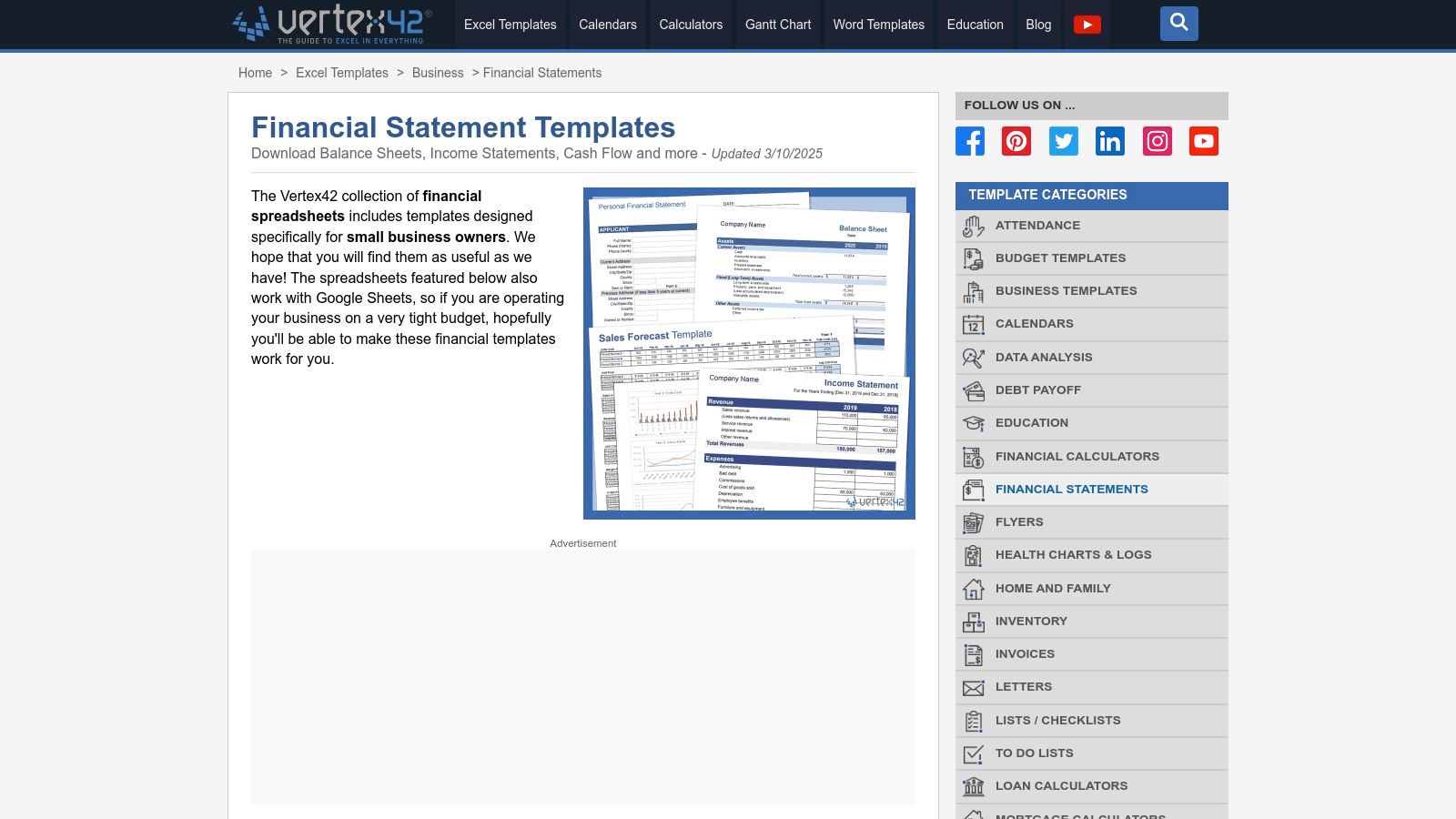
What makes Vertex42 particularly useful is its focus on practicality over complexity. The templates are lightweight, with clear instructions and pre-built formulas that do the heavy lifting. This makes them easy to adapt for specific business needs, reflecting principles of user-centric design in spreadsheet development.
Customisation for African SMEs
While not designed for Africa out-of-the-box, these Excel files are highly adaptable. You can easily add new line items to track mobile money transactions from platforms like M-PESA or MTN MoMo. Simply insert a new row under "Cash and Equivalents" on the balance sheet and another under "Revenue" or "Operating Expenses" (for transaction fees) on the income statement. Ensure the formulas in your total cells are updated to include these new rows.
Use-Case Scenario: A Kenyan retail startup can download the basic income statement template to track monthly sales. By adding a "M-PESA Revenue" line, they can clearly separate card payments from mobile money, helping with reconciliation and understanding customer payment preferences, a process vital for market analysis.
Pros and Cons
- Pros: Most templates are free to download without an account. The Excel-native format ensures maximum compatibility and offline access. Their simplicity makes them perfect for businesses new to formal financial reporting.
- Cons: The primary focus is on Excel, with limited options for Google Sheets users. These templates are general-purpose and do not adhere to specific IFRS for SMEs compliance standards without manual adjustments for formal auditing.
Website: https://www.vertex42.com/ExcelTemplates/financial-statements.html
2. Smartsheet – Free Financial Statement Template Set
Smartsheet offers a curated hub of financial statement templates that caters to businesses needing flexibility in format. Unlike sources that focus only on Excel, Smartsheet provides templates in Excel, Google Sheets, PDF, and its own proprietary format. This makes it an excellent choice for teams with diverse software preferences or those exploring a migration path to Smartsheet’s project management ecosystem. The collection is well-organised, featuring templates for the profit and loss statement, balance sheet, and cash flow statement, along with useful variations like pro-forma and non-profit statements.
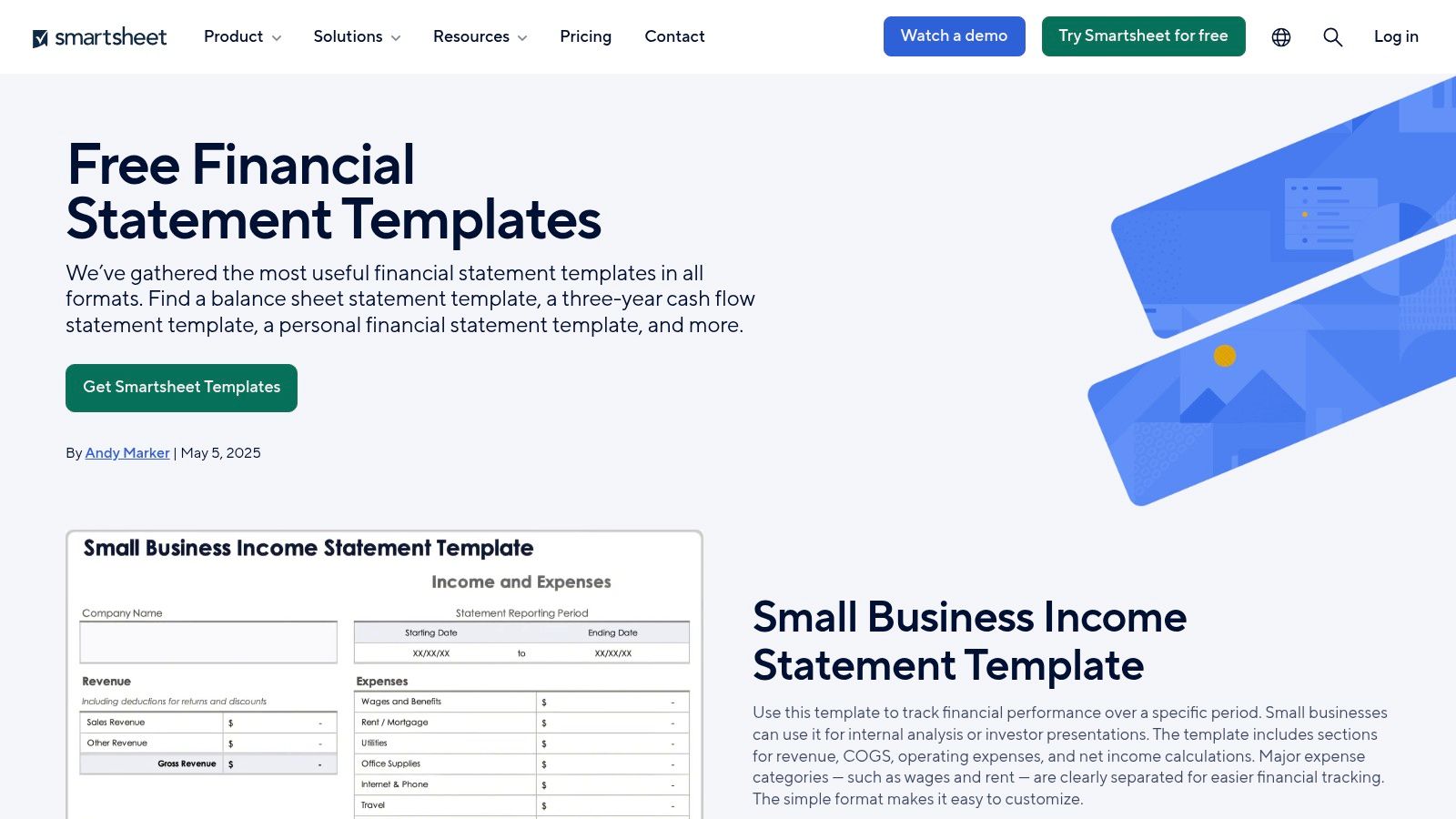
The platform stands out by including detailed guides and documentation alongside its downloads. This supplemental content explains the purpose of each statement and how to use the templates correctly, which is a great help for business owners new to financial reporting, aligning with adult learning principles of providing context with tools.
Customisation for African SMEs
The availability of Google Sheets versions is particularly beneficial for African SMEs that rely on cloud-based, collaborative tools. You can easily adapt these templates for regional needs. For instance, to handle multi-currency transactions common in markets like Nigeria or Ghana, add separate columns for local currency (NGN, GHS) and a reporting currency (e.g., USD) on your income statement. Use a cell with the current exchange rate to automate conversions, ensuring your totals are consistent.
Use-Case Scenario: A South African consulting firm can use the Google Sheets balance sheet template to collaborate with its remote bookkeeper. They can add a line item under "Current Liabilities" for "SARS VAT Payable" to specifically track their value-added tax obligations, ensuring compliance and clear financial oversight.
Pros and Cons
- Pros: Multiple download formats (Excel, Google Sheets, PDF) provide great flexibility. The templates come with credible documentation and role-specific variants (e.g., for non-profits). No signup is required for most downloads.
- Cons: Some templates use US-specific terminology (like "checking account" instead of "current account") that may need localisation. They are not built to meet specific IFRS for SMEs compliance standards without manual adjustments.
Website: https://www.smartsheet.com/content/financial-statement-templates
3. Microsoft Excel – Financial Management Template Gallery
For businesses deeply integrated with the Microsoft 365 ecosystem, the official Microsoft template gallery is a natural and trustworthy starting point. It offers a collection of financial statement templates and related business management spreadsheets directly from the source. The key advantage is its seamless integration; you can browse the gallery online and open your chosen template directly in Excel with a single click, ensuring authenticity and security.
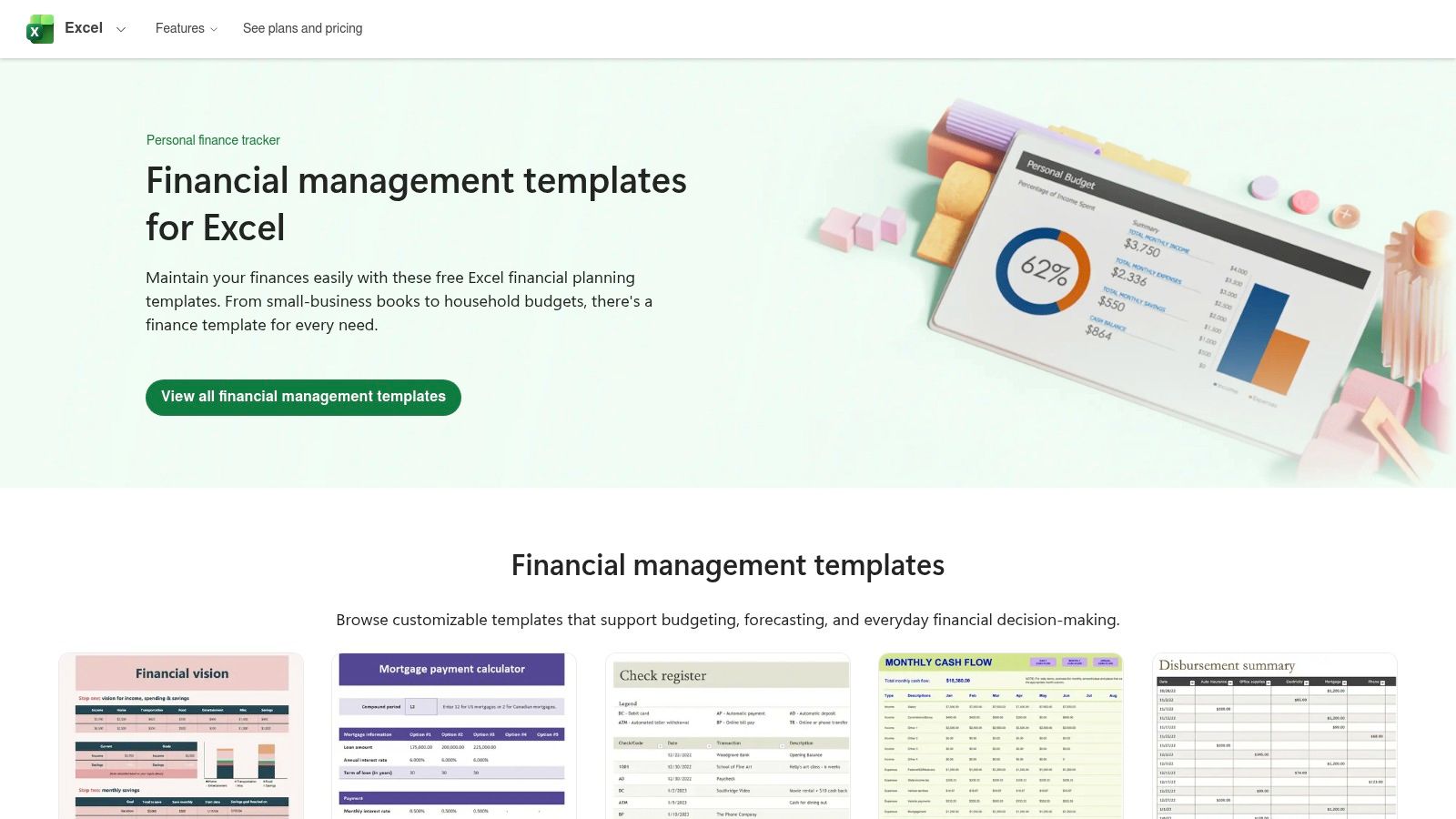
Unlike third-party sites, these templates are maintained by Microsoft, guaranteeing consistent formatting and functionality across the suite. This makes them ideal for teams that need standardised documents for internal reporting, from profit and loss statements to balance sheets and sales trackers. This standardization is a core principle of effective internal control systems, as noted by COSO.
Customisation for African SMEs
The familiarity of Excel makes these templates highly adaptable for African business contexts. To account for multi-currency operations, you can dedicate separate columns for local currency (e.g., KES, NGN) and a reporting currency (e.g., USD), using a fixed cell for the exchange rate to automate conversions. For instance, on the income statement, you could have a "Revenue (KES)" column and an adjacent "Revenue (USD)" column with a formula like =KES_Revenue_Cell / Exchange_Rate_Cell.
Use-Case Scenario: A Ghanaian services company can use the official balance sheet template and add a line item under "Current Assets" for "MTN MoMo Float". This helps them accurately represent mobile money balances, which are crucial for daily operations and liquidity management.
Pros and Cons
- Pros: Sourced directly from Microsoft, ensuring they are safe and free from third-party macros. The templates have a professional, consistent design and are fully compatible with all versions of Excel.
- Cons: The depth of detail can be inconsistent across different templates. They are built for general use and lack specific disclosures or structures required by IFRS for SMEs, necessitating manual adjustments for formal compliance.
Website: https://excel.cloud.microsoft/create/en/financial-management-templates
4. Spreadsheet123 – Financial Statements (Excel)
For SMEs that require a middle ground between basic sheets and complex financial models, Spreadsheet123 offers a collection of practical financial statement templates. The platform provides structured, print-ready Excel files, including Profit & Loss statements, a balance sheet with a three-year view, and templates for five-year financial projections. This focus on clear structure and multi-year planning makes it an excellent resource for businesses preparing for growth or seeking investment.
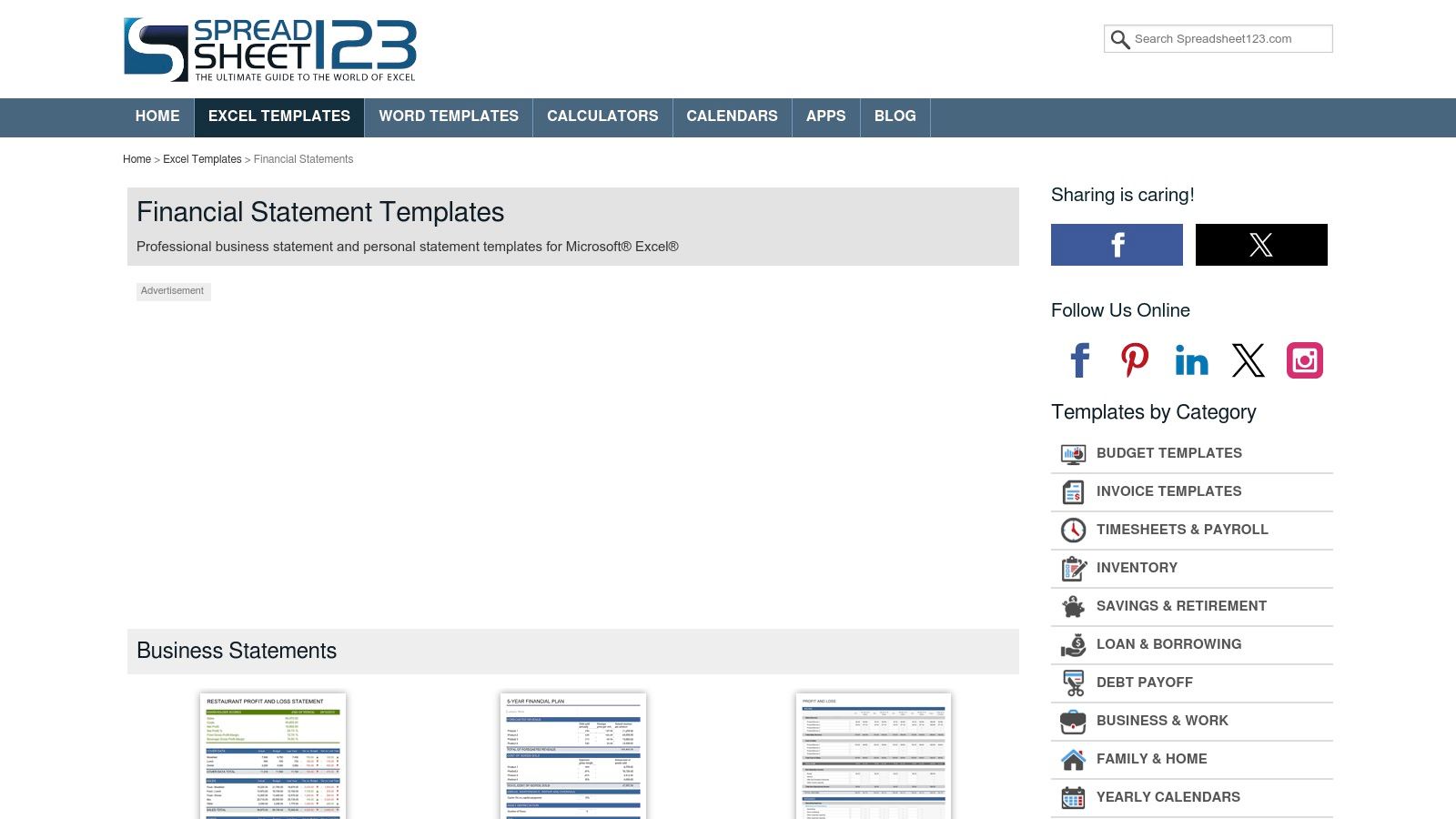
Spreadsheet123 stands out by designing its templates with small business operations in mind. The layouts are clean, well-organised, and ready for presentation to banks or stakeholders without significant reformatting. Most core templates are free, though more advanced versions are available for purchase, offering a scalable path as your financial reporting needs become more detailed.
Customisation for African SMEs
These Excel templates are easily modified for regional business practices. To manage multiple currencies, such as tracking revenue in both South African Rand (ZAR) and US Dollars, you can duplicate the income statement sheet. Label one for ZAR transactions and the other for USD, then create a summary sheet that consolidates totals using an agreed-upon exchange rate. This approach provides clarity on performance within different markets.
Use-Case Scenario: A Nigerian software-as-a-service (SaaS) company can use the 5-year financial planning template to project subscription revenue and operational costs. By adding specific expense lines for data centre hosting and international payment gateway fees, they can create a realistic long-term budget to guide their expansion strategy.
Pros and Cons
- Pros: Templates have a clear, professional structure tailored to SME reporting needs. The Excel format is straightforward with no complex macros, making it easy to use and adapt. Multi-year projection templates are included.
- Cons: The templates are not industry-specific and may require customisation. They provide limited guidance on IFRS for SMEs standards, so additional work is needed for formal compliance and audits.
Website: https://www.spreadsheet123.com/ExcelTemplates/financial-statements.html
5. Template.net – Financial Statement Templates (Excel/Docs)
For businesses prioritising presentation and branding, Template.net offers a massive catalogue of financial statement templates available in multiple formats, including Excel, Google Docs, and Word. It distinguishes itself with variety, providing numerous layouts and visual styles that are ideal for creating client-facing or investor-ready reports. Unlike spreadsheet-centric sites, Template.net focuses on documents where aesthetic polish is as important as the data itself.
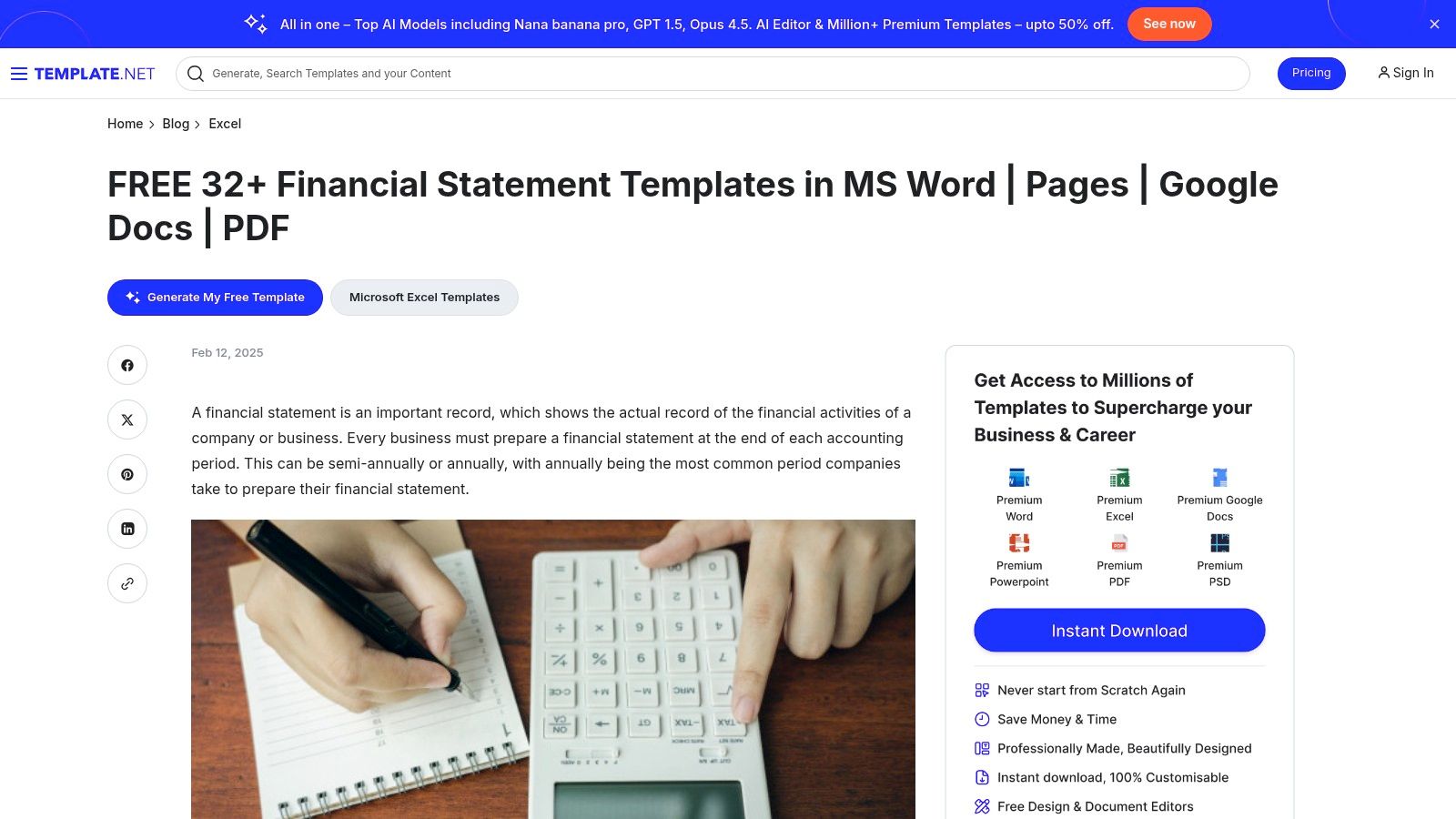
The platform is designed for quick customisation. Its templates feature editable headers, footers, and colour schemes, allowing non-technical users to align financial documents with their company’s branding without needing advanced design skills. This makes it a go-to resource for when a basic spreadsheet is not enough.
Customisation for African SMEs
The Word and Google Docs versions are particularly useful for reports that need narrative context alongside the figures. An SME in Nigeria can download a balance sheet template in Word, add their logo, and then insert a section to explain how currency fluctuations in the Naira affected foreign asset values. Because the templates are visually oriented, they can be adapted to present data from mobile money platforms clearly, such as by adding a branded "Mobile Money Assets" section.
Use-Case Scenario: A South African consultancy firm can download a professionally designed income statement template to include in a quarterly client report. They can easily add their logo and brand colours, presenting financial performance data in a format that looks polished and instills confidence.
Pros and Cons
- Pros: A wide selection of templates helps match specific branding needs. The formats (Excel, Word, Sheets) offer flexibility for different reporting purposes. They are simple for non-technical users to adapt.
- Cons: Template quality can be inconsistent across the large library. Full access to the best designs and unlimited downloads typically requires a paid subscription.
Website: https://www.template.net/excel/financial-statement-template/
6. HubSpot – Balance Sheet & Income/Expense Templates
Known primarily for its marketing and CRM software, HubSpot also provides a collection of free, high-quality business resources, including financial statement templates. These are ideal for startups and small business owners who want clean, straightforward spreadsheets without any fuss. The offering includes a balance sheet and an income/expense tracker, available for both Microsoft Excel and Google Sheets.
What makes the HubSpot templates a great starting point is their simplicity and backing by a credible brand. They are stripped of complex features, focusing instead on the core line items needed for basic financial reporting. This approach is perfect for founders who need to quickly assemble financials for an internal review or a small loan application. The direct download requires a simple form submission, giving you immediate access.
Customisation for African SMEs
The clean layout of HubSpot’s templates makes them very easy to modify for local business conditions. To account for mobile money, you can add a "Mobile Money Wallet (e.g., PesaLink, Chipper Cash)" line item under Current Assets on the balance sheet. On the income and expense sheet, you can add a "Mobile Money Fees" row to accurately track transaction costs associated with these payment methods.
Use-Case Scenario: A Ghanaian digital marketing agency can use the Google Sheets income/expense template to create a shared, live budget. By adding columns for different client projects, they can track profitability per client, a task that becomes simple due to the template's uncluttered design.
Pros and Cons
- Pros: Completely free from a trusted brand. Available in both Excel and Google Sheets formats for greater flexibility. The simple design makes them easy and fast to implement for any small business.
- Cons: The templates are offered individually and do not form a complete three-statement financial model (cash flow statement is missing). They provide minimal accounting guidance, assuming the user has a basic understanding of financial principles.
Website: https://www.hubspot.com/resources/templates/balance-sheet
7. Sage Advice – Balance Sheet and Income Statement Templates (Excel)
For businesses looking to understand the mechanics behind their numbers, Sage Advice offers a unique approach by combining its financial statement templates with clear, educational content. As a globally recognised accounting software provider, Sage lends authority and a practical perspective to its free Excel resources, making them ideal for SMEs transitioning towards more formal financial management. The site provides individual downloads for core statements like the balance sheet and income statement.
The primary value here is the context provided alongside the templates. Sage explains what each line item means, helping entrepreneurs not only fill in the blanks but also grasp the financial health indicators they are tracking. This educational component is a significant differentiator, bridging the gap between a simple template and a full accounting system.
Customisation for African SMEs
The Excel format ensures these templates are easily adjustable for local business realities. An Ivorian SME, for instance, can add specific rows to the income statement to track revenue from Orange Money versus Wave, offering clearer insights into popular payment channels. On the balance sheet, a liability line for a loan from a local SACCO or microfinance institution can be added to give a more accurate picture of the company's obligations.
Use-Case Scenario: A small South African consulting firm can use the Sage income statement template to prepare for its first tax submission. The accompanying explanations help the owner correctly categorise expenses like "Load Shedding Diesel Costs" under utilities, ensuring accurate profit calculation and compliance.
Pros and Cons
- Pros: Backed by a trusted accounting brand, providing confidence in the structure. The pragmatic instructions and explanations help demystify financial statements for beginners.
- Cons: Templates are offered individually rather than as an integrated package, requiring manual linking. They are simplified for educational purposes and lack the detailed disclosures needed for IFRS compliance.
Website: https://www.sage.com/en-us/blog/balance-sheet-template/
8. Bench Accounting – Excel Income Statement Template
Bench, a well-known bookkeeping service, offers a free and exceptionally beginner-friendly financial statement template focused exclusively on the profit and loss (P&L) statement. This resource is perfect for entrepreneurs who are not yet using accounting software and need to manually compile a P&L from bank statements or transaction exports. It strips away complexity, presenting a clean Excel file with clear, step-by-step instructions.
What makes the Bench template stand out is its educational approach. It is designed for non-accountants, providing simple examples and guiding users through the process of categorising their revenue and expenses. This makes it a great intermediate step before graduating to more robust accounting systems like QuickBooks, Xero, or integrated CRM platforms such as CRM Africa.
Customisation for African SMEs
The template's simplicity is its strength for adaptation. An SME in Nigeria or Ghana can easily customise it for local operations. For instance, to account for multi-currency transactions, you can add separate columns for income received in USD versus NGN or GHS, then use a final column to convert everything to your reporting currency based on the exchange rate at the time of the transaction. You can add specific expense lines for "Generator Fuel" or "Data Subscriptions" under operating expenses to reflect common local costs.
Use-Case Scenario: A freelance consultant in South Africa can use this template to prepare a quarterly P&L for tax purposes. By downloading their bank transactions and following the template's guide, they can quickly categorise income and expenses like "Client Fees," "Software Subscriptions," and "Co-working Space Rent" to calculate their net profit.
Pros and Cons
- Pros: Extremely approachable for those with no accounting background. The included instructions and examples make it easy to get started. It's an excellent tool for a quick, one-off P&L preparation.
- Cons: It only covers the income statement, so you cannot produce a complete set of financials. The template is best for simple businesses and may not scale well for complex operations with extensive inventory or assets.
Website: https://www.bench.co/blog/resources/excel-income-statement-template
9. WPS Office – Balance Sheet Template Gallery (Excel)
For teams that value visual presentation or use the WPS Office suite, WPS provides a large gallery of polished financial statement templates, with a strong focus on the balance sheet. Unlike basic spreadsheet sites, WPS offers dozens of design variants, allowing businesses to choose a layout that fits their brand or reporting style, from minimalist and modern to more detailed and traditional. The templates are available for direct download, primarily in Excel format.
What sets WPS Office apart is the sheer variety of styles available for a single financial statement. You can find templates specifically designed for non-profits, monthly reporting, or simple small business use. This aesthetic focus makes them great for presentations to investors or internal stakeholders where a professional appearance is important.
Customisation for African SMEs
The visual polish of these templates does not prevent customisation. An SME in Nigeria using OPay for business transactions can adapt a WPS balance sheet by inserting a row for "OPay Wallet Balance" under "Current Assets". On the income statement, transaction fees would be added as a distinct line item under "Operating Expenses". It is important to double-check that all sum formulas correctly include these newly added rows to maintain accuracy.
Use-Case Scenario: A Ghanaian design agency can download a visually appealing monthly balance sheet template from WPS to share with its board. The polished design adds a layer of professionalism to their financial reporting, which is especially useful when seeking new funding or partnerships.
Pros and Cons
- Pros: A large selection of visually polished templates offers more design flexibility than standard options. Instant downloads are available for multiple styles, including non-profit and monthly versions.
- Cons: The platform often prompts users to download the WPS Office suite. The quality can vary between templates, and they lack specific guidance for IFRS compliance, requiring manual verification.
Website: https://www.wps.com/template/balance-sheet/
10. Simple Sheets – Balance Sheet, P&L, Cash Flow Templates (Excel/Google Sheets)
For businesses that prioritise presentation and visual reporting, Simple Sheets offers premium financial statement templates designed for both Excel and Google Sheets. This platform is ideal for teams wanting a polished, dashboard-driven starting point without the time investment of building financial models from scratch. These are paid products, sold individually or in bundles, aimed at users who value a professional aesthetic and linked key performance indicators (KPIs) straight out of the box.
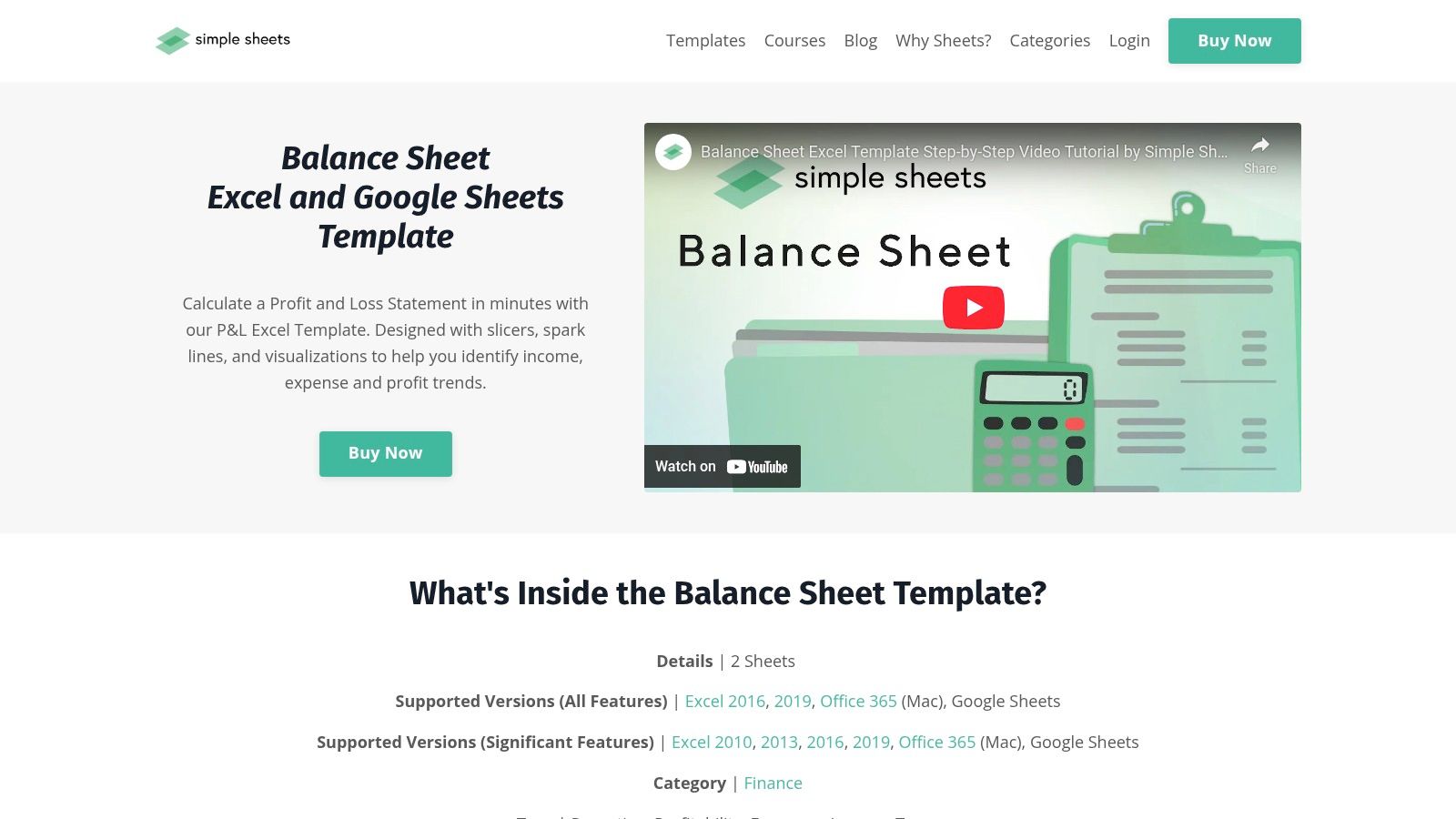
The key differentiator for Simple Sheets is the integration of visual dashboards directly into the templates. Charts and graphs update automatically as you input data into the income statement or balance sheet, providing an instant high-level overview. This feature is particularly useful for management meetings or investor updates where visual clarity is paramount.
Customisation for African SMEs
Because these templates are built in standard spreadsheet software, they are fully customisable. To account for regional payment methods, an SME in Ghana can add a line for "MTN MoMo" or "Vodafone Cash" under current assets on the balance sheet. Similarly, on the Profit & Loss (P&L) statement, a "Mobile Money Transaction Fees" line can be added under operating expenses to accurately track costs associated with these popular payment channels.
Use-Case Scenario: A South African consulting firm purchases the financial statement bundle to create its quarterly board pack. They can input their revenue and expense data and immediately have professional-looking charts that visualise profitability and cash flow, saving hours of manual formatting.
Pros and Cons
- Pros: Professionally designed with excellent visual polish for reporting. Available for both Excel and Google Sheets, offering platform flexibility. The interconnected nature saves time in creating a cohesive reporting package.
- Cons: These are paid templates, which may not suit startups on a tight budget. They are not built as a specific compliance framework for IFRS or other accounting standards.
Website: https://www.simplesheets.co/balance-sheet?utm_source=openai
11. IFRS Foundation – IFRS Illustrative Examples and Resources
For businesses aiming for the highest standard of financial reporting, the IFRS Foundation is the definitive source. It provides official illustrative examples and resources that demonstrate compliant presentation and disclosure according to International Financial Reporting Standards. These are not typical downloadable financial statement templates, but rather authoritative guides for ensuring your reports align with current IFRS and the IFRS Taxonomy.
What makes the IFRS Foundation's resources essential is their direct link to issued standards. They are published as companions to the standards themselves, providing clarity on required disclosures and presentation formats. This makes them an indispensable reference for finance teams, auditors, and companies preparing for an audit or seeking external investment.
Customisation for African SMEs
While these resources are guides, not templates, their principles are vital. An SME in South Africa using accounting software or a platform like CRM Africa can cross-reference its generated statements against these IFRS examples. You can ensure that line items for local realities, like mobile money receipts, are correctly categorised under "Cash and cash equivalents" and that related revenues and fees are disclosed in a compliant manner on the income statement.
Use-Case Scenario: A growing Nigerian manufacturing firm preparing for its first external audit can use the IFRS illustrative examples to validate the structure of its balance sheet and statement of comprehensive income, ensuring all necessary disclosures for property, plant, and equipment are included.
Pros and Cons
- Pros: The most authoritative source for IFRS compliance alignment. Essential for understanding the specific disclosure requirements for complex transactions. Helps standardise reporting for international comparison.
- Cons: Primarily published as locked PDFs, not editable spreadsheets. Access to the full library of standards and detailed implementation guidance often requires a paid subscription. The content is highly technical and assumes a strong accounting background.
12. SAICA – Illustrative Financial Statements (South Africa)
For South African businesses and accounting professionals requiring authoritative, locally compliant reporting examples, the South African Institute of Chartered Accountants (SAICA) is an essential resource. Instead of offering editable financial statement templates, SAICA provides illustrative financial statements that demonstrate best practices according to IFRS for SMEs. These are invaluable for ensuring your statements align with local practice, regulations, and upcoming standards.
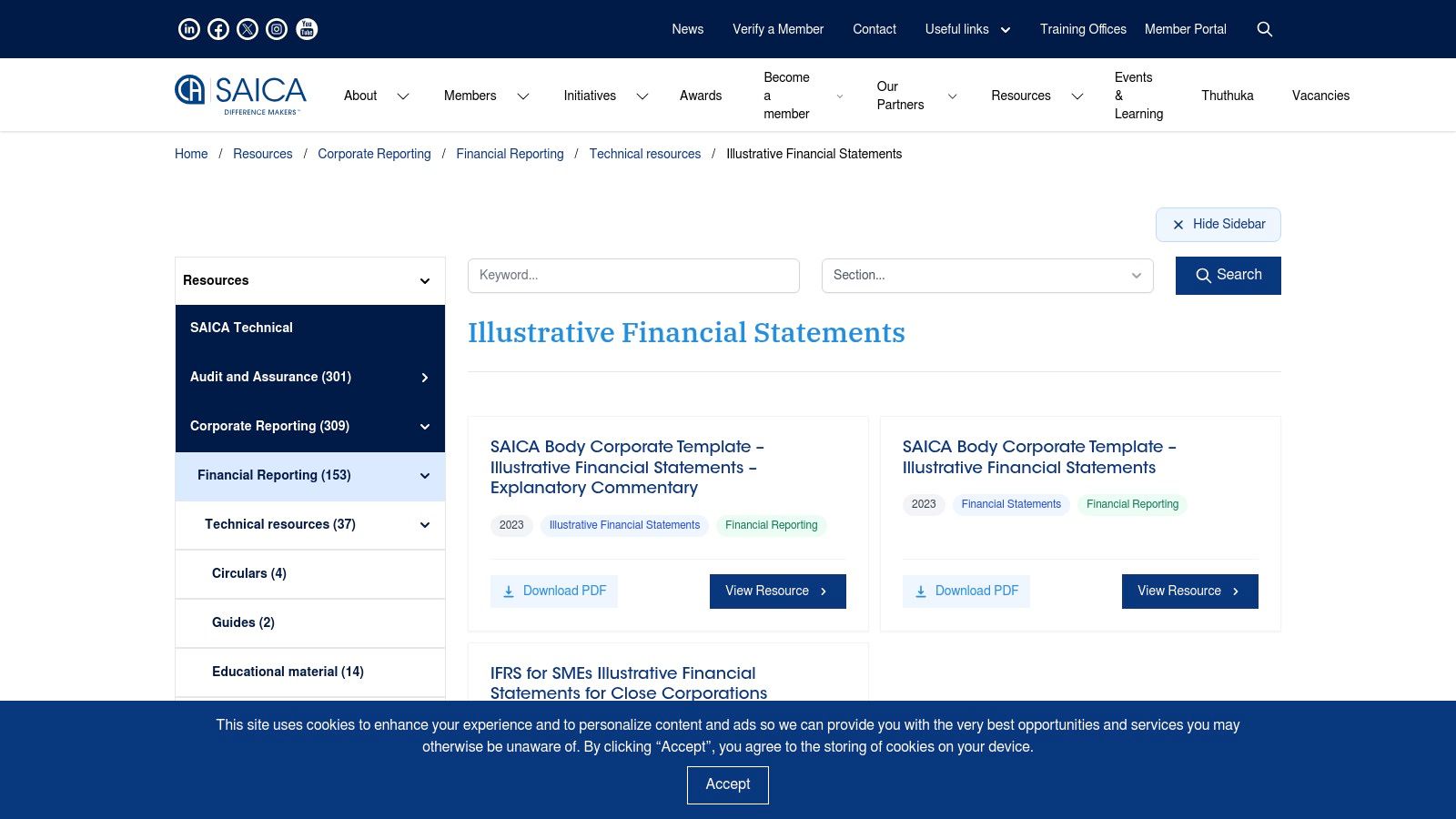
The primary value of these resources lies in their precision and relevance to the South African context. They are prepared by experts and often include commentary on the application of specific standards, making them a learning tool as much as a formatting guide for auditors and financial statement compilers.
Customisation for African SMEs
While these are illustrative PDFs and not working files, they serve as a blueprint for creating compliant statements in Excel or accounting software. A business can use these examples to structure its own reports correctly, ensuring that disclosures for BEE transactions or specific local tax treatments are properly placed. You can replicate the structure in a spreadsheet, then populate it with your own data.
Use-Case Scenario: A growing consulting firm in Johannesburg preparing for its first audit can use SAICA's IFRS for SMEs illustrative statements as a guide. This ensures their accountant correctly formats the statement of financial position and includes all necessary disclosure notes required by South African practice, reducing audit queries.
Pros and Cons
- Pros: Highly authoritative and aligned with South African regulations and IFRS for SMEs. Provides a clear benchmark for local best practice. Excellent for training and ensuring compliance ahead of standard changes.
- Cons: Materials are typically non-editable PDFs, not functional templates. Some advanced resources and guidance may be gated for registered SAICA members only, limiting access for the general public.
12 Financial Statement Templates Compared
| Provider | Core features | Formats & UX | Best for | Unique selling point | Price |
|---|---|---|---|---|---|
| Vertex42 – Financial Statement Templates (Excel) | Excel-native templates with built-in formulas | Excel-focused, printable, easy to adapt | SMEs wanting lightweight, editable sheets | Formula-driven, widely referenced by SMEs | Mostly free downloads |
| Smartsheet – Free Financial Statement Template Set | Curated P&L, balance sheet, cash flow + guides | Excel, Google Sheets, PDF, Smartsheet | Teams that may adopt Smartsheet workflows | Multi-format hub with Smartsheet integration | Free templates (account optional) |
| Microsoft Excel – Financial Management Template Gallery | Official, consistently formatted finance templates | One-click open in Excel; maintained by Microsoft | Organizations standardized on Microsoft 365 | Trusted official source, familiar UI | Free with Excel / M365 |
| Spreadsheet123 – Financial Statements (Excel) | P&L, balance sheet with 3-year view and projections | Excel; print-ready, clear structure | SMEs needing multi-year planning | Structured multi-year templates, print-ready | Mostly free |
| Template.net – Financial Statement Templates (Excel/Docs) | Large editable library across file types | Excel, Google Sheets, Word; brandable layouts | Users needing branded or client-facing docs | Broad selection and presentation styles | Free items + subscription for full access |
| HubSpot – Balance Sheet & Income/Expense Templates | Basic balance sheet and income/expense layouts | Excel & Google Sheets; very simple UX | Founders and early-stage teams | Free, clean templates from a credible brand | Free |
| Sage Advice – Balance Sheet and Income Statement Templates (Excel) | Excel templates with contextual explainers | Excel downloads with short guidance | SMEs transitioning toward accounting software | Trusted accounting brand with practical explainers | Free (editorial resources) |
| Bench Accounting – Excel Income Statement Template | Beginner-friendly P&L with step-by-step examples | Excel; guided setup for non-accountants | Non-accountants preparing basic P&Ls | Very approachable; example-driven | Free |
| WPS Office – Balance Sheet Template Gallery (Excel) | Dozens of visual balance sheet variants | Excel templates; visually polished | Teams wanting visual polish and variety | Large variety of visual styles | Free (WPS app prompts may appear) |
| Simple Sheets – Balance Sheet, P&L, Cash Flow Templates | Linked KPIs, dashboards, forecasting tools | Excel & Google Sheets; polished dashboards | Teams needing professional reporting packs | Ready-made dashboards and KPI links | Paid (per template or bundles) |
| IFRS Foundation – Illustrative Examples & Resources | Illustrative financial statements aligned to IFRS | PDFs and guidance (not editable spreadsheets) | Entities aiming for IFRS-compliant presentation | Authoritative IFRS compliance reference | Mostly free; some paid materials |
| SAICA – Illustrative Financial Statements (South Africa) | ZA-specific illustrative statements and sector notes | PDFs; some gated/member content | South African entities and auditors | Local practice alignment for South Africa | Some free; member-gated content |
Building a Foundation for Financial Clarity and Growth
Choosing the right starting point for your financial reporting can feel like a significant decision, and it is. Throughout this guide, we have explored a diverse collection of financial statement templates, each with its unique strengths and intended use cases. From the versatile and highly-regarded Excel sets offered by Vertex42 and Smartsheet to the compliance-oriented examples from authoritative bodies like the IFRS Foundation and SAICA, the resources available are plentiful.
Simple, targeted templates from providers like Bench Accounting and HubSpot are excellent for startups or sole proprietors needing to produce a quick profit and loss statement. In contrast, more detailed workbooks from Spreadsheet123 or Microsoft's own gallery provide a more structured framework for growing businesses. The key takeaway is that there is no single "best" template; the ideal choice depends entirely on your business's current size, complexity, and internal capacity.
Moving Beyond Manual Spreadsheets
While these downloadable templates are a fantastic first step towards professionalising your financial records, their true value is realised when they become part of a larger, more automated system. Manually keying in transactions from different sources-bank statements, mobile money receipts, and sales invoices-is not only time-consuming but also a significant source of errors. A single misplaced decimal or forgotten entry can distort your entire financial picture, leading to flawed business decisions.
The ultimate goal for any serious business is to create a reliable, single source of truth for its financial data. This is where integrated business management platforms become essential. When your invoicing, payment collection, and expense tracking are all managed within one system, the data required for your financial statements is already organised, accurate, and ready for export. This process eliminates the tedious and error-prone task of manual consolidation.
For businesses truly committed to achieving financial clarity and growth, understanding the fundamentals of accounting, including how to prepare financial statements from scratch, is just as important as having the right templates. This foundational knowledge empowers you to interpret the data correctly and make informed strategic choices.
The Power of an Integrated System
Consider the specific challenges faced by African SMEs. You may be dealing with multiple currencies, reconciling payments from various mobile money providers like M-PESA, and managing client projects with distinct billing cycles. A generic spreadsheet template, while helpful, cannot natively handle this complexity.
This is why platforms like CRM Africa are built. They connect the dots between your daily operations and your high-level financial reporting. By generating professional invoices, accepting payments through integrated gateways, and tracking every transaction automatically, such a system provides the clean, structured data needed to populate any financial statement templates with confidence. The time you save on manual data entry can be reinvested into analysing the results and planning for growth.
By beginning with a robust template and progressively integrating it with a smart operational system, you build a scalable framework for financial management. This foundation not only provides immediate clarity but also supports your long-term growth ambitions, whether you're expanding within your local market or across the continent. Your financial statements transform from a historical chore into a powerful, forward-looking strategic tool.
Ready to stop wrestling with spreadsheets and start building a reliable financial system? See how CRM Africa unifies your client management, invoicing, and pan-African payments to give you the clean data you need for accurate financial reporting. Start your free journey with CRM Africa today and build a foundation for sustainable growth.