
A solid SLA agreement format is your best defence against misunderstandings and mismatched expectations. It’s the structured document that clearly lays out the level of service a client can expect from you, the provider. Think of it less as a formality and more as a critical blueprint for the entire relationship, covering everything from service scope and performance metrics to responsibilities and penalties.
Getting this right from the start is what separates a smooth, professional partnership from a rocky, frustrating one.
Your Quick Guide To Structuring An SLA
Staring at a blank page when you need to draft a professional Service Level Agreement (SLA) can feel a bit daunting. The good news? A great SLA follows a predictable and logical structure. Once you understand this framework, you're halfway to creating a document that protects your business and builds genuine client trust.
Think of it as a checklist. It's there to make sure you've covered all your bases and left no room for ambiguity. This isn't just about preventing disputes; studies consistently show that clearly defined agreements are a cornerstone of successful, long-term client-provider relationships. According to a report by the World Commerce & Contracting association, "poor contract management costs companies 9% of their bottom line," much of which stems from ambiguous terms and misaligned expectations that a strong SLA aims to prevent.
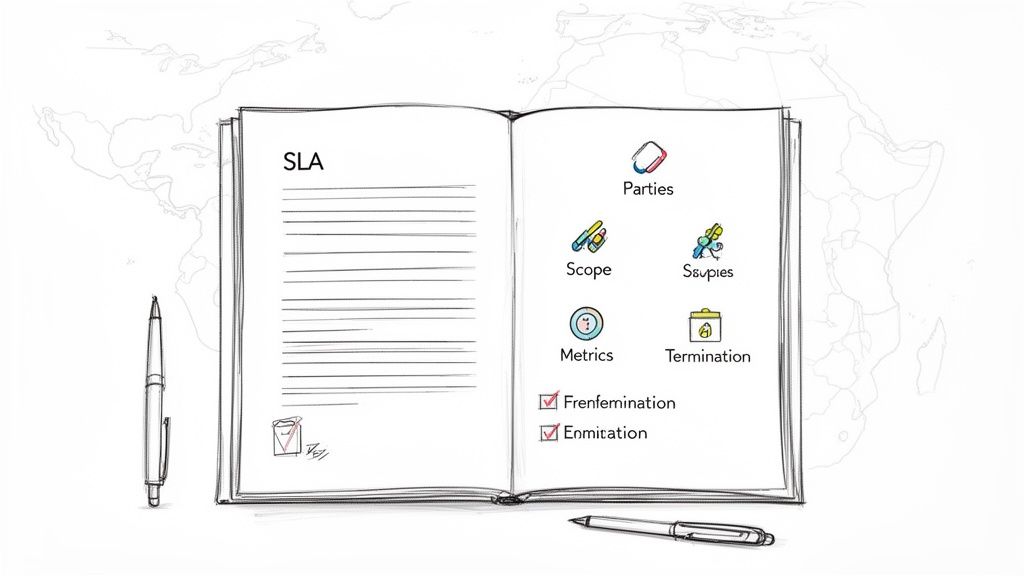
Essential Components of an SLA Agreement Format
A well-organised agreement clarifies everyone’s obligations right from the get-go, which is absolutely vital for any business delivering professional services, especially in the diverse African market.
Here’s a quick-reference table breaking down the core sections you’ll find in almost every standard SLA. Use this to guide your drafting process and ensure your final document is comprehensive and clear.
| SLA Section | Purpose | Key Information to Include |
|---|---|---|
| Agreement Overview | To define the parties and the SLA's effective date and duration. | Names and details of the client and provider, start/end dates. |
| Scope of Services | To detail the specific services covered by the agreement. | A clear description of deliverables and what is included. |
| Performance Metrics | To set measurable standards for service quality and delivery. | Uptime guarantees, response times, resolution times. |
| Responsibilities | To outline the duties of both the client and the provider. | Client obligations (e.g., providing information) and provider duties. |
| Penalties & Remedies | To define consequences for failing to meet service levels. | Service credits, financial penalties, or other remedial actions. |
| Termination Clause | To specify the conditions under which the agreement can be ended. | Notice periods and procedures for termination by either party. |
By ensuring each of these components is thoughtfully addressed, you create a living document that serves as a reliable reference point for both you and your client throughout your partnership.
Breaking Down the Key Parts of an SLA
A proper SLA agreement format is much more than a simple checklist; it’s what gives your promises real substance and legal teeth. Think of it as the go-to reference document that turns abstract commitments into solid, measurable actions. When you get this breakdown right, there’s no room left for guesswork, which is absolutely vital for keeping communication clear and building trust with your clients.
Let's pull apart the anatomy of a professional SLA, piece by piece. Each clause has a job to do—defining the relationship, setting expectations, and giving you a clear path forward when things don’t go according to plan. This level of detail is especially important in markets like Nigeria, Kenya, and South Africa, where a bit of clarity upfront can save you from a world of headaches and costly disputes down the line.
Agreement Overview and Scope of Services
This is your foundation. It’s where you spell out who the agreement is between, when it starts, and how long it lasts. It’s the basic "who" and "when" of your SLA. Right after that comes the Scope of Services clause, which needs to detail exactly what you’re delivering. This is a common tripwire for many businesses; vague descriptions are your enemy here.
For example, if you're in the IT support game, the scope needs to be crystal clear about things like:
- Which specific systems are covered (e.g., servers, desktops, named software applications).
- Your hours of operation (e.g., 9 am-5 pm CAT, Monday-Friday).
- What counts as an "in-scope" request versus a new, billable project.
An SLA is an agreement between you and your customers that clearly spells out the services you offer and what accounts can expect from support. According to research on SLA best practices, these agreements define response and resolution times, and they lay out what happens when expectations aren’t met.
Performance, Penalties, and Exclusions
This is where the rubber meets the road. The Performance Metrics section is where you put numbers to your promises. Next up, the Penalties and Remedies clause defines the consequences—like service credits—if you don't hit those numbers. Finally, the Exclusions clause is your safety net, clarifying what you’re not responsible for, like issues caused by a client's own dodgy internet connection.
Many businesses today don't leave this to chance; they use integrated platforms to keep an eye on everything automatically. A system like CRM Africa can track service metrics against your SLA targets in real-time. Other popular tools like Zoho Desk, HubSpot Service Hub, and Salesforce Service Cloud also offer strong SLA management features. This kind of automation is a huge help in staying compliant and building a transparent track record with your clients.
Defining Clear Service Levels and Metrics
This is where the rubber meets the road. The heart of any solid SLA agreement format lies in its metrics. These are the specific, measurable targets that turn vague promises into rock-solid commitments. Think of them as the rules of the game that everyone agrees on upfront, preventing messy disputes down the line.
Without clear key performance indicators (KPIs), an SLA is just a document of good intentions. As IT research firm Gartner notes, "SLAs must be based on objective, measurable, and mutually acceptable metrics to be effective." This section is your practical playbook for defining and measuring the numbers that truly matter. Getting these quantified expectations right from day one is the single best way to build and keep your client's trust.
Establishing Core Performance Metrics
Your SLA has to define targets for the service elements your clients care about most. A goal like "fast support" is useless because it can't be measured. You need hard numbers.
Most of these metrics fall into a few key categories that directly impact the client's experience.
Here are the non-negotiables:
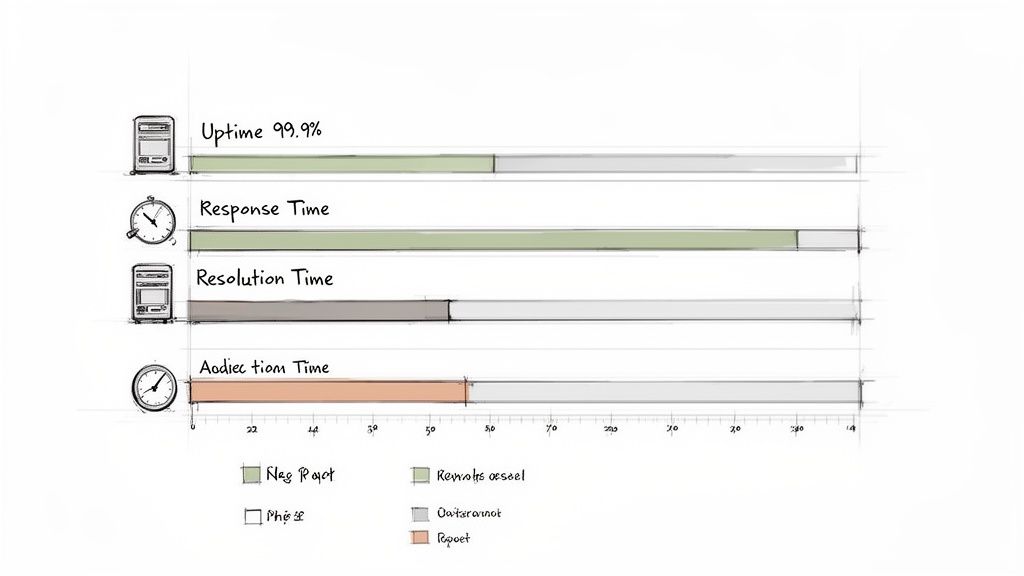
- Service Uptime/Availability: This is the big one. It's usually a percentage, like 99.9% uptime, promising how often the service will be up and running over a given period.
- First Response Time: This isn't about solving the problem; it's about speed. It measures how quickly your team acknowledges a new support ticket.
- Resolution Time: This is the target for completely fixing an issue from the moment it’s reported.
A smart move is to create different tiers for these metrics. This allows you to balance your client's needs with what your team can realistically deliver. For example, you wouldn't treat a full system outage the same as a minor user query.
Structuring a Tiered Support System
A tiered system is a common-sense best practice. It helps you point your resources where they’re needed most and manage client expectations before a crisis hits. By classifying issues into priority levels, you can assign different time-based targets to each one.
Here’s what that might look like in practice:
- Priority 1 (Critical): A complete system outage. You might promise a response within 15 minutes and a resolution within 4 hours.
- Priority 2 (High): A major feature is broken but the system is still online. Perhaps a response within 1 hour and resolution within 8 business hours.
- Priority 3 (Normal): A minor glitch or a general question. A response within 4 business hours and resolution within 3 business days is often reasonable.
This kind of structured approach isn't just a business fad; it mirrors standards you see in the public sector. For instance, South Africa's own government service delivery framework requires emergency services to be available 365 days a year. The framework sets an 80% compliance target for resolving emergency calls within one hour to minimise public disruption. You can see the full details in the Service Level Indicators document from COGTA.
Structuring Penalties and Service Credits
So, what happens when performance targets in your SLA agreement format are missed? This is where your penalty and service credit clauses really matter. They create a clear, pre-agreed path for what comes next, protecting you from poor service while giving your provider a solid reason to keep standards high.
A well-built penalty clause isn't about punishing the provider for the sake of it. The real goal is accountability and fair compensation when service levels take a dip. The most common way to handle this is through service credits—basically rebates or discounts on future bills—rather than messy financial payouts.
Building a Fair Penalty Framework
A tiered penalty system is almost always the most effective way to go. It scales the consequences based on how serious and frequent a service failure is. Think of it this way: a minor slip-up might only warrant a small service credit, but a critical outage should trigger something much more significant.
This isn’t just a theoretical model; it’s standard practice in major industries. Take South Africa's security and port operations, for example. They depend on detailed SLA penalty structures to keep things running smoothly. The Transnet National Ports Authority uses specific monetary penalties for any breaches, with fines climbing from R50 to R1,000 per incident based on severity. You can dig into the specifics in the official SLA documentation for the Port of Cape Town.
This really drives home a key point: penalties have to be proportional and spelled out in black and white.
A strong SLA keeps your company and customers on the same page, so you can avoid unpleasant surprises and strengthen relationships. Penalties and remedies should be included to outline what happens if your team breaks an SLA.
Calculating Credits and Capping Liability
The maths for calculating credits needs to be simple. A popular method is to link the credit amount directly to the scale of the failure. For instance, if uptime drops from a guaranteed 99.9% to 99.5%, you might offer a 10% credit on that month's fee. It’s clean and easy for everyone to understand.
It's also absolutely crucial to include a maximum liability cap. This clause limits the total amount of credits a client can rack up in a single billing cycle, usually as a percentage of the monthly fee (say, 50%). This is smart risk management for the service provider, protecting them from a financial catastrophe, while still making sure the client gets fair compensation when things go wrong.
Right, so you’ve got your SLA agreement format nailed down. But let's be honest, a document is only as good as your ability to actually track and enforce it. Trying to manually keep an eye on response times, calculate uptime, and pull together reports is a recipe for mistakes and wasted hours. This is exactly where a Customer Relationship Management (CRM) platform stops being a "nice to have" and becomes a critical part of your toolkit.
Using a CRM takes your SLA from a static piece of paper to a living, breathing part of your operations. You can monitor performance as it happens, create reports that leave no room for doubt, and make sure everyone—your team and your client—is on the same page. When you can back up your service delivery with hard data, you build the kind of trust that keeps clients for the long haul.
This simple flowchart breaks down how penalties typically work in an SLA.
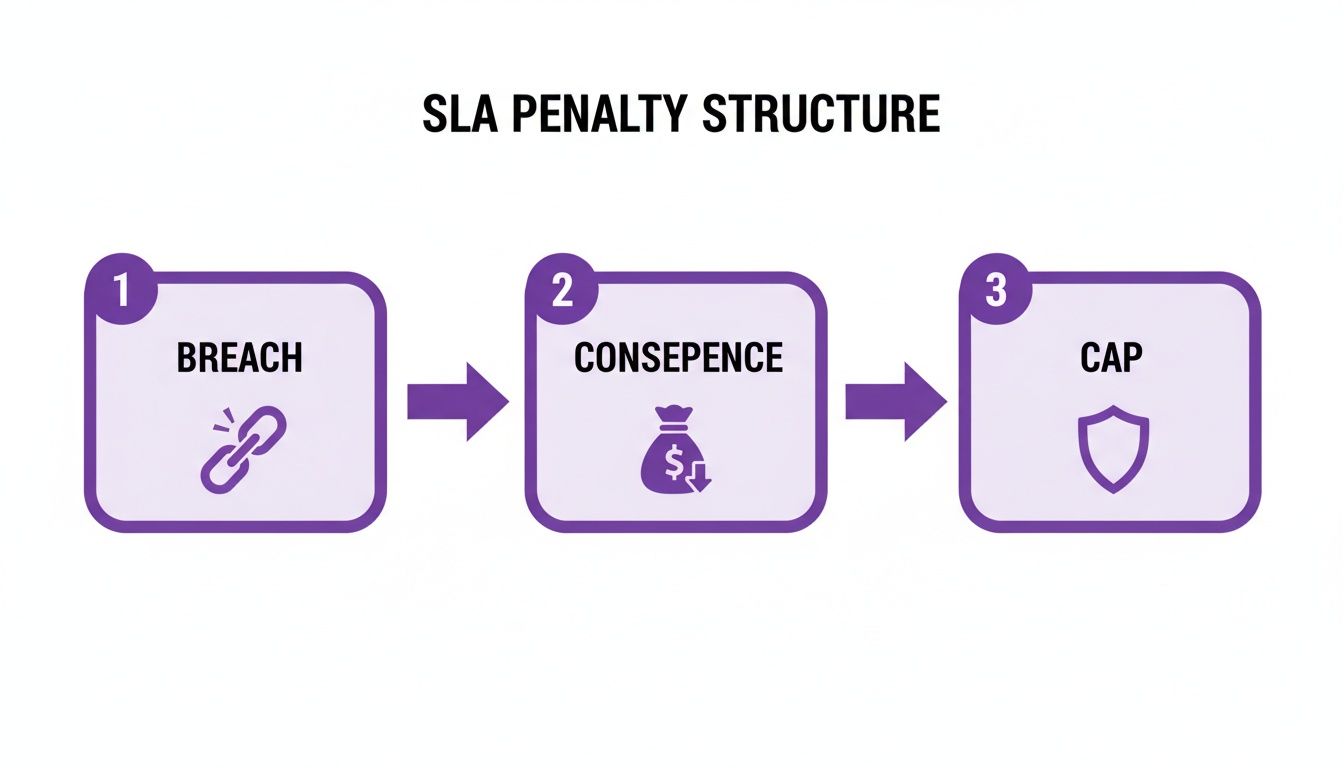
As you can see, the idea is straightforward: a breach has a clear consequence, but it’s always balanced by a cap to make sure the risk is manageable for everyone involved.
Putting Your SLA on Autopilot with the Right Platform
An integrated CRM is the engine that drives modern SLA management. Think of it as the central hub where every client interaction, service ticket, and piece of performance data lives. Centralising all this information is the secret to automating what used to be a painful manual grind.
When you're looking for a CRM to handle your SLAs, here are the non-negotiables:
- Automated Ticket Tracking: The system has to do the heavy lifting. It should automatically log requests from all your channels (email, phone, portal) and kick off timers to measure response and resolution against your SLA goals.
- Automated Escalations: You can't watch every ticket every second. The platform should automatically flag a ticket that's nearing a breach and push it up the chain to a manager or senior technician. This ensures nothing falls through the cracks.
- Client Portals: Give your clients a professional, self-service window into your operations. A branded portal lets them log tickets, check the status of their requests, and see performance reports for themselves. It’s all about transparency.
- Integrated Reporting: No more wrestling with spreadsheets. Your CRM should have dashboards that give you a crystal-clear, real-time picture of how you’re performing against every single metric you’ve defined.
The demand for this level of automation is exploding. In fact, the global market for SLA Tracking Systems is expected to hit USD 3.68 billion by 2029. This isn’t just a trend; it's a fundamental shift driven by the need for smarter ways to manage complex service agreements. If you're interested in the numbers, you can learn more about the rise of SLA tracking systems from the full market analysis.
Comparing CRM Platforms for SLA Management
Finding the right CRM is key to successful SLA management. While global giants offer powerful features, it's crucial to weigh them against platforms designed with the unique needs of African businesses in mind. This table compares some of the top contenders.
| Feature | CRM Africa | Zoho Desk | HubSpot Service Hub | Salesforce Service Cloud |
|---|---|---|---|---|
| Regional Integration | Full integration with African payment gateways (M-PESA, Paystack, Flutterwave) and localised invoicing. | Limited direct integration; relies on third-party connectors. | Limited native support; often requires custom integration. | Requires complex configuration and third-party apps for local payment gateways. |
| Client Portal | Fully brandable client portals for ticket management and reporting. | Customisable help centres and community forums. | Knowledge base and customer portal available on higher tiers. | Highly customisable portals, but can be complex and costly to set up. |
| Automated Workflows | Pre-built and customisable workflows for escalations, notifications, and invoicing. | Robust workflow automation for ticket routing and SLA rules. | Automation available for ticket routing, tasks, and follow-ups. | Powerful, enterprise-grade automation capabilities (Flows). |
| All-in-One Platform | Combines CRM, project management, invoicing, and support in one system. | Part of a broad ecosystem, but core functions are in separate apps. | Integrates well with other HubSpot hubs (Sales, Marketing). | Part of a massive ecosystem, but can feel disjointed without extensive customisation. |
| Pricing Model | Designed for SME affordability with transparent, all-inclusive pricing. | Tiered pricing that can become expensive as you add agents or features. | Starts with free tools, but SLA features are in paid tiers. | Enterprise-focused pricing; can be prohibitively expensive for many SMEs. |
While platforms from Zoho, HubSpot, and Salesforce are incredibly powerful, they often weren’t built with the African business landscape in mind. An all-in-one solution designed for the local market, like CRM Africa, can give you a serious edge.
The real power comes from connecting your service delivery directly to your financials. Imagine this: a service credit for a missed SLA target is automatically calculated and applied to your client’s next invoice. That's the kind of seamless process a platform like CRM Africa makes possible by bundling project management, invoicing, and support for payment gateways like M-PESA, Flutterwave, and Paystack into one system. This approach breaks down the walls between departments and gives you a single, reliable source of truth for the entire client relationship.
Navigating Legal and Jurisdictional Issues in Africa
It’s easy to think of an SLA as just a list of service promises, but it's so much more. This is a legally binding document. Its real strength, the kind that holds up when things go wrong, comes from how well it aligns with local laws—a critical detail when you’re operating across Africa’s incredibly diverse legal systems. Get this wrong in your SLA agreement format, and you might find your agreement is unenforceable right when you need it most.
A good place to start is the Governing Law clause. This clause is your anchor, clearly stating which country's laws will be used to interpret the agreement. Without it, a dispute could throw you into a chaotic and expensive legal mess, potentially fought across multiple countries.
Just as crucial is deciding where you'll resolve disputes. Will it be through the courts or arbitration? Your jurisdiction clause needs to lay out a clear roadmap for exactly how and where disagreements get handled, preventing confusion down the line.
Data Privacy Compliance Across Africa
With data being so central to just about every service today, you simply can't afford to ignore regional data protection laws. These regulations have a direct impact on how you write your data handling and security clauses. Many teams rely on platforms like CRM Africa, HubSpot, or Salesforce to manage customer information, making compliance a shared responsibility between you and your tools.
Here are a few key regulations you absolutely need on your radar:
- POPIA (Protection of Personal Information Act) in South Africa: This act dictates exactly how personal information must be processed. Your SLA has to spell out data protection measures that meet all of POPIA's conditions for lawful processing.
- NDPA (Nigeria Data Protection Act): Enforced by the NDPC, this law places strict obligations on data controllers and processors in Nigeria. It covers everything from data transfer rules to the rights of individuals.
- Data Protection Act in Kenya: This legislation requires clear consent for data collection and sets out specific rules for transferring data across borders, which directly shapes service delivery protocols.
As one legal expert put it, "Failing to align an SLA with local data privacy laws not only risks significant financial penalties but also erodes customer trust, which can be even more damaging in the long run."
Making sure your SLA agreement format is tough enough to be enforceable in these jurisdictions isn't just about ticking boxes; it's about smart risk management. Be explicit about your compliance measures and who is responsible for what when it comes to data protection. It’s the only way to build agreements that are truly secure and legally sound across the continent.
Common Questions About SLA Agreements
When you're trying to pin down the details of a Service Level Agreement, it's easy to get lost in the jargon. It’s a critical document, but a lot of questions tend to pop up along the way. Let's clear up a few of the most common ones we hear from businesses just like yours.
What Is the Most Important Part of an SLA?
Hands down, the most critical part of any SLA is the Service Levels and Metrics section. This is the engine room of the entire agreement. It’s where you stop talking in hypotheticals and start defining specific, measurable standards the provider has to hit.
Think of it this way: without quantifiable targets for things like uptime (e.g., 99.5%), first response times, and resolution times, your agreement is just a collection of nice-sounding promises. It’s completely subjective and almost impossible to enforce. These metrics, as highlighted in many guides on SLA best practices, are what give the agreement teeth and link directly to any penalties for non-performance.
How Often Should an SLA Be Reviewed?
As a rule of thumb, you should sit down and review an SLA at least once a year. But honestly, that’s just the bare minimum. A review is essential anytime there's a major shift in your business goals, service needs, or the technology you're using.
A great habit to get into is scheduling a joint review with your provider every six to twelve months. It’s a chance for both sides to look at the performance data, ask if the metrics still make sense, and tweak things as needed. If you’re dealing with a brand-new service or you're in a fast-moving industry, you might even want to do this quarterly, at least for the first year.
Can I Use a Standard SLA Template for My Business in Africa?
A standard template is a fantastic starting point, but you should never, ever just copy and paste it. Think of it as a scaffold, not a finished building. Your agreement has to be tailored to the exact services you're offering, what your client actually needs, and—this is a big one—the legal landscape you're operating in.
For any business working in Africa, it's absolutely crucial to account for local realities. This includes things like:
- Data privacy laws that vary by country, like POPIA in South Africa or the NDPA in Nigeria.
- Common payment methods that clients prefer, such as mobile money.
- Infrastructure challenges that might realistically impact how a service can be delivered.
Using a template to get your structure right is smart. But failing to customise it for your specific context is a recipe for disaster.
What Is the Difference Between an SLA and a Contract?
This one trips a lot of people up. A contract is the big-picture legal document that covers the entire business relationship, from payment terms to confidentiality. An SLA, on the other hand, is a much more focused component—it’s often just an appendix or a section within a larger Master Service Agreement (MSA). Its sole job is to define and measure the performance of the services being delivered.
In simple terms, service level objectives (SLOs) are the agreed-upon targets within an SLA. According to observability platform Dynatrace, an SLA is a contract guaranteeing a certain measurable level of service, often composed of many individual SLOs that formalise what is being promised.
So, while every SLA is a type of contract, not every contract includes an SLA. The SLA is all about managing expectations around service quality, availability, and support. It's the part you'll be tracking with tools like CRM Africa, Zoho, Salesforce, or HubSpot to make sure promises are being kept.
Ready to transform how you manage client agreements and get paid faster? CRM Africa provides an all-in-one platform with client portals, automated invoicing, and integrated African payment gateways to keep your projects on track and your cash flow healthy. Schedule your free demo today!