
The “WhatsApp Trap” is what we call it when a business tries to run its entire operation on a personal communication app like WhatsApp. It’s a fantastic tool for a quick chat, no doubt. But when you start using it as the foundation for your sales, customer service, and operations, things get chaotic. Fast. You end up with lost data, forgotten tasks, and absolutely no single, clear picture of your customer.
1. The Hidden Risks of Running a Business on WhatsApp

Across Africa, WhatsApp is king. It’s the natural first step for millions of businesses because, well, everyone is already on it. The ease of use and the fact that all your customers are there makes it feel like the perfect tool to get things going. According to GeoPoll, WhatsApp is used by 92% of internet users in Nigeria and 97% in Kenya, making it the most popular messaging app across the continent.
This is especially true in Egypt and the wider MENA region. Research shows that a staggering 75% of nationals across seven key countries use WhatsApp as their main way to communicate. In Egypt, its penetration among internet users is around 90%, making it a channel you simply can’t ignore. You can dive into the full research on WhatsApp usage to see just how dominant it is.
But this is where the convenience can fool you. This is the beginning of The WhatsApp Trap. When you rely on a tool for a job it was never built for, you’re essentially building your business on sand. It might hold up for a little while, but it just can’t support real growth. Sooner or later, it will start to crumble under the pressure.
The Daily Operational Dangers
When WhatsApp becomes your unofficial business system, chaos isn’t just a risk—it’s an inevitability. Every single day, your team is fighting a series of small, frustrating problems that quickly snowball into major operational failures.
Just think about what happens when everything lives on WhatsApp:
- Messages Disappear: A crucial client instruction gets buried under a flood of new notifications and is completely missed.
- Staff Lose Phones: A key team member’s phone is lost or stolen. Gone with it are months, maybe even years, of customer conversations and order details.
- Chats Aren’t Searchable: Trying to find a specific detail—like a delivery address or a price quote from three weeks ago—turns into a painful, time-sucking exercise in endless scrolling.
These issues create constant friction, slowing your team down and damaging the customer experience.
No Central Memory, No Clear Ownership
The biggest failure of a WhatsApp-only system is that it has no central “brain.” Your business’s memory is shattered into pieces across the personal devices of your staff, creating a host of strategic problems:
- Client History Isn’t Stored: There’s no single place to see a customer’s entire journey. Every employee only holds a tiny piece of the puzzle.
- Tasks Are Forgotten: A promise to “send the invoice tomorrow” or “follow up next week” is made in a chat and then instantly forgotten, leading to missed sales.
- Attachments Get Buried: That crucial contract or proof of payment sent weeks ago is lost in a sea of memes, photos, and voice notes.
- Ownership Is Unclear: When multiple people are in a group chat, accountability vanishes, and good opportunities fall right through the cracks.
The bottom line is simple: WhatsApp is an amazing communication channel, but it’s a terrible business system. It’s your business’s nervous system, not its brain. Recognizing these cracks is the first step toward building a business that’s stable, professional, and ready to scale.
2. Why Your Customer Data Is Dangerously Exposed

Running your business on WhatsApp is like trying to manage a library where every single book is held by a different person, scattered all over the city, with no central catalogue. You know the information is out there somewhere, but you have no real control over it, no easy way to find it, and zero guarantee it will be there tomorrow.
For countless small and medium enterprises (SMEs) across Africa, this isn’t just a metaphor—it’s the dangerous reality of being caught in The WhatsApp Trap.
Your customer data is your business’s most valuable asset. Seriously. It’s the story of every relationship, every sale, and every promise you’ve ever made. But when all that critical information lives on personal mobile phones, it’s constantly at risk. This isn’t just an organisational headache; it’s a direct threat to your ability to operate.
The Employee Exit Problem
Think about this all-too-common scenario: your star salesperson, the one who has built amazing client relationships for years, decides to leave. What happens next? All their conversations—every negotiation, every agreement, every bit of rapport they built—are sitting on their personal phone.
When they walk out the door, that entire customer history walks out with them.
You’re left with a massive, crippling blind spot. The new person who takes over has no context, no history, and no way to provide the seamless service your clients have come to expect. This vulnerability doesn’t just put your customer relationships in a shaky position; it gives former employees huge leverage.
When your customer conversations aren’t centralised, you don’t truly own your customer data. It becomes a liability tied to individual employees, ready to vanish at a moment’s notice.
This chaos also opens the door to costly mistakes. Without a unified view of what’s happening, one team member might give conflicting information to a client, creating confusion and making your business look unprofessional.
Lost Phones and Data Disasters
Then there’s the simple, physical security of the data itself. Every single day, phones are lost, stolen, or damaged. And while WhatsApp does have chat backups, they’re often incomplete or not configured correctly by every single employee. A single lost device can instantly wipe out years of priceless business intelligence.
This isn’t just about losing a few old messages. It means losing:
- Proof of Orders: The exact details of what a customer ordered and when.
- Payment Confirmations: Crucial records you need for your accounts and to resolve any disputes.
- Agreed Terms: The specifics of a contract or project scope that are now impossible to verify.
- Contact Information: The very foundation of your customer base, gone in a flash.
Trying to recover from a loss like that isn’t just difficult; for many businesses, it’s impossible. You’re forced to try and rebuild relationships from scratch, making you look disorganised and unreliable to the very people you depend on. To be blunt, you have to remember that your customer data is worth more than your equipment, yet it’s often the least protected thing you own.
The Urgent Need for a Centralised Library
The solution to this chaotic, decentralised system isn’t to stop using WhatsApp. It’s an incredibly powerful tool for connecting with customers, and nobody is denying that. The key is to graduate from using it as your business’s brain.
You need a secure, centralised library for your company’s knowledge—a system where every piece of customer information is stored, organised, and accessible to your entire team, whenever they need it. This is exactly what a Customer Relationship Management (CRM) platform does.
A CRM acts as that central catalogue, giving you a single, unified view of every interaction, no matter who had the conversation or what device it happened on. It transforms your scattered, risky data from a dangerous liability into a powerful, strategic asset that you finally, truly own and control.
3. Calculating the True Cost of ‘Free’ Communication

Let’s be honest, the biggest reason we all start using WhatsApp for business is simple: it’s free. For startups and small businesses watching every shilling, that’s an offer you can’t refuse. But what if that ‘free’ tool is quietly costing you a fortune in missed opportunities, wasted time, and a damaged reputation?
There’s no denying its power for getting a message seen. In Egypt and across the MENA region, WhatsApp is king, with over 90% of people using it daily. A message sent on WhatsApp has a staggering 98% open rate, making email’s average 20% look ancient, according to reports by AiSensy. This is exactly what makes it so deceptive. You feel productive because your messages are being read, but you’ve actually walked right into The WhatsApp Trap.
Those incredible stats don’t mean much if the conversations go nowhere. What good is a 98% open rate if the task you agreed on gets forgotten five minutes later? Or the sale is lost because the chat gets buried under a flood of new messages? This is where the real price of “free” starts to show up—not in your bank statement, but in the slow, silent drain of operational chaos.
The High Price of Disorganisation
So, let’s talk real numbers. The cost of running your business on a chat app isn’t a subscription fee. It’s paid in wasted hours, lost sales, and clients who lose faith in you. Every limitation of the app is another hole in your bucket.
- Forgotten Follow-ups: Every promise to “call back tomorrow” or “send the proposal” that vanishes into the chat history is a potential deal you’ve just lost.
- Wasted Hours Searching: Think about how much time your team spends scrolling, scrolling, scrolling… just to find a client’s address, an attachment, or a price you agreed on weeks ago. That’s time that could have been spent closing new business.
- Delayed Payments: When invoices and payment reminders are sent in a casual chat, they don’t carry any weight and are easily ignored. This directly slows down how quickly you get paid, putting a serious strain on your cash flow.
These aren’t minor inconveniences. They are daily leaks that, over time, add up to a massive financial drain.
Eroding Professionalism and Client Trust
It’s not just about the money you’re losing internally. Running your business entirely on WhatsApp makes you look disorganised to your clients. When they have to repeat themselves because you can’t find their information, or when you miss a promised follow-up, it chips away at their confidence.
Professionalism is built on consistency and reliability. When your internal systems are chaotic, that chaos inevitably spills over into the customer experience, making your business appear amateurish and untrustworthy.
This lack of structure poisons every interaction. A new team member has no idea about a client’s history, forcing them to ask questions the client has already answered multiple times. It’s frustrating for them and makes your business look like it doesn’t have its act together.
The Return on Investing in Structure
Getting out of The WhatsApp Trap doesn’t mean you have to stop using WhatsApp. It just means it’s time to graduate. You need a system that lets you use WhatsApp as a communication channel but manages all your important work in a central brain—like a proper CRM.
Putting money into a structured system plugs all those expensive leaks. It gives you one place to see all client information, automates follow-ups so nothing gets missed, and keeps tasks organised. This isn’t just another expense; it’s an investment that pays for itself almost immediately. If you want to see what this looks like, you can explore pricing models for dedicated business tools. By getting organised, you get back your lost hours, close more deals, and get paid faster. You stop being a chaotic operation and start becoming a professional, scalable business.
4. Introducing the CRM: Your Business’s Brain
After wrestling with lost messages, dropped tasks, and sensitive data floating around in chats, one thing becomes crystal clear: WhatsApp is an amazing communication channel, but it’s a terrible business system. This is the heart of The WhatsApp Trap—asking a simple tool to do a complex job. The answer isn’t to ditch WhatsApp, but to finally give your business the one thing it’s missing: a brain.
Think of it like this. WhatsApp is your nervous system—it zips messages back and forth between you and your customers instantly. But it has no memory, no logic, and zero ability to plan ahead. A Customer Relationship Management (CRM) platform is the central brain that takes in all those messages, makes sense of them, and turns the chaos into organised, actionable intelligence.
This brain is where every vital piece of business information from every channel—WhatsApp included—is stored, sorted, and actually put to use. It’s not just some overly complex software for giant corporations; for an SME, it’s the operational heart of your company.
Creating a Single Source of Truth
The most immediate superpower a CRM gives you is a single source of truth for every single customer. Imagine clicking on a client’s name and seeing every single interaction your team has ever had with them, all in one place.
This unified view would show you:
- Every email and WhatsApp message they’ve ever sent or received.
- A complete history of their purchases and payments.
- Notes from every phone call and meeting.
- Any open tasks or follow-ups linked to their account.
Suddenly, the frantic scramble for information just stops. Anyone on your team can jump in and deliver smart, consistent service because they have the full story right there. This one change alone can shift your operations from reactive and chaotic to proactive and professional.
WhatsApp is a channel. A CRM is your business brain. It’s the system that remembers everything so your team doesn’t have to.
This central hub doesn’t just clean up your service; it empowers your whole team. For example, a good CRM offers a shared space for collaboration, often through a dedicated client portal where customers can see progress and communicate directly. You can dig deeper into how a CRM with a client portal in Africa builds that all-important transparency and trust.
From Casual Chats to a Structured Pipeline
A CRM does more than just hold onto data; it makes that data work for you. It takes your messy, informal sales process and transforms it into a clean, visual sales pipeline. You can track every potential customer from their first “hello” all the way to the final payment, seeing exactly where every deal is at a glance.
This structure helps you spot bottlenecks, forecast your revenue with far more accuracy, and make sure no lead ever gets forgotten again. As businesses start to outgrow basic WhatsApp, many look for middle-ground solutions. It’s worth checking out guides that help you choose the right WhatsApp CRM to see what they can and can’t do. Ultimately, though, a full-fledged CRM provides the strategic oversight you need for real, sustainable growth.
At the end of the day, a proper CRM gives you the insights needed to make smart, strategic decisions. It’s the accessible, intuitive fix for the very problems we’ve been talking about, turning your business from a collection of scattered chats into a focused, intelligent, and scalable operation.
5. How to Graduate from WhatsApp Without Losing Customers
Making the leap from chaos to control feels like a massive risk. I get it. The biggest fear for any business owner is changing a process and accidentally disrupting customer relationships—or worse, losing them completely.
But let’s be clear: escaping The WhatsApp Trap isn’t about ditching the tool your customers know and love. It’s about building a smarter, stronger, and more reliable system behind the scenes.
The goal is a smooth, strategic shift that actually improves how you communicate, not breaks it. You can absolutely keep WhatsApp as your friendly, front-line channel while plugging everything into a CRM that acts as your business’s central brain.
This is your practical guide to making that move without your clients ever feeling a bump in the road.
The flow is simple. As this diagram shows, conversations still start on WhatsApp, but they get captured and organised by your CRM, turning scattered chats into actionable business intelligence.
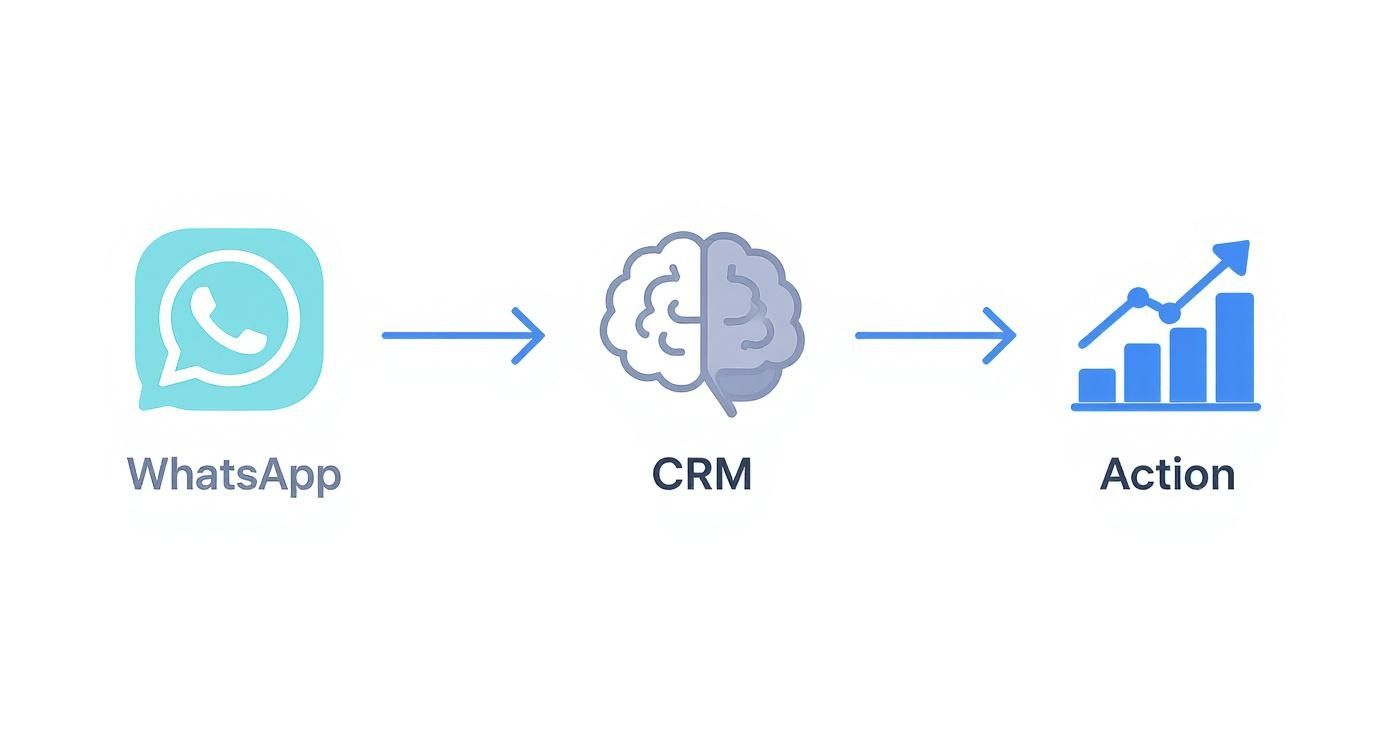
The key takeaway? WhatsApp remains the welcome mat for your business, but the CRM becomes the well-organised office where all the real work gets done.
Your Phased Migration Plan from WhatsApp to a CRM
Transitioning your business operations requires a clear, manageable plan. This table breaks down the journey into three distinct phases, helping you move from the reactive world of WhatsApp to a proactive, structured CRM environment without overwhelming your team or disrupting your customers.
| Phase | Key Actions | Success Metric |
|---|---|---|
| Phase 1: Foundation | Choose a CRM with robust WhatsApp integration and local payment support. Set up core accounts for your team. | The right CRM is selected and basic team profiles are created within the first week. |
| Phase 2: Staged Rollout | Start with the sales team, logging all new leads and chats in the CRM. Then, bring in the operations team for project management. Finally, connect invoicing. | 100% of new leads are captured in the CRM within the first month. All active projects are managed in the system by month two. |
| Phase 3: Adoption & Training | Migrate existing active customer data via spreadsheet import. Conduct hands-on training sessions focused on team-specific benefits (e.g., “no more lost leads”). | 90% of the team is actively using the CRM for daily tasks by the end of the first quarter. Customer data is fully centralised. |
By following these structured steps, you ensure a methodical and successful migration, turning a daunting task into a series of achievable milestones.
Phase 1: Find the Right Foundation
Your first step is the most critical: picking a CRM that actually gets how business is done in Africa. So many platforms are built for Western markets, saddled with complicated features and expensive per-user pricing that just don’t make sense here.
You need a tool that slots right into your existing workflow, especially with WhatsApp.
Look for a platform that delivers on these three non-negotiables:
- True WhatsApp Integration: The ability to pull entire conversations directly into a customer’s profile. This creates a single, unified timeline of every single interaction.
- All-in-One Functionality: A system that combines your sales pipeline, project management, and invoicing is a must. It saves you from the headache of juggling three or four disconnected apps.
- Local Payment Support: This is huge. Your CRM absolutely must support pan-African payment methods like mobile money and M-PESA. It’s the key to getting paid faster and making it dead simple for your customers.
Choosing the right system from the get-go saves you the pain of having to do this all over again in a year. This is the foundation for a more organised, efficient, and professional business.
Phase 2: Implement in Stages
Trying to change everything overnight is a recipe for disaster. It sends your team into a panic, scrambles your processes, and cranks up the risk of costly mistakes. A phased implementation is the only way to go.
Start with the part of your business that’s causing the most headaches. For most of us, that’s the sales process.
- Start with Your Sales Team: Get your sales reps to log all new leads and their WhatsApp chats in the CRM. Immediately, you start building a central database and stop valuable opportunities from slipping through the cracks.
- Move to Project Management: Once the sales team has found its footing, bring in your delivery or operations team. They can start managing tasks, tracking project progress, and communicating with clients from the same system. No more “Did you see my message?”
- Integrate Invoicing and Payments: The final piece is connecting your money. Begin sending professional invoices straight from the CRM. Let clients pay you with one click using the local payment methods they prefer.
This step-by-step approach makes the change manageable. It lets your team build confidence with the new system one piece at a time.
Phase 3: Migrate Data and Train Your Team
With the system in place, it’s time to bring over your existing customer information. Don’t overthink it—this doesn’t have to be some massive, complex project. Focus on migrating active clients and recent leads first.
Most CRMs let you import data with a simple spreadsheet. You can quickly upload contact details and sales history to get a running start.
At the same time, you have to invest in training. Show your team why this shift is happening and how the new system will make their jobs easier, not harder. Focus on the real-world benefits: no more endless scrolling to find a client’s message, clear ownership of every task, and a complete picture of every customer relationship. You can learn more about building automated systems in our guide on the business that runs even when you’re offline.
By taking these pragmatic steps, you can successfully graduate from the chaos of running your business on WhatsApp. You’ll keep the direct, personal touch your customers value while building a robust, scalable, and professional operation that’s ready for serious growth.
6. Building a Scalable Future Beyond the Trap
Stepping out of The WhatsApp Trap isn’t just about plugging leaks in a sinking ship—it’s about building a vessel that can actually sail towards the horizon. It’s the difference between running on a treadmill and paving a highway. One keeps you busy; the other gets you somewhere.
The vision is simple: a business that runs like a well-oiled machine, looks professional to every client, and is primed for whatever opportunity comes next.
This shift completely changes the feel of your day-to-day operations. Imagine your team, no longer digging through endless chat logs for a single piece of information, but working together seamlessly. With a central hub for all client interactions, everyone has the complete customer story at their fingertips. This is how you deliver the kind of consistent, clued-in service that turns customers into lifelong fans. Good service stops being a happy accident and becomes the natural result of a solid process.
From Guesswork to Growth
Graduating from WhatsApp means you stop running your business on gut feelings and start making decisions with real data. Instead of wondering which leads are actually promising or which clients bring in the most value, you’ll have clear, visual reports showing you exactly what’s going on.
This clarity is what unlocks real, sustainable growth. You can finally get a proper look at your sales pipeline, track how profitable your projects are, and understand precisely where your money is coming from.
A CRM isn’t just another monthly expense. Think of it as a foundational investment in your company’s future—its stability, its professionalism, and its ability to grow. It’s the engine that will power your success long after these early growing pains are a distant memory.
When you can bring new team members on board and have them instantly up to speed on every single client relationship, that’s when you know you can expand without everything falling apart. This is how you build an operation that doesn’t rely on one person’s memory, but on a reliable process anyone can follow.
Your Final Call to Action
The journey out of the trap starts with one decision: to treat your business operations with the same seriousness you give your product or service. You’ve already recognised the limits of running a business on a chat app—the lost messages, the buried tasks, the constant disorganisation. Now, it’s time to move towards the solution.
Making the leap to an all-in-one platform is your commitment to building a resilient, professional, and scalable business. It’s the final, empowering step that turns all your hard work into a company that not only survives but thrives, ready to seize the massive opportunities ahead. Your future self will thank you for it.
7. Got Questions? We’ve Got Answers.
Making the leap from a tool you know inside-out like WhatsApp to a more organised business system is a big step. It’s natural to have questions. Here are some straight-talking answers to the worries we hear most from business owners pulling themselves out of The WhatsApp Trap.
Do I Have to Stop Using WhatsApp to Talk to Customers?
Not at all. In fact, you shouldn’t. Moving on from the WhatsApp trap isn’t about ditching the app; it’s about upgrading its job description. WhatsApp is still your frontline—it’s fast, personal, and exactly how your clients want to reach you.
The big difference is that a proper all-in-one system works with WhatsApp. It plugs right in and automatically saves all those chats into one central place. You get the best of both worlds: the quick, friendly conversations your customers love, but now every single interaction is logged, organised, and ready for action inside your business’s main brain. No more lost details.
Isn’t a CRM Too Complicated for a Small Business Like Mine?
That’s a fair question, and for a lot of older systems, the answer would be yes. Many traditional CRMs were built for massive companies with entire departments just to run the software. But that’s not the world we live in anymore.
Modern platforms are designed from the ground up for small and medium-sized businesses, especially in places like Egypt. They strip out all the confusing corporate nonsense and focus on what you actually need to run your business better:
- Simple Sales Pipelines: A clear, visual way to see where every deal is at. No data science degree required.
- Joined-up Task Management: To-do lists that are directly connected to specific clients and projects, so nothing gets missed.
- One-Click Invoicing: Dead-simple tools to create and send professional invoices that get you paid faster.
The goal isn’t to add layers of complexity. It’s to bring just enough structure to make your day-to-day operations simpler, not more of a headache.
How Do I Get My Team to Actually Use a New System?
Getting the team on board is always the biggest hurdle. The secret isn’t just showing them a new tool; it’s showing them how it makes their own job less frustrating.
For your sales guys, it means they’ll never lose a lead in a messy chat history again. For your project managers, it means they can see exactly what needs to be done without chasing five different people on WhatsApp. You have to position the new system as the cure for their biggest daily headaches, not just another piece of software to learn. When they see it solves a real problem for them, they’ll jump on board.
The fastest way to get people to use a new tool is to make it solve a problem they already have. A good CRM solves the problem of chaos. It gives your team back the time they waste every single day just trying to find information.
What’s This Going to Cost Me?
The cost can be a major worry, but the old way of charging hefty “per-user” fees every month is on its way out. Many modern platforms now offer completely free plans for smaller teams. This lets you get everything set up and running smoothly without spending a single shilling.
You can prove to yourself that the system works and is saving you money before you ever have to pay for it. As you grow, you can switch to affordable plans that grow with you. The real question isn’t what a CRM costs—it’s how much money the chaos of the WhatsApp trap is already costing you in lost deals and wasted time.
Ready to escape the chaos and build a more professional, scalable business? CRM Africa offers an all-in-one platform with CRM, project management, and invoicing—completely free for teams of up to 10. Centralise your operations, get paid faster, and give your customers the organised experience they deserve. Get started for free today at https://crm.africa.