
Let’s be honest. For too many businesses in Nigeria, managing sales, customer data, and payments feels like trying to conduct an orchestra where every musician is playing a different song. It’s chaos. You’ve got your customer info in one place, your invoices in another, and your payment confirmations floating around in emails or WhatsApp.
A CRM with Paystack integration cuts through that noise. It’s not just about connecting two apps; it’s about merging your entire customer relationship workflow with Nigeria’s top payment gateway. This creates a single, streamlined system that handles the entire customer journey, from first contact to final payment.
1. Why Connecting Your CRM with Paystack Is a Game Changer

Think about the typical online store based in Lagos. The process is painfully manual. The team drafts an invoice, emails a payment link, and then plays the waiting game. Once the payment alert finally comes through, someone has to stop what they’re doing, find the customer’s record in the CRM, and manually mark the invoice as paid.
This isn’t just slow—it’s a recipe for mistakes and a frustrating experience for both your team and your customers.
This is exactly the headache a CRM with Paystack integration eliminates. It turns those clunky, manual steps into a smooth, automated process that actually generates revenue. Instead of your team chasing payments and updating spreadsheets, the system does the heavy lifting for you.
To really understand the shift, let’s look at the common pain points and how this integration solves them head-on.
Key Advantages of a CRM and Paystack Integration
| Common Business Challenge | How a CRM with Paystack Solves It |
|---|---|
| Chasing Late Payments | Send invoices with one-click payment links directly from the CRM. Customers can pay instantly, and the system automatically sends reminders. |
| Manual Data Entry | Once a payment is made, the transaction is automatically recorded and reconciled against the customer’s profile and invoice. No more “man-marking.” |
| Disconnected Customer View | See a customer’s entire history—every purchase, every interaction, every outstanding invoice—all in one place. No more guesswork. |
| Slow Cash Flow | Payments are processed faster, and automatic reconciliation means the money reflects in your books immediately. This dramatically improves your cash flow. |
Essentially, you move from a reactive, manual system to a proactive, automated one. This frees up your team to focus on what actually grows the business: building relationships and making sales.
Unify Your Customer and Payment Data
The real power here is creating a single source of truth. When a customer pays an invoice using a Paystack link generated from your CRM, that transaction data instantly syncs back to their profile.
Suddenly, you have a complete picture. This unified view gives you incredible insights, allowing you to see:
- A customer’s full purchase history at a glance.
- The real-time status of every single invoice, paid or pending.
- Which of your marketing efforts are actually bringing in the cash.
“In fintech, disputes are inevitable… Left unmanaged, disputes can lead to revenue loss, reputational damage, and regulatory penalties. But with the right systems in place, they become opportunities: to protect your bottom line, demonstrate operational maturity, and build long-term confidence.”
This point from Paystack’s own guide on handling disputes highlights why connected data is non-negotiable. When you have a clear, accurate transaction history tied directly to a customer record, you can resolve issues in minutes, not days, and keep your customers happy.
Drive Real Efficiency and Growth
This isn’t just about making life easier; it’s a strategic move for serious growth. By 2023, Paystack was already processing over 50% of all online payments in Nigeria, serving a massive network of over 60,000 businesses.
This isn’t just a vanity metric. This widespread adoption has allowed smart companies to sync their payment data directly into their CRMs, and the results speak for themselves. We’ve seen Nigerian SMEs report up to a 30% improvement in repeat business after putting these integrated workflows in place. Why? Because a smooth payment experience and personalised follow-up builds loyalty. You can read more about Paystack’s impact on Nigerian business growth.
2. What Your Paystack Integration Actually Does
Connecting Paystack to your CRM isn’t just a technical task you tick off a list. It’s about flipping a switch that immediately makes getting paid faster, easier, and a hell of a lot less work for you and your team.
This integration isn’t some background process; it’s an active tool designed to crush the friction in your sales cycle and kill off manual financial admin for good.
One-Click Invoices That Get Paid Faster
The most obvious win? Creating invoices with one-click payment links, right from your CRM.
Think about it. You’ve just closed a deal with a client in Abuja. Instead of jumping over to one app to build an invoice, then another to create a payment link, you do it all at once. A single click sends a professional invoice with an embedded Paystack link straight to your client’s email or SMS. Done.
Here’s a look at the Paystack dashboard, the command centre where businesses track all their incoming payments and customer data. This is the exact information that gets piped directly into your CRM.
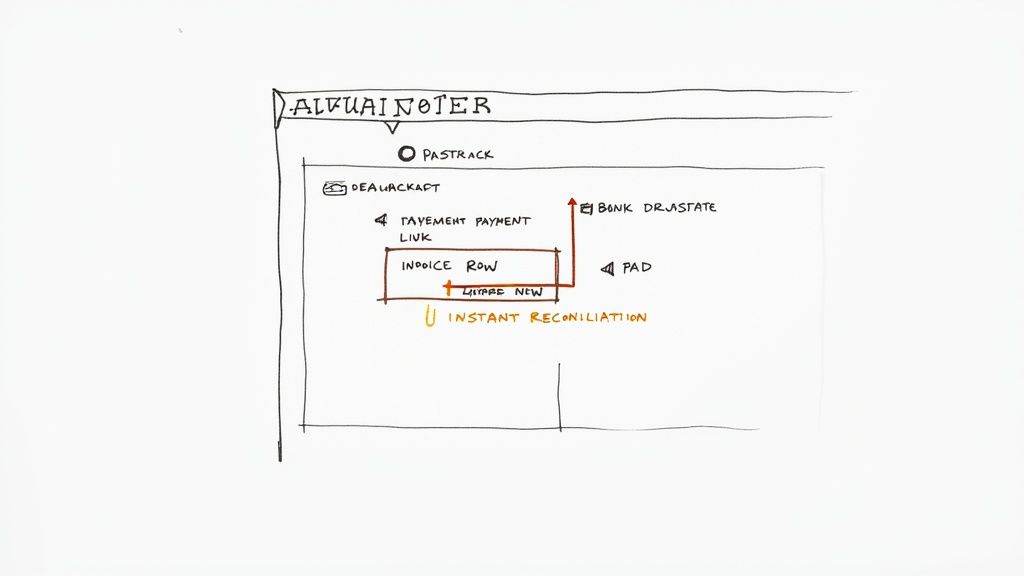
This clear overview of transactions and financial health is what makes the CRM integration so powerful—it brings this data right where your sales and support teams live.
Put Your Reconciliation on Autopilot
Now for the real magic. The moment a customer clicks ‘Pay’, automatic reconciliation kicks in and saves your finance team from hours of soul-crushing admin.
When that invoice gets paid, the integration instantly updates the customer’s record in your CRM. The invoice is marked as paid, their account balance is settled, and the transaction details are logged. All of it, automatically.
This is a complete game-changer. No more exporting bank statements and manually matching payments to invoices in your CRM. The system handles everything, ensuring your financial data is always accurate and live.
A frictionless payment experience is no longer a “nice-to-have”—it’s fundamental to keeping customers happy. When you automate reconciliation, you’re not just making your own life easier; you’re guaranteeing your customer data is a reliable source of truth for everyone in the business.
Imagine a digital marketing agency in Lagos. They can see exactly which clients have paid their monthly retainers without ever leaving their CRM dashboard. This frees up the accounts team to focus on growing the business, not chasing paperwork.
Accept Payments the Way Nigerians Actually Pay
Let’s be real: business in Nigeria isn’t just about credit cards. A powerful CRM with Paystack integration gets this. It’s built to handle the diverse mix of payment methods your customers use every single day.
The integration seamlessly processes payments from all the key channels:
- Bank Transfers: Still the king for many B2B and B2C transactions.
- Mobile Money: Absolutely essential for reaching customers everywhere.
- USSD: Lets customers pay easily, even without a stable internet connection.
- Card Payments: Of course, it covers all major local and international cards.
This isn’t just about convenience; it’s about survival. The Central Bank of Nigeria’s push for cashless policies has made this flexibility non-negotiable. In fact, Paystack’s own data revealed that bank transfers accounted for a massive 58% of all its transactions in 2023. This highlights just how critical it is for your CRM to capture this payment data to build a complete customer picture. You can dig deeper into fintech adoption trends in Nigeria to see where things are headed.
By integrating all these channels, you meet your customers on their terms, making it ridiculously easy for them to give you their money.
3. Integrating Paystack with Your CRM System
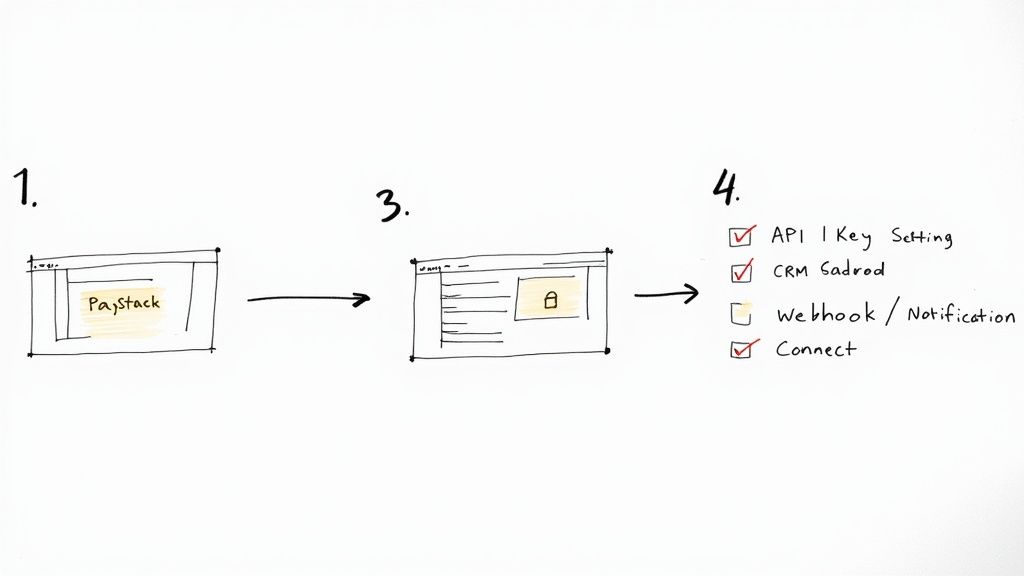
Let’s get one thing straight: connecting Paystack to your CRM is not the complicated, code-heavy task many business owners imagine it to be. You don’t need a developer on speed dial. The whole point is to put you in control, linking your customer data and your payment stream quickly and painlessly.
Before diving in, you just need two things ready. An active, verified Paystack account and a CRM, like CRM Africa, that has a direct integration with Paystack built-in. If you’ve got those, you’re good to go.
Locating Your Paystack API Keys
The magic that connects your CRM to Paystack relies on something called API keys. Think of them as a secure digital handshake—a unique password that lets the two systems talk to each other safely. Finding them is dead simple.
First, log into your Paystack dashboard. Head over to the “Settings” menu and find the section called “API Keys & Webhooks”. You’re looking for two specific pieces of text: your Live Secret Key and your Live Public Key.
Treat your Secret Key like your bank account password. Seriously. Never share it in an email or any public place. Your CRM will have a secure, designated field to input this key, keeping it encrypted and out of sight.
Once you find the keys, copy them somewhere safe for the next step. Now, it’s time to jump into your CRM.
Establishing the Connection in Your CRM
Inside your CRM’s settings, you’ll need to find the integrations area. This is usually under a tab named “Payment Gateways,” “Integrations,” or “Apps.” It’s designed to be easy to find. Once you’re there, just select Paystack from the list of options.
This is where the magic happens. Your CRM will show you two empty fields, one for the Live Secret Key and one for the Live Public Key. Carefully paste the keys you copied from Paystack into the right spots and hit save. That’s it. You’ve just authorised the connection. Your CRM can now create payment links and get updates on paid invoices directly from Paystack.
Finalising Your Setup for Success
With the technical bit done, there are a few final touches to make sure everything runs smoothly. This is about making the integration work for you.
- Switch on Payment Notifications: Go into your CRM settings and set up automated alerts. You want your team (or just yourself) to get a notification the second a Paystack invoice gets paid. It’s great for morale and keeps you on top of your cash flow.
- Update Your Invoice Templates: Make sure your invoice design clearly features a big “Pay with Paystack” button. You want to make it ridiculously easy for your clients to pay you. The fewer clicks, the faster you get paid.
- Run a Quick Test: This is non-negotiable. Create a small test invoice for N100 and pay it yourself through the new Paystack link. This little test run confirms the entire process is flawless—from sending the invoice to seeing the payment pop up as “Paid” in your CRM automatically.
Following these steps turns your CRM from a simple database into a powerful engine for automating payments and bringing all your crucial business data under one roof.
4. Real-World Scenarios for Nigerian SMEs
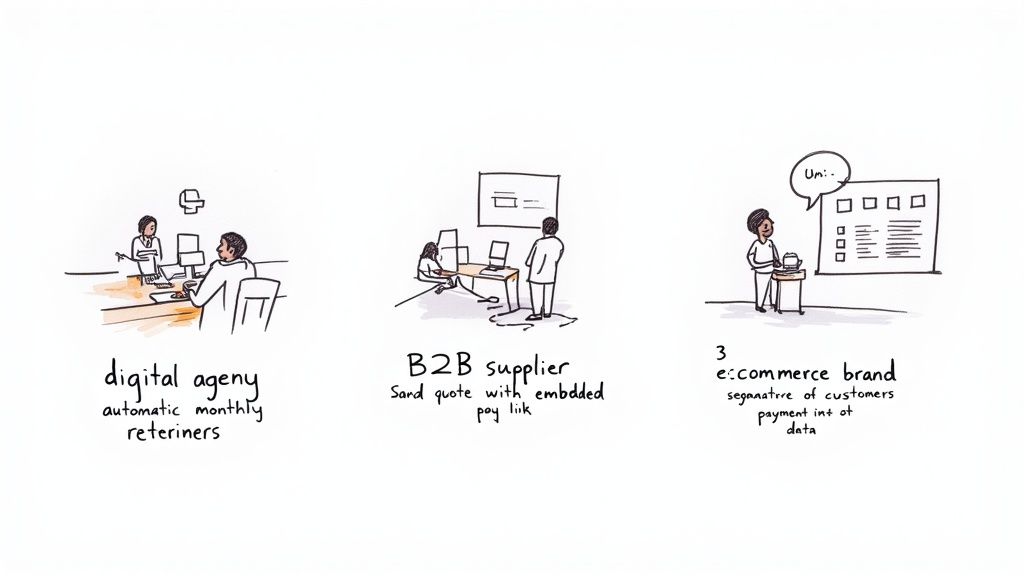
Theory is great, but seeing a CRM with Paystack in the wild is where it really clicks. Let’s get practical and look at how actual Nigerian businesses are using this setup to fix everyday headaches, slash admin time, and most importantly, get paid faster.
These aren’t just made-up stories; they’re the real, on-the-ground wins that SMEs across the country are scoring by finally connecting their sales and payment worlds.
Automating Retainers for a Digital Marketing Agency
Picture a busy digital marketing agency in Lagos. They’re juggling multiple clients on monthly retainers. Their old method? A chaotic mix of spreadsheets and manual follow-ups that always led to late payments and a serious cash flow problem.
- The Problem: The first week of every month was wasted manually creating and emailing invoices. They had no central system to see who had paid, which meant constantly digging through bank statements and updating a shared spreadsheet. A total mess.
- The Integrated Solution: By linking their CRM with Paystack, they put the entire recurring billing cycle on autopilot. Now, the CRM automatically generates and shoots out an invoice with a Paystack payment link to every client on the 25th of the month. No human intervention needed.
- The Tangible Result: Late payments have plummeted by over 40%. The system instantly flags any overdue invoices, and the team sees a live payment status for every client right inside their CRM dashboard. This frees them up to focus on client strategy, not chasing money.
Streamlining Quotes for a B2B Supplier
Think about a B2B supplier in Port Harcourt selling office equipment. Their process was clunky: send a PDF quote, wait for approval, and then send a separate payment link. That gap between approval and payment was a killer, slowing down the entire sales cycle.
A seamless workflow isn’t just about efficiency—it’s about professional presentation. Sending a quote that a client can approve and pay in a single motion removes friction and reinforces that your business is modern, reliable, and easy to work with.
This supplier integrated Paystack right into their CRM, and it completely changed their quoting game.
- The Problem: That two-step process—quote approval, then a separate payment link—was slow and created an unnecessary hurdle for the customer. It just felt awkward.
- The Integrated Solution: Now, their CRM generates quotes with a Paystack payment link baked right in. When a client gets the quote, they can approve it and pay on the same page, in one go.
- The Tangible Result: The time it takes to go from sending a quote to getting paid has been cut in half. The sales team can track which quotes have been viewed, approved, and paid, all from one place.
Powering Targeted Marketing for an E-commerce Brand
Finally, let’s look at an online fashion brand in Abuja. They were using Paystack to collect payments, which was great, but they weren’t using that goldmine of transaction data to bring customers back. Their marketing emails were generic, one-size-fits-all blasts.
This is where integrating payment data into the CRM unlocks a whole new level of marketing smarts. A 2023 study found that businesses leveraging Paystack’s API for CRM saw a 20% rise in customer satisfaction and a 25% increase in engagement. You can find more insights on how Paystack helps startups grow on africanexponent.com.
- The Problem: Everyone, from first-time shoppers to loyal fans, got the exact same marketing message. This led to low engagement and a ton of missed opportunities for repeat sales.
- The Integrated Solution: The brand’s CRM with Paystack integration now automatically segments customers based on their buying habits. The system knows who the high-spenders are, who bought just once, and who hasn’t been back in a while.
- The Tangible Result: They’ve switched to hyper-targeted campaigns. High-value customers get early access to new collections. First-time buyers automatically get a special discount code a week after their purchase. The impact on repeat business has been huge.
5. Taking Security and Compliance Seriously
Let’s be blunt: when you handle payments, you’re not just moving money. You’re handling your customers’ trust. Integrating a CRM with Paystack is built on a rock-solid security foundation, making sure every single transaction is buttoned up tight with industry-leading standards.
At the core of this is Paystack’s PCI-DSS Level 1 compliance. This isn’t just some fancy acronym; it’s the highest, most demanding level of certification in the entire global payments industry. It means a tough, independent auditor has gone through Paystack’s systems with a fine-toothed comb and verified they meet brutal security controls for handling cardholder data.
Understanding the Shared Security Model
It’s crucial to understand where the security responsibilities lie. It’s not all on you, and it’s not all on them. It’s a “shared security model,” and it’s smart because it lets each platform do what it does best.
- Paystack Secures the Payment: The moment a customer clicks your payment link, they’re whisked away to Paystack’s secure environment. Paystack takes over, managing the entire payment process—encrypting and protecting sensitive card details. That critical information never even touches your CRM or your servers.
- Your CRM Secures Customer Data: Your CRM provider, like CRM Africa, is responsible for protecting the relationship data you’ve gathered. This is your goldmine: contact info, purchase history, and all those conversation logs.
This separation is a massive security win. It slashes your compliance burden because you aren’t directly touching or storing raw payment card info, which is a huge security headache and risk.
By letting a PCI-compliant gateway like Paystack handle the heavy lifting of payment processing, you’re essentially outsourcing the most complicated part of payment security. This frees you up to focus on building great customer relationships, knowing their financial data is in safe hands.
Actionable Best Practices for Your Business
While Paystack locks down the payment side, there are still vital steps you need to take inside your CRM to protect financial information and keep your setup secure. The good news? You can implement these simple but powerful practices today.
First, lock down your data with role-based access control (RBAC) in your CRM. Not everyone on your team needs to see financial data. Be strict. Limit who can view transaction history and invoices to only your finance or management teams. No exceptions.
Second, get into the habit of regularly reviewing your integration logs. These logs are your audit trail, showing every interaction between your CRM and Paystack. A quick monthly check for any weird or unauthorised actions can help you spot a potential issue before it blows up into a real problem.
6. Paystack vs. Other Nigerian Payment Gateways: Who Wins for CRM?
When it comes to picking a payment gateway for your CRM in Nigeria, you’re not exactly starved for choice. While Paystack is a giant in the space, it’s smart to see how it stacks up against other heavyweights like Flutterwave and Remita before you commit.
This isn’t about declaring one platform the absolute “best.” It’s about understanding the practical differences that really matter when you’re trying to get your sales and payment systems talking to each other.
The Developer Experience: Why APIs Matter More Than You Think
Let’s be blunt: a payment gateway is only as good as its integration. This is where Paystack consistently punches above its weight. Its API documentation is legendary for being clean, straightforward, and incredibly well-supported by a massive developer community.
For any business using a platform like CRM Africa, this isn’t just tech jargon. It translates directly into a faster, more stable, and more powerful integration. Features get built quicker, and things are less likely to break.
Flutterwave also has a powerful API, no doubt. But developers often point to Paystack’s simplicity as a key advantage that cuts down on the time and headaches involved in getting a custom connection up and running smoothly.
A slick CRM integration lives or dies by the quality of the payment gateway’s API. Great documentation isn’t a “nice-to-have”; it directly impacts how fast you can automate your billing and get paid.
Let’s Talk Money: Fees and Pricing
For any SME, transaction fees are always front and centre. Nigeria’s top gateways are all competitive, but the devil is in the details of their pricing models.
Here’s a quick, high-level look at how they compare for businesses connecting them to a CRM.
Paystack vs. Alternatives for CRM Integration
| Feature | Paystack | Flutterwave | Remita |
|---|---|---|---|
| Local Transactions | 1.5% + NGN 100 | 1.4% (capped at NGN 2000) | 1.5% (capped at NGN 2500) |
| International Cards | 3.9% + NGN 100 | 3.8% | 3.5% (capped at NGN 20,000) |
| CRM Integration Quality | Excellent, well-documented | Strong, with broad reach | Varies, often requires more custom work |
So, what’s the final verdict?
Honestly, the best choice is the one that fits your specific business model. If your top priority is a headache-free, robust integration that just works out of the box, especially with a dedicated platform, then a CRM with Paystack is often the winning combination. The strength of its developer tools gives it a clear edge for businesses that can’t afford a clunky or unreliable payment workflow.
Got Questions? We’ve Got Answers.
As you get closer to connecting your CRM with Paystack, a few questions are bound to pop up. It’s a smart move to get these sorted before you dive in. Here are the straight-up answers to the most common queries we get from business owners just like you.
Can I Use Paystack with Any CRM?
The short answer? No. The longer, more useful answer is that while many CRMs claim to “integrate” with payment gateways, the reality on the ground can be messy.
You don’t want a clunky, third-party workaround. What you need is a deep, native integration built specifically for Paystack, which is exactly what you get with a platform like CRM Africa. This means features like one-click invoice payments and automatic reconciliation just work—no coding, no duct tape, no headaches.
Is This Integration Difficult to Set Up?
Not at all. Seriously, this is designed for business owners, not IT wizards.
As we touched on earlier, the whole process boils down to copying your API keys from your Paystack dashboard and pasting them into the right spot in your CRM’s payment settings. You can have the whole thing connected and ready to go in less than ten minutes. No code required.
The sign of a great integration is that it feels invisible. Connecting your payment gateway shouldn’t be a project; it should be a simple switch you flip to unlock more revenue and save time. It’s a core belief behind how platforms like Paystack are built.
How Quickly Do Payments Reflect in the CRM?
Almost instantly. The moment a customer pays your invoice through a Paystack link, the system fires off a notification straight to your CRM.
This isn’t a batch process that runs overnight. It’s real-time. The CRM immediately marks the invoice as “Paid,” logs the transaction, and updates the customer’s record. That manual lag you’re used to? Gone. You can see a bit more about how CRMs sync this kind of data in our guide.
Ready to stop chasing payments and start automating your cash flow? CRM Africa’s powerful, free-forever plan brings your sales, projects, and Paystack payments all under one roof. Get started with CRM Africa today.