It all boils down to timing and purpose. At its core, that’s the fundamental difference between an invoice and a receipt. Think of it this way: an invoice is a request for payment sent before a client pays you, while a receipt is proof of that payment, issued after the money hits your account. One says, “please pay me,” and the other says, “thank you for your payment.”
1. Understanding Invoice vs. Receipt: A Clear Comparison
For any small or medium-sized business in Africa, getting a firm grip on this distinction is non-negotiable for sound financial management. While both documents are part of the same transaction, they bookend the payment cycle. An invoice kicks things off, clearly stating what’s owed. A receipt wraps it all up, confirming the debt is settled.
Keeping these two separate is absolutely crucial. It’s how you track your revenue, manage your cash flow, and maintain crystal-clear, professional communication with your customers.
Let’s put this into a real-world context. Imagine a freelance graphic designer in Cairo finishes up a logo project. First, she sends an invoice that breaks down the design services, the final cost, and the due date. Once the client settles the bill, she then issues a receipt. This receipt acts as the client’s proof of purchase and becomes a vital record of income for the designer’s own books.
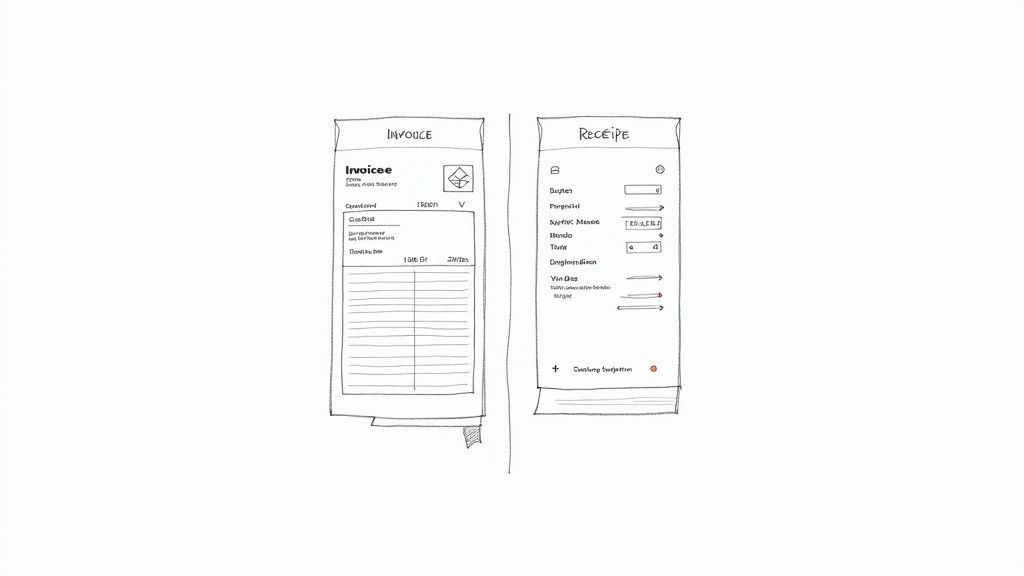
At a Glance: Key Differences Between an Invoice and a Receipt
To make it even clearer, let’s break down the core attributes side-by-side. Getting these points straight is the first step towards flawless bookkeeping and a healthy business.
| Attribute | Invoice | Receipt |
|---|---|---|
| Purpose | To request payment for goods or services | To confirm that payment has been received |
| Timing | Issued before payment is made | Issued after payment is received |
| Function | Tracks accounts receivable (money owed to you) | Records sales and confirms transaction completion |
| Call to Action | Asks the buyer to pay by a specific date | Acknowledges that the buyer has paid |
| Legal Status | A formal request, not proof of purchase | Legal proof of a completed purchase |
| For the Buyer | Details what they need to pay for | Serves as proof for returns, warranties, or expenses |
This table neatly sums up the essentials. Knowing when to use each document will keep your financial records clean and your customer relationships strong.
A common slip-up for new businesses is using these documents interchangeably. Remember: an invoice is an IOU from your client to you. A receipt is your official nod that the IOU has been paid in full. Getting this right from the start saves you from future payment disputes and makes tax time a whole lot simpler.
If you’re looking for a deeper dive, this resource does a great job breaking down the fundamental difference between an invoice and a receipt. And if you need to craft a professional bill for your own clients, our guide walks you through exactly what is an invoice and how to structure it perfectly for your business.
2. The Role of an Invoice in Your Business Workflow
Think of an invoice as more than just a bill. It’s a critical piece of your financial workflow, a formal request for payment that lays out the ground rules between you and your client before any money moves. Honestly, it’s your best tool for keeping your accounts receivable in check and your cash flow healthy.
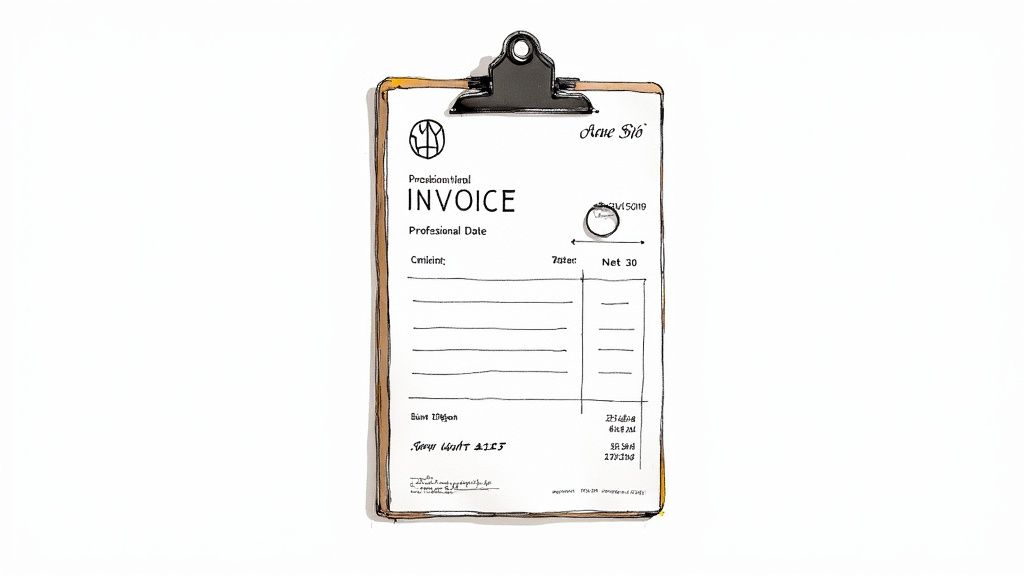
Unlike a simple sales slip, a professional invoice acts as a clear-cut agreement. It gives you a transparent, itemised record of the services you delivered or the products you sold, so there’s zero room for confusion. This kind of clarity is what builds trust and keeps client relationships professional—everyone knows exactly what was done and what it costs.
Essential Components of a Professional Invoice
For an invoice to do its job, it needs to have specific, standardised information. If you miss any of these details, you’re just asking for payment delays, confusion, or even legal headaches later. A proper invoice turns a casual “please pay me” into an official business document.
Every professional invoice you send must include these key elements:
- A Unique Invoice Number: This is non-negotiable for tracking payments and keeping your books organised. A simple sequential system stops duplicates and makes it easy to find any transaction.
- Issue and Due Dates: The issue date shows when you sent the bill, and the due date makes your payment deadline crystal clear.
- Detailed Itemisation: Break down every product or service. Include quantities, descriptions, and the price for each line item. This transparency is what justifies the total amount you’re asking for.
- Total Amount Due: The final figure should be impossible to miss. Make sure it includes any taxes like VAT or discounts you’ve applied.
- Payment Terms: Be specific. Use terms like “Net 30” (payment due in 30 days) or “Due Upon Receipt.” You can even add a note about late payment penalties to encourage promptness.
- Business and Client Details: You need the full names, addresses, and contact info for both your business and your client. This ensures the document is legally sound and gets to the right person.
- Payment Instructions: Tell them exactly how to pay. Provide your bank account details, mobile money numbers, or a link to an online payment gateway.
An invoice is essentially a short-term, interest-free credit agreement you extend to your client. It signals that you have delivered value and now expect payment according to the agreed-upon terms, making it a cornerstone of business-to-business (B2B) transactions.
Invoicing in the Modern Business Environment
How we handle invoicing has changed massively. Paper invoices haven’t disappeared, but digital invoicing is the new normal for anyone who values speed and efficiency. The global push towards digital financial records is impossible to ignore. For example, the e-invoicing market in Egypt hit USD 55.61 million and is expected to climb to USD 224.47 million by 2033—a clear sign of the digital shift in our region.
Going digital makes tracking everything so much simpler, cuts down on admin work, and gets you paid faster. It’s also important for businesses to understand the different documents used in more complex sales. For those situations, knowing the role of a proforma invoice can be a huge help. You can check out our detailed guide on using a sample of a proforma invoice to see how it fits into business operations.
At the end of the day, getting your invoicing process right is fundamental to your financial health. It’s what allows you to forecast revenue accurately, manage what you’re owed, and keep a clean, auditable record of every transaction.
3. Why a Receipt Is Essential for Both Buyer and Seller
Once an invoice gets paid, the deal isn’t really done until a receipt is issued. Think of this document as the final handshake that wraps everything up, serving as the official proof of purchase. An invoice is a request for payment; a receipt is the confirmation that settles the transaction once and for all.
A receipt officially closes the loop that the invoice opened. It’s a formal acknowledgement that the buyer has held up their end of the bargain and you’ve received the money you were owed. This simple step is vital for keeping financial records clean and transparent for everyone involved.
Critical Information Every Receipt Must Contain
For a receipt to be valid and truly useful, it needs to have specific details that tell the full story of the completed sale. It’s the transaction’s final summary, leaving zero doubt about what was paid for, when, and how. Getting this right is a big part of why understanding the difference between an invoice and receipt is so critical for any business.
A professional receipt should always include:
- The Amount Paid: The single most important detail, showing the exact sum of money that changed hands.
- Payment Date: The specific date the payment was made is crucial for accurate bookkeeping.
- Method of Payment: Was it cash, a card, a bank transfer, or mobile money like M-PESA? This detail makes reconciling your accounts much easier.
- Description of Purchase: A clear, itemised list of the goods or services provided, which should match the original invoice.
- Business and Customer Details: The names of both your business and the buyer, officially linking both parties to the finished transaction.
A receipt acts as an undeniable record that a financial obligation has been settled. For the seller, it moves an item from ‘accounts receivable’ to ‘revenue earned’. For the buyer, it transforms a ‘bill to be paid’ into a ‘documented expense’ or ‘asset owned’.
Why Receipts Matter to Your Customers
From your customer’s point of view, a receipt is much more than just a piece of paper or a digital file. It’s their go-to tool for anything that happens after the sale and serves a few functions they can’t do without. If they don’t have it, they’re often left with no options if something goes wrong.
For a buyer, a receipt is their ticket for:
- Returns and Exchanges: Pretty much every retailer requires proof of purchase to process a return or swap out a faulty product.
- Warranty Claims: To make a claim for a repair or replacement under warranty, manufacturers need the receipt to verify the purchase date and ownership.
- Expense Reimbursements: Anyone making purchases for their company needs to submit receipts to get their money back.
In short, the receipt empowers your customer. It gives them security, confirms their ownership, and builds trust. When customers feel confident that their purchase is officially documented and protected, they’re more likely to come back.
The Seller’s Stake in Proper Receipting
For your business, issuing receipts isn’t just good customer service—it’s a cornerstone of solid financial management. These documents are the bedrock of your sales records, giving you the proof you need to keep your accounts accurate and compliant.
Getting your receipt process right is crucial for:
- Verifying Sales: Receipts are the source documents for recording your sales figures, forming the foundation of your income statements.
- Accurate Bookkeeping: They let you match incoming payments to the right invoices, making sure your books are balanced and up-to-date.
- Account Reconciliation: When you’re checking your bank statements or mobile money accounts, receipts confirm which deposits belong to which sales.
The move to e-receipts is making this process a whole lot easier. Digital receipts cut down on paper waste, are simpler for customers to keep, and make your own record-keeping far more efficient. Automated systems can instantly generate and email a receipt the moment a payment comes through, ensuring no transaction goes undocumented and your financial data stays pristine.
4. Navigating Tax and Legal Requirements
When you’re running a business, it’s easy to think of invoices and receipts as just part of the daily paperwork. But when it comes to the law and taxes, these two documents are worlds apart. Tax authorities look at them for completely different reasons, and understanding why is crucial for staying compliant and avoiding some very costly headaches.
Think of an invoice as your primary tool for backing up the revenue you declare. It’s the official document that justifies the income you report. When you send an invoice, you’re creating a record of money owed to your business, which is the foundation for calculating your revenue and any sales taxes you need to pay, like Value Added Tax (VAT).
A receipt, on the other hand, is the final word. It’s the definitive proof that a transaction is complete and those taxes have been paid. It confirms the money has moved from your accounts receivable to your earned income, closing the loop on the sale.
The Legal Standing of Each Document
From a legal perspective, an invoice and a receipt don’t carry the same weight. An invoice is a formal request for payment that lays out the terms of a sale. It can definitely be used as evidence if you end up in a dispute over non-payment, but on its own, it doesn’t prove the deal was finalised.
A receipt, however, is your legally recognised confirmation of payment. It’s undeniable proof that goods have changed hands or a service has been paid for. This is precisely why receipts are so important for handling disputes, processing returns, and especially for validating your expenses during a tax audit.
Here’s how tax auditors see it: invoices show what you should have collected in revenue and taxes. Receipts prove what you actually collected. Any gap between the two is a huge red flag that will almost certainly trigger a deeper dive into your books.
Government Mandates and Digital Compliance
Around the world, tax authorities are tightening their grip on financial reporting to improve collections and clamp down on fraud. This has sparked a major push toward digital documentation, making meticulous record-keeping more important than ever. In this new environment, the difference between invoice and receipt becomes even more critical.
Governments are increasingly requiring digital financial records. For instance, the Egyptian Tax Authority (ETA) now mandates that businesses issue electronic receipts (e-receipts) for all business-to-consumer (B2C) sales. This move really highlights the legal importance of accurate, post-payment documents. You can read more about how Egypt is analysing billions of e-invoices and receipts to boost its economy on Daily News Egypt.
This shift means that failing to issue a proper receipt isn’t just bad practice anymore—it can be a direct violation of tax law, opening you up to serious fines.
Consequences of Poor Record-Keeping
Not managing your invoices and receipts properly can land your SME in hot water. The fallout isn’t just about administrative headaches; it can hit you right in the wallet.
Here’s what you’re risking:
- Tax Penalties and Fines: If you can’t produce the right paperwork during an audit, you could be facing penalties for under-reported income or uncollected taxes.
- Complicated Audits: Missing or disorganised records make tax audits longer, more stressful, and more expensive. Auditors get suspicious when they can’t easily trace a transaction from the initial invoice to the final receipt.
- Legal Disputes: Without a clear receipt, a customer could falsely claim you never delivered a product or service they paid for. On the flip side, without a solid invoice, it’s tough to chase down a client who hasn’t paid you.
- Inaccurate Financial Reporting: Confusing these documents gives you a distorted view of your own cash flow and profitability, making it nearly impossible to make smart business decisions.
At the end of the day, keeping separate, accurate records for invoices and receipts is non-negotiable. It’s what protects you from penalties, makes audits less painful, and gives you the clear, verifiable paper trail you need to run your business professionally and transparently.
5. Real World Examples for Your SME
Theory is great, but nothing beats seeing how invoices and receipts work in the real world. Let’s walk through a few everyday scenarios for small and medium-sized businesses across Africa. This will make the distinction crystal clear.
This workflow shows the journey of a transaction, from the moment you issue an invoice to its final place in your official records.
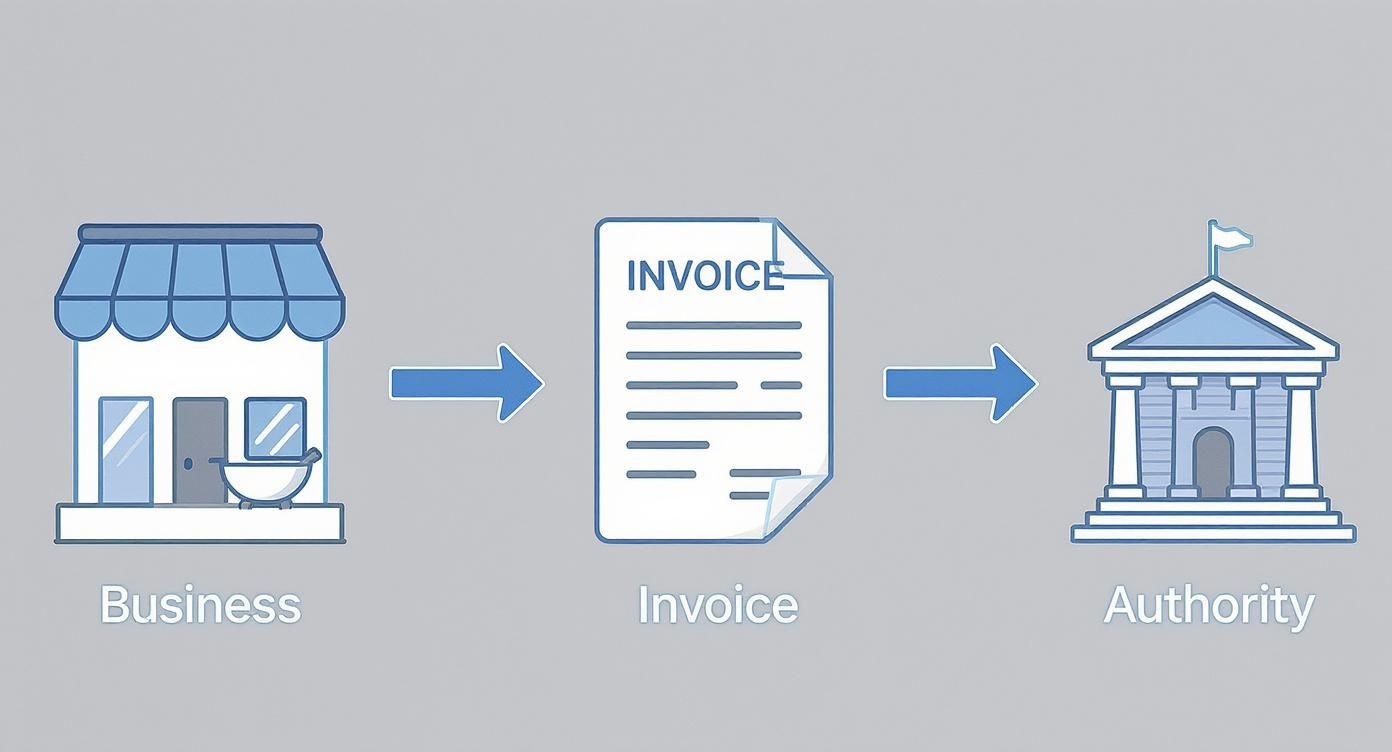
As you can see, the invoice isn’t just a request for payment; it’s a critical document that starts with your business and ends up as part of your tax records. It’s proof.
Scenario 1: A Freelance Consultant
Picture a marketing consultant in Lagos. She’s just wrapped up a three-month social media project for a new client. The work is done, and it’s time to get paid.
- Step 1: The Invoice. She creates a digital invoice. It includes her business details, the client’s info, a unique invoice number, and a “Net 30” payment term. It clearly itemises her services—”Social Media Strategy Development” and “Monthly Content Calendars”—along with the agreed fees. She then emails this directly to the client’s accounts team.
- Step 2: The Receipt. Two weeks later, the client pays the full amount via bank transfer. As soon as the funds land in her account, she creates a receipt. This document confirms the total amount paid, the date, and the payment method. She sends it to the client, officially closing out the transaction. Simple.
Scenario 2: A Retail Store in Nairobi
Now, let’s think about a small clothing boutique in Nairobi, where things move much faster. A customer comes in, picks out a few items, and heads to the counter.
- Step 1: No Invoice Needed. In a point-of-sale transaction like this, there’s no invoice. The customer is paying immediately, so there’s no debt to track or formal payment to request.
- Step 2: The Instant Receipt. The customer pays with M-PESA. The payment is instant. The shop’s point-of-sale system generates a receipt on the spot. It lists the clothes bought, shows the total paid, and confirms the M-PESA payment details. This receipt is the customer’s proof of purchase, which they’ll need if they want to return anything.
In direct retail, the process is compressed. The request for payment is verbal at the till, and the receipt is the only document produced. It’s the immediate proof that the sale is done and dusted.
Scenario 3: A Subscription Software Service
Finally, imagine a SaaS (Software-as-a-Service) company in Cape Town that provides monthly accounting software to other businesses. Their entire billing process is automated.
- Step 1: The Automated Invoice. On the first of every month, the system automatically emails an invoice to each subscriber. It details the upcoming month’s subscription plan, the fee, and notes that payment will be debited from the card on file.
- Step 2: The Automated Receipt. A few days later, the payment goes through successfully. This triggers the system to automatically generate and email a receipt. This e-receipt confirms the payment, shows the billing period it covers, and acts as a record for the client’s own expense tracking. No manual work needed.
Comparing the Scenarios
| Scenario | Invoice Role | Receipt Role | Key Takeaway |
|---|---|---|---|
| Freelancer | Essential. A formal request for payment after work is complete. | Essential. Proof of payment that closes the books on that transaction. | Critical for B2B services with credit terms. |
| Retail Store | Not Used. Payment is immediate at the point of sale. | Essential. The primary document, serving as instant proof of purchase. | Invoices are redundant for instant, in-person sales. |
| SaaS Business | Essential. An automated notice of an upcoming charge. | Essential. An automated confirmation that the subscription fee was paid. | Automation is the engine for recurring revenue models. |
These examples show that while both documents are vital for good financial hygiene, their use depends entirely on how you transact. A consultant relies on invoices to manage cash flow, while a shop owner deals almost exclusively in receipts. Getting this right from the start means your books are clean, your customers are happy, and your business runs smoothly. If you’re looking for more details, you can find a solid overview on the difference between invoices and receipts on helpersfinance.hu.
6. Putting Your Financial Documents on Autopilot
Let’s be honest, manually creating, sending, and then chasing every single invoice and receipt is a massive time sink for any business owner. It’s not just tedious admin work; it’s a breeding ground for human error. A simple typo can lead to delayed payments, messy records, and a completely warped view of your cash flow.
Thankfully, you don’t have to live with that headache. Modern business software can take this entire workflow off your plate. By automating how you handle financial documents, you get back precious hours while adding a layer of professionalism and accuracy to your business. For any SME serious about growth, this isn’t a luxury—it’s essential.
From Quote to Paid Invoice Without Lifting a Finger
The magic of automation starts long before you ask for payment. With platforms like CRM Africa, the entire sales and billing process becomes one connected flow. It kicks off when a potential client says “yes” to your quote. With a single click, that quote transforms into a professional, branded invoice. No more double-data entry, which means far fewer chances for mistakes to creep in.
Once it’s ready, the system can automatically email the invoice to your client. This gets the payment clock ticking immediately, without you or your team having to do a thing. It’s a perfect example of how to handle the difference between invoice and receipt in a modern workflow; the system transitions from one stage to the next flawlessly.
Instant Receipts and Stress-Free Reconciliation
This is where automation really shows its power. When a client pays an invoice, especially through integrated gateways like Paystack, Flutterwave, or mobile money, things get interesting. For businesses across Africa, this is a total game-changer. The system immediately registers the successful transaction.
That single payment triggers two critical actions, instantly:
- A receipt is created on the spot, confirming payment has been received.
- That receipt is automatically emailed to your client, giving them the proof of purchase they need.
Automation is the bridge between issuing an invoice and confirming payment. It ensures that the moment an invoice is paid, a receipt is generated and delivered, closing the loop perfectly, every single time.
Think about what this eliminates: no more checking your bank account multiple times a day, trying to match payments to the right invoices, and then manually creating and sending out receipts. The system does the heavy lifting, marking the invoice as paid and updating your financial records in real-time. If you’re looking for these kinds of powerful tools, checking out the best invoice management software for small business can give you a better idea of what’s out there.
The benefits are clear. You drastically cut down on admin work, payments come in faster, and you always have an accurate, up-to-the-minute picture of your company’s financial health. This frees you up to do what you do best—grow your business. To see how this can work for you, it’s worth exploring the benefits of using free invoicing software for your business.
7. Frequently Asked Questions
Getting the hang of financial documents can feel like learning a new language. Let’s clear up some of the most common questions business owners have about invoices and receipts.
Can an Invoice Be Used as a Receipt?
In short, no. Think of an invoice as an “IOU” from your client—it’s a formal request for payment, detailing what they owe you. A receipt, on the other hand, is the “thank you” that confirms the debt is settled.
While some businesses might stamp an invoice as “Paid” and hand it back, that’s not really best practice. For clean, professional bookkeeping that keeps everyone on the same page, you should always issue a separate, dedicated receipt once the payment comes through. It eliminates any potential confusion down the line. As the experts at Docuclipper note, a proper receipt is essential for valid proof of purchase.
How Long Should a Business Keep Invoices and Receipts?
A good rule of thumb is to hold onto all your financial records—invoices and receipts included—for about five to seven years. This isn’t just about being organised.
These documents are your lifeline during a tax audit, providing the evidence needed to back up your numbers. They’re also crucial for tracking your business’s financial health over time and can be your best defence if a payment dispute ever pops up with a customer.
A classic mistake is tossing receipts but keeping invoices. You need both to tell the full story of a transaction. Tax auditors will want to see the entire paper trail to verify your income and expenses.
Is an Invoice Always Necessary Before a Receipt?
Not at all. It really depends on when you get paid. For immediate, on-the-spot transactions—like selling goods at a market stall or serving a coffee—there’s no need for an invoice. The customer pays, and you issue a receipt straight away. Simple.
Invoices come into play when payment is delayed. This is common in business-to-business (B2B) sales, freelance projects, or for services billed on a recurring basis, like a monthly consulting retainer. In these cases, the invoice starts the payment clock ticking.
Juggling all this paperwork by hand is a massive time sink. CRM Africa takes the entire process off your plate, from creating a sharp-looking invoice to automatically sending a receipt the moment a payment hits your M-PESA, Paystack, or Flutterwave account. Get your finances in order and get paid faster. Check it out at https://crm.africa.