In a world obsessed with data, it's easy to get lost in a sea of numbers. We chase metrics that look good on a report but do little for the actual health of our business. Key Success Indicators (KSIs) offer a lifeline, shifting our focus from short-term activity to the outcomes that build long-term, sustainable growth.
Moving Beyond Metrics That Don't Matter
Too many businesses fall into the trap of measuring activity instead of impact. We celebrate clicks, page views, and new followers, assuming those numbers automatically translate to success. While they’re easy to count, they rarely tell you the whole story.
Think of it like this: a typical Key Performance Indicator (KPI) is like your car's speedometer. It tells you how fast you're going right now. A Key Success Indicator (KSI), on the other hand, is the engine warning light. It alerts you to underlying problems that could stop you from ever reaching your destination.
Shifting Focus From Activity to Impact
Relying only on surface-level data can steer your strategy in the wrong direction. A huge spike in website traffic is exciting, but what if those visitors are the wrong audience and never become customers? A high number of sales calls might look productive, but what if your aggressive tactics are causing customer satisfaction to nosedive?
Key Success Indicators force you to look deeper. They push you to ask the tough questions about the long-term health of your business by measuring things like brand reputation, customer loyalty, and innovation—the real fuel for lasting success (Kaplan & Norton, 1992).
This guide will walk you through how to pinpoint and track the metrics that genuinely matter. To dig deeper into moving beyond superficial data and focusing on what drives real value, check out these strategies for improving marketing ROI.
Adopting a KSI mindset isn't just about new metrics; it's a fundamental shift in thinking. It’s moving from asking, "How much did we do?" to "What was the lasting result of our efforts?" Ultimately, it's about making sure your engine is sound for the long journey ahead, building a more resilient and prosperous business on a foundation of real strength, not just fleeting numbers.
KPIs vs KSIs: What You Really Need to Know
While they sound like corporate jargon twins, Key Performance Indicators (KPIs) and Key Success Indicators (KSIs) actually do very different jobs. Understanding the difference is critical for building a business strategy that leads to lasting success, not just a few good quarters.
Think of KPIs as the how and the how much. They’re the hard numbers, the operational metrics that track your performance against specific targets. For example, learning how to measure Key Performance Indicators for a clothing boutique means digging into concrete figures like daily sales, website conversion rates, or how quickly your inventory turns over. These are tactical metrics that give you immediate feedback.
KSIs, on the other hand, are all about the strategic why. They are the bigger-picture, often qualitative, measures that tell you about the overall health and long-term potential of your business. A KSI might be something like customer loyalty, your brand’s reputation, or the strength of your company culture. These are tougher to stick a number on, but they're the real engines of sustainable growth.
The Core Difference In Focus
KPIs are fundamentally backward-looking. They report on what’s already happened. When your sales team hits their KPI for "number of deals closed," it’s a report card on their past performance. This is incredibly useful for fine-tuning your processes and hitting your immediate targets.
KSIs are forward-looking; they give you a glimpse into your potential for future success. An indicator like an "employee engagement score" isn't just about how happy your team is today. It's a powerful predictor of future innovation, productivity, and whether your top talent will stick around (Harter, Schmidt, & Hayes, 2002).
So, while a KPI tells you if you hit your monthly target, a KSI tells you if you’ll still be in business to set targets in five years.
This image sums it up nicely. Some metrics are like a speedometer, showing you how fast you're going right now. KSIs are more like the engine warning light—they alert you to deeper issues that could stop you from ever reaching your destination.
To put the main differences side-by-side, here’s a quick breakdown that helps clarify when to use each.
KSI vs KPI: A Quick Comparison
| Attribute | Key Success Indicator (KSI) | Key Performance Indicator (KPI) |
|---|---|---|
| Focus | Strategic & long-term health | Tactical & operational performance |
| Nature | Often qualitative, holistic | Always quantitative, specific |
| Time Horizon | Forward-looking, predictive | Backward-looking, reflective |
| Purpose | Guides the "why" | Measures the "how much" |
| Example | Customer loyalty, Brand reputation | Monthly sales, Website traffic |
This table shows that while both are essential, they answer very different questions about your business. One steers the ship, the other measures the speed of the engines.
An over-reliance on KPIs can lead to short-sighted decisions, where teams chase numbers at the expense of customer relationships or long-term brand value (Marr, 2012). A study by the KPI Institute found that while 68% of companies reported improved performance with KPIs, the real challenge lies in ensuring those metrics align with a healthy, long-term strategy (The KPI Institute, 2020).
Ultimately, you need a balanced approach. KPIs are essential for managing your day-to-day operations effectively. But they must be guided by your overarching key success indicators to ensure that every small action contributes to your bigger vision and helps you build a resilient, thriving business.
How to Define Your Own Key Success Indicators
Alright, let's get practical. Moving from theory to action means you need a solid framework. Defining your own key success indicators isn't about plucking a few metrics off a list you found online; it’s about carefully building a measurement system that genuinely reflects your business's unique vision and where you want to be in the long run.
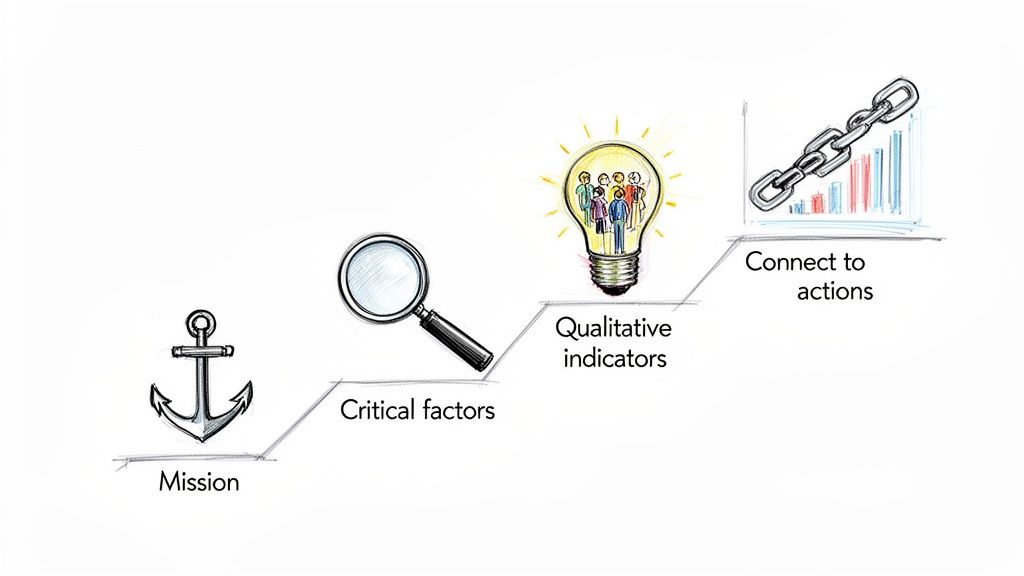
This process makes sure your KSIs are deeply rooted in what makes your business viable, not just what keeps it busy. The most powerful indicators are always tailored to your specific industry, your strategic goals, and the market realities you face every day.
Anchor Your Metrics in Your Mission
First things first: go back to your core mission. Why does your business even exist? What's the fundamental problem you're solving for your customers? Every single KSI you create must have a direct, unbreakable link back to this purpose.
For instance, if your mission is to be the most trusted IT partner for SMEs in Kenya, your KSIs need to reflect that trust and partnership. You'll want to think less about “number of new clients” and more about things like “client project success rate” or “long-term client retention.”
A clear mission acts as your North Star. When you anchor your key success indicators to it, you ensure that every part of your business is pulling in the same strategic direction, creating alignment and purpose (Collins & Porras, 1996).
This alignment stops you from chasing vanity metrics that might look impressive on a dashboard but do absolutely nothing to move your real vision forward. It keeps your eyes on the prize: building lasting value.
Pinpoint Critical Success Factors
With your mission as your guide, it’s time to identify the handful of factors that are absolutely critical for your long-term survival and growth. Think of these as the pillars holding up your entire business. Ask yourself this gut-check question: "If we failed in this one area, would the whole business be at risk?"
These factors often fall into a few key categories:
- Customer Relationships: Is retaining and delighting your existing customers essential? Understanding that your customer data is worth more than your equipment is the first step towards prioritising this factor.
- Team & Culture: Does your success hinge on a highly skilled, motivated, and stable team?
- Innovation & Market Position: Do you have to constantly innovate just to stay ahead of the competition?
- Operational Excellence: Is flawless service delivery or product quality completely non-negotiable for you?
Brainstorming these factors, a concept popularized by John F. Rockart (1979) as "Critical Success Factors," helps you get past generic business metrics and focus on the qualitative indicators that truly define what success looks like for you. From there, you can connect these big-picture concepts to tangible, everyday business activities and build a measurement system that actually reflects your journey.
Practical KSIs for Emerging Markets
When we talk about key success indicators, it’s easy to get caught up in generic, global benchmarks. But for businesses in emerging economies like South Africa, that’s a recipe for chasing the wrong goals. Here, where market conditions can shift on a dime and competition is relentless, the most powerful KSIs aren’t about explosive, short-term growth. They’re grounded in resilience, stability, and making a real impact on the community.
For many local businesses, the true measure of success isn't a vanity metric like social media followers. It's the ability to build something solid in a tough environment. This means we need to shift our focus from what looks impressive to what actually builds a business that lasts.
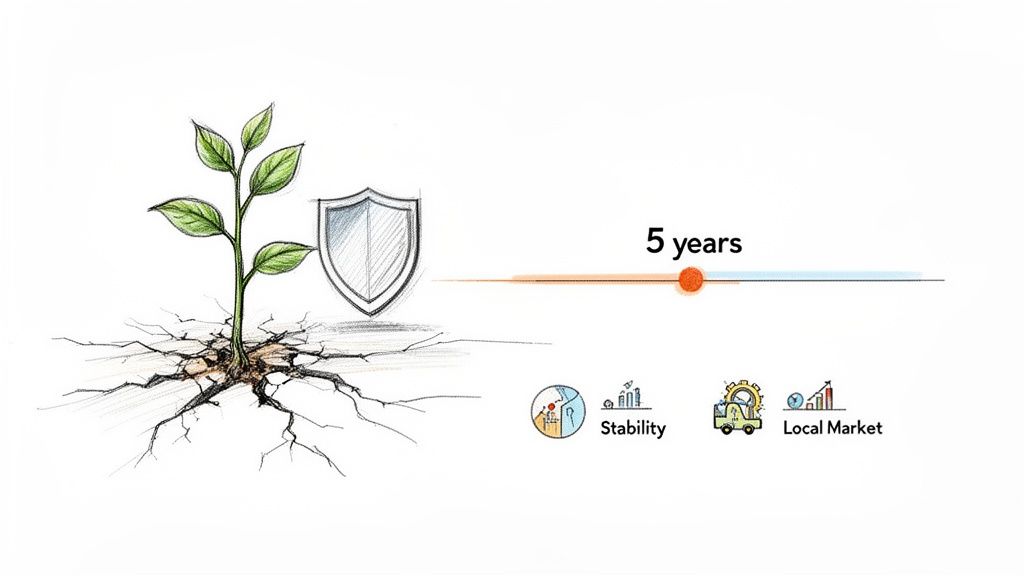
Business Survival as a Core KSI
In South Africa, one of the most powerful KSIs for a small or medium enterprise (SME) is simply this: survival. Research into local SMMEs is sobering, revealing that a staggering 70%–80% fail within their first five years (Fatoki & Garwe, 2010). Think about that for a moment. If your business makes it past the five-year mark, you’re already in the top percentile. You’ve outlasted the vast majority of your peers, proving your model is resilient. For more on this, check out the research into the challenges South African SMMEs face.
Just keeping the doors open isn't a small feat; it's a testament to achieving operational stability. It tells you that your processes, your customer base, and your cash flow are strong enough to handle whatever the market throws at you. For any business, but especially those built on strong client relationships, hitting that five-year milestone is a huge indicator of long-term viability.
Resilient Turnover in a Contracting Economy
While explosive revenue growth is great, a far more realistic—and potent—KSI in many African markets is resilient turnover. This isn't about massive jumps in profit. It's about your ability to maintain or achieve steady, modest revenue growth even when the rest of the economy is struggling. It proves your value proposition is solid enough to keep customers loyal when they’re being extra careful with their money.
Put it this way: a 10% year-on-year growth during an economic boom might just be average. But pulling off 5% growth during a recession? That's an extraordinary sign of business health and market leadership. This focus on resilience over raw numbers gives a much truer picture of your company’s real strength.
Rather than chasing fleeting trends, the most successful businesses in emerging markets root their key success indicators in what matters locally. This could mean job creation, skills development within the community, or building a loyal customer base that feels truly understood and valued (Prahalad, 2004).
Customer Loyalty and Community Impact
Beyond the balance sheet, qualitative KSIs carry immense weight. In markets where trust is everything, you have to measure customer loyalty. This goes deeper than repeat purchases. We're talking about tracking client engagement, satisfaction, and referrals. A strong Net Promoter Score (NPS) or consistently high satisfaction ratings are clear signs you're building a sustainable business (Reichheld, 2003). If you need some ideas on this, take a look at our guide on how to measure customer satisfaction.
Other meaningful KSIs could also include:
- Local Job Creation: Tracking the number of stable jobs you've created for people in your community.
- Employee Retention and Development: Measuring how well you keep and upskill your team, which builds institutional knowledge and stability.
- Supply Chain Localisation: Looking at the percentage of your suppliers that are local businesses, which shows you're contributing to the wider economic ecosystem.
By embracing these grounded, market-specific key success indicators, your business can measure what truly matters for long-term health and impact within the unique context of an emerging economy.
Putting It All Together: How to Track Your KSIs
Alright, you've figured out your Key Success Indicators. That's a huge step. But let's be honest—without a solid way to track them, they're just well-intentioned ideas floating around in a strategy document.
The real challenge, especially with these often-qualitative metrics, is moving past the chaos of scattered spreadsheets and disconnected apps. To get a single, clear picture of your business's long-term health, you need to bring everything under one roof.
This is exactly where an all-in-one system like CRM Africa changes the game. It’s built for more than just logging sales calls or tracking deals. It’s designed to connect the dots between different parts of your business, turning day-to-day operational data into powerful strategic insights. After all, your most important KSIs usually show up in the relationships between different business functions, not in isolated data points.
Centralise Your KSI Tracking
Think of a unified dashboard as the command centre for your business, giving you a real-time view of its vital signs. It’s not just a nice-to-have; research shows that businesses using performance dashboards are better able to make data-driven decisions and improve outcomes (Eckerson, 2010). Why? Because they make complex data easy to digest at a glance.
When you pull information from various sources into one place, you can finally see how different activities fuel your big-picture goals.
For example, you stop looking at project completion rates in a vacuum. Instead, you can see how they directly correlate with client satisfaction scores and, ultimately, repeat business. This centralised approach smashes data silos and gives you a true 360-degree view of your operations and customer relationships—which is the only way to track KSIs effectively.
Measure What Truly Matters
An integrated platform helps you get under the hood to measure the nuanced indicators that really define long-term success. With a system like CRM Africa, you can use specific features as direct proxies for your most important KSIs:
- Client Portal Usage: This is so much more than a convenience feature. High engagement in your client portal is a powerful KSI for customer satisfaction and loyalty. When you track logins, message response times, and how often clients view documents, you're getting a clear signal of how invested they are in the partnership.
- Project Delivery Excellence: Here's where you prove your reliability. Monitoring metrics like on-time completion rates, budget adherence, and milestone achievements gives you a hard-data indicator of your operational efficiency. This isn't just internal admin; it's the bedrock of your market reputation.
- Cash Flow Stability: Using integrated payment systems, you can easily track invoice payment times and successful transaction rates. For any business, but especially in volatile markets, a steady and predictable cash flow is one of the most fundamental KSIs there is.
This dashboard from CRM Africa is a perfect example of how these different data points come together to tell a clear, actionable story.
It visualises everything from invoices and payments to active projects and client interactions, transforming raw numbers into a narrative about your business's health. If you need some ideas on how to pull this kind of data together, take a look at our monthly report sample for inspiration.
By tracking these interconnected metrics, you graduate from simply measuring activity to truly understanding the health of your entire business ecosystem.
Got Questions About Key Success Indicators? We’ve Got Answers.
As you start weaving this new way of thinking into your business, a few questions are bound to pop up. It’s only natural. Let's tackle some of the most common ones I hear from business owners, so you can move forward with confidence.
Can a Metric Be Both a KPI and a KSI?
Absolutely, and this is a fantastic question because it gets right to the heart of the matter. The difference isn't in the metric itself, but in the story it tells about your business.
Think about Customer Retention Rate. For a customer service team, this is often a standard Key Performance Indicator (KPI). It’s a measure of how well they’re doing their job on a day-to-day basis. But what if your entire business strategy is built on becoming a long-term, trusted partner to your clients?
Suddenly, that same metric is no longer just an operational number. It becomes a Key Success Indicator (KSI). It’s now a direct reflection of your core strategy and the overall health of your business model. It's not just about performance anymore; it's about your very survival and long-term vision.
The real test is asking yourself: does this number just track a department's output, or does it measure the pulse of our entire strategic direction?
How Often Should We Be Looking at Our KSIs?
This is where KSIs and KPIs really part ways. You might glance at your KPIs daily or weekly, but KSIs demand a bit more patience. They tell a longer story.
For most businesses, a quarterly or semi-annual review hits the sweet spot. This rhythm gives you enough time to see real trends emerge, helping you avoid knee-jerk reactions to the normal ups and downs of the market. You're looking for patterns, not blips.
These check-ins shouldn't be just another meeting on the calendar. They should be a core part of your big-picture strategic planning sessions. This is where you ask the tough questions: "Are these indicators still pointing us toward our North Star? Has our vision changed?"
Of course, if something massive happens—you pivot your business model or a huge market shift rocks your industry—don't wait. Revisit your KSIs immediately.
What's the Biggest Mistake People Make with KSIs?
Hands down, the most common pitfall is choosing too many. It’s tempting to want to measure everything, but that just creates noise and dilutes your focus. Your KSIs should be a shortlist of the metrics that truly, fundamentally matter.
Another classic error is picking indicators that sound good on paper but are vague or impossible to measure consistently. If you can't track it, it's not a useful indicator; it's just a nice idea.
Finally, people often confuse KSIs with goals. Here's a simple way to think about it: a KSI is like your blood pressure—a continuous measure of your business's health. A goal is like running a marathon—a specific target you want to hit. Your KSIs tell you if you're healthy enough to even attempt the marathon and finish it strong.
Ready to centralise your operations and track the metrics that truly matter? CRM Africa brings your sales, projects, and payments into one powerful platform so you can get a clear view of your business health. Get started for free.