
Before you issue a final, binding invoice, a crucial preliminary document sets the stage for a smooth transaction: the proforma invoice. This document is not a demand for payment but a detailed quotation or a 'good faith' agreement that outlines the specific goods or services you intend to supply and their total cost. For small and medium-sized enterprises (SMEs) across Africa, from a creative agency in Johannesburg to a goods exporter in Alexandria, mastering the proforma invoice is fundamental to professional operations.
It acts as a vital tool to align expectations with a client, formalise a sale before commitment, and in many cases, facilitate international trade by providing necessary details for customs clearance. A well-structured proforma prevents disputes over pricing and scope, helping to secure the deal efficiently. According to the International Chamber of Commerce (ICC), clear documentation like a proforma invoice is essential for mitigating risks in trade finance (ICC, 2021). To further clarify its place in the billing cycle, it's helpful to understand the key differences between an invoice and a receipt, as each document serves a unique purpose.
This guide provides an in-depth look at eight distinct, downloadable samples of proforma invoice, each meticulously tailored for key African business sectors. We will dissect each template, analyse its strategic importance, and provide actionable takeaways. You will learn how to adapt these examples for professional services, international exports, recurring subscriptions, and project-based work, ensuring your business communicates with clarity and secures revenue more effectively.
1. International Trade & Export Proforma Invoice Template
For African businesses venturing into global markets, the International Trade & Export Proforma Invoice is an indispensable tool. It transcends a simple price quote, acting as a foundational document for customs clearance, securing financing, and formalising the terms of an international sale before any goods are shipped or payment is made. This proforma invoice sample is meticulously organised to meet the stringent requirements of cross-border commerce.
This type of invoice is crucial because it provides customs authorities in both the exporting and importing countries with a detailed preview of the shipment. It declares the value, nature, and origin of the goods, which is essential for calculating duties and taxes. For example, a Nigerian cocoa exporter sending a shipment to Europe would use this document to detail the quantity, grade, and value of the cocoa beans, allowing the European buyer to arrange for import licenses and pre-pay duties. The United Nations Conference on Trade and Development (UNCTAD) emphasizes the importance of accurate proforma invoices for facilitating smooth customs procedures (UNCTAD, 2020).
Strategic Analysis & Key Components
The strength of this template lies in its inclusion of internationally recognised trade-specific fields. These elements prevent costly delays at customs and minimise misunderstandings between buyer and seller.
- HS Codes (Harmonised System): These are universal codes used to classify traded products. Including the correct HS code is non-negotiable for smooth customs processing (World Customs Organization, 2022).
- Incoterms (International Commercial Terms): Terms like FOB (Free on Board) or CIF (Cost, Insurance, and Freight) clearly define who is responsible for the goods at each stage of the shipping process.
- Country of Origin: This is vital for determining eligibility for trade agreements and calculating tariffs.
- Multi-Currency Details: It specifies the transaction currency and provides exchange rate information, crucial for financial clarity.
Key Insight: A well-prepared export proforma invoice acts as a commitment and a comprehensive guide for the transaction. It aligns expectations for the exporter, importer, freight forwarders, and customs officials, significantly reducing the risk of disputes and logistical hurdles.
Actionable Takeaways
To effectively use this proforma invoice sample, African SMEs should:
- Verify HS Codes: Always confirm HS codes with your national customs authority or a freight forwarder. The World Customs Organisation's HS Nomenclature is the primary reference.
- Clearly State Payment Terms: Specify the payment method (e.g., Letter of Credit, Telegraphic Transfer), due dates, and bank details.
- Use a Robust System: Manually creating these documents is prone to error. A platform like CRM Africa can automate the generation of multi-currency proforma invoices, ensuring accuracy and maintaining a clear audit trail for compliance. For a deeper dive into invoicing fundamentals, you can learn more about the differences between invoice types.
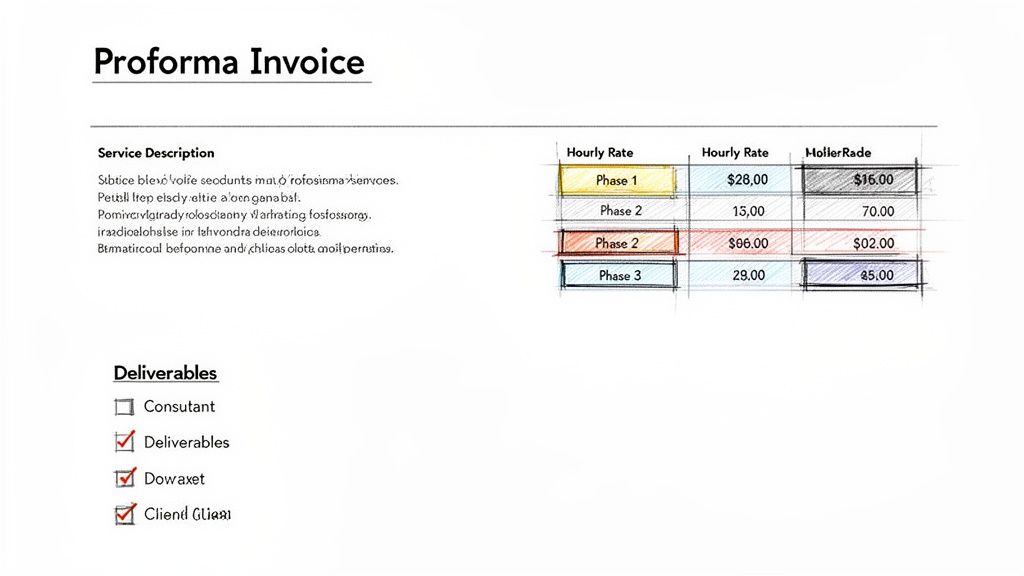
2. Professional Services & Consulting Proforma Invoice Template
For Africa's burgeoning service-based economy, the Professional Services & Consulting Proforma Invoice is a critical document. Designed for agencies, consultants, and legal or financial advisors, it shifts the focus from physical goods to intangible value. This document formalises a service agreement by clearly outlining the scope of work, project milestones, and associated costs before any engagement begins. It serves as a preliminary bill of sale, ensuring both the provider and the client are aligned on expectations and deliverables.
This type of invoice is essential for managing client relationships and project finances. It provides a transparent breakdown of services, preventing scope creep and disputes over billing. A study by the Project Management Institute (PMI) found that poorly defined scope is a primary reason for project failure, a risk that proforma invoices help mitigate (PMI, 2021). For example, a marketing agency in Lagos pitching a digital campaign would use this proforma invoice to detail costs for strategy, content creation, and ad spend. Similarly, an IT consulting firm in Nairobi would outline the phases of a software development project, from discovery to deployment, with costs tied to each stage.
Strategic Analysis & Key Components
The effectiveness of this proforma invoice lies in its detailed, service-oriented structure. It replaces product-centric fields like HS codes with components that define the scope and terms of professional work.
- Detailed Service Descriptions: Instead of product names, this section provides a granular breakdown of each service. For example, "Phase 1: Market Research & Competitor Analysis".
- Unit of Measure (Hours/Projects): It clarifies the billing method, whether it's an hourly rate, a fixed project fee, or a retainer. This is crucial for financial transparency.
- Payment Milestones: Links payments to specific project phases or deliverables (e.g., 40% upon signing, 30% upon first draft delivery, 30% upon project completion).
- Terms and Conditions: Includes clauses on revision limits, confidentiality, and rates for any work that falls outside the initial scope.
Key Insight: For service providers, this proforma invoice is more than a price quote; it is the foundation of the project agreement. It clearly defines the value being delivered, aligns project timelines with payment schedules, and protects both parties by establishing clear boundaries and expectations from the outset.
Actionable Takeaways
To leverage this proforma invoice sample effectively, African service-based businesses should:
- Be Explicit with Deliverables: Avoid vague descriptions. Instead of "Branding Services," list "Logo Design (3 concepts)," "Brand Style Guide," and "Social Media Kit."
- Align Payment with Progress: Structure payment milestones to correspond with tangible project progress. This improves cash flow and demonstrates value to the client at each step.
- Integrate with Project Management: Use a tool like CRM Africa to convert an accepted proforma invoice into a project with assigned tasks and deadlines. This creates a seamless workflow from sales to execution, ensuring the promises made in the invoice are tracked and delivered. For more on managing client projects, you can explore how to build a project management dashboard.
3. Subscription & Recurring Service Proforma Invoice Template
For African businesses in the booming digital and service economy, the Subscription & Recurring Service Proforma Invoice is a vital instrument for managing predictable revenue. This document formalises the terms of an ongoing service agreement before the initial billing cycle, providing clarity on subscription tiers, billing frequency, and renewal policies. It is essential for SaaS companies, digital agencies, and any business offering services on a recurring basis.
This type of invoice is crucial because it establishes a clear, mutual understanding of the service terms upfront, reducing future payment disputes and customer churn. Research from McKinsey & Company indicates that a positive customer onboarding experience, which includes clear billing terms, is critical for long-term retention (McKinsey, 2021). For example, a Kenyan SaaS provider offering accounting software would use this proforma invoice to detail the features of a selected plan, the monthly or annual cost, and the auto-renewal date. This allows the client to formally approve the recurring charge and understand the cancellation process, building trust and ensuring compliance.
Strategic Analysis & Key Components
The effectiveness of this proforma invoice sample comes from its focus on the specific dynamics of subscription-based models. It addresses the unique requirements of recurring billing, which are different from one-off sales.
- Subscription Tier & Plan Details: Clearly itemises the specific plan (e.g., Basic, Premium, Enterprise) and the features included, preventing scope creep and misunderstandings.
- Billing Cycle & Frequency: Explicitly states the billing period, such as monthly, quarterly, or annually. This is fundamental for the client's financial planning and your revenue forecasting.
- Auto-Renewal & Cancellation Terms: Legally crucial, this section outlines how and when the subscription will automatically renew and the exact procedure for cancellation, protecting both parties.
- Payment Method Authorisation: Specifies the agreed-upon payment method for recurring charges, whether it's a credit card, direct debit, or a mobile money wallet like M-PESA.
Key Insight: A well-structured recurring service proforma invoice is more than a price quote; it's a foundational agreement that sets the stage for a long-term customer relationship. It automates clarity, reduces administrative overhead, and secures predictable revenue streams.
Actionable Takeaways
To leverage this proforma invoice effectively, African subscription businesses should:
- Offer Annual Discounts: Clearly display a discounted annual payment option on the proforma invoice. This incentivises longer-term commitment, improves cash flow, and reduces the monthly churn rate.
- State Renewal Terms Unambiguously: Ensure your auto-renewal and cancellation clauses are easy to understand and legally sound, complying with consumer protection laws in target markets like South Africa or Nigeria.
- Automate with a Subscription Management System: Manually tracking renewals and sending invoices is inefficient and error-prone. A platform like CRM Africa can automate the generation of recurring proforma invoices, manage subscription lifecycles, and send automated renewal reminders, ensuring timely payments and a professional customer experience.
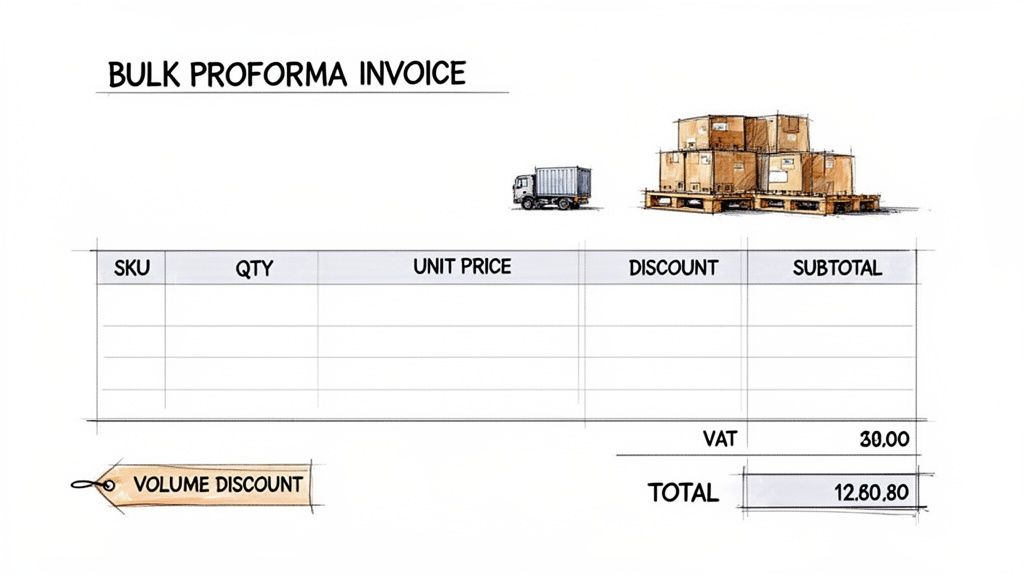
4. E-Commerce & Bulk Product Proforma Invoice Template
For African e-commerce businesses, wholesalers, and distributors, the E-Commerce & Bulk Product Proforma Invoice is the operational backbone for managing inventory and sales. This document is specifically designed to handle transactions involving physical goods, whether for single retail sales or large wholesale orders. It formalises a preliminary sales agreement by detailing product specifications, quantities, and pricing, allowing buyers to secure funds and sellers to allocate stock before the final tax invoice is issued.
This type of proforma invoice is crucial for managing the complex logistics of product sales. It provides clarity on inventory details, which is essential for preventing stockouts and overselling. As noted by logistics experts, accurate documentation is the first step in an efficient supply chain (Christopher, 2016). For example, an electronics distributor in Lagos supplying retail shops would use this document to confirm an order of 100 smartphones, specifying SKUs, unit prices, and any applicable volume discounts. This allows the retailer to arrange payment and the distributor to reserve the stock, ensuring a smooth fulfilment process. For those scaling their operations, understanding how to start optimizing offshore solutions for e-commerce businesses can further enhance efficiency for bulk sales and international transactions.
Strategic Analysis & Key Components
The power of this template lies in its detailed, inventory-centric fields that streamline the order-to-fulfilment cycle. These components are vital for maintaining clear records and managing customer expectations effectively.
- Product SKUs (Stock Keeping Units): These unique identifiers for each product are non-negotiable for accurate inventory management, picking, and packing.
- Volume/Tiered Discounts: Clearly itemised discounts incentivise larger orders and build loyalty with wholesale customers.
- Minimum Order Quantity (MOQ): This specifies the smallest quantity a buyer can purchase, which is essential for maintaining profitability on wholesale transactions.
- Delivery Timelines & Stock Status: Providing estimated delivery dates based on current stock levels helps manage buyer expectations and reduces post-sale inquiries.
Key Insight: A well-structured bulk product proforma invoice functions as a dynamic sales and inventory management tool. It aligns the seller's stock capabilities with the buyer's order, minimising the risk of fulfilment errors and ensuring transactional transparency from the outset.
Actionable Takeaways
To leverage this proforma invoice sample for growth, African e-commerce and wholesale businesses should:
- Implement a Strict SKU System: Ensure every product variant has a unique SKU. This is foundational for accurate tracking and avoiding costly shipping mistakes.
- State Commercial Terms Clearly: Define MOQs, discount structures, and payment options upfront. For local convenience, explicitly list mobile money options like M-PESA or other regional payment gateways.
- Integrate with an Inventory System: Manually tracking stock for proforma invoices is unsustainable. Using an integrated solution like CRM Africa connects your sales documents directly to your inventory levels, preventing overselling and automating stock allocation. You can explore how to manage this efficiently with the right free invoicing software for your business.
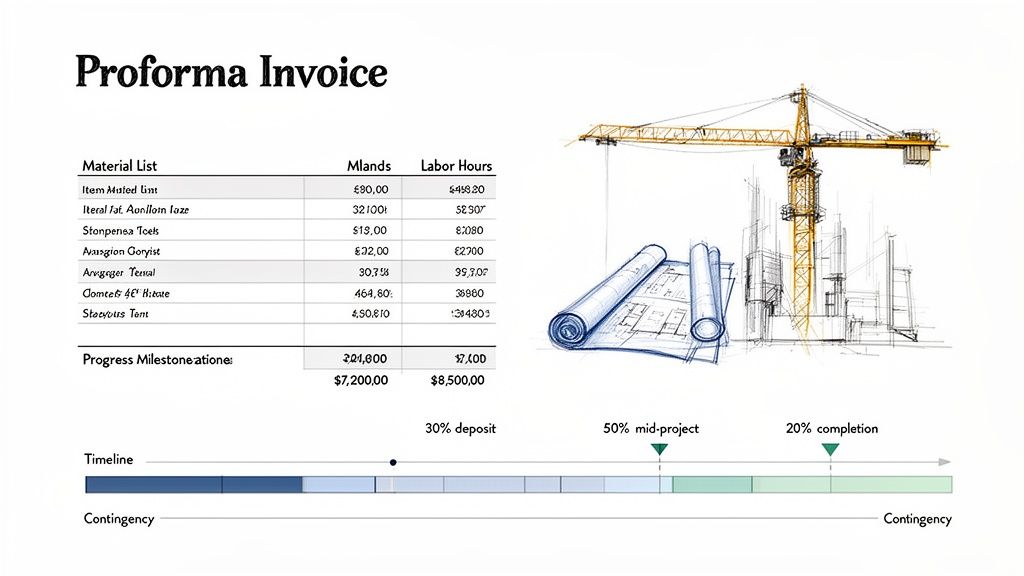
5. Construction & Project-Based Proforma Invoice Template
For African construction firms and project-based businesses, a standard quote is often insufficient. The Construction & Project-Based Proforma Invoice is a specialised document designed to manage the complexity of large, phased projects by detailing costs, timelines, and payment schedules tied to specific milestones. It serves as a financial blueprint that aligns the expectations of contractors, clients, and suppliers before any significant work commences.
This type of proforma invoice is essential for maintaining cash flow and transparency throughout a project's lifecycle. Poor cash flow management is a leading cause of failure in the construction industry (Levy, 2018). For example, a real estate developer in Egypt managing a new residential complex would use this document to outline costs for foundation work, structural framing, and finishing. This allows the client to see a clear breakdown and arrange financing accordingly, while the contractor can secure payment as each major phase is verifiably completed.
Strategic Analysis & Key Components
The power of this proforma invoice sample lies in its ability to deconstruct a complex project into manageable financial and operational segments. This proactive approach minimises disputes over scope and payment, a common challenge in the construction industry.
- Milestone-Based Payments: Instead of a single final bill, payments are broken down and linked to the completion of specific project phases (e.g., foundation, roofing).
- Detailed Cost Schedules: It separately lists material costs, labour rates, equipment rental fees, and other direct expenses, providing full transparency to the client.
- Contingency Allowance: Including a pre-agreed contingency fund (typically 10-15%) helps manage unforeseen costs without derailing the project or requiring constant renegotiation.
- Compliance and Insurance: It specifies requirements for safety compliance, permits, and necessary insurance coverage, protecting both the contractor and the client.
Key Insight: A project-based proforma invoice transforms a price quote into a project management tool. By clearly defining payment triggers and itemising all costs, it establishes a framework of accountability and trust, crucial for the successful delivery of long-term projects.
Actionable Takeaways
To leverage this proforma invoice for construction and project work, African contractors should:
- Define Milestones Clearly: Break the project into distinct, verifiable stages. Define what "completion" means for each stage to avoid ambiguity when triggering a payment request.
- Attach Supporting Documents: Include detailed material schedules, supplier quotes, and architectural plans as appendices to substantiate the costs outlined in the proforma invoice.
- Integrate with Project Management: Use a platform like CRM Africa to link your proforma invoice directly to project tasks and milestones. This allows you to track progress in real-time and automatically generate payment requests as stages are completed, ensuring a smooth and organised workflow.
6. Manufacturing & Custom Production Proforma Invoice Template
For African manufacturers creating bespoke goods, from custom furniture in Nigeria to branded textiles in Kenya, the Manufacturing & Custom Production Proforma Invoice is a critical operational document. It goes far beyond a standard price list, detailing the entire production journey from raw materials to final delivery. This document acts as a binding preliminary agreement, outlining specifications, costs, and timelines before significant resources are committed.
This proforma invoice sample is vital because it establishes clear, agreed-upon terms for custom work, which inherently carries more complexity than off-the-shelf products. For instance, a packaging company in Ghana producing custom-branded cartons for a client would use this invoice to specify material grade, printing colours, die-cut dimensions, and production lead times. This preemptively addresses potential disputes over the final product, ensuring both the manufacturer and the client are aligned on every detail.
Strategic Analysis & Key Components
The power of this template is its specificity, which translates complex production requirements into a clear financial and operational framework. It minimises ambiguity and provides a solid foundation for the client relationship.
- Detailed Specifications: This section breaks down the product into its core components, including raw materials, colours (e.g., Pantone codes), dimensions, and finishes. It leaves no room for interpretation.
- Production Milestones & Lead Times: Instead of a single delivery date, it often outlines key production stages and their estimated completion, managing client expectations throughout the process.
- Customisation Charges: Clearly separates the base cost from additional charges for specific customisations, design revisions, or tooling setups.
- Approval & Revision Terms: It formally states the process for design approval, the number of included revisions, and the costs associated with changes requested after sign-off.
Key Insight: In bespoke manufacturing, this proforma invoice functions as a project blueprint and a financial agreement rolled into one. It protects the manufacturer from scope creep and ensures the client receives exactly what they commissioned, building trust and preventing costly misunderstandings.
Actionable Takeaways
To leverage this proforma invoice sample for maximum benefit, African manufacturers should:
- Mandate Upfront Deposits: Always include a non-refundable deposit requirement (typically 50%) to cover initial material costs and secure the client's commitment before production begins.
- Formalise Payment Schedules: Detail all payment stages clearly. For larger projects, a structured schedule of payments is essential for managing cash flow. To implement this effectively, you can learn more about creating a schedule of payments.
- Document Everything in a CRM: Use a system like CRM Africa to attach design sketches, specification documents, and client communications directly to the proforma invoice record. This creates an indisputable audit trail, protecting your business and ensuring all production details are centrally organised and accessible.
7. Mobile Money & Microfinance Proforma Invoice Template
For Africa's burgeoning fintech and microfinance sectors, a specialised proforma invoice is essential. The Mobile Money & Microfinance Proforma Invoice Template is designed for entities like mobile money aggregators, fintech startups, and micro-lenders. It goes beyond a simple bill, acting as a clear, compliant preliminary agreement that itemises service charges, transaction fees, and currency conversions before a transaction is fully settled. This document is organised to provide transparency and build trust in a fast-paced digital financial environment.
This type of invoice is crucial for financial service providers as it offers clients a transparent breakdown of all costs associated with a service. The GSMA's annual "State of the Industry Report on Mobile Money" consistently highlights transparency and trust as key drivers of adoption (GSMA, 2022). For example, a Nigerian fintech firm aggregating payments for an e-commerce platform would use this document to outline the per-transaction fee, monthly service charge, and any applicable currency conversion rates. This clarity helps the e-commerce client understand their costs upfront, preventing disputes and fostering stronger business relationships. Similarly, a microfinance institution in Ghana can use it to detail loan processing fees before disbursing funds.
Strategic Analysis & Key Components
The power of this template lies in its focus on financial transparency and regulatory compliance, which are paramount in the fintech space. These elements help mitigate risk, reduce client friction, and ensure adherence to financial regulations.
- Itemised Service Fees: Clearly separates different charges, such as transaction fees, platform access fees, or service charges, providing complete cost transparency.
- Real-Time FX Rates: Specifies the exchange rates used for cross-currency transactions, often referencing the rate at a particular time to avoid ambiguity.
- Compliance & Regulatory IDs: Includes fields for transaction IDs, regulatory registration numbers, and compliance statements, which are vital for audits and reporting.
- Settlement Timelines: Clearly states the expected timeframe for funds to be settled into the client’s account, managing expectations effectively.
Key Insight: In the digital finance sector, transparency is currency. This proforma invoice acts as a tool for building credibility, clearly communicating value and cost, and ensuring both parties have a documented understanding of the financial terms before settlement.
Actionable Takeaways
To leverage these samples of proforma invoice effectively, African fintech and microfinance companies should:
- Prioritise Clarity on Fees: Break down every single charge. Ambiguity leads to customer disputes. For instance, clearly distinguish between a percentage-based transaction fee and a flat monthly service fee.
- Reference Regulatory Compliance: Mention adherence to local financial regulations (e.g., Central Bank of Nigeria guidelines) on the invoice to build credibility and assure clients of your legitimacy.
- Automate for Accuracy: Manually creating these complex invoices is risky. A system like CRM Africa can automate the generation of multi-currency proforma invoices, pulling real-time exchange rates and maintaining a secure audit trail essential for regulatory reporting. To understand the invoicing process better, you can explore detailed invoicing guides.
8. Hospitality & Event Management Proforma Invoice Template
For the vibrant and fast-paced hospitality and events sector in Africa, this proforma invoice template is a critical organisational tool. It is specifically designed for hotels, event planners, caterers, and venue operators who manage complex bookings with multiple service components. This document acts as a detailed preliminary agreement, outlining all anticipated costs, from venue hire and catering to service charges and potential contingencies, before a final tax invoice is issued.
This type of invoice is crucial for establishing clear financial expectations and securing commitments for services that require significant upfront planning and resource allocation. For example, a hotel in Lagos hosting a multi-day corporate conference would use this proforma invoice to detail room block rates, conference hall fees, catering menus, and audio-visual equipment hire. This allows the corporate client to approve the budget and pay the required deposit to confirm the booking, protecting the hotel's revenue and schedule.
Strategic Analysis & Key Components
The effectiveness of this template comes from its detailed and itemised structure, which pre-empts common client questions and prevents scope creep. It provides a transparent breakdown of costs, which is vital for building trust and managing large-scale events.
- Itemised Service Lines: Separately lists costs for venue hire, per-person catering, equipment rental, and staffing. This transparency is key for client budget approval.
- Contingency Fund Clause: Includes a line item for contingencies, typically 10-15% of the total, to cover unforeseen expenses. This manages client expectations for potential cost overruns.
- Tiered Payment Schedule: Clearly outlines the payment structure, often a non-refundable deposit (e.g., 40%), a mid-event payment, and the final balance due post-event.
- Detailed Event Specifications: Provides space to specify the event date, number of guests, and specific service requirements, linking the financial terms directly to the agreed-upon deliverables.
Key Insight: In the events industry, a proforma invoice is more than a price list; it's a project blueprint and a risk management tool. It formalises the scope of work and payment terms, securing the booking and protecting the service provider from last-minute cancellations or changes that could result in significant financial loss.
Actionable Takeaways
To leverage this proforma invoice sample for maximum benefit, African hospitality businesses should:
- Mandate a Non-Refundable Deposit: Always require a deposit of 30-40% upon acceptance of the proforma invoice to confirm the booking and cover initial costs.
- Define Deadlines Clearly: State firm deadlines for critical information, such as the final guest count confirmation (usually 14 days prior to the event), to lock in catering and staffing numbers.
- Use a Client Portal for Management: Employ a system like CRM Africa to send the proforma invoice and allow clients to view event details, track payment schedules, and communicate changes. This creates a centralised, professional record of the entire engagement. For more on managing client financial interactions, you can explore different types of invoices and their uses.
8-Template Proforma Invoice Comparison
| Template | Implementation complexity | Resource requirements | Expected outcomes | Ideal use cases | Key advantages |
|---|---|---|---|---|---|
| International Trade & Export Proforma Invoice Template | High — requires customs/regulatory details | Trade knowledge, HS code lookup, multi-currency tools, shipping data | Faster customs clearance; fewer cross-border delays | Exporters, trading companies, agricultural exporters | Compliance-ready (HS, Incoterms), multi-currency and shipping detail |
| Professional Services & Consulting Proforma Invoice Template | Medium — detailed scope and milestones | Detailed scopes, time-tracking, team allocation, proposal docs | Clear billing, reduced scope creep, aligned client expectations | Agencies, consultants, legal/accounting firms | Milestone billing, transparent service descriptions |
| Subscription & Recurring Service Proforma Invoice Template | Medium — recurring billing logic and renewals | Subscription management, payment gateway, SLA documentation | Predictable recurring revenue and automated renewals | SaaS, membership platforms, software vendors | Auto-renewal support, flexible billing cycles |
| E-Commerce & Bulk Product Proforma Invoice Template | Medium — SKU and inventory complexity | Inventory system, SKU management, shipping and tax calculators | Accurate bulk orders, fewer fulfillment errors | Wholesalers, retailers, distributors, e‑commerce platforms | Volume discounts, inventory integration, clear SKU details |
| Construction & Project-Based Proforma Invoice Template | High — phased billing and detailed costing | Project plans, supplier quotes, labor estimates, PM tools | Payments aligned to progress; lower financial risk | Construction firms, contractors, project developers | Milestone payments, detailed material/labor breakdown |
| Manufacturing & Custom Production Proforma Invoice Template | High — custom specs and lead-time management | BOMs, production schedules, samples, quality specs | Fewer production errors; clearer price justification | Manufacturers, custom producers, textile/furniture makers | Transparent cost breakdown, customization and MOQ handling |
| Mobile Money & Microfinance Proforma Invoice Template | High — regulatory and FX considerations | Compliance/KYC docs, FX feeds, payment-rail integrations | Transparent fees and better compliance reporting | Fintechs, payment providers, microfinance institutions | Clear fee/FX disclosure, multi‑rail and multi‑currency support |
| Hospitality & Event Management Proforma Invoice Template | Medium — many variable line items | Event specs, staffing plans, AV/equipment costs, deposit policies | Clear event cost estimates; fewer disputes over extras | Hotels, event planners, caterers, venue operators | Detailed venue/catering breakdown, cancellation and deposit terms |
Automate Your Invoicing and Get Paid Faster with CRM Africa
Throughout this article, we have explored a diverse range of samples of proforma invoice, each tailored to the unique operational demands of African SMEs. From the detailed requirements of international trade and customs clearance to the recurring precision needed for subscription services, it is clear that a proforma invoice is far more than a simple price quotation. It is a critical communication tool that establishes clear expectations, builds client trust, and initiates the payment cycle on a professional footing.
The key takeaway from analysing these varied templates is the paramount importance of context and clarity. A proforma for a construction project requires detailed milestone breakdowns, whereas one for a bulk e-commerce order must prioritise SKU numbers, quantities, and harmonised system (HS) codes. Ignoring these industry-specific nuances not only risks confusing your client but can also lead to significant delays in approvals, payments, and even customs clearance, directly impacting your cash flow and operational efficiency. As highlighted by a study on SME financial management, delays in invoicing and payments are a primary contributor to cash flow problems for small businesses (Atrill, 2019).
From Manual Templates to Automated Excellence
While the provided samples of proforma invoice offer an excellent starting point for standardising your documentation, their manual application represents a significant operational bottleneck. The process of copying templates, manually entering client data, calculating totals, and then tracking each document's status across spreadsheets is inefficient and highly susceptible to human error. A misplaced decimal, an incorrect client address, or a forgotten follow-up can damage client relationships and stall revenue.
This is where the strategic advantage shifts from merely having good templates to implementing an intelligent system. The true goal is not just to create a professional document, but to streamline the entire "quote-to-cash" cycle. This involves:
- Integration: Your proforma invoice should not exist in isolation. It needs to be intrinsically linked to your client records, sales pipeline, and product or service catalogue.
- Automation: Generating, sending, and tracking these documents should be automated to minimise administrative burden and ensure consistency.
- Actionability: A modern proforma invoice should be a digital, actionable document that allows clients to approve, reject, or comment directly, and seamlessly convert it into a final, payable invoice.
- Reconciliation: The system should automatically track when the proforma is approved and when the subsequent final invoice is paid, reconciling the transaction against the client's account without manual intervention.
The Strategic Value of a Centralised System
Mastering the art of the proforma invoice is a crucial step towards professionalising your business operations. It demonstrates a commitment to transparency and efficiency that clients appreciate. However, the ultimate competitive edge lies in leveraging technology to make this process seamless and scalable. By moving beyond static templates and adopting a platform that unifies your customer relationship management with your billing and payments, you transform a tedious administrative task into a powerful driver of business growth.
An integrated system provides a single source of truth for all client interactions and financial data. This centralised view eliminates data silos, reduces the risk of errors, and provides real-time insights into your business's financial health. Research from Forrester Consulting confirms that businesses adopting integrated CRM and financial systems see marked improvements in sales productivity and forecast accuracy. By automating these foundational processes, you free up invaluable time and resources, allowing you and your team to focus on what truly matters: delivering exceptional value to your clients and strategically expanding your business across the continent.
Ready to move beyond manual templates and accelerate your payment cycle? CRM Africa empowers you to generate professional, industry-specific proforma invoices in seconds, pulling data directly from your client records. Convert approved proformas to final invoices with one click and get paid faster through integrated gateways like M-PESA and Flutterwave. Schedule a free demo of CRM Africa today and discover how to centralise your operations and transform your invoicing process.