
Most African businesses serve only one customer: the one who pays the bill. But focusing only on the transaction means you’re missing the other customer—the one who holds the real key to your growth: the customer experience.
While getting paid is obviously crucial, it’s how people feel when they interact with you that builds loyalty and keeps them coming back for more.
1. Meeting the Two Customers Your Business Actually Has
Every business really serves two different customers, whether they realise it or not. The first one is easy to spot: the person who settles the invoice. This is your transactional customer, the one focused on price, terms, and the bottom line. For many companies, the journey ends right there. Once the payment clears, the relationship is on pause until the next purchase.
But there’s a second, hidden customer you should pay attention to: the experiential customer. This isn’t about who pays; it’s about how they feel through the entire process. And this customer notices everything.
The Details That Define the Experience
The experiential customer is the true decision-maker when it comes to long-term loyalty. They are constantly evaluating the subtle (and not-so-subtle) signals your business sends out.
They notice things like:
- Response times: How quickly do you solve their problem?
- Invoice clarity: Is your billing straightforward, or a confusing mess?
- Professionalism: What’s the tone of your emails?
- Organization: How seamless is your project management?
- Consistency: Can they count on the same quality of service every time?
- Transparency: Are you open about timelines and costs?
- Proactive updates: Do you keep them in the loop?
- Respect: Do they feel valued as a partner?
This split is critical because, as a study by PwC highlights, 73% of consumers point to experience as a key factor in their purchasing decisions, right behind price and product quality. A competitor can always come along with a similar offer, but a consistently positive experience forges a powerful connection that’s much harder to replicate.
To help clarify this, let’s break down the two customer mindsets.
The Paying Customer vs. The Experiential Customer
This table shows where each customer’s focus lies. One is concerned with the mechanics of the deal, while the other is building the foundation for a long-term partnership.
| Attribute | The Paying Customer (The Transaction) | The Experiential Customer (The Relationship) |
|---|---|---|
| Primary Focus | Price, payment terms, and invoice details. | The overall journey, feeling, and interaction. |
| Key Question | “Is this a fair price for the service?” | “Do I feel valued and respected by this business?” |
| Motivation | Getting the best possible deal. | Feeling understood, secure, and confident. |
| Measures Success By | A completed payment and a closed invoice. | Ease of communication and a hassle-free process. |
| Impact on Business | Drives short-term revenue. | Drives long-term loyalty and referrals. |
Looking at it this way, it’s clear that only satisfying the paying customer leaves a huge opportunity on the table.
Who Is the Real Customer?
In many markets, the line between who pays and who uses is already blurry. Take Egypt, for instance, where the person paying for a service is often not the one using it. Research shows that over 70% of household purchasing decisions are made collectively, especially for big-ticket items like electronics or educational courses.
While one person might handle the mobile money transfer, the actual ‘customer’—the one whose needs prompted the purchase—could easily be a spouse, a child, or even a whole team at a company. This dynamic proves why the experiential side is so vital. You can find more of these insights in this report from PwC on consumer behaviour.
A great experience transforms a simple transaction into a lasting relationship. It’s the difference between a customer who buys from you once and a partner who advocates for your business for years.
Ultimately, serving only the paying customer is a short-sighted game. To build a resilient business that grows, you have to obsess over the feelings, perceptions, and entire journey of every single person who interacts with your brand.
2. Why Emotionally Secure Customers Are Your Biggest Asset
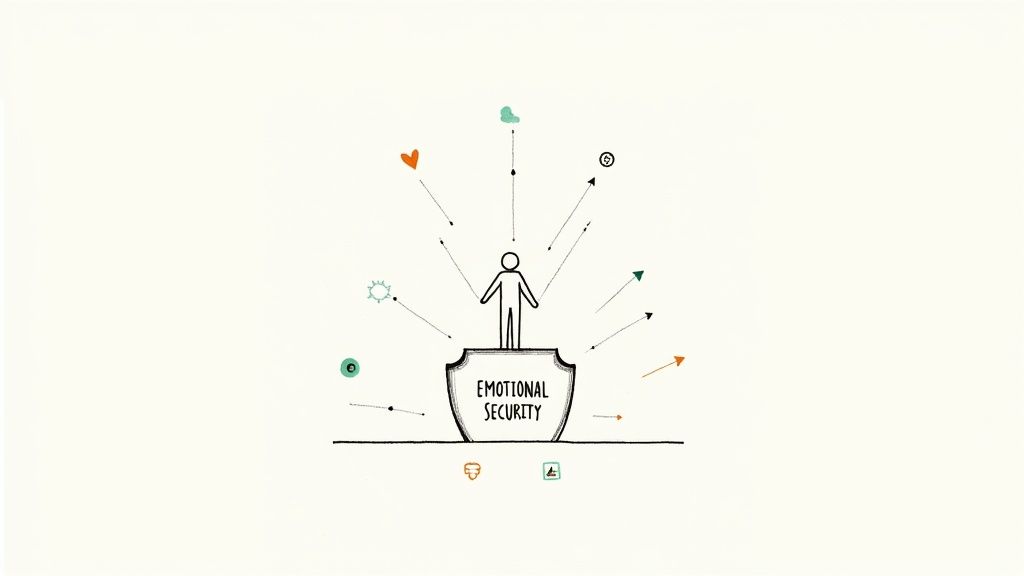
While some customers are purely focused on the price tag, a far more valuable group operates on a different currency: emotional security. This isn’t some vague, fluffy concept. It’s the quiet confidence a client feels knowing your business is solid, professional, and genuinely has their back.
It’s that simple feeling of being heard and respected—not just as an invoice number, but as a partner. When you get this right, emotionally secure customers buy more and complain less. The usual friction and perceived risk of doing business with you just… melts away. This deep-seated trust makes them comfortable buying more often and investing in your higher-value services without all the back-and-forth.
Let’s be clear: a lack of security is a direct path to churn. A study by Zendesk found that 81% of consumers say a positive customer service experience increases the chances they will make another purchase. Emotionally secure customers, on the other hand, are way less hung up on price. Why? Because they place a much higher value on the predictability and peace of mind you deliver. They get that the customer who pays you is not the customer you think; they’re investing in a reliable outcome, not just a line item.
The Small Things That Build Rock-Solid Security
Building this kind of security isn’t about grand, expensive gestures. It’s forged in the small, consistent things you do every single day that signal competence and care. Every interaction is a chance to either build up that foundation or let it crack.
Think about what really contributes to this feeling:
- Organised Processes: When a project just flows and you hit your milestones on time, it sends a powerful message: “We’ve got this under control.”
- Professional Communication: Clear, timely, and respectful emails and calls build confidence. They prevent the small misunderstandings that can snowball into big problems.
- Consistent Updates: Proactively keeping clients in the loop—good news or bad—kills their anxiety. It shows you value transparency and aren’t afraid to communicate.
These aren’t just “nice-to-haves.” They are the tools you use to build a psychological safety net. This net makes customers feel secure in their decision to hire you, and that security is what fuels your growth.
How That Feeling of Safety Turns into Real Revenue
When customers feel safe, their behaviour changes in ways that directly pad your bottom line. An emotionally secure customer is far more likely to work with you on a solution when a minor issue pops up, rather than immediately threatening to walk. You’ve earned the benefit of the doubt.
This loyalty has a powerful compounding effect. According to Qualtrics, businesses in the U.S. risk losing an estimated $1.9 trillion in yearly sales due to poor customer experiences.
People don’t stay for the product. They stay for the experience. When they feel secure, they don’t just buy more—they become your most powerful advocates, referring new business without you even having to ask.
This holds true no matter what you sell. A freelance developer in Lagos who gives clear project timelines and weekly updates is building more security than one who is cheaper but communicates erratically. A consulting firm in Nairobi that sends professional, easy-to-understand invoices fosters more trust than one whose billing is a confusing mess.
Each of these small acts of professionalism is a direct deposit into the bank of emotional security. And the returns on those deposits? Far greater than the effort you put in.
3. Deconstructing the Modern Customer Experience Journey
Right, let’s move from theory to action. What really is the customer experience? It’s not one big thing. It’s a series of small moments, or touchpoints, where a customer interacts with your business. Think of it like a chain; every single link matters. At each point, trust is either built or broken.
This is your chance to prove you’re reliable and that you see them as more than just an invoice number.
So many businesses, particularly here in Africa, get hyper-focused on the final product and completely miss the journey. They’ll build a stunning website or deliver a brilliant report, but if the process was a mess of missed deadlines and poor communication, that client is never coming back. It’s those small, in-between moments that turn a one-off sale into a long-term partnership.
Let’s break down the core pieces that make a customer feel secure, respected, and eager to stick around.
The Power of Prompt and Professional Responses
In a world of instant everything, how fast you reply isn’t just about efficiency—it’s about respect. When a potential client reaches out and hears silence, you’re sending a loud and clear message: “You’re not my priority.” A quick, helpful response, on the other hand, screams competence and care.
But it’s not just about speed. Your professionalism is just as critical. This means writing clear, well-structured emails. It means using a respectful tone on the phone. It means ditching the slang that might make you sound less like the expert you are. You’re building an image of a business that has its act together.
Imagine a consulting firm in Nigeria. A prospect sends an email inquiry. Within a couple of hours, they get a detailed, professional reply that addresses all their questions. Instantly, their confidence in that firm’s ability to handle a complex project skyrockets. That single interaction sets the tone for everything that follows.
“A delayed response is a negative response. Every moment of silence creates an opportunity for a competitor to be heard.”
This gets to the heart of it. Mastering communication is the first, simplest step to winning over the modern customer. It costs you nothing but delivers a massive return in trust.
Building Trust Through Clarity and Organisation
Nothing kills a customer’s confidence faster than confusion. When your process is a jumble, your invoices are a puzzle, and updates are sporadic, you’re basically asking your clients to worry. A well-organised business takes that anxiety off the table by making every step smooth and predictable.
This is especially true when money is involved. Invoice clarity isn’t a “nice-to-have”; it’s non-negotiable. A bill that’s hard to decipher, full of vague line items, or sprinkled with surprise charges immediately triggers suspicion. It puts the person paying on the defensive.
Compare that to a clear, itemised invoice. It feels honest and transparent. It shows you have nothing to hide and you respect your client enough to be upfront. This small detail has a huge impact on how secure they feel doing business with you.
Here’s what an organised journey looks like in practice:
- Consistency: The same high standard, every single time. From the first proposal to the final handover, predictability makes people comfortable.
- Transparency: Be open about timelines, potential roadblocks, and costs. Nobody likes surprises, especially when their budget is on the line.
- Proactive Updates: Keep clients in the loop before they have to chase you. A simple weekly update email can prevent a dozen anxious phone calls.
Respect Is the Ultimate Retention Tool
When you strip it all back, everything we’ve talked about—promptness, professionalism, clarity, organisation—comes down to one thing: respect.
When you treat your customers like valued partners instead of just numbers on a spreadsheet, you build a business that lasts. People don’t just stay for a great product; they stay because of how you make them feel. They remember the business that respected their time, valued their intelligence, and handled their concerns with a sense of urgency.
So, as we’ve been saying, the customer who pays you is not the customer you think. The real customer is the experience itself. It’s the sum of all the feelings and impressions that convince them to trust you, to come back, and to tell their friends about you. When you break down their journey and polish every touchpoint, you stop selling a commodity and start building a relationship—and that’s something your competitors can’t just copy.
4. How to Identify Your Payer and User Personas
To really nail your service, you first need to know who you’re talking to. In so many businesses, the person signing the cheque is not the one using your product every day. This is the classic split between a Payer Persona and a User Persona, and if you don’t distinguish between them, you’re just creating noise and missing opportunities.
Think about a typical B2B software sale. The Chief Financial Officer (the Payer) is focused on one thing: the numbers. They’re looking at the return on investment, potential cost savings, and the overall financial sense of the deal. But the marketing team (the Users)? They’re the ones who will be living inside that software every single day. They care about usability, speed, and whether they can get help fast when something breaks.
Their worlds are completely different.
Trying to reach both with the same message just doesn’t work. The CFO isn’t fussed about a minor feature update, and the marketing team has zero interest in the long-term amortisation schedule. The first step is realising that the customer who pays you is not the customer you think. The next is to get your hands dirty and figure out who is who.
Practical Methods for Uncovering Personas
You don’t need a huge research budget to sort this out. You can get fantastic insights by weaving a few simple discovery steps into your existing workflow. The goal is just to listen for the different priorities that tell you whether you’re speaking to a Payer or a User.
Here are a few straightforward ways to do it:
- Onboarding Discovery Calls: The start of a relationship is the perfect time for direct questions. Ask, “Who will be our main point of contact for billing?” and follow up with, “And who on the team will be using this service day-to-day?” Boom. You’ve just segmented your audience.
- Post-Sale Surveys: A quick, one-question survey after a purchase can tell you everything. Ask: “What was the single most important factor in your decision to purchase?” A Payer will likely say “price” or “ROI,” while a User might say “ease of use” or “specific features.”
- Analyse Feedback Channels: Just look at who is sending you what. Users submit support tickets about functionality. Payers are the ones questioning line items on an invoice. This is real-time persona identification happening right in front of you.
As you gather this info, you can start building simple profiles. Good subscriber data management is key here, letting you tag contacts in your CRM to make sure the right message always gets to the right person. For a deeper dive on this, check out our guide on managing subscriber data.
Building trust with both personas comes down to a few core principles. You have to be transparent, consistent, and respectful to everyone involved.
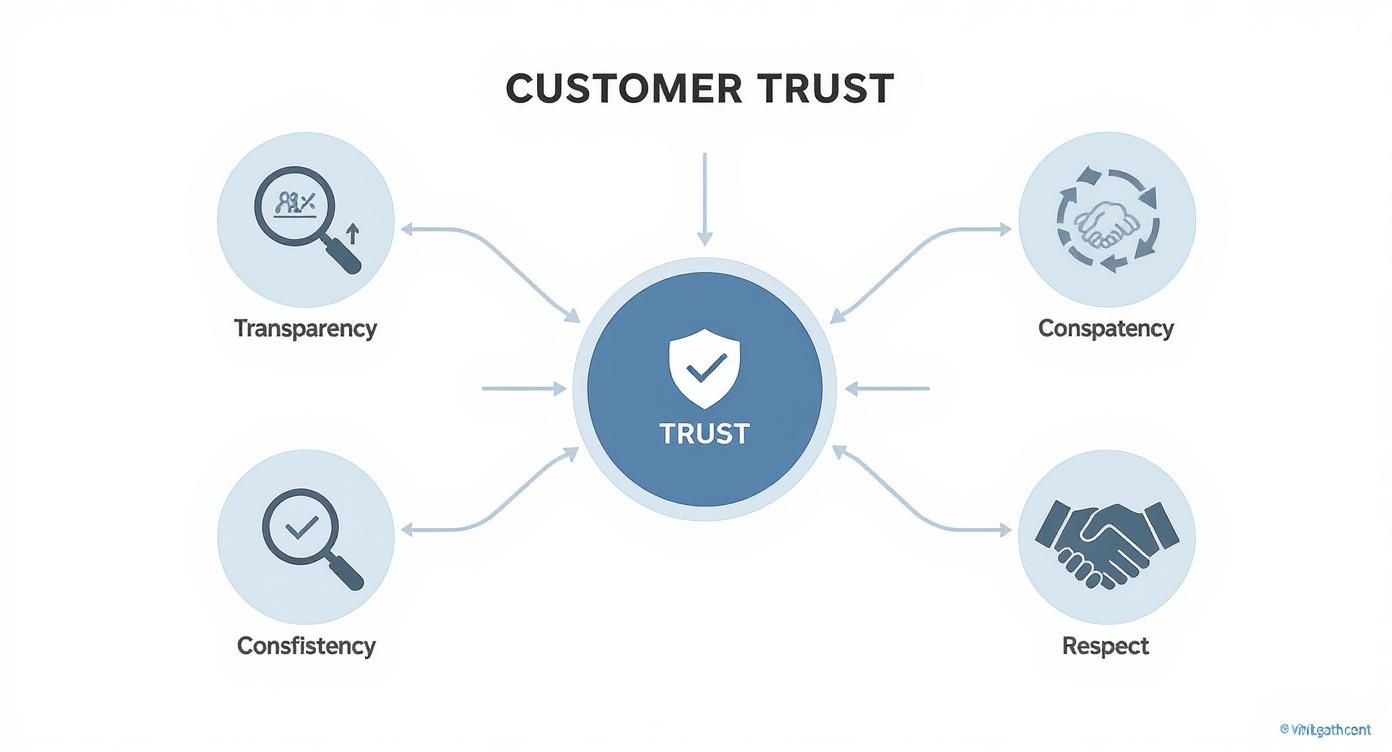
As the diagram shows, trust isn’t built by accident. It’s the result of clear communication and dependable service, which satisfies the needs of both the Payer and the User.
Creating Simple Payer and User Profiles
Your personas don’t need to be massive, detailed documents. A simple outline is often all you need to sharpen your communication strategy. Just focus on what they care about most and what a “win” looks like from their point of view.
A Payer Persona is focused on financial outcomes and risk management. A User Persona is focused on daily efficiency and functional support.
To make this crystal clear, let’s break down how different their worlds really are. This table shows why you can’t use the same script for both.
Payer vs User Persona Key Attributes
This table highlights the different concerns and focus points for payer and user personas, which can help you tailor your communication far more effectively.
| Attribute | Payer Persona (e.g., CFO, Parent) | User Persona (e.g., Marketing Team, Child) |
|---|---|---|
| Primary Concern | “What is the return on this investment?” | “Will this make my job easier?” |
| Pain Points | Budget overruns, unclear ROI, billing errors. | Clunky features, slow support, poor usability. |
| Measures Success By | Cost savings, increased revenue, contract terms. | Time saved, tasks completed, ease of use. |
| Key Vocabulary | Budget, ROI, TCO (Total Cost of Ownership), Invoice. | Features, bugs, support ticket, workflow. |
| Communication Focus | High-level reports, financial summaries, contract talks. | Product updates, how-to guides, support channels. |
Once you master this distinction, you can deliver the right value to the right person, every time. You can reassure the Payer of the sound financial logic behind their purchase while empowering the User with the tools and support they need to get their job done. It’s a dual approach that ensures everyone feels seen, understood, and valued.
5. Optimising Payments as a Customer Experience Tool
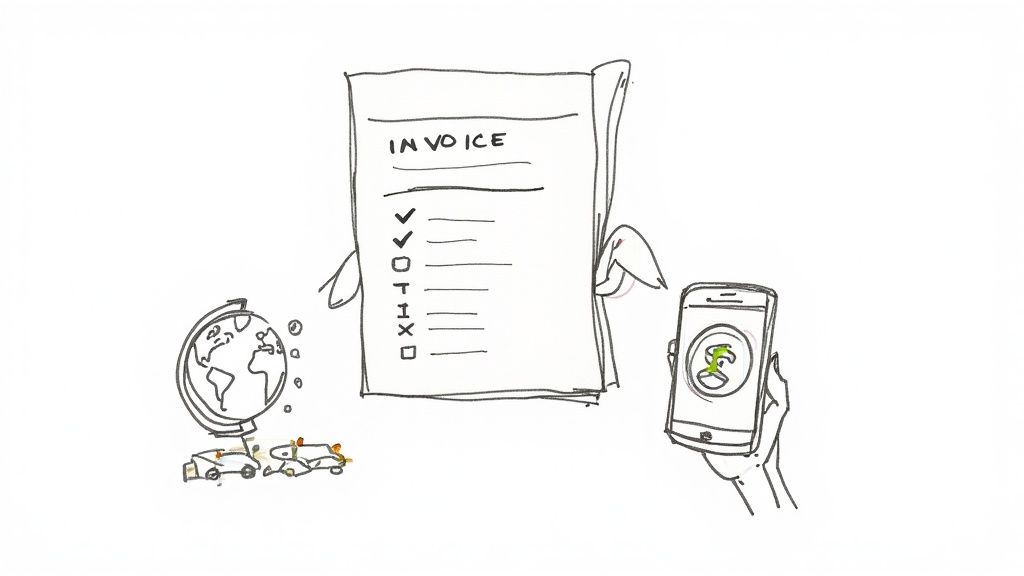
Let’s be honest: money talk can be awkward. It’s one of the most sensitive parts of any customer relationship, yet businesses often treat billing and payments like a cold, mechanical afterthought. This is a huge mistake.
Every invoice, every payment reminder, every receipt is a touchpoint. It’s a chance to either build trust or create friction. This proves, once again, that the customer who pays you is not the customer you think. The real customer is the experience, and how you handle the financial side of things speaks volumes about your professionalism and respect for the relationship.
Think about it. A confusing invoice or a rigid payment system can undo all the goodwill you’ve spent weeks building. It puts your paying customer on edge, making them second-guess the value you’ve provided. On the flip side, a smooth, transparent, and flexible financial process reinforces their decision to work with you. A simple transaction becomes a trust-building asset.
Transforming Invoices From Demands to Reassurances
The humble invoice is far more than just a request for cash; it’s a critical communication tool. When it’s badly designed, it creates work for your client. They’re forced to decipher vague line items or question unexpected charges. But a great invoice? It provides absolute clarity and reinforces the value you delivered.
See the difference for yourself:
- Vague Invoice: “Consulting Services – £5,000”
- Clear Invoice: “Project Scoping & Strategy (Phase 1) – 20 hours @ £125/hr = £2,500” and “Initial UI/UX Wireframes (Phase 2) – 20 hours @ £125/hr = £2,500”
The second example doesn’t just ask for money; it tells a story of progress. It’s transparent and professional, leaving zero room for doubt. For more ideas on this, our guide explains how to create the invoice that sells for you.
Your billing process should feel like a helpful summary of a successful partnership, not an aggressive demand for payment. Clarity eliminates confusion, and confusion is the enemy of trust.
This mindset extends to payment reminders, too. Ditch the blunt, all-caps “OVERDUE” notice. Instead, frame it as a helpful nudge. A simple, polite email checking if they received the invoice and offering assistance can maintain a positive relationship while still making sure you get paid.
Meeting Customers Where They Are With Flexible Payments
In markets across Africa, flexibility isn’t just a nice-to-have, it’s essential. Insisting on a single payment method that’s inconvenient for your client is like building a wall right at the finish line.
You need to offer options that fit their world. This means providing mobile money options (M-PESA, MTN Mobile Money) right alongside traditional bank transfers or card payments. It shows you understand and respect their reality.
This is especially true when dealing with multiple currencies. A client in Ghana shouldn’t have to guess the final cost in Cedis when you’ve quoted them in USD. Providing clear conversions and being upfront about any fees demonstrates honesty and builds incredible confidence.
Case Study: A Kenyan Agency’s 30% Retention Boost
Here’s a real-world example. A web agency in Nairobi was doing fantastic work but couldn’t figure out why clients were leaving. After some digging, they realised their invoicing was chaotic. Bills were inconsistent, lacked detail, and the payment instructions were all over the place.
So, they overhauled their entire financial workflow. They standardised their invoices with detailed breakdowns of the work done. They added one-click payment options via M-PESA and Pesapal. They even set up automated, friendly reminders.
The result? Client retention shot up by over 30% in the next year. Clients told them they felt more respected and had more confidence in the agency’s professionalism. It was proof that a smooth payment experience directly strengthens loyalty.
It’s not always about discounts. Creative payment strategies can do wonders for loyalty. For instance, some e-commerce businesses are exploring things like store credit to deepen relationships, as detailed in this guide on increasing customer lifetime value with Shopify store credit. It all goes to show that how you handle money is a powerful tool for building a business people want to stick with.
6. Building a Business Where People Stay for the Experience
In a crowded market, a great product might get your foot in the door, but it’s the experience that makes people want to stick around. It’s a simple idea, but it’s everything: people don’t just buy what you do; they buy how you make them feel.
The real measure of your business isn’t closing that first deal. It’s the second, the third, and the referrals that start rolling in because people love working with you. This all comes down to a crucial shift in perspective—from focusing on the transaction to nurturing the relationship.
The moment you realise the customer who pays you is not the customer you think, your entire approach changes. Every interaction becomes a fresh opportunity. From the first email to the final invoice, each step is a chance to serve your most important customer: the experience itself.
Think about a creative agency in Accra. Their design work was top-notch, but their clients felt neglected. Communication was slow, and project updates were a mess. So, they changed their focus. They started sending clear weekly progress reports and used a client portal to keep everything transparent. The quality of their design didn’t change, but suddenly, their client retention shot through the roof.
The Long-Term Rewards of an Experience-First Mindset
Putting experience first isn’t just about being nice; it’s a hard-nosed business strategy with real, tangible payoffs. When you focus on the experiential customer, you’re building a company that’s more resilient and far more profitable.
The benefits just keep growing:
- Higher Customer Lifetime Value (CLV): Customers who feel valued and respected simply spend more money with you over time. It’s that simple.
- A Stronger Brand Reputation: Happy clients become your best marketing team, spreading the word about their great experience.
- A Steady Stream of Referrals: People who are genuinely impressed with your service can’t wait to recommend you to others in their network.
- Lower Customer Acquisition Costs (CAC): Keeping a happy customer is massively cheaper than constantly chasing new ones.
This is exactly why so many businesses are now investing in tools and strategies built around loyalty. Understanding how to go about maximizing customer retention with a small business loyalty program is no longer a bonus; it’s essential for long-term survival.
Your Final Call to Action
Every business owner faces a choice: serve the transaction or serve the experience. Serving the transaction gets you paid today. Serving the experience gets you paid for years to come.
“People don’t stay for the product. They stay for the experience.”
This is the one thing to remember. Your product gets you in the game, but the experience is how you win it. By delivering consistency, professionalism, transparency, and respect, you create emotional security for your customers. That security is what turns one-time buyers into loyal advocates who complain less and buy more.
As you move forward, keep in mind that many businesses bleed money long after a sale is made, often without even realising it. You can dig deeper into this common trap in our guide on why most businesses lose money after the sale.
Start seeing every interaction not as a cost, but as an investment in a relationship. Build a business where the experience is so good, your customers wouldn’t even think about looking elsewhere.
7. Still Have Questions? Let’s Clear Things Up
Getting your head around the difference between the person who pays the bills and the person who actually uses your service is a big mental shift. It changes everything. Here are a few common questions that pop up when businesses start putting this idea into practice.
How Can a Small Business Improve Its Customer Experience on a Tight Budget?
A fantastic experience doesn’t have to cost a fortune. In fact, the most powerful changes often cost nothing more than a bit of your attention. It all boils down to two things: consistency and communication.
Start with the simple stuff. The low-hanging fruit:
- Prompt replies: Get back to emails and messages quickly, even if it’s just to say, “Got it, I’ll look into this and get back to you.” It shows you respect their time.
- Transparent invoicing: Make sure every single bill is crystal clear, itemised, and dead simple to understand. No surprises.
- Professional tone: Keep a respectful and helpful tone in every single interaction, from a sales call to a support ticket.
These small, consistent actions build a mountain of trust and make your customers feel secure, all without denting your budget.
What’s the First Step to Tell My Payer and User Apart?
Just start by listening and observing. You’re probably already getting the clues you need.
On your next sales call, notice who’s asking about the nitty-gritty features versus who’s asking about payment terms and pricing. The one obsessed with the day-to-day use? That’s likely your user. The one focused on the cost? Almost certainly your payer.
If you want to be more direct, a simple question during onboarding can work wonders. Try asking, “Who will be the primary person using this service every day?” That one question gives you an immediate answer and helps you realise that the customer who pays you is not the customer you think. From there, you can tailor your communication to the right person.
Does Focusing on Experience Mean My Product Can Be Lower Quality?
Absolutely not. Let’s be clear: a great experience will never, ever make up for a bad product.
Think of your product as the foundation of a house. The experience is the paint, the furniture, the decor. Without a solid foundation, the whole thing comes crashing down, no matter how beautiful it looks.
The goal isn’t to pick one over the other. The goal is to combine a quality product with an exceptional experience. That powerful combination is what separates you from the pack and makes you a market leader. People might come to you for the product, but they’ll stay with you because of the experience.
Ready to deliver an exceptional experience from the first conversation to the final payment? CRM Africa combines project management, clear invoicing, and a client-branded portal into a single, free platform for up to 10 users. See how it all comes together at https://crm.africa.