
A business continuity plan, or BCP, isn’t just a document you file away. It’s your company’s survival guide—a live-action playbook for keeping the lights on when a crisis hits. According to the Business Continuity Institute (BCI), a BCP is about “identifying and managing current and future threats to an organization” to ensure it can continue operating. Think of it as the GPS that steers your business through the storm when the road ahead is completely washed out.
1. Why a Business Continuity BCP Is Not Optional in South Africa
Let’s be honest. Running a business in South Africa means staring down disruptions that other countries only read about. Persistent load-shedding, economic instability, and crumbling infrastructure aren’t abstract risks; they’re daily realities. This is exactly why a formal business continuity BCP stops being a “nice-to-have” and becomes a non-negotiable tool for survival, a concept echoed by standards like ISO 22301:2019 on Business Continuity Management Systems.
Picture a city-wide power grid failure that lasts for days. Without a BCP, you’ve got chaos. Customer data is trapped on-site, production grinds to a halt, and your communication channels go dead. With a BCP, your team has a clear set of instructions. They fire up the backup generators, switch operations to cloud servers, and activate alternative communication plans. A solid plan transforms panic into a calm, structured response.
The Modern South African Risk Landscape
The challenges here are unique and deeply connected. A BCP that works in Europe or the US will fail here because it doesn’t account for our specific environment. The IRMSA Risk Report 2025/2026 flags energy insecurity and weak governance as massive threats. These problems amplify the damage from climate events and failing municipalities, creating a perfect storm for businesses.
The report’s main warning? Our collective risks are growing faster than our national resilience. That makes proactive planning an absolute necessity. You can get a deeper look at these challenges in Curasoftware’s 2025 risk analysis.
A business continuity plan isn’t about predicting the future. It’s about building the muscle to handle whatever the future throws at you. It’s about absorbing the punch, getting critical operations back online, and adapting to the new reality.
Building Your Roadmap to Resilience
To create a BCP that actually works when you need it most, you need a clear roadmap. This guide is designed to walk you through building your plan step-by-step, starting with the basics and moving to practical, real-world actions.
Here’s what we’ll cover:
- Understanding the Building Blocks: We’ll break down core concepts like the Business Impact Analysis (BIA) and Risk Assessment into simple terms.
- Pinpointing Critical Risks: You’ll learn how to identify the specific threats that matter most to your business in the South African context.
- Crafting Recovery Strategies: We’ll get into the practical stuff—from data backups and off-site storage to securing alternative places to work.
- Future-Proofing with Technology: A look at how modern tools can make your BCP smarter, faster, and more automated.
- Keeping Your Plan Alive: A plan is useless if it’s outdated. We’ll cover the vital importance of regular testing, training, and updates.
2. Understanding the Building Blocks of Your BCP
A powerful business continuity plan isn’t a single document you write and forget. It’s a living framework built on four crucial pillars. Think of it like building a house to withstand a storm: you need a solid foundation, strong walls, and a protective roof. Each part has a distinct job, but they all work together to keep your business standing when a crisis hits. This methodology is supported by frameworks from organizations like the Disaster Recovery Institute International (DRII).
This hierarchy shows how a Business Continuity Plan (BCP) acts as a shield against disruptions, ultimately building resilience from the ground up.
The goal isn’t just to survive; it’s to build lasting organisational strength and the ability to adapt to whatever comes next.
The Foundation: Business Impact Analysis (BIA)
First things first: you can’t protect what you don’t understand. The Business Impact Analysis (BIA) is your starting point, the absolute foundation of your plan. It’s a diagnostic tool that helps you pinpoint the exact processes that are vital for survival. As outlined in the U.S. Federal Emergency Management Agency (FEMA) guidelines, a BIA is essential for determining the operational and financial impacts of a disruption.
The BIA forces you to answer one simple but brutal question: “If everything went wrong, what parts of our operation must keep running?” This isn’t guesswork. It’s about identifying your core functions—like processing payments, managing customer data, or keeping your production line moving—and then putting a real number on the damage their failure would cause.
For example, a retailer might think their point-of-sale system is the top priority. But a good BIA might reveal the warehouse inventory system is actually the heart of the operation. If it goes down, there’s nothing to sell in the first place. That’s the kind of painful clarity a BIA delivers.
The Lookout Post: Risk Assessment
Once you know what’s critical, you need to figure out what could break it. That’s the job of the Risk Assessment. While the BIA looks inward at your operations, the risk assessment looks outward at the potential threats circling your business. This process is a core component of risk management frameworks like ISO 31000.
Think of it as your lookout post, scanning the horizon for dangers. For a South African business, this means looking beyond generic threats like cyberattacks. You have to get specific and local: what’s the plan for Stage 6 load-shedding? What happens when protests shut down your supply chain? What if the local water infrastructure gives out?
It’s easy to mix these two up, but they are completely different. A BIA tells you the impact if a critical function fails. A Risk Assessment identifies the likelihood of a specific threat causing that failure. You absolutely need both to see the full picture.
To make this distinction clearer, let’s break down what each analysis focuses on. The BIA is about understanding your own vulnerabilities from the inside, while the Risk Assessment is about identifying external threats that could exploit those vulnerabilities.
Business Impact Analysis vs Risk Assessment
| Aspect | Business Impact Analysis (BIA) | Risk Assessment |
|---|---|---|
| Primary Goal | Identify critical business functions and the impact of their disruption. | Identify potential threats and vulnerabilities that could cause a disruption. |
| Focus | Inward-looking: “What are our most important processes?” | Outward-looking: “What could happen to us?” |
| Key Question | “How much would it cost us (in money, reputation, etc.) if this process stopped?” | “How likely is this threat to occur, and how severe would it be?” |
| Output | A prioritised list of critical functions and their recovery time objectives (RTOs). | A list of potential risks, ranked by probability and potential impact. |
| Example | Determines that the online payment gateway is a critical function that must be restored within 1 hour. | Identifies a high probability of a DDoS attack targeting the payment gateway during peak season. |
Understanding this difference is key. The BIA tells you which parts of your “house” are most important, and the Risk Assessment tells you which storms are most likely to hit.
The Toolkit: Recovery Strategies
Now we’re getting to the actionable stuff. With a clear map of your critical functions (from the BIA) and the threats they face (from the Risk Assessment), you can start building your toolkit of Recovery Strategies. These are the practical, real-world procedures you’ll use to fight back when a disruption happens.
These aren’t vague concepts; they are specific, planned actions you can deploy at a moment’s notice. Your toolkit should include things like:
- Data Recovery: Not just backups, but cloud-based systems that let you restore critical information fast after a server melts or a ransomware attack hits.
- Workplace Alternatives: A concrete plan for employees to work remotely or from a secondary site if your main office is suddenly off-limits.
- Supplier Diversification: Pre-vetted backup suppliers ready to go, so a single point of failure in your supply chain doesn’t bring your entire operation to a halt.
- Power Contingency: Generators or uninterruptible power supplies (UPS) that can actually handle the load of your critical systems during extended load-shedding.
The Blueprint: Plan Development
Finally, Plan Development ties it all together. This is where you document everything—your BIA findings, your risk assessment, your recovery strategies—into a clear, concise, and easy-to-use business continuity plan.
This document is not a paperweight. It’s a step-by-step emergency blueprint for your team. It needs to spell out roles and responsibilities, what triggers the plan, how everyone will communicate, and the exact procedures to follow for each scenario you’ve identified. Think of it as the instruction manual your team will grab when the alarms are ringing, ensuring everyone knows exactly what to do to keep the business alive.
3. Pinpointing Your Real-World Risks and Impacts
Alright, let’s get our hands dirty. We’re moving from the ‘what’ to the ‘how’—turning the idea of risk into a solid foundation for your business continuity plan. This is where you map out exactly what you need to protect and, more importantly, what’s trying to break it.
Think of it this way. Say you run a manufacturing firm in Gauteng that depends entirely on one specialised supplier for a critical component. A Business Impact Analysis (BIA) would immediately flag that production line as a vital organ. The Risk Assessment then points a spotlight on the most likely threats—regional strikes or transport network failures cutting off your supply.
This one-two punch gives you absolute clarity. It’s how you build a plan that actually works for your business, in your unique South African environment.
Digging Deep with a Business Impact Analysis (BIA)
The BIA is your internal audit. The goal is simple: identify your most critical business processes and understand the real-world consequences if they suddenly stop working. This isn’t about guesswork; it’s about using data to make smart decisions.
A classic mistake is thinking the most profitable department is automatically the most critical. A BIA often uncovers a different truth. It might reveal that your small, overlooked IT team—the one keeping the servers running—is the actual heart of the operation. Without them, nobody else works.
Here’s how to get started:
- Map Out Your Processes: List every major function in your business. Sales, marketing, logistics, customer support—get it all down.
- Talk to Your People: Interview the department heads and managers on the ground. They know the day-to-day dependencies and operational weak spots better than anyone.
- Calculate the Damage: For each process, quantify the impact of an outage over time. What’s the financial loss? The damage to your reputation? Any legal penalties?
- Rank Everything: Using that data, create a prioritised list of your most critical business functions. This list becomes the very cornerstone of your entire business continuity plan.
Setting Your Recovery Deadlines
Once you know what’s critical, you need to decide how fast it needs to be back online. This is where two key metrics come into play: Recovery Time Objective (RTO) and Recovery Point Objective (RPO). Don’t let the jargon put you off; the ideas are straightforward. These concepts are standardized in business continuity literature, including resources from the National Institute of Standards and Technology (NIST).
- RTO (Recovery Time Objective): This is the absolute maximum downtime you can stomach for a specific process after a disaster hits. It’s a hard deadline. For your online payment gateway, the RTO might be one hour. For internal HR reports, it could be 48 hours.
- RPO (Recovery Point Objective): This measures the maximum amount of data you can afford to lose, measured in time. If the RPO for your customer database is 15 minutes, it means you need backups running at least every 15 minutes.
Getting your RTOs and RPOs right is everything. These numbers dictate your entire recovery strategy. A one-hour RTO for your database demands a far more robust (and expensive) solution than a 24-hour RTO. This is how you connect your business needs directly to your technical requirements.
Assessing Your Unique South African Risks
With your BIA done, it’s time to look outside your four walls with a Risk Assessment built for our local reality. This means identifying specific threats and sizing up both their likelihood and their potential impact. Sure, global risks like cyber-attacks and hardware failure matter, but your plan is useless if it ignores what’s happening on our doorstep.
A company in Cape Town, for instance, has to take the risk of prolonged water shortages seriously—it could shut down their operations. That’s a threat that might not even appear on the radar for a business overseas. This is the kind of specific, localised thinking that makes a business continuity plan genuinely effective.
Consider these South Africa-specific threats:
- Infrastructure Failure: This goes way beyond load-shedding. We’re talking about water supply interruptions, unstable internet connectivity, and failing municipal services.
- Civil Unrest and Protests: These events can sever supply chains in an instant, stop employees from getting to work, and pose a direct physical threat to your property.
- Economic Volatility: Sudden swings in the Rand can hammer your suppliers, inflate operational costs, and change customer demand overnight.
- Logistical Challenges: The state of our road and port infrastructure can be a massive weak point for any business that moves physical goods.
When you combine the “what-if” scenarios from your BIA with the “what’s-likely” analysis from your Risk Assessment, you build a powerful, practical foundation. You’ll know exactly which parts of your business are most vulnerable and which specific threats you need to prepare for first.
4. Crafting Your Disaster Recovery and Continuity Strategies
You’ve done the hard work of identifying your biggest risks and calculating what they could cost you. Now it’s time to build your defences. This is the moment your business continuity BCP transforms from a document of analysis into a real-world action plan—the practical strategies that will keep the lights on when a crisis hits.
It’s about having the right tools ready and, just as importantly, knowing exactly how to use them.
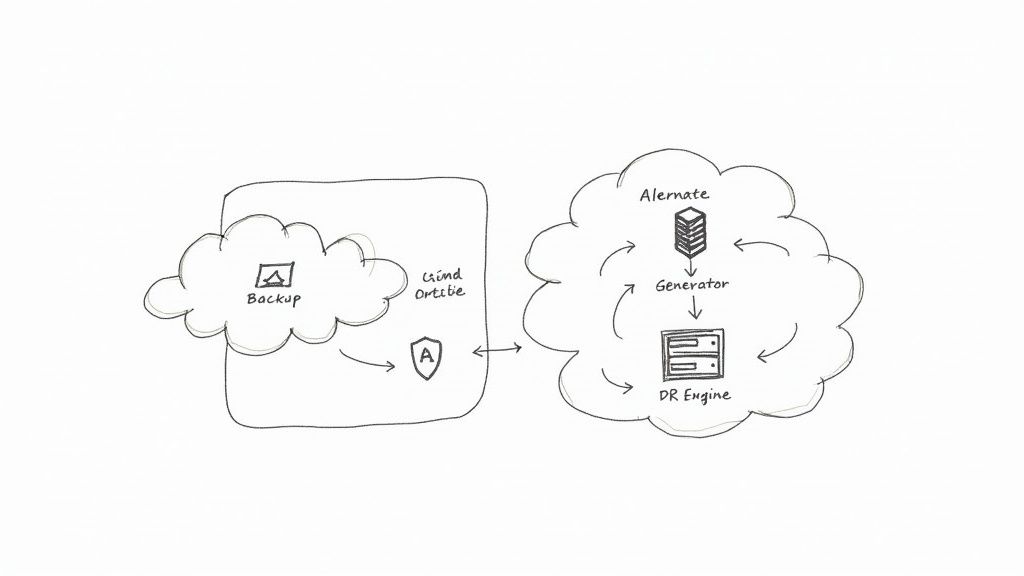
This isn’t about vague ideas. We’re talking about specific, actionable recovery strategies designed to counter the threats you’ve already mapped out, ensuring you can respond with speed and confidence.
The BCP and Disaster Recovery Plan Relationship
People often throw the terms business continuity plan and Disaster Recovery (DR) plan around as if they’re the same thing. They’re not. They are two sides of the same coin, but they serve different, complementary roles.
Think of your BCP as the master playbook for the entire business. It covers everything: people, processes, suppliers, and how you communicate with stakeholders. It’s the big picture.
Your DR plan, on the other hand, is a critical, specialised chapter within that playbook. It’s the engine room, focusing purely on the technical steps needed to get your data, systems, and digital infrastructure back online. While the BCP ensures your call centre staff can work from home, the DR plan is what makes sure the systems they need are actually running.
A Disaster Recovery plan is all about restoring IT systems and data after a disaster. A Business Continuity Plan is the much broader strategy that keeps the entire organisation functioning during and after that disaster. You simply cannot have a complete BCP without a rock-solid DR plan at its heart.
In the South African context, the stakes are incredibly high. Research shows a chilling statistic: around 40% of businesses never recover from a major disaster, and a further 27% fail within six months. Backing up your data isn’t enough; you need a plan to restore entire systems and applications fast. You can get a deeper look into this critical need in this deep dive on disaster recovery for SA businesses.
Building Your Toolkit of Practical Recovery Options
Your recovery strategies have to be grounded in reality—your specific risks, your budget, and the level of risk you’re willing to accept (as defined in your BIA). The goal is to create a defence with multiple layers so that one failure doesn’t cascade into a total shutdown.
Here are some tangible strategies to build into your business continuity bcp:
- Technology and Data Recovery: This is the core of your DR plan, and modern solutions are light-years ahead of old-school backups. Think about cloud-based data replication, which creates a live mirror of your systems in a secure, off-site location, allowing for almost instant restoration.
- Workplace Recovery: What’s the plan if your office is suddenly out of action due to a fire, flood, or protest action? A solid workplace recovery strategy could involve having a contract with a shared office provider on standby or equipping key staff for secure, long-term work from home.
- Supply Chain Diversification: Putting all your eggs in one supplier’s basket is a huge gamble. You need to proactively find and vet alternative suppliers for your most critical materials or services. This move alone can prevent a single point of failure from grinding your entire business to a halt.
Aligning Strategy with Reality
Choosing the right strategies is a balancing act between your Recovery Time Objectives (RTOs) and what your budget can handle.
If your BIA shows that your e-commerce site absolutely must be back online within one hour, you’ll need to invest in robust, automated failover systems. But if your internal accounting system has an RTO of 24 hours, a more manual restoration process from cloud backups might be perfectly fine—and far more cost-effective.
Your plan also needs to cover the basic infrastructure needs that are so often overlooked until it’s too late. Ask yourself:
- Backup Power: Do your critical servers have an uninterruptible power supply (UPS)? Is there a generator capable of handling extended stages of load-shedding?
- Communication Channels: What happens if your primary network goes down? You need an alternative way to talk, like a dedicated group chat on a separate platform, to coordinate your response team effectively.
- Key Personnel: Your plan must spell out exactly who is in charge of what during a crisis. Who has the authority to declare a disaster? Who calls the suppliers? Who keeps the customers informed?
By focusing on these practical, proactive measures, your business continuity bcp becomes more than just a document. It becomes a powerful tool for readiness.
5. Using AI to Future-Proof Your Business Continuity BCP
A traditional business continuity BCP is built for one thing: reacting to a crisis after it’s already happened. But what if you could see the storm coming before the first drop of rain? That’s exactly how Artificial Intelligence (AI) is flipping the script on continuity planning, shifting it from a reactive scramble to a predictive strategy.
Think about it. Instead of just having a plan for a supply chain failure, AI-powered tools can analyse global shipping data, weather patterns, and even social media chatter to flag a potential disruption weeks ahead of time. This gives you a massive head start—letting you line up alternative suppliers or reroute shipments long before your competitors even smell trouble.
How AI Strengthens Your BCP
Modern tech isn’t just about faster computers; it’s about smarter insights. South African companies are already using AI to build continuity plans that are alive and intelligent, not just static documents gathering dust on a shelf. A Gartner report noted that AI and machine learning are becoming integral to risk management by providing predictive insights into potential disruptions.
Here’s where AI makes a real, tangible difference:
- Predictive Risk Management: Machine learning algorithms are brilliant at spotting subtle patterns that a human might miss. They can signal an impending equipment failure or flag the early signs of a cyber-attack, giving you a chance to act before the system goes down.
- Automated Incident Response: When a disruption hits, AI can be your first responder. It can instantly trigger alerts, notify the right teams, and even kick off predefined recovery steps automatically, saving precious minutes when they matter most.
- Dynamic Resource Allocation: In the middle of a crisis, AI can process real-time data to help you make tough calls on where to put your limited resources. Should you reroute delivery vehicles? Prioritise which customer support tickets get answered first? AI provides the data to make the best decision.
The move towards AI for risk management is happening fast. Roughly 45% of South African companies are now using AI for exactly this, putting us ahead of the continental average. For instance, some local financial firms use machine learning to predict how climate events might impact their operations, while mining companies use it to forecast equipment failures and slash downtime. You can get a deeper look into how AI is shaping business continuity in South Africa.
A Balanced View on Technology Risks
While AI offers some incredible advantages, weaving it into your business continuity BCP also adds new layers of complexity. It’s a powerful tool, but it’s not a magic wand—especially when you factor in the unique realities of doing business in South Africa.
Relying solely on automated systems can create a dangerous blind spot. Your plan must account for what happens when the technology itself fails, ensuring you have robust manual overrides and well-trained teams ready to step in.
Before you jump into any new tech, you need to go in with your eyes wide open to the potential pitfalls.
- Data Privacy Compliance: AI systems often crunch massive amounts of sensitive data. If you don’t manage this perfectly, you could be facing serious compliance risks under regulations like POPIA.
- Infrastructure Dependency: What good is your smart, AI-driven system during a national power outage or when the internet goes down? Your plan absolutely must have a backup for when load-shedding or connectivity problems take your advanced tools offline.
- The Skills Gap: Running and maintaining sophisticated AI tools isn’t a job for just anyone; it requires specialised skills. Without the right in-house experts, you could end up with misconfigurations that create more risk than they solve.
At the end of the day, technology should be there to support your people, not replace them. When you strategically use AI to get better at prediction and to automate the boring stuff, you free up your team to make the critical, human-led decisions that truly matter when navigating a crisis.
6. Keeping Your BCP Relevant Through Testing and Updates
So, you’ve created your business continuity plan. That’s a huge step, but the work isn’t over. A plan that just sits on a shelf collecting dust is about as useful as a chocolate teapot. To turn that document into genuine organisational resilience, you have to bring it to life with consistent training, testing, and updates. This principle is a cornerstone of the BCI Good Practice Guidelines.
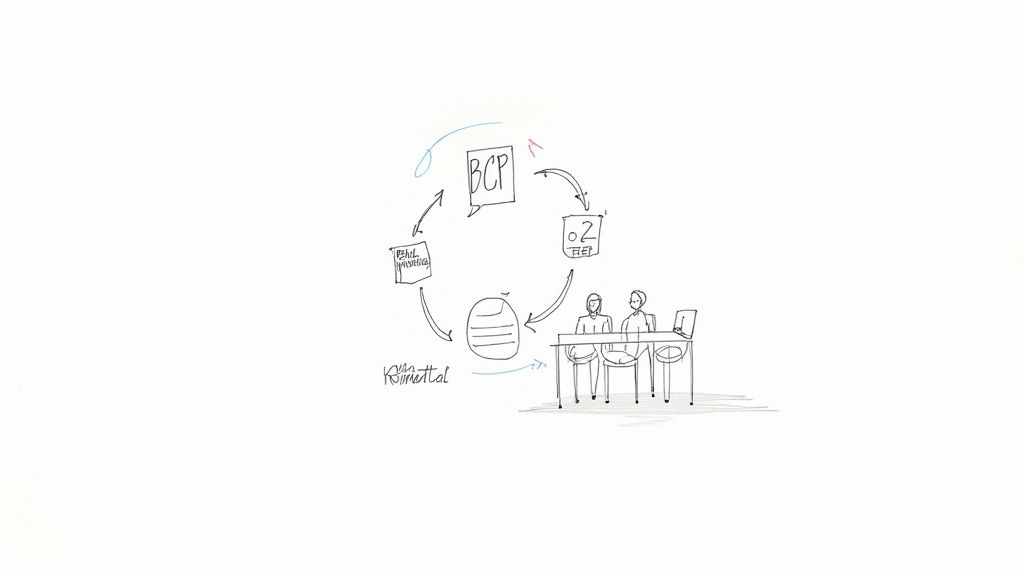
Think of your BCP as a finely tuned engine. It might look perfect on paper, but you’ll never know if it actually works until you turn the key. Regular testing and maintenance are what ensure that engine will roar to life the moment you need it most, rather than sputtering out and dying.
Embedding the Plan Within Your Organisation
A BCP is only effective if your team actually knows what to do. The first step is to get the plan out of a document and into your company culture through focused training. This is how you ensure that when a crisis hits, your people respond with practised calm, not panic.
Here’s what that training should cover:
- Role-Specific Drills: Every single person on the crisis management team needs to know their exact responsibilities, cold. Run drills where they practise their specific tasks, whether it’s activating communication channels or getting on the phone with backup suppliers.
- Clear Communication Chains: Establish and test a crystal-clear chain of command. Who has the authority to declare a disaster? Who talks to employees, customers, and the media? Any confusion here will only make a bad situation worse.
- Employee Awareness: It’s not just about the crisis team. All employees should understand the basics of the plan and know exactly who to contact in an emergency. This builds a company-wide culture of preparedness.
Finding Weaknesses Before a Real Disaster Does
The only way to find out if your plan has holes is to actively try and poke them yourself. Regular testing isn’t about passing or failing; it’s about learning and improving. As any risk management expert will tell you, these exercises are the only way to know if your procedures will hold up and if everyone truly understands their role.
An untested business continuity plan is not a strategy; it’s a theory. Testing transforms that theory into a proven, reliable capability, exposing flaws in a controlled environment so you can fix them before a real crisis does.
There are a few common testing methods, each with a different level of intensity. This lets you build up your team’s readiness over time.
- Tabletop Exercises: This is a great, low-stress starting point. Get your crisis team in a room, hit them with a realistic scenario (like a city-wide power outage), and have them talk through their response, step by step.
- Walk-through Drills: This is a bit more hands-on. Team members physically walk through their assigned recovery tasks, like checking backup power sources or accessing data from an off-site location.
- Full-Scale Simulations: This is the big one. It’s the most comprehensive test, simulating a real disaster as closely as possible. This could involve activating backup sites, restoring systems from scratch, and managing mock press conferences.
Establishing a Regular Review Cycle
Your business isn’t static, and neither are the risks you face. Your business continuity plan has to evolve with you. A regular review cycle—at least once a year, or whenever there’s a major change in the business—is non-negotiable for keeping your plan relevant and effective.
7. Common Questions About Business Continuity Planning
Even with a solid game plan, getting into the weeds of a business continuity BCP can bring up some tricky questions. Let’s tackle them head-on. Answering these common queries helps clear the fog and builds confidence as you put together a strategy that actually protects your business.
Here are the straightforward answers to the questions we hear most from business leaders across South Africa.
How Is Business Continuity Different from Disaster Recovery?
This one trips up a lot of people, but the difference is critical.
Think of it like a medical emergency. Disaster Recovery (DR) is the paramedic rushing to the scene. Their job is technical, immediate, and focused on stabilising the patient’s most vital systems—in this case, your IT infrastructure—right after the crisis hits.
Business continuity, on the other hand, is the entire hospital’s response. It’s the bigger picture. It covers everything from getting the patient to the hospital and into surgery (restoring core operations), to keeping the family informed (stakeholder communication), and even planning for physiotherapy and long-term care (getting all business functions back to normal).
In short, DR is a crucial piece of your BCP, but the BCP itself is the master plan for the whole organisation—people, processes, and all.
A huge mistake we see is people thinking their data backup plan is a DR plan. It’s not. Backups are just stored data. A real DR plan outlines the exact procedures, hardware, and software needed to get your entire IT operation back online within your target timeframe (your Recovery Time Objective).
How Often Should We Test Our BCP?
An untested plan isn’t a plan; it’s a guess. Best practice is to run some kind of test at least once a year. But the type of test you run can, and should, vary. For example, the ISO 22301 standard requires organizations to conduct exercises and tests at planned intervals.
- Annual Full-Scale Simulation: This is the big one. It’s a proper drill where you actually activate your backup systems and sites, mimicking a real disaster as closely as you can without breaking things.
- Bi-Annual Tabletop Exercises: These are structured, discussion-based sessions. You get your crisis team in a room and talk through a specific scenario, like a major supplier going bankrupt overnight, to poke holes in your plan.
- Quarterly Component Checks: Smaller, more frequent checks are just as important. This could be as simple as making sure the backup generators start or verifying that everyone’s contact details on the emergency list are still correct.
Consistency is everything. Your business is always changing—new people, new tech, new partners. Your business continuity BCP has to be tested and updated to keep up.
Who Should Be Involved in Creating the BCP?
This should never, ever be a one-person (or one-department) job. Shoving this onto the IT department and calling it a day is a classic recipe for failure. A real disruption doesn’t just hit your servers; it hits every single part of your business. As noted by industry bodies like DRII, successful BCP requires cross-functional collaboration.
Your core planning team needs a seat at the table for people from across the organisation:
- Executive Leadership: To give the plan authority and make sure it aligns with where the business is heading.
- IT and Cybersecurity: They handle the technical guts of data and systems recovery.
- Operations: These are the people who actually know how the business runs day-to-day. Their input is priceless.
- Human Resources: To look after employee safety, communications, and policies for things like remote work.
- Finance: To figure out the financial hit of a disruption and budget for the recovery efforts.
When you bring everyone together, you build a plan that’s realistic, complete, and has buy-in from the whole company. It’s how you connect your technical defences to what really matters: your business goals.
A solid business continuity BCP keeps your operations afloat, but you still need a central hub to manage everything else. CRM Africa pulls your project management, invoicing, and client communication into one place. It helps you keep closing deals and getting paid, even when things go sideways.
Start for free with CRM Africa and centralise your business operations today.