
For small and medium-sized enterprises (SMEs) and agencies across Africa, growth often brings complexity. Managing customer relationships, tracking sales pipelines, and handling invoicing manually can lead to disjointed workflows, friction in collecting payments via mobile money, and ultimately, lost revenue opportunities. A Customer Relationship Management (CRM) system is more than just a contact database; it's a central hub that organises your entire business operation, from the first contact to the final payment. According to a study by Grand View Research, the global CRM market is expected to expand at a compound annual growth rate (CAGR) of 13.9% from 2023 to 2030, highlighting its increasing importance for businesses worldwide.
This guide moves beyond generic descriptions to provide concrete CRM software examples tailored for the African market. We will explore real-world use cases, showing you exactly how businesses are solving regional challenges. Inside, you'll find detailed breakdowns of platforms like CRM Africa, HubSpot, and Skynamo, complete with screenshots of sales pipelines, invoice workflows, and client portals.
Our goal is to give you a strategic blueprint. Each example includes a deep analysis of the problem, the CRM solution, and the measurable outcomes. You will gain actionable takeaways and replicable strategies to help you select and implement the right CRM to manage client projects, integrate with M-PESA and other mobile money systems, and drive tangible growth for your organisation.
1. CRM Africa
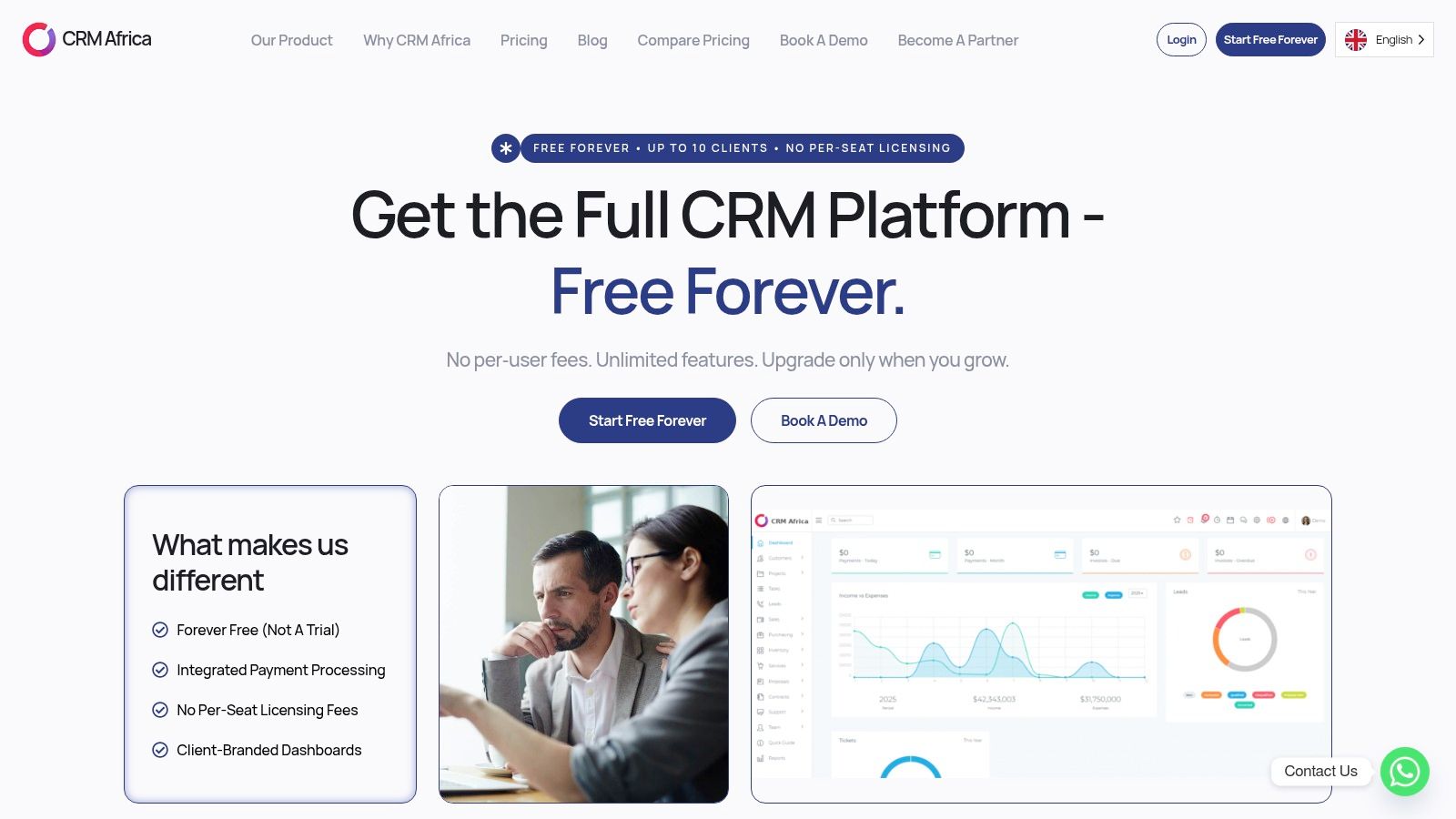
CRM Africa presents itself as a powerful, all-in-one business management platform built specifically for the operational realities of small and medium-sized enterprises (SMEs) across Africa. It goes beyond a simple contact database, combining sales automation, project management, and professional invoicing into a single, unified system. This integration is designed to reduce the need for multiple, disconnected software tools, centralising core business functions from lead management to final payment collection. For many growing teams, this consolidation is a significant step towards more organised and efficient operations.
The platform's standout strength lies in its deep integration with regional and global payment systems. It natively supports mobile money gateways like M-PESA and major African processors including Flutterwave, Paystack, and Pesapal. This focus on local payment methods is a critical differentiator, allowing businesses to offer one-click payment options on invoices that align with how customers in markets like Kenya, Nigeria, and Ghana actually transact. This direct approach helps accelerate cash flow and simplifies financial reconciliation, a common pain point for many African businesses. The platform also includes support for global gateways like Stripe and PayPal, making it a versatile tool for companies serving both local and international clients.
Key Strengths and Strategic Advantages
- Region-Specific Payment Integration: The ability to accept payments directly via M-PESA and other mobile money platforms is a significant operational advantage. It reduces payment friction, shortens the payment cycle, and meets customers where they are.
- No Per-Seat Licensing: CRM Africa’s pricing model is a major draw for startups and scaling teams. Instead of charging per user, its plans allow for a set number of users without incremental costs, removing a common barrier to growth.
- True All-in-One Functionality: By combining a sales pipeline, project and task management, contracts with e-signatures, inventory, and branded client portals, it provides a complete operational toolkit. This reduces "tool churn" and keeps all client-related activities in one place.
- Client-Facing Portals: A professional, client-branded portal where customers can view project progress, approve estimates, and pay invoices builds trust and improves the customer experience. This feature elevates the professionalism of small agencies and consultancies.
Pricing and Access
CRM Africa offers a tiered pricing structure that accommodates businesses at different growth stages:
- Forever Free: A genuinely free plan for up to 2 users and 10 clients, ideal for freelancers or new businesses.
- Kick Start: $69.99/month for growing teams.
- Thunder: $99.99/month for established businesses needing more capacity.
- Enterprise: $299/month for larger-scale operations.
Yearly billing provides a 20% discount. Users can start with a free account or book a demo to see the platform in action. For those new to the concept, CRM Africa also offers resources that explain the fundamentals of client relationship management.
Website: https://crm.africa
2. HubSpot CRM
HubSpot CRM is a widely adopted, modular platform known for its powerful free tier and its ability to scale with a business. For African SMEs and startups, it presents an accessible entry point into organised sales and marketing, offering a unified system for managing contacts, deals, and customer activities. Its strong onboarding experience allows teams to get started quickly, making it a popular choice for those wanting fast time-to-value. As of 2023, HubSpot reported serving over 200,000 customers worldwide, a testament to its broad appeal.
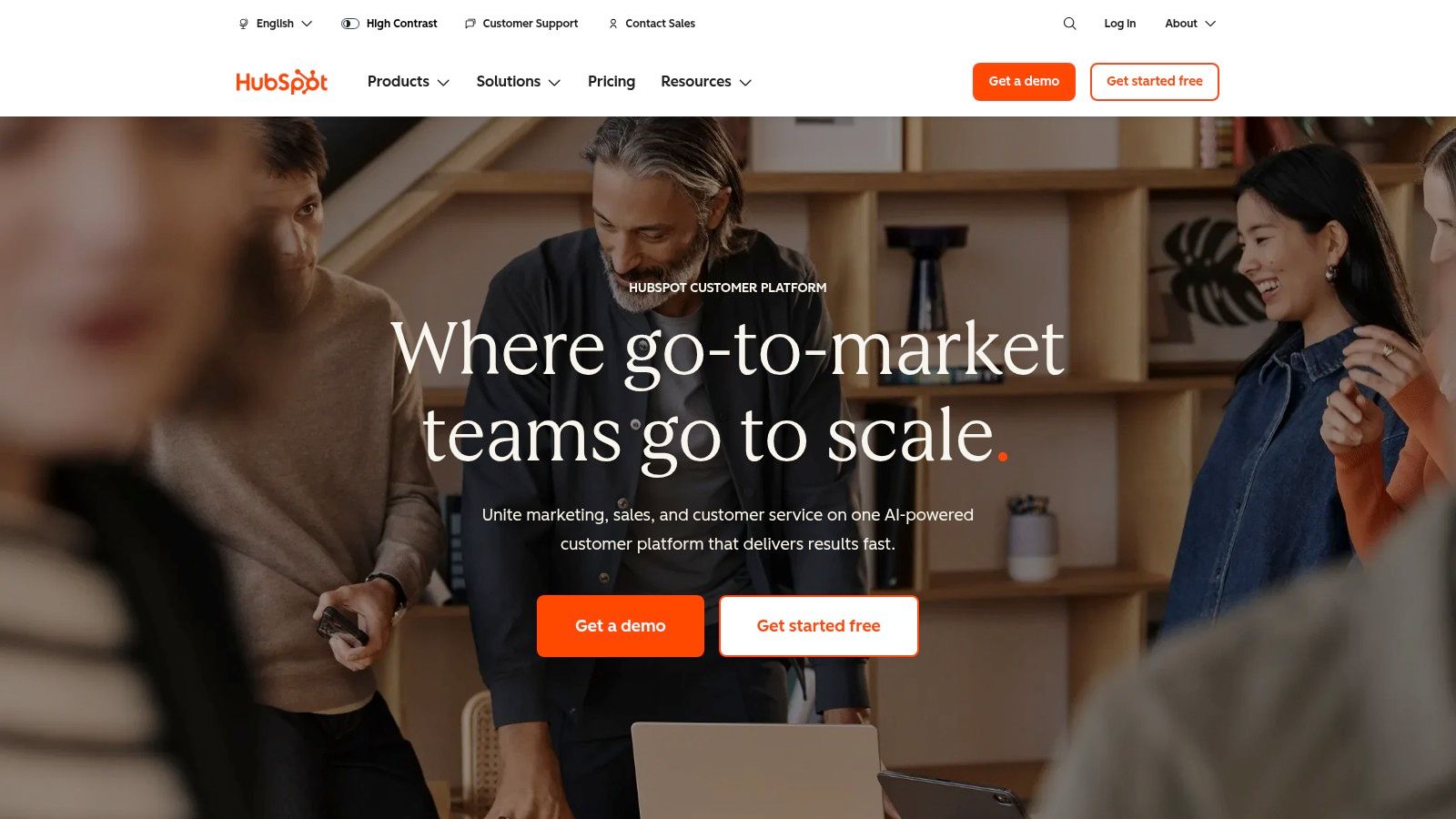
What makes HubSpot stand out among other crm software examples is its all-in-one approach, even in the free version. It bundles native tools for email marketing, meeting scheduling, live chat, and form building directly into the CRM. This integration means less time spent connecting third-party tools and more time focused on customer interactions. As a business grows, HubSpot's functionality expands through its paid "Hubs" for Marketing, Sales, Service, and Content Management, offering features like advanced automation, sales playbooks, and detailed forecasting.
Strategic Analysis
HubSpot’s freemium model is its core strategic advantage. It lets small teams and solo entrepreneurs organise their entire sales process without any initial financial commitment. However, the cost structure is a critical consideration for growing teams. The platform operates on a per-seat pricing model for its paid tiers, which can become expensive as a team expands. The jump from the free or Starter tiers to the Professional tier often involves significant cost increases due to bundled seat minimums and feature-gated add-ons. It's crucial for businesses to forecast their growth and understand how per-user fees might affect their budget; you can explore more about the impact of per-seat CRM pricing to see how this model compares to others.
While HubSpot has an extensive integration marketplace, it's important to note that direct integrations with African mobile money platforms like M-PESA are not native and often require custom development or third-party connectors like Zapier, which can add complexity and cost.
Key Takeaways:
- Pros: Excellent free plan for startups, great user experience, and a massive ecosystem of integrations.
- Cons: Paid plans can become expensive quickly, and key features for African payment processing require workarounds.
- Website: https://www.hubspot.com
3. Zoho CRM
Zoho CRM is a feature-rich platform that forms the core of the extensive Zoho ecosystem, popular with African SMEs for its balance of deep functionality and competitive pricing. It provides a powerful, customisable system for managing the entire customer lifecycle, from leads and deals to accounts and post-sale support. For cost-conscious organisations that need more than a basic sales tracker, Zoho offers an affordable path to advanced workflow automation, analytics, and integration with other business tools. According to the company, the Zoho suite serves over 100 million users across more than 55 applications.
What makes Zoho CRM stand out among other crm software examples is its seamless integration with the broader Zoho suite. Businesses can connect it to Zoho Books for invoicing, Zoho Desk for customer service, and Zoho Campaigns for email marketing, creating a unified operating system without relying on third-party connectors. This "all-in-one" approach simplifies operations and keeps costs down. Even on its own, Zoho CRM includes powerful features like custom modules, omnichannel communication tools, and, on higher tiers, an AI assistant named Zia for sales predictions and task automation.
Strategic Analysis
Zoho’s primary strategic advantage is delivering enterprise-grade functionality at an SME-friendly price point. Its free plan supports up to three users, and its paid tiers are significantly more affordable than many competitors, making it a strong choice for businesses needing advanced features without a large budget. The ability to create custom modules allows businesses in niche industries across Africa to tailor the CRM to their specific processes, whether tracking farm yields or managing logistics for imported goods.
However, the platform's depth can also be a challenge. The user interface is dense with options, and realising its full potential often requires a dedicated administrator or significant configuration time. While its integration with the Zoho suite is a major strength, connecting to external systems, especially local African payment gateways, might still need middleware like Zapier. For teams seeking a simpler, more focused solution that natively integrates with tools like M-PESA, other platforms such as CRM Africa offer a more direct approach for payment collection.
Key Takeaways:
- Pros: Highly competitive pricing with deep functionality, excellent for businesses invested in the Zoho ecosystem, and strong multilingual and multi-currency support.
- Cons: The user interface can feel overwhelming and requires time to configure; advanced analytics may require upgrading or adding Zoho Analytics.
- Website: https://www.zoho.com/crm/
4. Salesforce Sales Cloud
Salesforce Sales Cloud is a market-leading, highly extensible CRM built for organisations needing enterprise-grade customisation, analytics, and a large partner ecosystem. For established African businesses with complex operational needs, Salesforce provides a foundation for managing intricate sales processes, diverse customer segments, and extensive third-party toolchains. It is best suited for teams that anticipate complex workflows, require strong governance, and plan to scale significantly. Salesforce holds a dominant position in the CRM market, with a market share consistently reported to be over 20%.
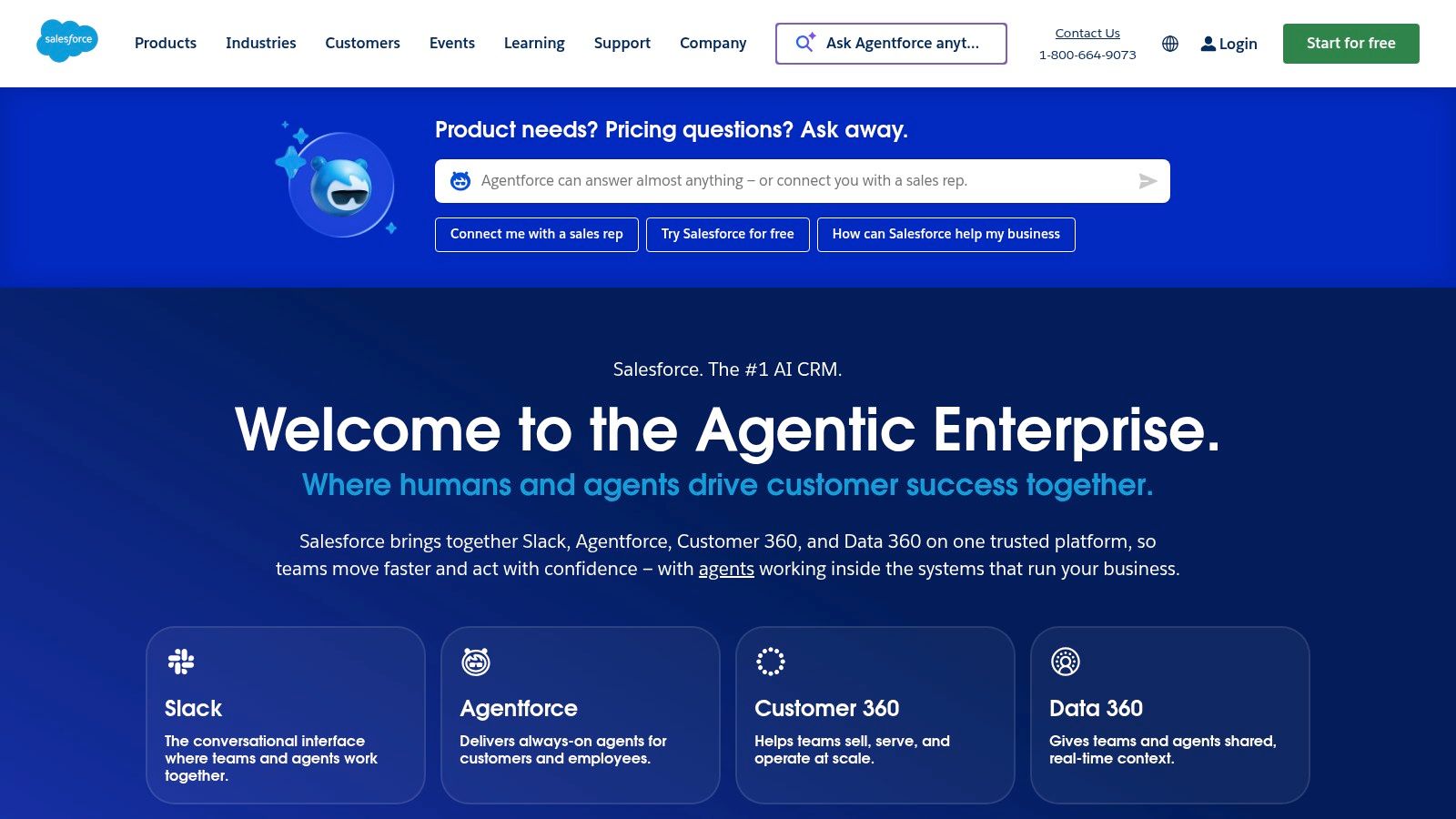
What makes Salesforce stand out among other crm software examples is its sheer depth and customisability. The platform's AppExchange marketplace is the largest of its kind, offering thousands of applications to extend functionality for nearly any business requirement. Its powerful data model and robust APIs allow for deep integrations, from ERP systems to custom-built applications. Features like advanced territory management, detailed forecasting, and AI-powered insights through Einstein give larger sales organisations granular control and predictive capabilities.
Strategic Analysis
Salesforce’s primary strategic advantage lies in its scalability and the breadth of its ecosystem. It is designed to be the central nervous system for an entire enterprise, not just a sales team. However, this power comes at a significant cost. The list pricing for its core editions is high, and many essential features are sold as expensive add-ons, which can substantially increase the total cost of ownership. The platform's complexity often means implementation requires certified consultants or partners, adding another layer of expense and time.
While the AppExchange is vast, direct, out-of-the-box integrations for African-specific payment gateways like M-PESA or Paystack are not standard. These typically require third-party apps or custom development, which can add complexity for SMEs. Furthermore, while Salesforce offers features for invoicing and project management, they often come as separate products (e.g., Salesforce CPQ, or through AppExchange apps), unlike platforms where you might find a CRM with invoicing and project management built-in from the start.
Key Takeaways:
- Pros: Unmatched ecosystem and third-party solutions, deep customisation, and strong role-based security.
- Cons: High total cost of ownership, and implementation often requires certified partners.
- Website: https://www.salesforce.com
5. Pipedrive
Pipedrive is a sales-first CRM known for its sharp focus on pipeline clarity and user-friendly design. It is built for sales teams that need to get up and running quickly, offering visual pipeline management and straightforward automation without requiring heavy administrative setup. For African sales teams, its intuitive nature means less time spent on training and more time focused on closing deals, making it a strong contender for businesses prioritising sales activity. Over 100,000 companies in more than 179 countries use Pipedrive to manage their sales process.
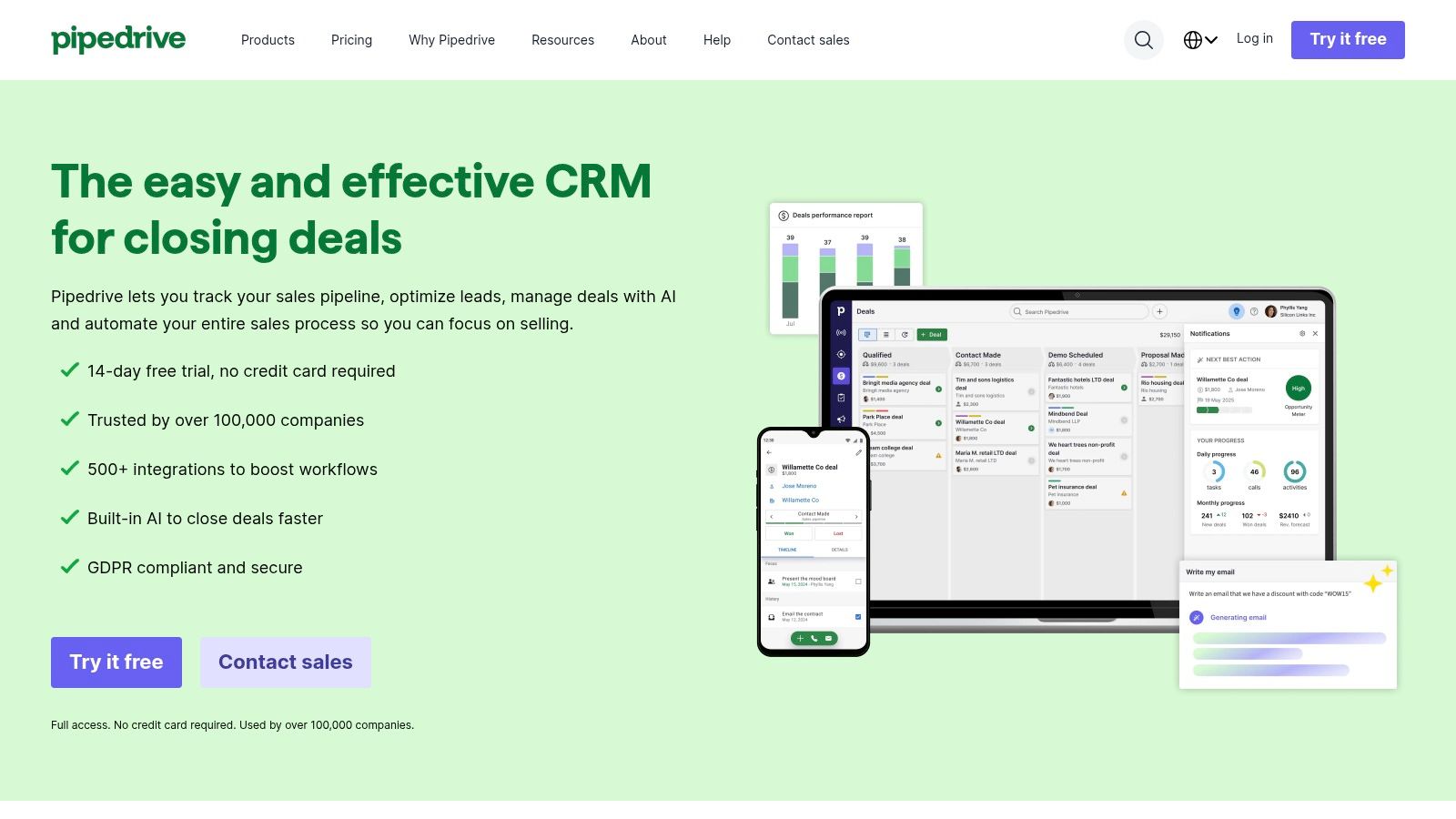
What makes Pipedrive a compelling choice among crm software examples is its unwavering dedication to the sales process. The drag-and-drop pipeline is the core of the experience, encouraging reps to focus on activities and move deals forward. Features like email sync, tracking, and a built-in scheduler are available on mid-tier plans to support these activities. As a business scales, Pipedrive offers modular add-ons for lead generation, web visitor tracking, and project management, allowing companies to expand functionality as needed.
Strategic Analysis
Pipedrive's core strategy is simplicity and sales focus, which translates to rapid adoption for most teams. Its activity-based selling methodology is baked into the platform, guiding reps to take the next best action. However, it operates on a free trial model, not a true free plan, meaning there is an inevitable cost after the trial period. This can be a barrier for early-stage startups compared to platforms offering permanent free tiers.
While the base plans are competitively priced, key features like advanced analytics, lead generation tools, and some automation capabilities are often gated behind higher tiers or require purchasing separate add-ons. This modular approach provides flexibility but can also increase the total cost of ownership. For businesses in markets like Kenya or Nigeria, it is important to note that direct integration with mobile money payment systems like M-PESA is not a standard feature and will require third-party tools, adding another layer of cost and management.
Key Takeaways:
- Pros: Extremely intuitive UI for sales reps, fast to set up, and good automation features for the price.
- Cons: No permanent free plan, and advanced features often require more expensive tiers or add-on purchases.
- Website: https://www.pipedrive.com
6. Freshsales (Freshworks)
Freshsales, part of the Freshworks suite, offers a modern, AI-powered CRM that is particularly appealing to small and medium-sized businesses in Africa. It is recognised for its strong value proposition, combining a user-friendly interface with built-in communication tools like phone and chat. This native functionality provides a cohesive system for sales teams to manage leads and conversations without relying on multiple separate applications. Freshworks serves more than 67,000 customers globally, demonstrating its popularity among SMBs.
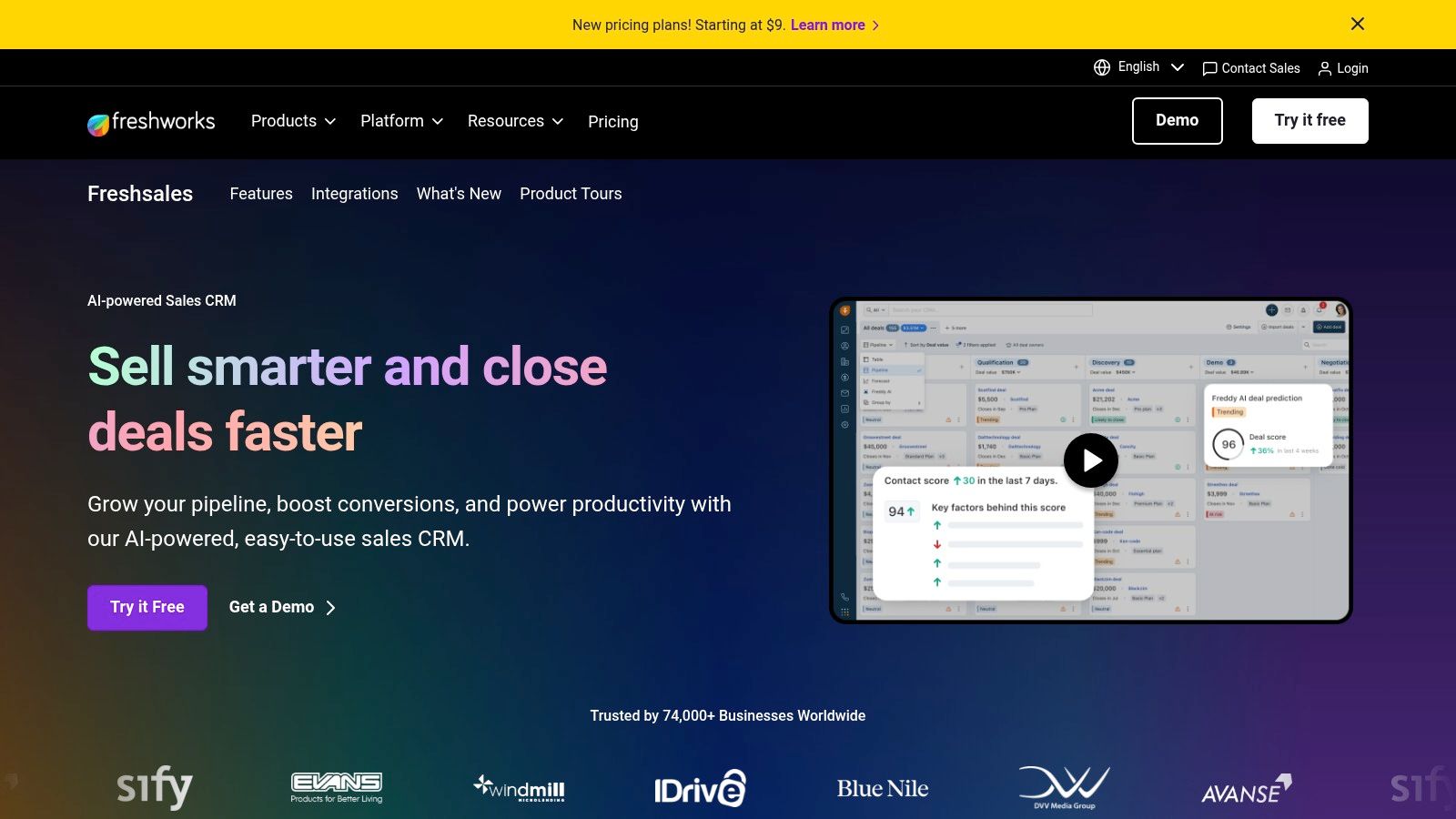
What makes Freshsales a notable entry among crm software examples is its focus on embedding sales intelligence directly into the workflow. Its AI assistant, Freddy, provides predictive contact scoring, identifies deals at risk, and offers insights to help salespeople prioritise their efforts. For African businesses looking to optimise sales efficiency, these features can guide teams to focus on the most promising opportunities. The platform also supports sales sequences, territory management, and multiple pipelines, providing the structure needed for a growing sales organisation to scale its processes effectively.
Strategic Analysis
Freshsales’ primary strategic advantage is its highly competitive pricing combined with robust, native communication features. The free plan provides a solid starting point for very small teams, while its paid tiers offer significant functionality at a cost that is often more accessible than competitors like Salesforce. This makes it an excellent choice for budget-conscious SMEs that still require advanced tools like AI-driven forecasting and lead scoring. The all-in-one nature of the core CRM reduces vendor complexity and associated costs.
However, businesses must consider the total cost of ownership if they plan to expand into the full Freshworks suite for marketing and customer service. While the core CRM is affordable, accessing the complete "Customer-for-Life Cloud" involves additional costs that can accumulate. Furthermore, while Freshsales offers integrations via its marketplace, direct, out-of-the-box connections to specific African payment systems such as mobile money are not standard. Implementing these often requires third-party tools or custom development, similar to the challenges found with other global CRM platforms. Another alternative to consider for deep local payment integration is a platform like CRM Africa, which is built with these specific regional needs in mind.
Key Takeaways:
- Pros: Very competitive entry-level pricing and a useful free plan, native phone and chat tools reduce the need for other software, and strong value in its higher-tier plans.
- Cons: The full marketing and sales suite costs more than the standalone CRM, and its integration ecosystem is not as extensive as those of larger competitors.
- Website: https://www.freshworks.com/crm/
7. Skynamo
Skynamo is a South African, mobile-first field sales CRM built for distributors, manufacturers, and FMCG teams that operate on the road. It is designed for low-connectivity environments, with strong offline capability, route planning, and deep integrations with ERP and accounting systems. For businesses with field representatives covering large geographies, it offers a specialised toolset to manage on-the-ground sales activities effectively. The company was founded in Stellenbosch, South Africa, giving it deep roots and understanding of the regional market.
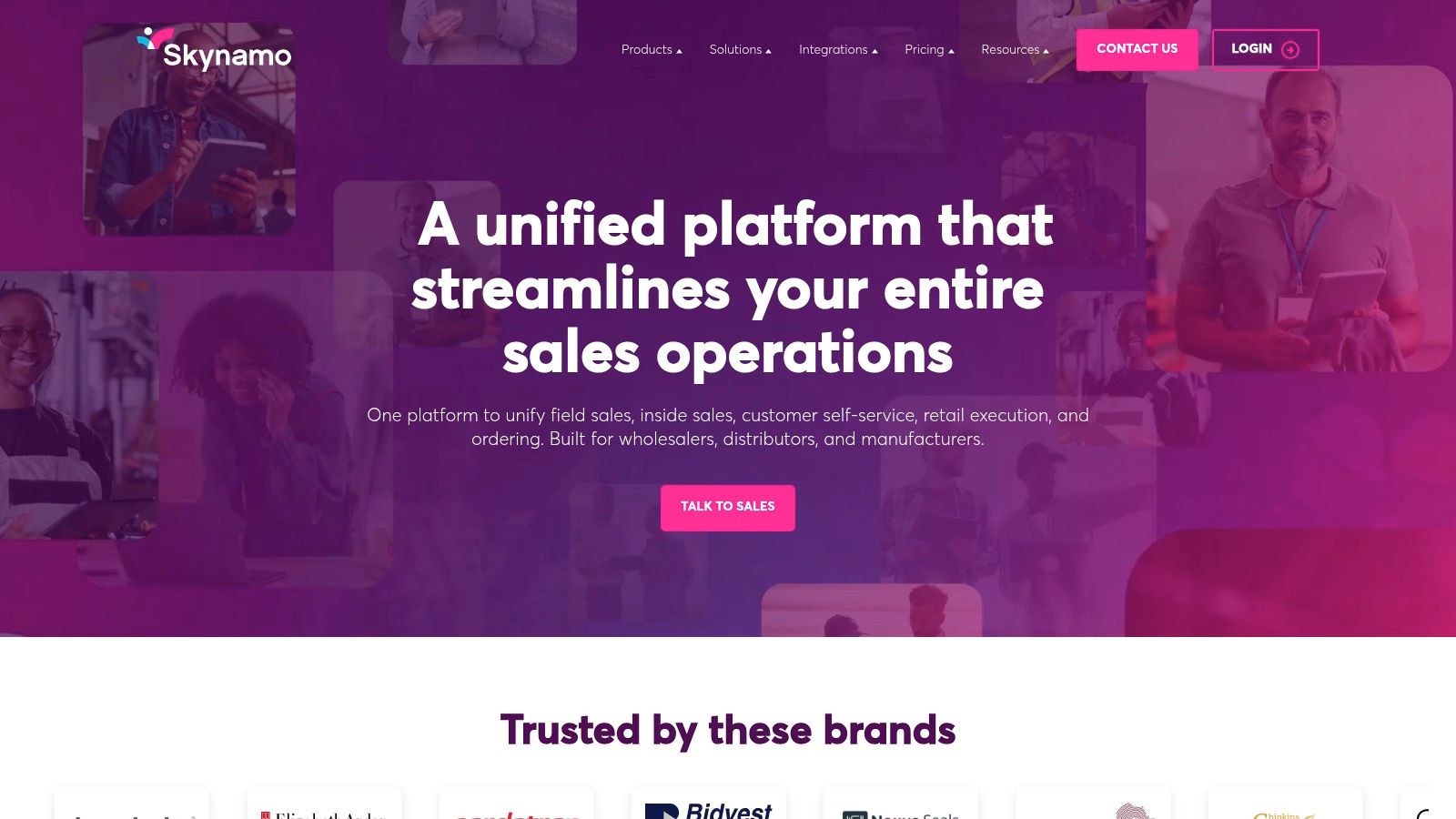
What makes Skynamo stand out among other crm software examples is its singular focus on the field sales representative. The native mobile app for Android and iOS gives reps real-time product catalogues, pricing, stock levels, and customer history, even when offline. This allows them to capture quotes and orders directly in the field, which then sync back to head office systems like Sage, Xero, or QuickBooks. This level of integration automates visit reporting and order processing, drastically reducing the administrative burden on sales teams.
Strategic Analysis
Skynamo’s core strength is its purpose-built design for the unique challenges of field sales in Africa, including intermittent internet access and the need for tight ERP integration. By not trying to be an all-in-one back-office suite, it excels at its primary function: empowering mobile teams. This contrasts with more general-purpose CRMs like CRM Africa, which provide a broader set of features including project management and billing in a single platform. Skynamo's approach is to perfect one part of the sales process and connect seamlessly with the systems that handle the rest.
A key consideration is its pricing model. Skynamo does not publicly list its prices, requiring businesses to request a customised quote. While this allows for tailored packages, it can make initial budgeting more difficult for SMEs who prefer transparent, tiered pricing. The month-to-month subscription model, however, offers flexibility and avoids long-term lock-in. Its local presence with offices in the Western Cape and Gauteng provides a significant advantage for South African businesses seeking accessible, hands-on support.
Key Takeaways:
- Pros: Purpose-built for field and van sales, excellent offline capabilities, and strong integrations with major ERP/accounting software.
- Cons: Not a complete back-office solution and relies on other systems; pricing requires a direct quote.
- Website: https://skynamo.com
Top 7 CRM Software Comparison
| Product | Implementation complexity | Resource requirements | Expected outcomes | Ideal use cases | Key advantages |
|---|---|---|---|---|---|
| CRM Africa | Low–Moderate; straightforward onboarding, some payment setup | Low for small teams; scales with paid plans | Centralized ops, faster payments, improved cash flow | Startups/SMBs in Africa needing invoicing + payments | Free‑forever tier, no per‑seat fees, native regional payments |
| HubSpot CRM | Low for basic use; Moderate–High for enterprise automation | Low to High: starts cheap, cost rises with seats/add‑ons | Fast time‑to‑value, scalable integrations and automation | Teams needing modular CRM with marketing & sales growth | Generous free plan, large app marketplace, strong automation |
| Zoho CRM | Moderate; configurable with some setup effort | Low cost; integrates easily with Zoho suite | Rich feature set at budget price, multi‑currency support | Cost‑conscious SMEs wanting extensibility into apps | Competitive pricing, deep functionality, Zoho ecosystem |
| Salesforce Sales Cloud | High; often requires certified implementers | High: significant admin, development and licensing | Enterprise‑grade customization, governance and scale | Large orgs with complex workflows, compliance needs | Extensive ecosystem, deep customization and security |
| Pipedrive | Low; very fast to set up and adopt | Low–Moderate; modular add‑ons as needed | Clear pipeline visibility and quicker sales adoption | Lean sales teams focused on pipeline efficiency | Intuitive UI, fast setup, good automation value |
| Freshsales (Freshworks) | Low–Moderate; easy for SMBs with built‑in tools | Low entry cost; additional suite features increase spend | Unified communications, AI insights, good SMB value | Startups/SMBs needing native telephony/chat and CRM | Native phone/chat, competitive pricing, Freddy AI |
| Skynamo | Moderate; mobile/offline config and ERP integrations | Moderate: mobile devices, ERP sync and user training | Reduced field admin, better route planning and order capture | Field sales, distributors, FMCG in low‑connectivity areas | Offline mobile app, GPS routing, ERP integration |
From Examples to Execution: Your Next Steps to CRM Success
Throughout this exploration of real-world CRM software examples, a clear theme has emerged. The right CRM is not merely a digital address book; it is a central nervous system for your business operations, especially for small and medium enterprises across Africa. The examples we’ve analysed, from the retail store in Nairobi streamlining its M-PESA payments to the Johannesburg-based consultancy managing client projects, all show that success comes from matching a specific business problem to a specific software solution. These are not just success stories; they are blueprints for efficiency and growth. Research consistently shows that a well-implemented CRM can increase sales by up to 29%, improve sales productivity by up to 34%, and boost forecast accuracy by 42%.
The key takeaway is that your biggest challenge should dictate your choice of tool. The array of CRM software examples demonstrates a solution for virtually every business bottleneck.
- For Streamlining Payments and Operations: If collecting payments via mobile money and managing invoices, projects, and clients in one place is your priority, an all-in-one system like CRM Africa, with its built-in regional payment gateways, offers a distinct advantage.
- For Scaling with Content Marketing: Businesses focused on generating inbound leads and nurturing them through content will find HubSpot CRM's free tools provide a solid foundation to start and grow.
- For Deep Customisation: For more complex organisations with unique operational needs, the extensive ecosystems of Zoho CRM and Salesforce Sales Cloud offer powerful, though often more intricate, customisation possibilities.
- For Activity-Driven Sales Teams: When the goal is to drive sales performance through clear, actionable steps, Pipedrive’s laser focus on the sales pipeline makes it a powerful ally.
- For Field Sales Management: For businesses with teams on the move, a mobile-first solution like Skynamo is essential for tracking field activities, managing orders, and empowering reps away from the office.
Your Actionable Checklist for CRM Implementation
Moving from theory to practice requires a methodical approach. The detailed CRM software examples in this article give you a head start, but your internal process is what will guarantee a return on investment. Before committing to any platform, follow these crucial steps to ensure you select and implement the right system for your unique context.
- Identify Your #1 Bottleneck: What is the single biggest pain point in your daily operations? Is it late payments? Disorganised lead tracking? Inefficient project handovers? Be specific. Your primary problem is your starting point.
- Shortlist 2-3 Relevant CRMs: Based on your bottleneck, select two or three platforms from our list that directly address that issue. Don't get distracted by features you don't need; focus on the core functionality that will make the biggest difference.
- Test the Workflow with Free Trials: Every CRM feels different in practice. Use the free trials or free-forever plans to run a real-world test. Can you easily build a sales pipeline? Does the invoicing process make sense for your business? Can your team actually use it?
- Prioritise a Growth-Friendly Model: Pay close attention to pricing structures. For scaling teams, solutions that penalise growth with high per-user fees can become expensive quickly. Look for platforms that offer generous user limits or flat-rate pricing.
The journey to operational excellence begins with a single, informed decision. The examples have shown what’s possible. Now, it's time to take that first step, armed with the knowledge of what works and a clear plan to apply it to your own business.
Ready to see how a CRM built for the African market can solve your specific challenges? CRM Africa integrates sales, invoicing, project management, and crucial mobile money payments into one simple platform. Book a free, personalised demo to discover how our solution can be configured for your exact business needs, just like the successful CRM software examples you’ve seen today.