If you're running a growing South African business, there’s a good chance that trusty Excel spreadsheet you use for customers is starting to feel less like a tool and more like a ticking time bomb. As your business expands, these manual systems quickly become a mess of errors and missed opportunities, making it nearly impossible to give customers the experience they expect. Switching to one of the many CRM systems South Africa has available is the single best move to turn that chaos into clarity and set your business up for real, sustainable growth.
Why Spreadsheets Are Holding Your South African Business Back
Let’s be honest—that collection of spreadsheets you’re using to juggle contacts, track sales, and handle service tickets is straining at the seams. Every new row and column just adds another layer of complexity, turning what was once a simple fix into a major business risk. This isn't just about messy data; it's about the very real opportunities that are slipping through the cracks every single day.
Think about it. Your customer information is probably scattered across different files, floating around in email inboxes, and maybe even scribbled on sticky notes. A sales rep has a game-changing conversation, but that goldmine of information never makes it to the marketing team. A service issue gets sorted out, but the sales team is left in the dark, missing a perfect chance to follow up. When everything is disconnected, you simply can't build proactive relationships.
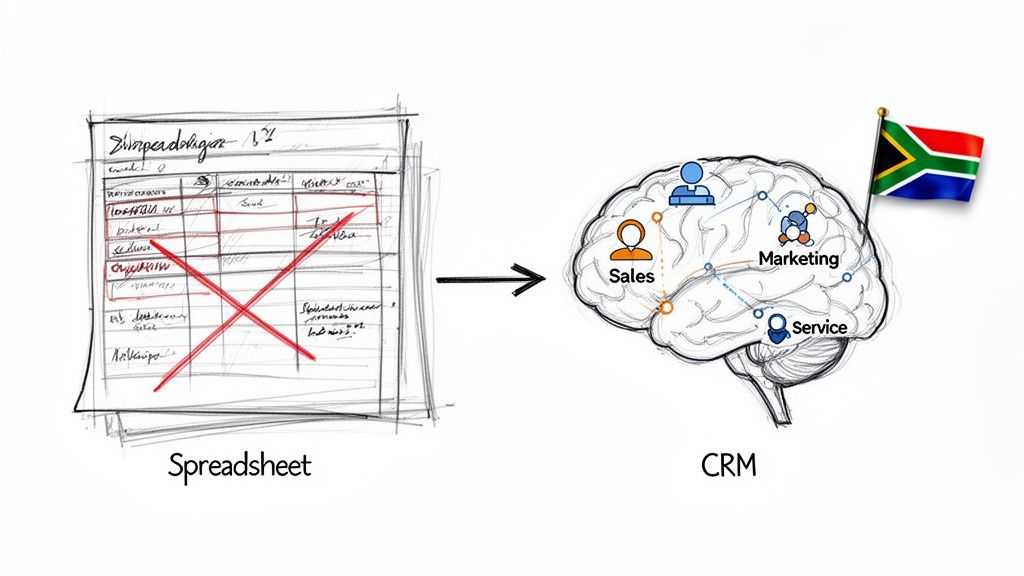
From a Digital Filing Cabinet to a Business Brain
This is where a Customer Relationship Management (CRM) system comes in. It acts as the central brain for your entire operation. Instead of a bunch of isolated files, it gives you a single, unified place where every customer interaction—from the first hello to the latest support ticket—is tracked and instantly accessible to your whole team. This simple shift changes absolutely everything.
A CRM transforms your business from being reactive and just solving problems to being proactive and actually managing relationships. It brings sales, marketing, and customer service together, giving you a complete 360-degree view of every customer.
This kind of connected system is a massive leveller for small and medium-sized enterprises (SMEs). With a proper CRM, your team can finally:
- Organise all customer data in one secure, easy-to-search place.
- Track every single conversation, whether it's an initial enquiry or post-sale support.
- Automate all those repetitive tasks, freeing up your team to build real connections.
- Get powerful insights into your sales performance and what your customers are actually doing.
Tapping into a Global Trend
Moving away from manual systems isn't just something happening here; it's a global shift. The worldwide CRM market is absolutely exploding and is projected to hit an incredible USD 320.99 billion by 2034, according to a report by Spherical Insights. As economies across Africa continue their rapid growth, the pressure is on for businesses to get their customer management right. The good news? This global boom means South African businesses now have access to more powerful and affordable tools than ever before.
But it goes beyond just managing customers. Spreadsheets also hold businesses back from exploring broader business process automation examples for SMEs that can improve all sorts of operational areas. A modern CRM is often the gateway to wider automation, helping you improve everything from invoicing to project management. Our guide on https://crm.africa/how-to-manage-clients-their-invoices-and-tasks-in-one-crm/ dives deeper into creating this kind of unified workflow. Ultimately, adopting a platform like CRM Africa, which is built to integrate these functions, can turn your business into a far more efficient, customer-focused machine.
A Look at the South African CRM Market in 2026
The market for CRM systems in South Africa isn't just expanding; it's evolving at a serious pace. We're seeing this happen for two big reasons: businesses everywhere are going digital, and there's a growing realisation that just finding new customers isn't enough. The real money is in keeping the ones you already have.
For South African businesses, this means a CRM is no longer a "nice-to-have" luxury. It’s becoming a core part of the toolkit for any company that wants to stick around and grow. This shift is creating some clear trends, especially for small and medium-sized businesses (SMEs), many of whom are just starting their CRM journey.
The Cloud is King
One of the biggest changes we're seeing on the ground is the huge shift to cloud-based CRMs, also known as Software-as-a-Service (SaaS). The days of needing a dedicated server room and a massive upfront cheque for software licenses are thankfully behind us. Today’s cloud tools offer incredible flexibility, letting you start small and add more firepower as your business grows.
This is a complete game-changer for South African SMEs. It gives them access to the kind of powerful systems that, just a few years ago, were only available to huge corporations. Platforms like HubSpot, Zoho, and our very own CRM Africa are making it possible, offering affordable and scalable ways to get started. Paying a predictable monthly fee without the headache of maintenance has opened the door for everyone.
A Market with Plenty of Room to Grow
While more and more businesses are getting on board, the market is nowhere near full. South Africa is currently the largest and most developed CRM market in Africa, but there’s still a huge slice of the pie left. In fact, around 20% of South African organisations are still running without a proper CRM system in place, as noted in market analyses.
That number tells a story. It highlights a massive opportunity for CRM providers who truly get the needs of local businesses. You can dig deeper into this trend by checking out the in-depth analysis of the South African CRM software sector on Statista.com. The race to bring these businesses into the fold is on, with both global giants and focused local players like us vying to help them succeed.
To give you a clearer picture of where things are headed, here's a quick summary of the key market dynamics we're tracking.
At a Glance: South African CRM Market Trends for 2026
| Market Trend | Key Statistic or Insight |
|---|---|
| SME Adoption Rate | Increasing rapidly as SMEs move from spreadsheets to their first formal CRM. |
| Cloud CRM Dominance | Over 85% of new CRM implementations are expected to be cloud-based (SaaS), according to Gartner forecasts. |
| Untapped Market | Roughly 20% of organisations still operate without a dedicated CRM system. |
| Mobile-First Approach | High demand for CRMs with strong mobile apps for sales and service teams on the move. |
| Integration Needs | Priority on integrations with local payment gateways (PayFast, Yoco) and accounting software (Xero, Sage). |
| Market Size Projection | The market is forecast to continue its double-digit annual growth through 2026, per Statista. |
These trends show a market that is not just growing, but getting smarter and more specific in its demands.
For a South African SME, adopting a CRM is no longer just about organising contacts. It’s a strategic decision to build a more resilient, customer-centric business that can compete effectively on both a local and global stage.
CRM Is Now a Core Business Investment
Smart companies in South Africa aren't just spending on marketing; they're pairing those budgets with serious investments in CRM and automation. They don't see this tech as a cost. They see it as an engine for bringing in revenue and getting ahead of the competition.
When you bring all your sales, marketing, and service data into one place, you start to understand your customers on a much deeper level. This clarity helps you make better decisions everywhere:
- Smarter Marketing Campaigns: When you know a customer's history, you can create personalised marketing that actually speaks to them.
- A More Efficient Sales Team: Your sales reps can stop guessing and start focusing on the most promising leads, armed with all the info they need to close deals.
- Proactive Customer Service: Your support team can spot potential problems and offer solutions before they turn into major complaints, keeping customers happy.
Ultimately, putting your money into the right CRM system builds the foundation for growth that lasts. It's how you turn customer data from a messy spreadsheet into your most valuable business asset.
Comparing the Top CRM Systems for Local SMEs
Trying to pick the right CRM can feel like wading through a sea of options, all shouting that they're the best. To find what truly works, you need to look past the marketing noise and compare platforms based on what a South African SME actually needs. This means putting the big international players side-by-side with strong local contenders.
The goal is simple: find a system that fits your budget, your team's current size, and where you want to grow. For most local businesses, the decision usually comes down to a handful of well-known and effective CRM systems South Africa has already put to the test.
This infographic gives a great overview of the current landscape, showing where the real opportunities are for smaller businesses right now.
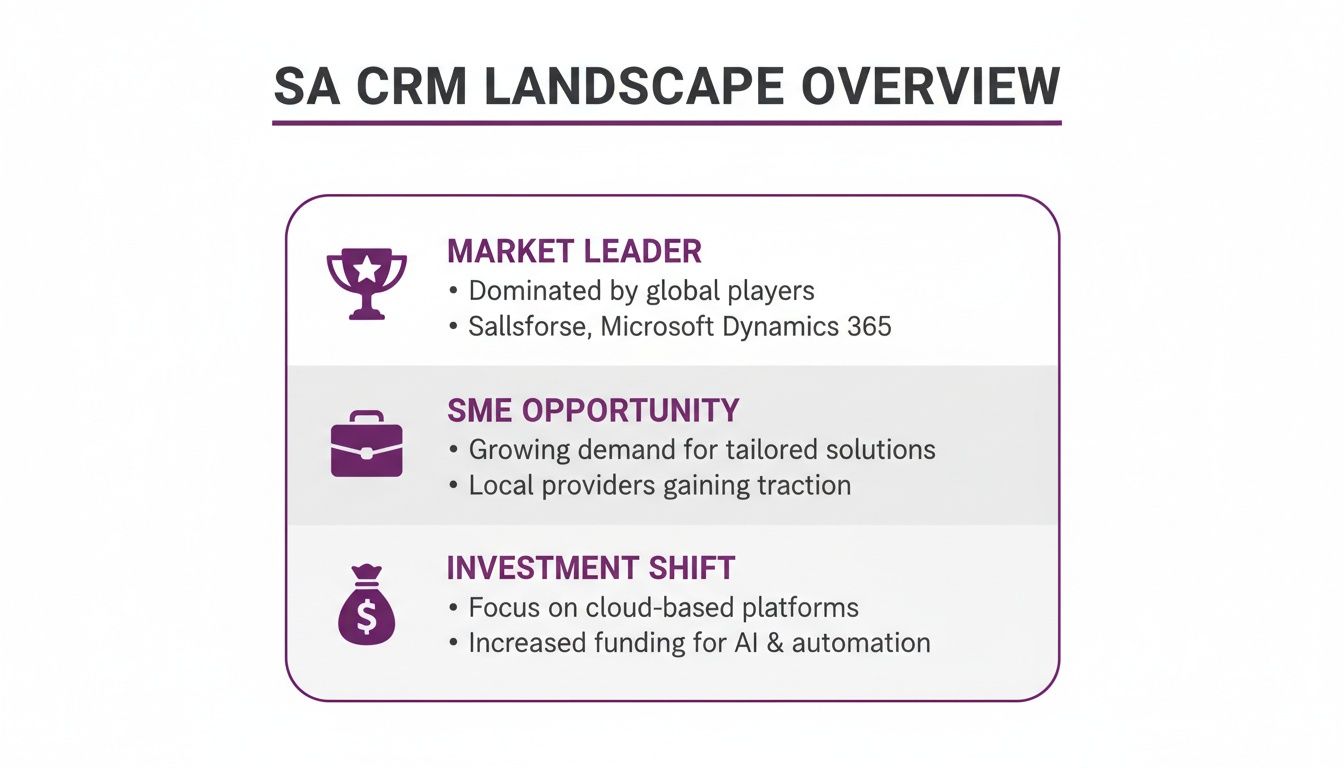
The data tells a clear story. While the big names are firmly in place, the most exciting growth is coming from SMEs who are finally making serious investments in their customer relationship tools.
The International Powerhouses
A few global CRM brands have a major footprint in South Africa. They offer feature-rich, powerful platforms and are often the first stop for businesses starting their CRM journey.
- Salesforce: As the global giant, Salesforce delivers an incredibly deep and customisable platform. It’s generally a better fit for larger companies or fast-growing SMEs with complex sales funnels and the budget to match its power.
- HubSpot: Famous for its easy-to-use interface and best-in-class marketing tools, HubSpot is a go-to for businesses that live and breathe inbound marketing. The free CRM is an amazing starting point, but be aware that costs can climb as you add more sales and service features.
- Zoho: Zoho offers a massive suite of connected business apps, with Zoho CRM sitting at the heart of it all. It's a fantastic choice if you want an all-in-one ecosystem, but figuring out its different plans and bundles can sometimes feel a bit overwhelming.
While these platforms are undeniably robust, their global focus sometimes means that local nuances—like specific payment gateways or straightforward ZAR pricing—aren't always front and centre.
The Local All-in-One Champion: CRM Africa
On the other hand, you have local solutions built from the ground up with the South African market in mind. This is where CRM Africa really shines, offering a complete platform designed for the day-to-day realities of local SMEs.
The real game-changer for a lean South African business is finding a single platform that handles clients, projects, and invoicing. This eliminates the cost and complexity of juggling multiple subscriptions, a common pain point with many other systems.
CRM Africa smartly combines core CRM functions with project management and invoicing, turning it into a single, cost-effective hub for your whole business. Its generous free-forever plan is a massive advantage, letting teams jump in and get organised without any upfront financial risk. And because it doesn't charge per user, you can grow your team without being penalised by rising software costs.
A Realistic Look at Pricing
Getting a handle on the true cost is vital. Many CRMs lure you in with low starting prices, but the features you actually need are often tucked away in more expensive tiers.
The pricing for CRMs in South Africa varies wildly, with options for nearly every budget. For example, Salesforce might start from USD 25 (~R450) per user, but a genuinely functional setup for a team often lands in the USD 75-150+ (~R1,350-R2,700+) range. Zoho CRM has plans from USD 12 (~R215), though most SMEs will find the sweet spot in tiers costing USD 20-45 (~R360-R810). This just goes to show why you have to look beyond the advertised price.
Feature and Pricing Comparison of Popular CRMs in South Africa
To make things a bit clearer, we've put together a simple table comparing these platforms on the things that matter most to a growing South African business.
| CRM Platform | Ideal For | Key Feature Highlight | Starting Price (Approx. ZAR) |
|---|---|---|---|
| Salesforce | Large enterprises with complex needs | Unmatched customisation and third-party app ecosystem. | ~R450/user/month (Essentials) |
| HubSpot | Marketing-focused teams and startups | Excellent free CRM and inbound marketing automation tools. | Free, with paid Sales Hub from ~R810/month |
| Zoho CRM | Businesses needing a wide suite of apps | Integrated ecosystem of over 50 business applications. | ~R215/user/month (Standard) |
| CRM Africa | SMEs needing an all-in-one solution | Combines CRM, projects, and invoicing with no per-user fees. | Free Forever Plan (Paid plans offer more) |
This table is a great starting point, but the "best" CRM is always the one that aligns with your specific business goals. For a closer look at a wider variety of platforms, be sure to check out our detailed guide on examples of CRM software.
Ultimately, the best CRM systems South Africa can offer are those that equip you for today's challenges while giving you a clear, affordable path to grow tomorrow.
Must-Have Features for the South African Market
When you're looking at the different CRM systems South Africa has available, it's easy to get lost in a sea of feature lists. But here’s the thing: it’s not about finding the one with the most features. It’s about getting the one with the right ones.
A generic CRM, built for a different market, can quickly turn into a source of constant frustration. For a South African SME, your CRM needs to do more than just store names and numbers. It has to understand how we do business here—from how we get paid to the laws we follow, and how our teams work when they’re out on the road.
Let's break down the non-negotiable features that make a CRM a genuine asset for a local business.
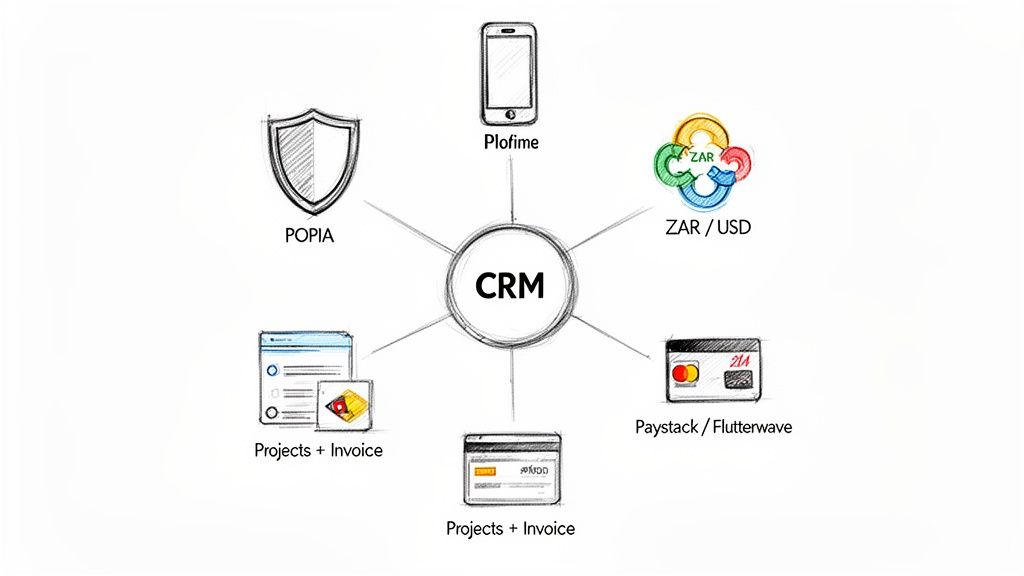
Seamless Local Payment Gateway Integrations
Let's be honest, getting paid is the whole point. And in South Africa, that means using the payment gateways your customers already know and feel safe with. A top-tier CRM for our market needs to integrate smoothly with local champions like Paystack and Flutterwave.
This isn't just about sticking a payment button on your website. True integration runs much deeper, allowing you to:
- Generate and send professional invoices straight from your CRM with just a click.
- Embed a "Pay Now" link right on the invoice, making it incredibly easy for clients to settle their accounts instantly.
- Automate your payment reconciliation, so incoming funds are automatically matched to the right invoice.
This kind of slick automation doesn't just improve your cash flow; it frees up hours of mind-numbing admin work. It's why solutions like CRM Africa are built from the ground up with these Pan-African payment rails in mind—to make getting paid faster and less of a headache.
Built-in POPIA Compliance Tools
The Protection of Personal Information Act (POPIA) isn't just some legal footnote; it’s a core part of doing business in South Africa. Handling customer data the right way isn’t optional—it’s the law. Your CRM should be your best friend when it comes to compliance, not another risk to manage.
Think of a good CRM as the very foundation of your POPIA strategy. It brings all your customer data into one secure, organised place, which is infinitely easier to manage and protect than a chaotic mess of spreadsheets.
Your CRM needs to give you tools like role-based access controls, so you can decide exactly who gets to see or change sensitive information. It should also help you manage consent for marketing, keep a clear record of opt-ins, and let you respond quickly when someone asks to see or delete their data.
Multi-Currency Support for ZAR and Beyond
While most of your business might happen in Rands, the world is getting smaller. You might find yourself invoicing a client in Namibia or using a service provider from Kenya. Your CRM needs to handle different currencies without giving your bookkeeper a panic attack.
The absolute must-have is solid support for the South African Rand (ZAR) as your main currency for all your reporting and local invoicing. But a great platform will also let you create an invoice in a client's currency while still tracking your revenue perfectly in ZAR back home. It's a level of flexibility that industry leaders like Sage and Salesforce also recognise as crucial for modern business.
Robust Mobile Accessibility
Your team isn't glued to their desks from 9 to 5. Your sales reps are out meeting clients, and your field technicians are on-site fixing problems. A CRM that only works on a desktop is a serious handicap in today's world.
A clean, powerful mobile app is non-negotiable. It gives your team the power to:
- Look up and update customer details from anywhere, at any time.
- Log notes from a meeting or call the second it’s over.
- Check their sales pipeline and daily tasks while grabbing a coffee between appointments.
This kind of real-time access means your data is always up-to-date, your team is always in sync, and opportunities don't get lost just because someone was out of the office.
All-in-One Platform Efficiency
For any small or medium-sized business, every Rand counts. Juggling separate monthly subscriptions for your CRM, project management software, and invoicing tool is expensive and clunky. The most powerful CRM systems South Africa can offer SMEs are the ones that bring these vital functions under one roof.
An all-in-one system like CRM Africa gives you a massive advantage. When your client management, project tasks, and billing are all connected, you eliminate the frustrating data silos that cause so many problems. This unified view gives you a true 360-degree picture of your business, letting you manage the entire customer journey from one single, streamlined dashboard.
Your Step-by-Step Guide to Choosing and Launching a CRM
Making the leap to your first CRM can feel like a massive undertaking, but it doesn’t have to be a headache. The secret is breaking the entire process down into simple, manageable stages. This practical roadmap will walk you through choosing and launching the right system for your South African business, helping you sidestep common pitfalls and get your team on board from day one.
Think of it like building a house. You wouldn't just show up and start laying bricks without a detailed blueprint. In the same way, you need a clear plan before you commit to a CRM platform. A little bit of focused prep work now will pay off in a big way down the road.
Step 1: Define Your Goals
Before you look at a single feature or watch one demo, ask yourself the most important question: "What problem are we actually trying to solve?" Your answer is the compass that will guide every other decision you make. Are you trying to shorten your sales cycle? Get a better handle on your leads? Or maybe just claw back the hours your team loses to manual admin?
Get specific. Vague goals like "improve sales" are useless here. You need clear, measurable targets. For example:
- Increase lead conversion by 15% in the next six months.
- Cut down time spent on invoicing by 5 hours per week.
- Improve customer retention by 10% over the next year.
With concrete goals like these, it becomes much easier to evaluate the different CRM systems South Africa has to offer and see which one truly lines up with what you need to achieve.
Step 2: Map Your Customer Journey
Next, it's time to walk in your customer's shoes. How do people first find out about you? What are the exact steps they take to make a purchase? And what happens after the sale is done? Mapping this entire journey, from initial awareness to becoming a loyal fan, is non-negotiable.
This exercise will shine a light on all the key moments where a CRM can make a real difference. You might realise your lead follow-up is painfully slow, the handover from sales to support is a mess, or you have no real way of knowing who your most valuable customers are. Finding these friction points shows you exactly where the right CRM will deliver the most impact.
A customer journey map is like a diagnostic tool for your business. It highlights the cracks in your current processes that a good CRM is designed to fix, ensuring you invest in a solution that solves real-world problems.
Step 3: Involve Your Team and Create a Feature Shortlist
Do not, under any circumstances, skip this step. Your team are the ones who will live inside this software every day. If they don't see the value in it, or if it makes their jobs harder, they simply won't use it. Low user adoption is the number one killer of CRM projects, a fact widely cited by industry analysts at firms like Forrester and Gartner.
Get your sales, marketing, and service staff in a room. Ask them about their biggest daily frustrations and what tools would make their lives genuinely easier. Based on their feedback and the goals you set in step one, put together a "must-have" feature list. This might include things like:
- A visual sales pipeline for the sales team.
- Integrated invoicing and payment links for your accounts person.
- A shared calendar for the project team to track client work.
This approach doesn't just help you choose the right features; it gives your team a sense of ownership and makes them part of the solution from the very beginning.
Step 4: Set a Budget and Test Drive the Options
With your feature list ready, you can finally start looking at vendors. It's crucial to understand the total cost of ownership, not just the advertised monthly price. Some platforms, like Salesforce or Sage, can have complex pricing tiers and expensive add-ons. Others, like CRM Africa, offer a more straightforward model. To dig deeper on this, you can learn how to choose a CRM without per-user fees in our detailed guide.
Don't just watch slick demos—get your hands dirty with free trials. Ask your core team members to use the system for a real-world task. Can they add a new lead without getting confused? Can they create and send an invoice easily? Does the interface feel intuitive? This hands-on testing is the single best way to know if a platform is the right fit.
Step 5: Plan a Smooth Launch
Once you’ve made your choice, a successful rollout is all about smart planning. Don’t try to do everything at once.
- Start with a Pilot Group: Pick a small, enthusiastic group of users to go first. Their feedback will be gold for ironing out any kinks before you roll it out to the whole company.
- Prioritise Data Migration: Decide what customer data is absolutely essential to move over. Start with clean, current data. This is not the time to migrate years of messy, outdated spreadsheets.
- Invest in Training: Schedule proper training sessions for everyone. Don't just show them how to use the CRM; show them why it will make their jobs better and help the business grow.
By following these steps, you can move from evaluation to implementation with confidence, ensuring your new CRM becomes a powerful engine for growth—not just another software subscription gathering digital dust.
Got Questions About CRMs in South Africa? We’ve Got Answers.
Even after seeing all the benefits laid out, taking the leap into the world of CRM systems in South Africa can feel like a big step. It’s natural to have a few nagging questions before you commit. We get it.
These are the practical, real-world questions we hear every day from entrepreneurs and team leaders just like you. Let's tackle them head-on so you can make a decision with confidence.
How Much Does a CRM System Actually Cost in South Africa?
Alright, let's talk brass tacks. This is usually the first question on everyone's mind, and the honest answer is: it's a huge range. A CRM in South Africa can cost you anything from nothing at all to thousands of Rands every month, depending on how complex it is and how many people are on your team.
You can get your foot in the door for R0 with platforms like CRM Africa or the free version of HubSpot, which are fantastic for startups and small businesses wanting to test the waters. For paid plans, many popular CRMs start somewhere in the R200–R450 per user, per month ballpark. Then you have the heavy hitters like Salesforce, where advanced plans can easily sail past R2,700 per user.
The most important factor isn't the starting price but the total cost as you grow. Look for a scalable solution that doesn't penalise you with high per-user fees every time you add a new team member.
Is a CRM Going to be a Nightmare to Set Up and Use?
This is a common fear, but let me put your mind at ease. Modern cloud-based CRMs are built for normal people, not IT wizards. The days of needing a dedicated tech team just to get software running are long gone. Most platforms today have clean, intuitive layouts, visual dashboards, and step-by-step guides to get you up and running fast.
All-in-one platforms like CRM Africa make life even simpler by keeping all your tools under one roof, so there's no need to juggle and connect a dozen different apps. While moving your existing data might feel like a big task, the secrets to a smooth transition are a phased rollout and solid team training. Get that right, and you'll have everyone on board and excited to use the new system.
How Does a CRM Help with POPIA Compliance?
A CRM is one of your best friends when it comes to staying compliant with the Protection of Personal Information Act (POPIA). Think about it: instead of customer data being scattered across insecure spreadsheets, random documents, and countless email inboxes, a CRM gives you a single, secure database. That alone is a massive step towards meeting the Act's requirements.
A good CRM helps you tick the compliance boxes in a few key ways:
- Access Control: You can set up role-based access, giving you total control over who can see or change sensitive customer information.
- Consent Management: It's built to help you manage marketing consent, keep track of opt-ins, and maintain a clear audit trail. No more guesswork.
- Data Subject Requests: When someone asks to see, fix, or delete their personal info (as is their right), a CRM makes it simple to find and manage that data, keeping you on the right side of the law.
Can I Use South African Payment Gateways with a CRM?
Yes, but this is where choosing the right CRM becomes absolutely critical. This is a deal-breaker for many local businesses. A lot of the big international platforms have very limited or clunky support for South African payment providers, forcing you into awkward workarounds. You need a system that actually understands our local payment scene.
Solutions built with the African market in mind, like CRM Africa, come with seamless, built-in integrations for popular gateways like Paystack and Flutterwave. This isn't just a nice-to-have; it's a huge advantage that lets you:
- Create and fire off invoices directly from the CRM.
- Pop a payment link right into the invoice so clients can pay you online, instantly.
- Automate a huge chunk of your financial admin and reconciliation.
This direct integration is a game-changer for your cash flow and saves you countless hours of manual work. It's a core function that platforms like Sage also prioritise to make life easier for their users.
Ready to stop juggling spreadsheets and start building better customer relationships? CRM Africa provides the all-in-one platform your South African business needs to manage clients, projects, and payments in one place. Start for free and see how a unified system can transform your workflow.
Explore the features and sign up today at https://crm.africa.