An electronic point of sale (EPOS) system is basically a computerised network that ties together your sales, stock, and customer information in one place. It's what you get when a classic cash till grows up and gets smart, combining hardware and software to track every single transaction your business handles.
Understanding The Electronic Point of Sale System
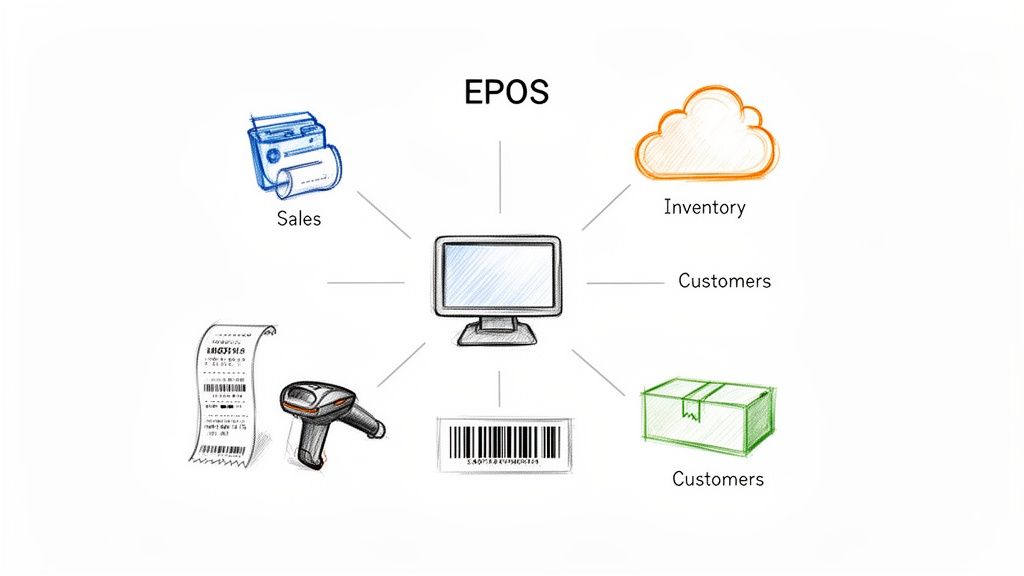
Picture your business's central nervous system for a moment—a single hub that processes every sale, keeps an eye on every product, and remembers every customer. That’s exactly what an electronic point of sale system does. It's so much more than a digital cash register; it’s the command centre for your entire shop.
To really get it, we first need to understand what is a POS system and the basic role it plays beyond just taking money. An EPOS takes the daily chaos of running a business and turns it into a smooth, automated process. It grabs data right at the "point of sale"—the moment a transaction happens—and instantly shares that info with different parts of your business.
From Cash Till to Command Centre
The jump from a clunky old cash till to a modern EPOS is a big one. A traditional till just tracks money coming in and out, leaving you with the headache of manual stock-takes and separate bookkeeping. That old-school approach isn't just a time-sink; it's a magnet for human error, which can hit your bottom line hard. As noted by industry experts, manual data entry can have error rates as high as 1%, which can significantly impact financial reporting and inventory accuracy.
A modern EPOS, on the other hand, gives you a connected, data-rich environment. Every time a barcode is scanned or a service is tapped on the screen, the system kicks into gear and does several things all at once:
- Processes the payment quickly and securely.
- Updates inventory levels in real-time, so you don't run out of your bestsellers.
- Records sales data for you to look at later.
- Ties the purchase to a customer's profile, building a relationship.
This tight integration of sales, stock, and customer information gives you powerful insights to make smarter calls. You can see your top products at a glance, pinpoint your busiest hours, and start to truly understand your customers' buying habits.
An electronic point of sale system isn’t just a tool for processing transactions. It's the data-driven heart of a modern business, paving the way for smarter decisions on everything from stock and customer loyalty to your overall growth strategy.
Why SMEs in Africa Are Making the Switch
For small and medium-sized enterprises (SMEs) across Africa, bringing in an electronic point of sale system isn't just a fancy upgrade—it's a strategic move to boost efficiency and unlock real growth. Manual methods create bottlenecks that choke a business's ability to scale. A report from the GSMA highlights that digital transformation is a key driver for SME growth in emerging markets, with payment automation being a critical first step.
By automating tasks like stock-takes and sales reporting, business owners and their staff get precious time back. Instead of spending hours counting boxes or wrestling with spreadsheets, they can focus on what really matters: marketing, talking to customers, and planning their next move. That shift is absolutely vital for staying competitive and building a business that lasts.
The Core Features Every Modern EPOS Should Have
When you think of an electronic point of sale system, it’s easy to focus on the hardware—the sleek touchscreen, the barcode scanner, and the receipt printer. But while that’s the part you see and touch, the real magic happens inside the software. This is the brain of your business, the engine that does so much more than just process payments.
A truly modern EPOS is all about its software capabilities. To get real value, you need to look for a system built on three core pillars. These are the non-negotiables that separate a simple digital cash register from a powerful business management tool.
Real-Time Inventory Management
The single most important feature of any serious EPOS is real-time inventory management. This is way more than just a digitised product list. It's a live, constantly updated picture of your stock levels, whether you sell from a physical shop, an online store, or both.
Every time an item is sold, returned, or received from a supplier, the system automatically adjusts the count. This smart tracking means you can finally wave goodbye to those long, frustrating nights of manual stock-takes that are always full of errors. More importantly, it helps you avoid the two biggest profit killers in retail: stockouts (running out of your best-selling items) and overstocking (having too much cash tied up in products that just don’t move).
A good EPOS should have:
- Low-stock alerts: Get automatic notifications when it’s time to reorder, so you never miss a sale because an item is out of stock.
- Purchase order automation: Create and send purchase orders to your suppliers directly from the system, making reordering a breeze.
- Stock transfers: If you have more than one branch, you need the ability to easily move inventory between your locations to meet local demand.
This level of control keeps your capital flowing instead of being stuck on shelves, and it makes sure you never have to tell a customer, "Sorry, we're sold out."
Powerful Sales and Analytics Reporting
For a small business, data is everything, and your EPOS is the machine that collects it. It captures a huge amount of information with every transaction, and its analytics and reporting features are what help you make sense of it all. This is where you graduate from simply running your business to truly understanding it.
Strong analytics transform raw sales numbers into a clear roadmap. They show you what's working, what isn't, and where your biggest opportunities for growth are hiding.
Look for a system that gives you clear, customisable reports on the metrics that matter most. You should be able to see your best-selling products at a glance, pinpoint your busiest hours of the day, and track how different staff members are performing. This isn't just nice-to-have information; it's essential for making smart decisions about everything from staff scheduling and marketing promotions to which products you should double down on.
Customer Relationship Management (CRM)
A sale shouldn't be the end of the conversation with your customer; it should be the beginning of a relationship. That's where Customer Relationship Management (CRM) features come into play. A good EPOS helps you build loyalty by capturing customer details (with their permission, of course) right at the checkout. According to research, acquiring a new customer can be five times more expensive than retaining an existing one, making CRM a critical function.
This lets you create detailed profiles for each customer, tracking what they buy, how often they visit, and how much they spend. Armed with this insight, you can start to:
- Build targeted marketing campaigns: Send a special discount to your top customers or a friendly "we miss you" email to those who haven't stopped by in a while.
- Create loyalty programmes: Reward repeat business with points or exclusive deals. Many modern systems have robust coupon management capabilities, allowing you to run targeted promotions and track them effortlessly.
- Personalise the customer experience: Imagine greeting a regular by name and suggesting a new product based on their past purchases. That’s the kind of service that builds loyalty.
While many EPOS systems include basic CRM tools, some businesses, especially service providers or B2B companies, often need something more robust. For them, an all-in-one platform might be the answer. A CRM with invoicing and project management capabilities can offer a much more complete picture of the entire client journey.
Top platforms like HubSpot, Pipedrive, Zoho, and CRM Africa are great at integrating sales and customer data, giving you the tools to turn one-off buyers into true fans of your brand.
Connecting to Africa's Payment Ecosystem
For any EPOS to work in Africa, it has to speak the local financial language. A system that can’t handle the payment methods your customers actually use is little more than a fancy calculator. This means plugging directly into the continent’s diverse and booming payment scene isn’t just a nice-to-have feature—it’s absolutely essential for survival.
The reality for small and medium-sized businesses (SMEs) across Africa is that customers demand flexibility. Whether they want to pay with mobile money or an international card, your ability to say "yes" is what keeps them coming back. A modern EPOS is the bridge that connects your till to the financial tools your customers carry in their pockets every day.
Tapping into Mobile Money
Across the continent, mobile money isn't just an alternative; for millions, it's the primary way they handle their finances. With an estimated 760 million registered accounts in Sub-Saharan Africa as of 2022, according to the GSMA's 'State of the Industry Report on Mobile Money', services like M-PESA, MTN Mobile Money, and Airtel Money are woven into the fabric of daily life. Any EPOS worth its salt has to connect seamlessly with these platforms.
This integration lets a customer pay straight from their mobile wallet with a quick tap or a few clicks. The impact on your business is immediate.
- Faster Transactions: Forget counting cash or waiting for a card machine to connect. Queues move faster, and customers are happier.
- Reduced Risk: Less cash in the till means less risk of theft and fewer headaches from human error when cashing up.
- Automatic Reconciliation: Payments are instantly logged in your EPOS, which means no more tedious hours spent manually matching mobile money statements to your sales records.
If you're looking to really grasp the power of this, check out how a CRM with mobile money integration can completely overhaul your payment process. This direct link is a massive leap forward for any business's efficiency.
The diagram below shows how an EPOS acts as the central nervous system for your business, connecting sales, stock, and customer data.
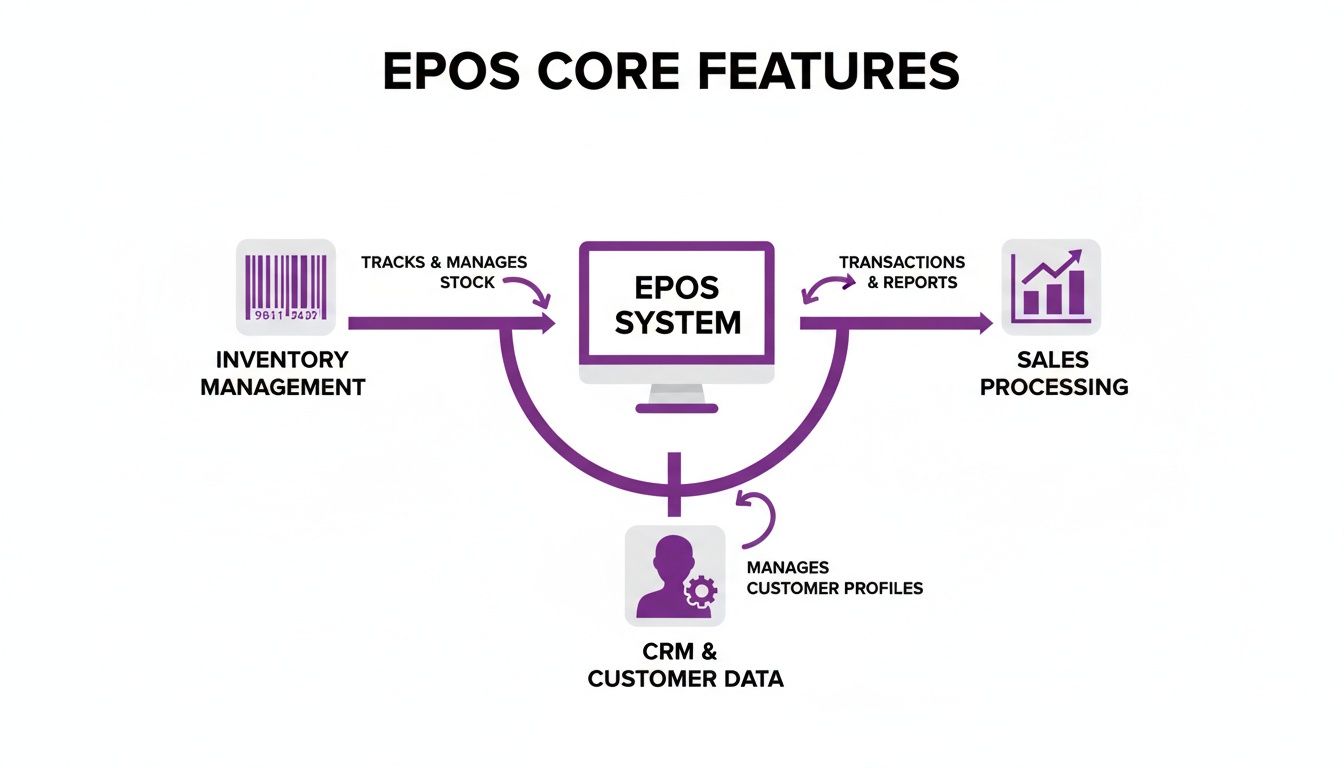
As you can see, the EPOS isn't just for taking payments. It’s a hub that ensures every transaction instantly updates all the moving parts of your operation.
Integrating with Modern Payment Gateways
Of course, mobile money is only part of the story. African businesses also need to serve customers who prefer traditional banking methods or use international credit cards. That's where payment gateways come in. Think of them as secure go-betweens, processing payments from all kinds of sources and making sure the money lands safely in your account.
A good EPOS will integrate with the major pan-African and global gateways that your customers trust.
- Paystack: A powerhouse in Nigeria and Ghana, it's known for reliably handling card payments, bank transfers, and even USSD.
- Flutterwave: With a massive footprint across Africa, it lets businesses accept payments in multiple currencies from a huge variety of methods.
- DPO Group: Operating in over 20 African countries, it offers a solid solution for processing cards, mobile money, and even payment links for remote sales.
For SMEs, an EPOS with integrated payments can lead to a significant reduction in transaction errors and a notable increase in customer satisfaction simply by making checkouts faster and more convenient, as corroborated by various case studies on digital payment adoption.
A Frictionless Customer Journey
Let's walk through what this looks like in the real world. Imagine a customer walks into your boutique in Nairobi, finds an item they love, and comes to the counter. With an integrated EPOS, the entire checkout is smooth and professional.
Your staff scans the item. The EPOS screen shows the payment options: card, M-PESA, or Airtel Money. The customer chooses M-PESA, you type in their number, and they get an approval prompt on their phone.
Once they approve it, the EPOS instantly confirms the sale, updates your inventory levels, logs the transaction in your reports, and prints a receipt. The whole thing takes less than a minute. No fumbling for change, no scribbling a manual receipt, and no need to keep checking your phone to see if the payment came through. This isn't just about saving time; it's about building trust and creating an experience that makes customers want to shop with you again.
An electronic point of sale system isn't just a fancy cash register. Thinking of it that way misses the point entirely. It's a strategic move, an investment in how your business runs, grows, and ultimately, succeeds. The tech is cool, sure, but the real magic is in what it lets you do.
Let's move past the technical jargon and talk about the real-world results. I find it helps to think about the benefits in three main areas: making your day-to-day operations smoother, giving you a much tighter grip on your finances, and unlocking serious business growth.
Pillar 1: Supercharge Your Operational Efficiency
The first thing you'll notice when you switch to a modern electronic point of sale system is just how much faster everything gets. All those repetitive, manual tasks that eat up your day? The EPOS automates them, freeing you and your team to focus on what really matters—like talking to customers or thinking up your next big marketing idea.
It’s like hiring the most efficient assistant you've ever had. Checkouts are quicker, which means shorter queues and happier customers. Studies on customer experience consistently show that long wait times are a major reason for purchase abandonment.
This efficiency goes straight to your stockroom. Forget guesswork and endless manual counts. The system becomes your eyes and ears.
- Automated Stock Alerts: Get a ping on your phone when your best-selling items are running low. This simple feature can save you from the disaster of a stockout on a busy weekend.
- Fewer Human Errors: Manually typing in sales and stock figures is a recipe for mistakes. An EPOS minimises these slip-ups, so you can actually trust the numbers you're looking at.
- Simpler Daily Tasks: From placing new orders with suppliers to managing staff schedules, your daily workflow becomes a whole lot less complicated.
Pillar 2: Get a Smarter Grip on Your Finances
To build a business that lasts, you have to know your numbers inside and out. An EPOS acts as your financial command centre, serving up clear, accurate, real-time data so you can stop guessing and start making decisions with confidence.
Let's be honest, manual bookkeeping is a nightmare. Trying to reconcile cash sales with mobile money payments and card transactions can take hours. An integrated EPOS brings all of it together—every payment from M-PESA, card, or cash—into one clean dashboard. For the first time, you might have a truly accurate, up-to-the-minute picture of your revenue.
With detailed and automated reporting, you can shift from just putting out fires to actually planning for the future. You’re using real historical data to predict what’s coming next, and that’s a powerful place to be.
This kind of accurate reporting is a lifesaver for financial forecasting, and it makes tax time so much less painful. Many systems can generate the specific reports you need for tax filings. Given the complex rules around sales tax on digital and physical goods in different regions, having precise records isn't just helpful—it's essential for compliance.
Pillar 3: Unlock Real Business Growth
At the end of the day, any investment you make should help your business grow. An EPOS gives you the insights to not only keep your current customers happy but to find new ones and turn them into regulars.
The data your EPOS collects is pure gold. By looking at sales trends, you can instantly see which products are flying off the shelves and which services are your most profitable. This lets you double down on what's working, run promotions to shift slower stock, and make much smarter buying decisions. A local restaurant, for example, can see which dishes are popular on which days, helping them perfect their menu and slash food waste.
But it goes deeper than that. Many EPOS systems come with built-in customer relationship management (CRM) features that help you turn one-time buyers into loyal fans. By tracking what people buy and when, you can:
- Spot Your VIPs: Identify your top customers and create special offers or loyalty programmes just for them.
- Personalise Your Marketing: Send targeted promotions based on past purchases to bring people back through the door.
- Build Actual Relationships: Stop seeing customers as just transactions and start building a community around your brand.
While some EPOS tools have basic CRM, dedicated platforms like HubSpot, Pipedrive, Zoho, and CRM Africa take this to another level. They help you organise customer info, track every interaction, and build the kind of lasting relationships that form the bedrock of a healthy, growing business. When you truly understand who your customers are and what they want, you can consistently give them a reason to choose you over the competition.
A Practical Checklist for Implementing Your First EPOS
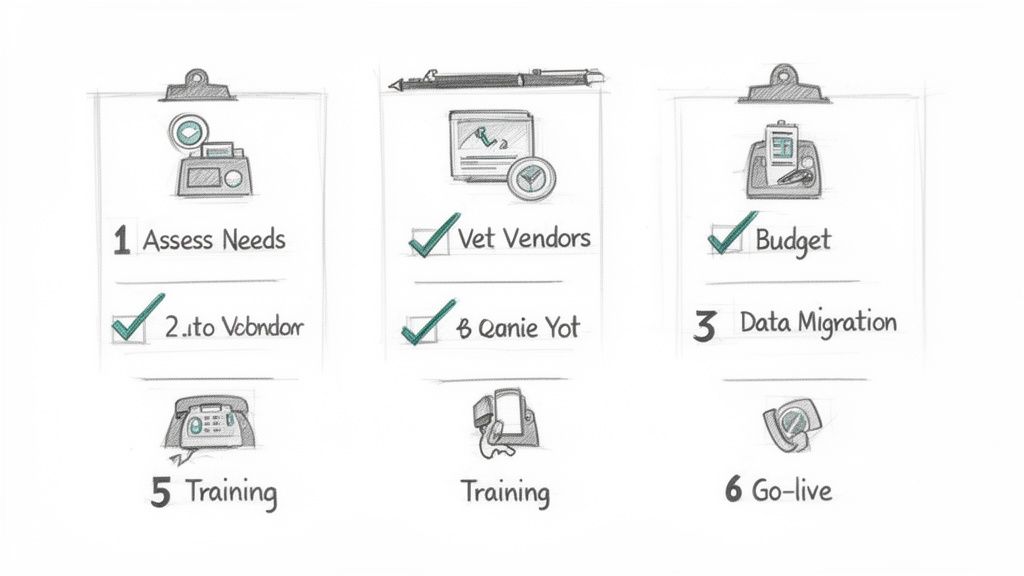
Making the jump to an electronic point of sale system is a big, exciting move for any business. But without a clear plan, that excitement can quickly turn into a headache.
To make sure your transition is as smooth as possible, we've put together a practical checklist. Think of it as a roadmap to help you dodge common mistakes and get your new system humming along perfectly from day one.
1. First, Figure Out What Your Business Actually Needs
Before you even start window shopping for vendors, you need to take a good, hard look at your own operations. What are the biggest headaches you're trying to fix? Getting crystal clear on your pain points is the single most important step.
For instance, are you always getting caught off-guard when your best-selling items run out? If so, a system with powerful, real-time inventory management should be at the top of your list. Or maybe you're missing sales because you can't easily accept mobile money? In that case, seamless integration with platforms like M-PESA is an absolute deal-breaker.
Take a moment to create a simple list of "must-haves" versus "nice-to-haves." This little exercise will keep you grounded and prevent you from getting sidetracked by flashy features you'll never use.
2. Choose Your Vendor Wisely
Once you know what you need, it's time to find the right partner to provide it. And make no mistake, choosing a vendor is just as critical as choosing the software itself. You're looking for a provider who genuinely understands the local African market and won't leave you hanging when you need support.
When you're talking to potential vendors, ask the tough questions:
- Local Support: Do they have a team on the ground that operates in your time zone? Nothing is more frustrating than waiting 24 hours for an email response when your system is down.
- Scalability: Can this system grow with you? You want something that makes it easy to add new locations, bring on more staff, or open an online store down the road.
- Payment Integrations: Does it work with the payment gateways and mobile money services your customers actually use every day?
An electronic point of sale system is a long-term relationship, not a one-off purchase. Look for vendors who are transparent about their pricing, offer great training, and have a clear vision for how their product will evolve.
3. Plan Your Budget with Your Eyes Wide Open
It's an easy mistake to make: you look at the monthly software fee and think you've got the cost covered. In reality, the sticker price is just one piece of the puzzle. A realistic budget needs to account for everything.
Make sure you've factored in:
- Hardware: This could be anything from touchscreen tills and barcode scanners to receipt printers and cash drawers.
- Software Fees: These are usually a monthly or annual subscription. Costs often scale with the number of users or the features you need.
- Payment Processing: Remember, every single transaction comes with a small fee. Get a clear breakdown of the rates for both card and mobile money payments.
- Training: Don't forget to account for the time it will take to get your team trained up and confident.
4. Get Your Data Ready for the Move
Moving your existing business data—especially your product lists and customer details—is a make-or-break moment. A clean import is the foundation for accurate reports and stock control from the very beginning. For most small businesses, this means moving away from messy spreadsheets.
Before you even think about migrating, set aside some time to clean up your current data. This is your chance to get organised: remove duplicate products, standardise your naming conventions, and double-check that all your pricing is correct. Many EPOS providers have tools or dedicated support to help with this, so be sure to ask what's available.
5. Get Your Team Excited and Trained
At the end of the day, your shiny new EPOS is only as effective as the people using it. If your staff aren't on board, you're going to have a rough time.
Schedule dedicated training sessions before you go live. This helps build confidence and reduces the natural anxiety that comes with change. Modern systems from providers like Exatouch are designed to be user-friendly, but there's no substitute for hands-on practice.
Focus on the tasks your team will perform every day: ringing up sales, processing returns, and checking stock levels. When you empower your team with the right training, they'll see the system for what it is: a tool that makes their job easier, not another complication.
Beyond EPOS: The Future Is Integrated Business Platforms
While a traditional electronic point of sale system is a massive leap forward for shops and restaurants, what happens when your business sells services, not products? Think about consultants, creative agencies, or any B2B service provider. The core idea of an EPOS—centralising your operations and data—is just as crucial for them, even without a physical checkout counter.
The truth is, the future of business management is built on this very principle, but it’s evolving far beyond the point of sale. We’re now seeing the rise of integrated, all-in-one platforms that take the centralising power of an EPOS and apply it to the entire client lifecycle.
These platforms are the next logical step. They combine invoicing, project management, and powerful customer relationship management (CRM) tools into a single, cohesive system.
The New Command Centre for Service Businesses
For a service business, a "sale" isn't a quick tap-and-go transaction. It's a relationship that unfolds over time, involving proposals, contracts, project delivery, and constant communication. An all-in-one platform becomes the command centre for managing this entire journey.
Instead of tracking inventory, these systems track projects, tasks, and billable hours. Instead of processing a one-time payment, they handle recurring invoices, subscriptions, and complex payment schedules. They deliver the same core benefits as an EPOS—efficiency, data-driven insights, and better financial control—but are built for a completely different business model.
Bridging the Gap With EPOS-Like Features
Modern business platforms offer features that mirror the functions of an electronic point of sale system but are purpose-built for service delivery. A great example is a platform like CRM Africa, which gives SMEs a unified solution for exactly this.
It allows a business to:
- Generate professional invoices that clients can pay with a single click.
- Integrate with the same pan-African payment gateways like Paystack and Flutterwave, making it seamless for clients to pay via mobile money or card.
- Offer a secure client portal where customers can view project progress, approve quotes, and settle invoices, creating a transparent and professional communication channel.
Here’s a quick look at the CRM Africa platform, which shows how these different business functions come together in one clear dashboard.
This unified view helps you manage everything from the first client chat to the final payment without juggling a dozen different apps. It brings your entire workflow under one roof.
The most powerful shift is moving from seeing sales as single events to managing the entire client relationship. Integrated platforms make this possible by connecting every touchpoint, from the first proposal to the final payment, into one continuous story.
A World of Integrated Solutions
This move toward integration is a huge trend in business software. While global giants like Salesforce, HubSpot, and Zoho offer powerful (and often complex) suites for large enterprises, a new wave of platforms is emerging specifically for the needs of African SMEs.
Solutions like CRM Africa are in a unique position because they are built with the local business environment in mind. They offer accessible pricing—often with free tiers perfect for small teams—and crucial integrations for pan-African payment methods that larger international platforms can sometimes overlook. For those curious about how these work, exploring various ERP system examples can offer a clearer picture of how integrated systems function across different industries.
By combining the data-centralising logic of an electronic point of sale system with the relationship-focused tools of a CRM, these platforms offer a complete solution. They empower service-based businesses to streamline their operations, get paid faster, and build the strong client relationships they need to grow.
Common Questions About EPOS Systems
Thinking about a new point of sale system can bring up a lot of questions. And when you're choosing something as central to your business as an electronic point of sale system, you want to be sure you have all the facts before you commit.
Let's walk through some of the most common queries we hear from business owners.
What Happens If My Internet Goes Down? Can I Still Use It?
Yes, you can. This is probably the number one worry for businesses, especially in areas with shaky connectivity, and modern EPOS providers have built their systems with this exact problem in mind.
Most cloud-based systems today come with an "offline mode." This means you can keep ringing up sales and serving customers even when the internet decides to take a break. The system safely stores all the transaction data on your device. The moment you're back online, it all syncs up automatically with the cloud. You won't lose a single sale.
How Much Is an EPOS System Going to Cost Me?
The cost of an electronic point of sale system really does vary depending on what you need. There are generally two pricing models you'll come across:
- Cloud-Based (SaaS): Think of this like a subscription. You'll pay a monthly fee, which can be anywhere from $30 to over $150 a month per terminal, according to market data. You'll also have the one-time cost for hardware like a tablet, scanner, or receipt printer.
- On-Premise: This route has a much bigger upfront cost for the software licence and all the hardware. The trade-off is that your recurring monthly fees are usually very low, or you might not have any at all.
Always ask for a complete cost breakdown from any vendor you're considering. It's easy to get caught out by hidden fees for payment processing, customer support, or extra features. You need a crystal-clear picture of the total investment before you sign anything.
Is It Going to Be a Headache to Train My Staff?
Not at all. In fact, the best modern EPOS systems are designed to be incredibly simple to use. If your staff can use a smartphone app, they'll pick this up in no time.
Most reputable vendors give you excellent training materials, from quick video guides to live support, to help your team get comfortable. For the day-to-day stuff—processing sales, handling returns, checking stock—most people only need a couple of hours to feel confident. It minimises disruption and gets everyone on board with the new tech right away.
For some businesses, a traditional EPOS is only part of the puzzle. If you need to bring your sales, projects, and client management under one roof, an all-in-one platform like CRM Africa offers a powerful alternative. By integrating your CRM with invoicing and a client portal, you can centralise your operations and get paid faster. Schedule a free consultation to see how it can work for you.