

Exceptional sales consultant skills are a powerful mix of deep empathy, razor-sharp strategic thinking, and a solid grasp of today’s digital tools. This blend is what elevates a salesperson from just “selling” to becoming a trusted advisor for their clients. It’s how they diagnose real problems, build lasting relationships, and genuinely help a client’s business grow.
1. What Skills Define a Modern Sales Consultant
First things first, let’s ditch the old image of a pushy salesperson. Today’s top sales consultant is more like a strategic partner. Their job isn’t just to close a deal; it’s to guide clients toward their long-term goals.
The modern market requires a sophisticated set of interconnected skills that go way beyond old-school sales tactics. The entire approach is built around creating real, tangible value for the client, which is what builds the kind of loyalty that lasts. According to research from Gartner, B2B buyers now spend only 17% of their time meeting with potential suppliers, meaning consultants must maximize the value of every interaction (Gartner, 2018).
These aren’t just fluffy concepts; they are the practical tools you’ll use every day to build trust and prove your worth. This visual gives a great overview of the core pillars every modern consultant needs.
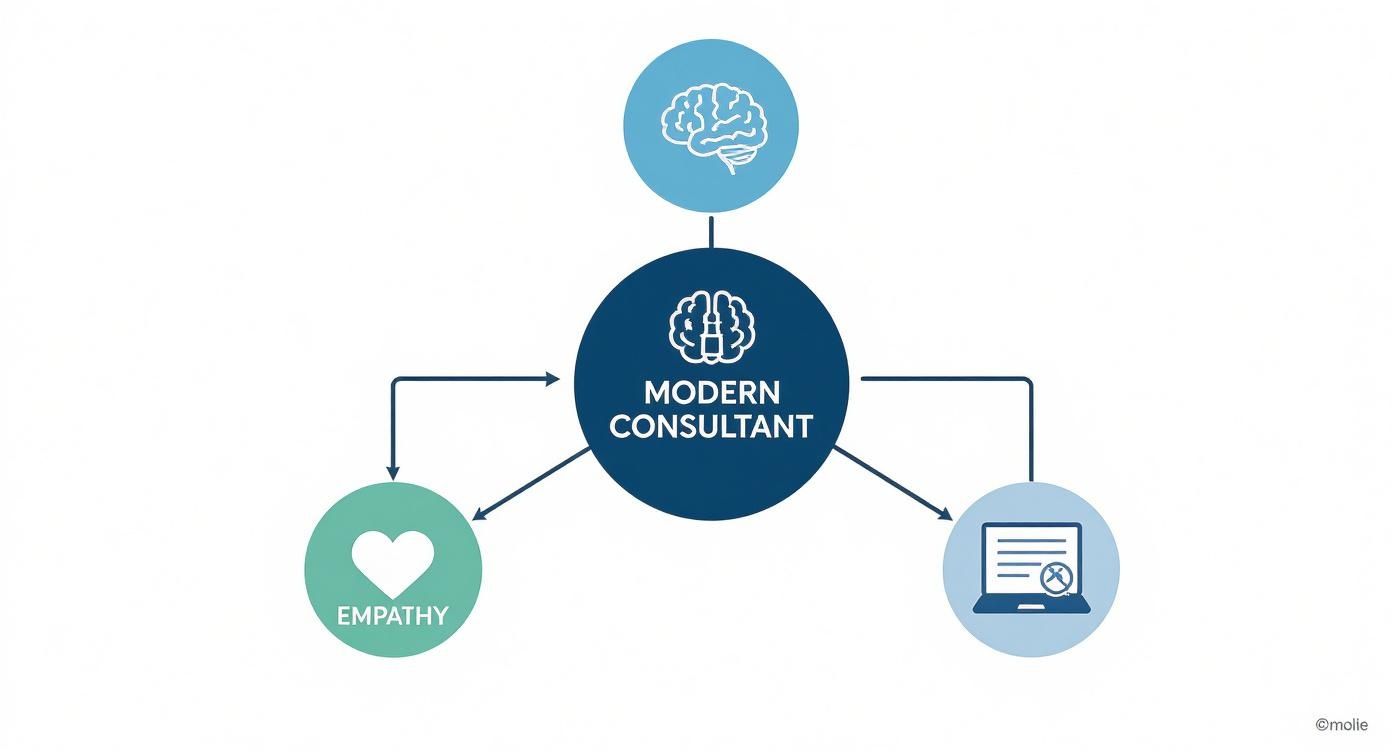
As you can see, empathy, strategy, and digital capability aren’t separate things. They’re woven together, each one making the others stronger.
The Evolving Demands in the Egyptian Market
In a fast-moving business environment like Egypt, the most valuable sales consultant skills reflect the bigger trends happening in the region. Digital literacy and excellent communication are the absolute baseline.
Data from connected European markets shows that 54% of employers prioritise multilingual candidates, a skill that’s incredibly relevant in Egypt’s export-focused economy. While we don’t have hard numbers for Egypt just yet, it’s clear that fluency in Arabic, English, and other languages like French gives consultants a massive advantage in this strategic trade hub. You can read more about in-demand skills in Europe’s job market.
The World Economic Forum flags problem-solving and critical thinking as crucial skills for the future of consulting and sales (World Economic Forum, 2023). This highlights a global shift toward sales roles that are far more analytical and strategic.
What does this all mean on the ground? Companies are looking for consultants who are masters of modern tools. Using a CRM platform like CRM Africa to manage client relationships, using social media for engagement, and applying data analytics to fine-tune sales strategies are no longer nice-to-haves. They are essential for anyone who wants to compete.
2. Mastering the Art of Consultative Communication
Great communication is the bedrock of every other skill a sales consultant needs. Forget the flawless pitch—this is about forging a real connection that gets to the heart of a client’s biggest headaches. This consultative approach transforms selling from a simple transaction into a genuine partnership.
It all starts with listening. And I don’t mean just waiting for your turn to talk; I mean listening to understand. Picture yourself as a doctor. You wouldn’t dream of prescribing a treatment before you’ve diagnosed the ailment, would you? Active listening is your diagnostic tool. It helps you pinpoint the root causes of a client’s pain, not just the surface-level symptoms they bring up. In fact, research by Salesforce shows that 86% of buyers are more likely to buy from a salesperson who listens to their needs (Salesforce, 2022).

This whole diagnostic process is fuelled by asking powerful, open-ended questions. Instead of cornering them with a “Do you have a problem with X?” which just begs for a ‘yes’ or ‘no’, try something like, “Can you walk me through your current process for managing X?” That simple switch peels back the layers of the problem and reveals all the crucial context you need.
The Strategic Role of Empathy
Too often, empathy gets written off as a “soft skill.” In consultative sales, it’s a hard-hitting strategic advantage. When you show genuine empathy, you build the kind of trust that makes a client feel safe enough to get real about their business struggles. The data backs this up, showing that nearly half of all customers would rather talk to an empathetic representative (Forrester, 2021).
“In 2021, customers expect companies to be more empathetic and flexible than before,” notes Ben Motteram, a Principal and CX Expert. That expectation hasn’t gone away; if anything, it’s become a non-negotiable for building any kind of lasting loyalty.
When you can anticipate a client’s concerns before they even say them out loud, you’re showing a level of understanding that immediately sets you apart. This isn’t about reading minds. It’s about combining sharp listening skills with your industry knowledge to connect the dots for them.
To really nail consultative communication, you have to get serious about your interpersonal abilities. Building rapport is a great place to start, and you can dive deeper by exploring these essential relationship building skills.
Turning Conversations into Data
Think of every conversation as a goldmine of intelligence. By using a CRM like CRM Africa, you can log key insights, pain points, and even those little personal details that come up in your chats. This simple habit turns every interaction into a smarter, more personalised follow-up.
For instance, if you log a client’s concern about cash flow, you can tailor your very next conversation to highlight your solution’s flexible payment features. It shows you were listening and that you have a direct answer to their specific problem.
To help you get started, let’s break down some of the most effective communication techniques and how you can put them into practice right away.
Core Communication Techniques for Sales Consultants
The table below outlines a few foundational techniques, their direct impact on the sales process, and a simple tip to start using each one today.
| Technique | Impact on Sales | Actionable Tip |
|---|---|---|
| Active Listening | Uncovers a client’s true needs and builds trust right out of the gate. | Paraphrase what the client says (“So, if I’m understanding correctly…”) to confirm you’re on the same page. |
| Powerful Questioning | Shifts the conversation from surface-level problems to their bigger strategic goals. | Frame your questions with “what,” “how,” and “why” to encourage them to share more detailed responses. |
| Strategic Empathy | Forges a strong, trust-based relationship that goes beyond the sale. | Always acknowledge their frustrations and validate their concerns before you jump in with a solution. |
Mastering these skills won’t happen overnight, but consistently applying them will fundamentally change the way you connect with clients and, ultimately, the results you achieve.
3. Developing a Strategic Problem-Solving Mindset
The truly exceptional sales consultants? They don’t just sell products; they deliver real solutions to complex business problems. This is a massive shift in thinking. It’s about moving past a simple features list and stepping into the role of a strategist. Think of it like a doctor diagnosing a patient—you’re focused on the root cause of their pain, not just the symptoms they’re complaining about.
This whole process kicks off with a rock-solid needs analysis. By asking sharp, insightful questions and actually listening to the answers, you can start to peel back the layers and uncover the core issues holding a client back. This diagnostic approach instantly changes your relationship. You’re no longer just another vendor trying to make a sale; you’re a strategic advisor. According to a LinkedIn report, 71% of buyers want to talk to sellers who can help them see a new perspective on their business (LinkedIn State of Sales, 2022). The goal is to get to know their business so well that you can draw a straight line from your solution to their most critical strategic goals.

When you reach that level of insight, your proposal becomes incredibly compelling. It’s almost impossible for a client to ignore. The conversation naturally pivots from, “How much does this cost?” to, “How will this help us hit our targets?”
From Reactive Selling to Proactive Advising
The most effective consultants I’ve ever met are proactive. They don’t just sit back and wait for a client to call with a problem. They’re constantly anticipating needs by keeping a finger on the pulse of market research and industry trends. When you understand the competitive landscape your client is operating in, you can bring fresh insights to the table—ideas they might not have even considered themselves.
This forward-thinking approach makes you an indispensable partner. In Egypt, for instance, the demand for sales consultant skills with a strategic edge is booming, right alongside the country’s economic growth and digital push. We’re seeing this across the region; nearby consulting markets have posted annual growth between 1% and 4%, a trend that aligns perfectly with Egypt’s ambitious 2030 Vision. Businesses in major sectors like manufacturing, retail, and telecoms are actively hunting for consultants who can help them navigate a tough market where digital sales tactics are no longer optional. You can dig into more on this by checking out the European sales consulting market trends.
Problem-solving in sales isn’t about having all the answers right away. It’s about having a framework to find the best answer for each unique client. That framework is built on a foundation of data, empathy, and a crystal-clear understanding of their business goals.
Using Data to Drive Your Strategy
A strategic mindset runs on data. Your CRM is so much more than a fancy contact list; it’s a goldmine of intelligence that can reveal patterns and help you predict what’s coming next. When you start analysing the data across your client base in a platform like CRM Africa, you can quickly spot common challenges and emerging opportunities.
This data-backed approach lets you:
- Anticipate Client Needs: Spot the pain points that typically pop up at certain stages of a client’s growth, letting you offer solutions before they even know they need them.
- Develop Targeted Strategies: Use historical data to figure out which solutions have delivered the biggest bang for the buck for specific types of businesses.
- Prove Your Long-Term Value: Show clients the cold, hard data on how your solutions have directly impacted their most important KPIs.
When you blend deep client knowledge with sharp, data-driven insights, your problem-solving becomes more precise, more effective, and a whole lot more valuable. That’s what being a modern, strategic sales consultant is all about.
4. Leveraging Technology and Digital Sales Tools
In today’s world, being great with people isn’t enough. The best sales consultant skills get a massive boost from technology, turning gut feelings into sharp, data-backed strategies. Being comfortable with digital sales tools isn’t a bonus anymore—it’s the price of entry.
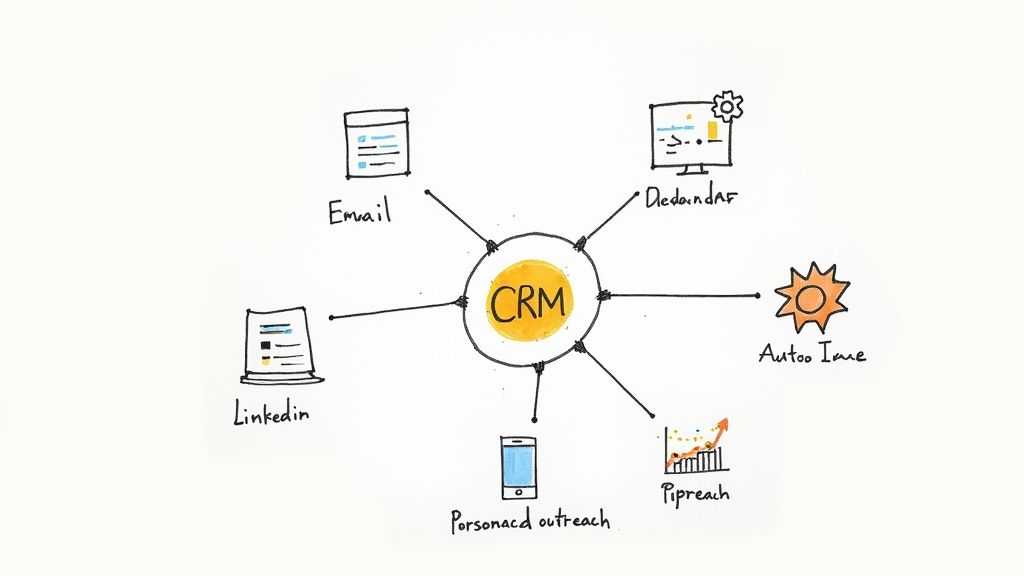
Think of your CRM as the central nervous system for your entire sales operation. It needs to be more than just a glorified address book. With a platform like CRM Africa, you can build smart workflows to manage your pipeline, forecast revenue with scary accuracy, and put routine follow-ups on autopilot. This carves out more time for what really matters: having high-value conversations that close deals. Research from HubSpot indicates that 75% of companies using a CRM report sales growth (HubSpot, 2021).
The Power of an Integrated Tech Stack
While a CRM is the heart of your operation, it doesn’t work alone. The most successful consultants build a seamless tech stack where every tool talks to every other tool. This integrated approach ensures no lead gets lost and every client interaction is packed with relevant, up-to-the-minute information.
Imagine how these tools can work together:
- Social Selling: Platforms like LinkedIn are goldmines for prospecting and establishing yourself as an expert. Any insights you gather can be logged straight into your CRM, adding rich detail to your client profiles.
- Email Automation: You can set up personalised email sequences that nurture leads automatically. This keeps the conversation going without you having to manually type out every single message.
- Digital Demos: Forget static slideshows. Giving prospects a hands-on feel for your product can dramatically boost engagement. For any consultant looking to up their game, it’s worth understanding why many now see interactive product demos as a sales superpower.
When your tools are connected, you get a complete picture of the customer’s journey. Every email, call, or message becomes smarter and more effective.
It’s not just a hunch. A recent study by McKinsey & Company found that high-performing sales teams are 2.3 times more likely to use analytics and data to shape their strategies. This isn’t just about being efficient; it’s about gaining a serious competitive edge.
Using Technology to Personalise at Scale
Ultimately, the real magic of sales technology is that it lets you work smarter, not just harder. These tools make it possible to personalise your outreach on a massive scale, connecting with prospects more deeply than you ever could manually.
By tracking client interactions in your CRM, for instance, you can pinpoint the exact right moment to send a follow-up or share a case study they’ll actually find useful. If you want to dive deeper into the basics, our full guide explains what is customer relationship management.
This data-driven approach shifts your sales process from reactive to proactive. Instead of guessing what a client might need, you’re using technology to analyse their behaviour and anticipate their next move. This blend of human intuition and powerful digital tools is precisely what separates the top-tier sales consultants from everyone else.
5. Building Resilience and a Growth-Oriented Mindset
Sales isn’t a sprint to the finish line; it’s a marathon of navigating complex relationships and high-stakes decisions. In this game, your most valuable asset isn’t a single closing technique—it’s your mindset. The psychological skills of resilience and a growth-oriented outlook are what separate the consistently high-performing consultants from those who burn out.
Resilience is your ability to bounce back from the inevitable knockdowns. It’s about learning to reframe rejection, seeing it not as a personal failure but as a data point. When a client raises an objection, it’s not a roadblock. Think of it as an invitation to understand their concerns on a deeper level and sharpen your approach.
This kind of mental toughness is tied directly to having a growth mindset—the core belief that your abilities aren’t fixed but can be developed through dedication and hard work, a concept popularized by Stanford psychologist Carol Dweck (Dweck, 2006). Every lost deal becomes a lesson learned. Every challenging conversation is an opportunity to strengthen your sales consultant skills.
Organising for Peak Performance
A resilient mindset doesn’t just happen; it’s supported by practical habits that keep burnout at bay and maintain consistency day in and day out. This is where effective time management and organisation become non-negotiable. They create the structure you need to handle the pressures of sales without getting overwhelmed. For more on this, check out our practical guide on how to handle pressure in the workplace.
This means building a systematic way to improve yourself by learning from every single interaction. Your CRM can be a powerful ally here. By tracking your conversations and their outcomes in CRM Africa, you start to see patterns in your own performance, revealing what truly works and what doesn’t.
The real measure of success is not whether you get knocked down, but how quickly you get back up. A growth mindset ensures every stumble becomes a step forward, fuelling your long-term development and success.
In Egypt’s evolving consulting market, this discipline has a real, measurable impact. Regional best practices show that consultants who use structured funnels and consistent follow-up methods—habits built on a foundation of resilience and organisation—close deals 30% faster. What’s more, adopting formal systems for lead generation and marketing can boost a consultant’s annual revenue contributions by 15% to 25%, proving just how much mindset and process discipline drive success.
Ultimately, it’s this blend of psychological fortitude and organised execution that allows a sales consultant to thrive through the highs and lows of the profession, turning challenges into career-defining strengths.
6. Creating Your Personal Skill Development Plan
Getting good at sales isn’t a one-and-done deal; it’s a journey that never really ends. The best consultants are always learning, always refining their approach. Think of this final step as creating your own personal training plan—a way to turn good intentions into real, measurable progress.
It’s about being strategic. After all, a study by Zendesk found that 77% of customers are more loyal to companies that handle problems well, and that kind of positive experience comes directly from skilled professionals. Your plan is the roadmap to becoming that professional.
Self-Assessment and Prioritisation
First things first: take an honest look in the mirror. Where are you already strong? Where are the gaps? You can’t fix everything at once, so don’t even try. Pick one or two skills that, if improved, would make the biggest difference to your results right now.
- Identify Your Focus: Maybe you need to ask sharper diagnostic questions. Or perhaps time management is holding you back. Pinpoint what will give you the most bang for your buck.
- Define Your Goal: Vague goals get vague results. Instead of “get better at communication,” make it concrete. A much better goal is, “I will increase my active listening time in client calls by 20%.”
- Set Actionable Steps: Now, how will you actually do it? To improve your listening, you could commit to paraphrasing client statements in every single meeting. Another great habit is to log key takeaways in CRM Africa the moment a call ends, while they’re still fresh.
This simple framework puts you in the driver’s seat of your own career. When you regularly check in on your progress and shift your focus as you improve, you stop being just another vendor and start becoming an indispensable partner.
Your development plan is more than a to-do list; it’s a commitment to your clients and your career. It ensures you are always evolving, learning, and delivering more value than ever before. This is how you build valuable, lasting relationships.
7. Frequently Asked Questions About Sales Skills
As you start the journey to becoming an elite sales consultant, a few questions always seem to pop up. Let’s tackle some of the most common ones with clear, straightforward answers to help you focus on what really moves the needle.
Think of it this way: mastering the fundamentals gives you a solid foundation to build everything else on. Let’s dive in.
What Is the Most Important Skill for a New Sales Consultant?
While you eventually need a full toolbox of skills, the single most critical one right out of the gate is active listening. Forget about pitching for a moment. Before you can even dream of offering a solution, you have to truly understand the client’s world—their real problems, their unspoken frustrations, and the business pressures they’re facing.
When you master active listening, you build trust almost instantly. It’s how you uncover the crucial insights that make every other skill, from negotiation to problem-solving, ten times more effective. It is the absolute bedrock of any strong client relationship.
How Can I Improve My Sales Skills Without Formal Training?
You don’t need a classroom to get better; you just need to take ownership of your growth. Start by immersing yourself in the industry. Listen to podcasts on your commute, read books by consultative selling experts, and follow seasoned sales leaders on LinkedIn. Absorb everything you can.
But consumption is only half the battle. You have to practice with intention.
- Ask for Feedback: Pull a trusted colleague or mentor aside after a client call and ask for their honest, no-fluff opinion on how you did.
- Review Your Tapes: Get permission to record your calls, then listen back. It can be cringeworthy, but it’s the fastest way to spot your own bad habits and areas for improvement.
- Use Your CRM as a Lab: Don’t just see your CRM as a database. Analyse your notes and activity logs to figure out which communication styles and actions consistently lead to wins.
This kind of proactive self-coaching is priceless. And if you’re gearing up for a new role, brushing up on common sales questions asked in an interview is a great way to sharpen your thinking about what top companies are looking for.
Is Product Knowledge More Important Than Soft Skills?
This is a classic debate, but it’s a false choice. The truth is, they’re two sides of the same coin. You can’t succeed with one and not the other.
Product knowledge is your “what”—it gives you the credibility to even be in the room. Soft skills, like empathy and strategic questioning, are your “why” and “how”—they allow you to diagnose the actual problem and build the trust needed for a client to even consider your solution.
Think about it: a consultant who only has product knowledge can rattle off features all day but can’t connect any of them to what the client actually cares about. On the flip side, a consultant with only soft skills can build a great relationship but falls apart when it’s time to solve a real, technical business problem. The best in the business blend both, shifting from being just another vendor to becoming a trusted, indispensable problem-solver.
Ready to amplify your sales skills with the right technology? CRM Africa provides an all-in-one platform to manage client relationships, automate tasks, and gain the data-driven insights you need to close more deals. See how our free-forever plan can help your business grow by visiting https://crm.africa today.