
To be a top-tier sales consultant today, you need a potent mix of strategic thinking, killer communication skills, and a knack for problem-solving. But the secret weapon? Technological prowess. The game has changed; modern consultants aren’t just selling products anymore. They’re trusted advisors who diagnose a client’s real needs and build valuable, long-term solutions.
1. The Evolution of the Modern Sales Consultant

Let’s be clear: the role of a sales consultant has been completely transformed. The days of high-pressure tactics and one-and-done deals are long gone. Today’s business world demands consultants who act more like strategic partners, genuinely invested in their clients’ success. This isn’t just a trend—it’s a direct result of smarter, more informed customers and increasingly complex markets. Research from McKinsey shows that B2B buyers now regularly use a mix of ten or more channels to interact with suppliers, up from just five in 2016 (McKinsey, 2021).
This evolution calls for a sophisticated blend of skills. Consultants are now expected to be analysts, communicators, and strategists all rolled into one. It’s no longer enough to have a surface-level chat. You have to dig deep, uncover the root causes of a client’s pain points, and then architect customised solutions backed by solid data.
The Advisor Mindset
The first, and most crucial, shift is adopting an advisor mindset. This means putting your client’s long-term success ahead of your short-term sales targets. It’s a simple change in perspective that builds indispensable partnerships, turning one-off customers into loyal advocates for your brand. This isn’t just a feel-good idea; it’s reflected in major economic trends. For instance, the European sales consulting market has seen consistent growth, fuelled by a corporate-wide pivot to customer-centric strategies. You can discover more insights about this European market evolution.
“Exceptional consultants don’t just sell; they solve. Their value is measured not in deals closed, but in the lasting impact they create for their clients’ businesses.”
The Role of Modern Tools
Getting these skills right takes more than just natural talent; it demands the right tools. A modern CRM like CRM Africa is the central hub for everything—managing client relationships, tracking every interaction, and analysing critical data. It’s what gives a consultant superpowers. In fact, a study by Nucleus Research found that the average return on investment for CRM is $8.71 for every dollar spent (Nucleus Research, 2014).
With a powerful CRM, you can:
- Organise Client Data: Keep a detailed, living history of every conversation and touchpoint, from the first “hello” to ongoing support.
- Identify Opportunities: Use analytics to spot patterns and uncover hidden chances for upselling or cross-selling that you’d otherwise miss.
- Streamline Communication: Automate follow-ups and personalise every message based on a client’s unique history and needs.
Throughout this guide, we’ll dive into each essential sales consultant skill. We’ll give you practical, actionable advice on how to build them and, just as importantly, how to use technology to amplify your impact.
2. Mastering Communication and Interpersonal Skills

At the heart of every great sale is a real, human connection. It’s easy to talk about communication, but elite consultants practise it like a diagnostic art. It’s not just about what you say; it’s about creating a conversation where clients feel genuinely heard and understood right from the very first hello.
That process often starts before you even pick up the phone. A huge part of mastering communication is writing compelling sales email subject lines that get opened, read, and responded to—making that first digital handshake count. From that point on, every interaction is a chance to build trust, not just push a product.
The Power of Active Listening
Active listening is easily one of the most critical sales consultant skills, but it’s also one of the most misunderstood. It’s not just about staying quiet until it’s your turn to talk. Think of yourself as a detective—your job is to uncover the client’s unspoken needs, their hidden frustrations, and the goals lurking just beneath the surface of their words. As Stephen R. Covey famously wrote in The 7 Habits of Highly Effective People, “Most people do not listen with the intent to understand; they listen with the intent to reply” (Covey, 1989).
This takes more than just hearing them out; it demands total engagement. You have to tune into their tone, notice any hesitation, and listen for what isn’t being said. A great consultant will use techniques like paraphrasing—simply repeating a client’s point back to them in their own words—to confirm they’ve got it right and show they’re truly locked in.
For example, after a client explains a challenge, you could say, “So, if I’m hearing you correctly, the real bottleneck is the time it takes to manually sort out payments, which is then delaying your project kick-offs?” That one simple act validates their problem and builds instant rapport.
Building Trust Through Empathy
Empathy is what fuels trust. It’s your ability to step into your client’s shoes and see the business world exactly as they see it. Once a client feels you genuinely care about their problems, their defensive walls start to come down, and you can begin to build a real partnership. A study published in the Journal of Marketing found that salesperson empathy positively influences customer trust and, subsequently, long-term relationship quality (Drollinger, Comer & Warrington, 2006).
Empathy transforms a sales process from a transactional exchange into a collaborative problem-solving session. It’s the difference between being a vendor and becoming an indispensable advisor.
To really build your empathy muscle, try focusing on the emotions behind a client’s statements. Are they frustrated with their current software? Stressed about hitting their targets? Just acknowledging those feelings creates a powerful connection that goes way beyond features and pricing.
Crafting Compelling Narratives
Facts tell, but stories sell. It’s just how our brains are wired. We remember narratives far more effectively than we remember a dry list of data points. Research by cognitive psychologist Jerome Bruner suggests that we are 22 times more likely to remember a fact when it has been wrapped in a story. The very best consultants are masterful storytellers who know how to frame their solutions inside a compelling and unforgettable context.
Instead of just listing what a tool like CRM Africa does, weave a story around it:
- The Hero: Your client, who is facing a massive business challenge.
- The Villain: The obstacle getting in their way, like disorganised data, missed follow-ups, or painfully slow payment processing.
- The Guide: You, the consultant, who truly understands their struggle.
- The Plan: The solution (like implementing a CRM) that gives the hero the power to defeat the villain.
This structure makes your pitch feel less like a sale and more like the logical, emotionally satisfying conclusion to their own story. And that’s far more persuasive.
3. Developing Strategic Thinking and Problem-Solving
What separates a good sales consultant from a truly exceptional one? It really boils down to one thing: they are masters at solving problems.
This isn’t just about knowing your product inside and out. It’s about cultivating an analytical mind that can accurately diagnose a client’s business pains and then architect a strategy to fix them. It’s the difference between seeing the next move on the chessboard and seeing the entire game.
This all kicks off with a proper needs analysis. It’s a classic mistake to just address the surface-level issues a client brings up. A real consultant goes deeper, asking sharp, open-ended questions to get to the root cause of the problem. Think of it like a doctor who doesn’t just hand out cough syrup but investigates the underlying infection. As a Harvard Business Review article notes, top-performing salespeople excel by diagnosing unrecognised needs (Adamson, Dixon & Toman, 2012).
Building Your Analytical Toolkit
To turn that gut feeling into a solid insight, you need a structured game plan. A few key practices form the bedrock of strong analytical and problem-solving sales consultant skills, giving you a framework to fully grasp a client’s world.
Your analytical toolkit should include:
- Strategic Account Planning: This is your roadmap for every client relationship. It’s where you set clear goals, pinpoint the key players you need to influence, and map out exactly what’s needed to help the client hit their long-term targets.
- Competitive Analysis: You can’t just understand your client’s business; you have to understand their battlefield. Knowing what their rivals are up to lets you position your solution as a genuine competitive edge, not just another tool.
- Market Research: Keeping your finger on the pulse of industry trends, economic shifts, and new tech is non-negotiable. This knowledge helps you spot challenges and opportunities for your clients before they even see them coming.
From Data to Data-Backed Solutions
Let’s walk through a real-world scenario. A client tells you their customer satisfaction scores are slipping. A typical salesperson might jump straight to pitching a new customer service tool. But a strategic consultant pulls out their CRM first to do some detective work.
By digging into the data within a platform like CRM Africa, a consultant can stop guessing and start building a credible, evidence-based recommendation. They can spot patterns, trace interaction histories, and find the exact source of the friction.
In this case, the CRM data might show that the problem isn’t the support team’s performance at all. Maybe it’s a recurring product bug that keeps getting missed. Or perhaps negative feedback always spikes right after invoices go out, pointing to a confusing payment process.
Once you identify the real problem, the solution becomes laser-focused and obvious. This data-driven approach is everything. If you’re new to this, learning how to measure customer satisfaction is a great place to start building this muscle.
At the end of the day, strategic thinking is about connecting the dots. It’s about using the hard evidence from your CRM to back up your insights, building a compelling case that a client simply can’t ignore. This is how you shift from being just another vendor to becoming a trusted, indispensable partner.
4. Leveraging Technology as a Strategic Advantage
In a world drowning in data, the best sales consultants are the ones who’ve mastered their digital toolkit. Let’s be honest, technological fluency isn’t a “nice-to-have” anymore; it’s a fundamental part of the modern sales consultant skills set. The top performers I know don’t see tech as an administrative chore. They see it as a strategic amplifier for everything else they do.
At the very heart of this tech stack is the Customer Relationship Management (CRM) system. Platforms like CRM Africa are so much more than a digital address book. Think of it as your command centre for forecasting sales pipelines, automating the tedious tasks that eat up your day, and analysing your performance with surgical precision. If you’re new to the concept, it’s worth understanding what customer relationship management is and why it’s so foundational to modern sales.
Turning CRM Data into Actionable Insights
Being great with a CRM means letting its data guide your every move. Instead of just going with your gut, you can pull up a client’s entire interaction history. This allows you to personalise your outreach, see exactly when they’ve engaged with a proposal, and spot those high-value upselling opportunities that would have otherwise been completely invisible.
This tech-first approach is quickly becoming the standard. In fact, European Commission data shows that over 90% of jobs, sales consulting included, now demand at least basic digital skills (European Commission, 2023). There’s a real hunger for people who can analyse data and use AI to shape their sales strategies.
To really get ahead, smart consultants are always exploring and folding in the best AI tools for sales to make their workflow smoother and their results better. A Salesforce report found that high-performing sales teams are 2.3 times more likely than underperforming ones to use AI (Salesforce, 2023).
Beyond the CRM: Essential Digital Tools
While the CRM is your home base, a consultant’s toolkit needs to be broader. Getting comfortable with these platforms isn’t just about being efficient; it’s about making data-backed decisions that give you a serious competitive edge.
Other must-have tools include:
- Social Selling Platforms: Think LinkedIn Sales Navigator. It’s perfect for pinpointing key decision-makers, keeping an eye on company news, and connecting with prospects in a way that’s relevant and perfectly timed.
- Virtual Presentation Software: Tools like Zoom or Microsoft Teams are non-negotiable. They allow you to deliver powerful, interactive presentations to clients anywhere in the world, complete with screen sharing and collaborative features.
- Data Analytics Tools: When you connect your CRM to analytics platforms, you can uncover deeper trends in your sales cycles, customer behaviour, and team performance, helping you sharpen your strategy over time.
To tie it all together, let’s look at how these core skills are amplified by a good CRM.
Core Sales Consultant Skills and Their CRM Application
| Core Skill | Description | How a CRM Helps (e.g., CRM Africa) |
|---|---|---|
| Active Listening | Understanding client needs beyond surface-level comments. | Logs every interaction—calls, emails, meetings—creating a rich history to reference and understand context. |
| Problem-Solving | Identifying client pain points and proposing effective solutions. | Tracks support tickets and past issues, revealing patterns that inform proactive, valuable solutions. |
| Communication | Articulating value and building rapport clearly and persuasively. | Provides templates for consistent messaging and tracks email opens/clicks to show what resonates with clients. |
| Negotiation | Reaching mutually beneficial agreements on price and terms. | Stores past deal information and pricing, giving you data-backed leverage and context for current negotiations. |
| Strategic Thinking | Developing a long-term plan for account growth and success. | Offers pipeline forecasting and sales analytics, allowing you to see the bigger picture and plan your next moves. |
| Tech Fluency | Using digital tools to enhance efficiency and decision-making. | The CRM itself is the central tool. Mastery unlocks automation, data insights, and streamlined workflows. |
This table really drives home the point: a CRM isn’t just a piece of software; it’s the engine that powers nearly every critical skill a sales consultant needs to succeed.
This concept map shows how strategic thinking—a crucial sales consultant skill—is built on a structured, data-driven foundation.
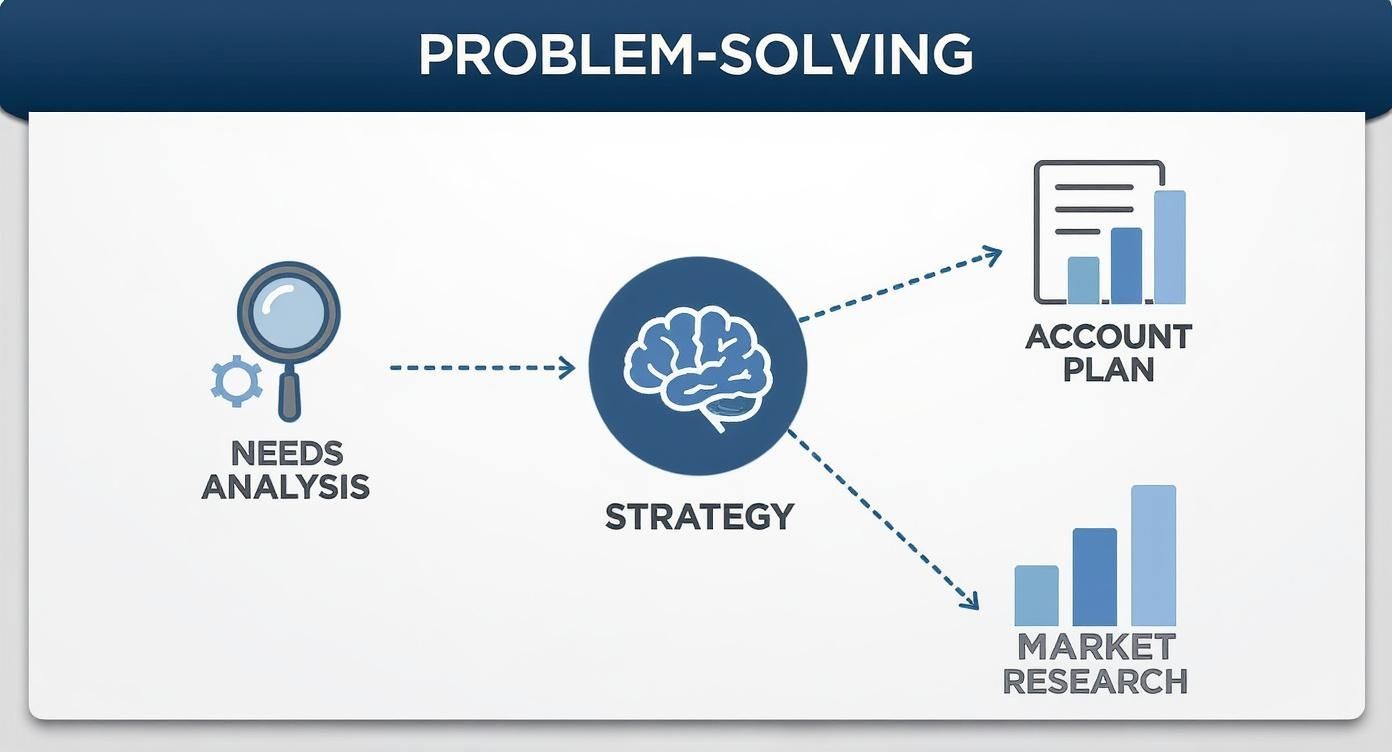
As you can see, a solid strategy is built on interconnected pillars like needs analysis and market research, and technology is the thread that ties them all together and makes them stronger.
By truly mastering these digital tools, a consultant evolves from a simple relationship manager into a data-powered strategist. They can anticipate what a client needs, back up their recommendations with cold, hard evidence, and ultimately deliver superior results that forge lasting partnerships. Technology becomes the engine that drives every other skill forward.
5. Building Your Skills for a Successful Consulting Career
Mastering the art of sales consulting is a marathon, not a sprint. The best in the business know their education never really stops. They treat professional growth as an ongoing journey, constantly investing in their careers to stay sharp and effective.
This commitment to lifelong learning isn’t just a nice-to-have; it’s essential for getting to the top. Just look at the data. Historical trends from consulting firms in Eastern Europe and nearby regions show that climbing the ladder from an entry-level analyst to a senior partner can take anywhere from 25 to 27.5 years. That tells you everything you need to know about the dedication required to truly master the craft and build real client impact. You can read the full research on consulting career progression.
Create a Personal Growth Roadmap
If you want to intentionally build your sales consultant skills, you can’t just wing it. You need a clear, actionable plan. Think of it as a roadmap that blends formal training with practical, on-the-ground experience. It’s like building a house—you need a solid blueprint and the right materials if you want it to last.
Here are a few strategies to bake into your growth plan:
- Find a Mentor: Connect with industry veterans who have already walked the path you’re on. A great mentor offers priceless guidance, helps you untangle complex challenges, and can even open doors you didn’t know existed. According to a study by Sun Microsystems, employees who acted as mentors were six times more likely to be promoted.
- Sign Up for Targeted Training: Pinpoint your weakest areas and find specific programmes to shore them up. It could be a course on advanced negotiation, a new sales methodology, or software like CRM Africa. Targeted learning always delivers a high return on your time.
- Pursue Relevant Certifications: Getting certified in well-known sales frameworks or technology platforms is a great way to validate your expertise and make yourself far more marketable.
True career growth isn’t about collecting certificates. It’s about relentlessly applying what you learn to deliver better outcomes for your clients. Every new skill should directly translate into tangible value.
Build Your Personal Brand Through Thought Leadership
Beyond structured training, making a name for yourself as an expert is key to moving up. This means building a powerful personal brand by sharing what you know—showcasing your expertise to a wider audience.
Start by sharing your unique insights. That could be publishing articles on LinkedIn, speaking at a local industry event, or even starting a professional blog. Doing this doesn’t just build your reputation; it forces you to stay curious and on top of the trends impacting your clients.
When you proactively share your knowledge, you stop being just another consultant and start becoming a recognised authority in your field. This level of expertise will also help you ace any interview, giving you a deep well of knowledge to pull from. To get ready, it’s always a good idea to review some common sales questions asked in an interview.
6. Common Questions About Sales Consultant Skills
As you get your footing in the world of sales consulting, you’ll find it’s all about constantly tweaking your approach. Here are some answers to the questions we hear most often about the skills you need to really make your mark.
What’s the single most important skill for a new consultant?
If you could only pick one, it has to be active listening. No question.
Before you can even think about pitching a solution, you first have to get to the heart of a client’s world—their real challenges, what drives them, and what they’re trying to achieve. Great listening isn’t just about hearing words; it’s about building instant trust and spotting the subtle opportunities that your competitors will almost certainly miss. This is the skill that makes sure your advice actually hits the mark, laying the groundwork for a solid partnership. A Gong.io analysis of over 2 million sales calls revealed that top-performing reps listen more than they talk, with a talk-to-listen ratio of approximately 43:57 (Gong.io, 2017).
How can I get better at strategic thinking in sales?
It starts with being brutally honest with yourself after every deal, win or lose. Don’t just accept the surface-level reason; dig deeper by repeatedly asking “why” until you uncover the real factors that led to the outcome.
Also, make it a habit to zoom out. Carve out time each week to study what’s happening in the market, what your competitors are up to, and most importantly, what’s changing in your clients’ industries.
Your CRM is a goldmine for this. Use it to run a post-mortem on your data. Look for patterns in the deals you won versus the ones that slipped away. That’s how you start backing up your strategy with hard evidence instead of just gut feelings.
Do I really need to be a tech expert to succeed?
You don’t need to know how to code, but you absolutely need to be comfortable with technology. Getting to know your CRM inside and out is non-negotiable—it’s your command centre for every client relationship and piece of data you have.
Beyond that, you should be fluent in the tools of modern business, like virtual meeting platforms and professional networks like LinkedIn. The goal isn’t to become an IT whiz. It’s about using technology to be more organised, efficient, and insightful in how you help your clients. LinkedIn’s 2023 State of Sales Report found that 89% of top salespeople use technology to close more deals.
Ready to put these skills into action with a tool that works as hard as you do? CRM Africa pulls all your client data into one place, simplifies communication, and gives you the insights needed to close more deals. Start managing your entire sales process for free at https://crm.africa.