If you're an entrepreneur in Africa, you know the hustle. You're juggling a dozen roles to bring your vision to life. But let's be honest, when you think about small business taxes, that ambition can quickly turn into a headache. This guide is here to change that. We're cutting through the jargon around things like income tax, VAT, and payroll to give you a clear, practical roadmap.
Getting a Handle on Small Business Taxes in Africa
For most business owners, "tax season" is a phrase that brings on a cold sweat. But here’s a different way to look at it: getting your taxes right isn’t just about staying out of trouble with the authorities. It’s one of the smartest things you can do for your company’s financial health.
Think of it less like a chore and more like building a solid foundation. A strong, compliant business is one that’s built to last and grow.
Right from the start, the way you structure your business—whether you’re a sole proprietor, in a partnership, or have a limited liability company—is the first thing that shapes what taxes you owe and how you pay them. This is a point emphasized by tax advisors globally, who stress that early structural decisions have long-term tax implications.
Why Good Tax Habits Are Your Secret Weapon
Keeping your small business taxes in order does more than just give you peace of mind. It’s a genuine strategic advantage that sets you up for bigger things.
- You'll Dodge Costly Penalties: Let's face it, late filing fees and interest charges are a cash-flow killer. Staying on schedule keeps that money in your pocket.
- You Become More “Bankable”: Looking for a loan or an investor? The first thing they'll want to see is clean, compliant financial records. No exceptions. Financial institutions and venture capitalists routinely cite poor financial records as a key reason for rejecting funding applications.
- You Build a Rock-Solid Reputation: A good compliance track record makes you look reliable to everyone—customers, suppliers, and government agencies alike.
- You Can Make Smarter Decisions: When your tax records are accurate, you have a crystal-clear view of your profitability. This helps you plan your next move with confidence.
When you get good at managing your tax obligations, you turn a mandatory chore into a business asset. Flawless records and on-time payments don't just keep you compliant; they open doors to funding and growth.
From Complicated to Clear
Here’s the good news: you don’t need a degree in accounting to get this right. It all boils down to starting with good habits, like keeping detailed records from day one and having a separate bank account for your business.
Modern tools can also make this whole process feel a lot less daunting. Platforms like CRM Africa, Zoho, or HubSpot are designed to help you automate a lot of the heavy lifting.
By keeping all your invoices, payments, and client information in one place, these systems create a neat financial paper trail automatically. We’ll show you how to use these tools to make tax prep a simple, ongoing part of your routine—not a frantic, last-minute dash. So, forget the stress. This is your guide to mastering small business taxes so you can get back to what you love: growing your business.
Understanding the Core Types of Business Taxes
For any small business owner, the word "tax" can feel a little overwhelming. It often brings to mind a confusing mess of rules and deadlines. But it doesn't have to be that way.
Think of it less like a single, massive hurdle and more like a set of distinct responsibilities. Once you get a handle on what they are and how they work, managing your finances becomes a whole lot clearer. This isn’t about becoming a tax guru overnight; it’s about building a practical map so you can run your business with confidence and avoid those nasty, expensive surprises down the road.
Let's break down the main types of taxes you’ll almost certainly run into across Africa.
Corporate Income Tax (CIT)
This is the one most people think of first. Corporate Income Tax (CIT) is a tax on your company’s net profits. Simply put, it’s the government's share of the money you have left after paying all your business expenses, from salaries and rent to marketing and supplies.
I like to think of a business as a small farm. You spend the year planting seeds, watering, and harvesting your crops (that’s your revenue). Along the way, you pay for fertiliser, tools, and labour (your expenses). CIT is the portion of your final harvest (profit) that you owe. The rates vary from country to country, and some places, like South Africa, even have lower rates for smaller businesses, which is a big help when you're starting out.
The key to getting this right is meticulous record-keeping. Every single sale and every single expense needs to be tracked. Without that data, you're just guessing at your true taxable income, which is a recipe for trouble.
To get you started, here's a quick look at the most common taxes you'll encounter in some of Africa's major economies.
Common Business Taxes in Key African Markets
| Tax Type | What It Is | Example Application |
|---|---|---|
| Corporate Income Tax (CIT) | A direct tax on your company's annual net profit. | If your business in Nigeria makes a profit, you'll pay CIT on those earnings, typically around 30%. |
| Value-Added Tax (VAT) | An indirect tax collected from customers on goods and services sold. | In Kenya, a business registered for VAT adds 16% to the price of its products, which it then remits to the KRA. |
| Pay-As-You-Earn (PAYE) | Income tax you deduct from your employees' salaries and pay to the government on their behalf. | A South African company deducts PAYE from each employee's monthly salary according to official tax tables. |
| Withholding Tax (WHT) | A tax deducted at the source from payments made to suppliers or for specific services. | When a Ghanaian business pays a contractor for services, it withholds a percentage (e.g., 7.5%) and pays it to the GRA. |
This table is just a snapshot, of course. The specific rates and rules can change, so it's always smart to check with your local tax authority or a professional advisor.
Value-Added Tax (VAT)
Next up is Value-Added Tax (VAT), which some countries call Goods and Services Tax (GST). This one works a bit differently. It’s a tax on consumption, meaning the final cost is paid by the end customer, but you, the business, are responsible for collecting it.
Think of it like a relay race. A manufacturer adds VAT when they sell to a wholesaler. The wholesaler adds VAT when they sell to you. When you sell the final product to your customer, you collect VAT on the full retail price. Your job is to pay the tax authority the difference between the VAT you collected from sales (output tax) and the VAT you paid on your purchases (input tax).
The most critical thing for a growing business to watch is the VAT registration threshold. Every country sets a minimum annual revenue; once your sales cross that line, you are legally required to register for VAT, start collecting it, and file returns.
For instance, in Nigeria, the VAT threshold is an annual turnover of N25 million. In South Africa, it's R1 million in any 12-month period. Keeping a close eye on your revenue is non-negotiable to avoid penalties for registering late. As regulations evolve, many countries are also going digital. If you do business in Egypt, for example, you'll need to understand their new systems—you can learn more in our guide on e-invoicing in Egypt.
Payroll Taxes (PAYE)
If you have employees, you automatically take on a new role: tax collector for the government. This happens through Payroll Taxes. The most common system is Pay-As-You-Earn (PAYE), where you deduct income tax directly from your employees' salaries every single month.
It's your responsibility to calculate the correct amount based on each person's earnings and pay it over to the revenue authority on time. Depending on your country, this will also include other mandatory contributions for things like social security or unemployment insurance.
Mismanaging PAYE is a huge red flag for tax authorities because you're handling money that belongs to both your team and the state. A good payroll software or service is almost always a worthwhile investment to keep things accurate and above board.
Withholding Tax (WHT)
Finally, there’s Withholding Tax (WHT). This is essentially an advance payment of tax. It’s an amount you deduct at the source when making certain types of payments to your own suppliers, contractors, or for services like rent and dividends.
So, instead of paying a supplier their full invoice amount, you "withhold" a small percentage and pay that portion directly to the tax authority on their behalf. This counts as a pre-payment toward that supplier's own income tax bill. The rates and the types of payments that WHT applies to vary wildly between countries, so it's absolutely vital to check your local regulations to see when you're required to do this.
For any small business owner in South Africa, just hearing the words "small business taxes" can be enough to cause a headache. Let's be honest, it often feels less like a civic duty and more like a high-stakes tightrope walk. This isn't just about paperwork; it's a real source of pressure that can stunt your growth or even threaten your survival. Before we can fix the problem, we have to get real about the challenges you're facing every day.
The dread that comes with filing returns with the South African Revenue Service (SARS) is palpable. A recent survey put a number on this feeling: a staggering 55% of small businesses find the tax filing process stressful and complicated. This admin burden isn't just an annual nuisance; it's tangled up in the day-to-day financial reality of running your business. You can dig deeper into the full research about these small business challenges to see just how widespread the pressure is.
This sense of being overwhelmed pushes entrepreneurs down two very different paths. Some decide to brave the SARS eFiling portal on their own, hoping to save a bit of cash. Others hand everything over to an accountant to deal with the complexity. Neither route is perfect. The DIY approach can easily lead to expensive mistakes, while hiring a professional is another bill to pay when the budget is already stretched thin.
The Ripple Effect of Tax and Cash Flow Stress
The anxiety around small business taxes is almost always made worse by a much more immediate problem: unpredictable cash flow. That same study found that 46% of SMEs are constantly battling late payments from their own clients. On top of that, 28% said they spend a huge chunk of their time just chasing those overdue invoices.
It’s a vicious cycle. When you’re spending your days chasing money you're owed, you don't have the cash on hand to meet your own deadlines—including your tax obligations. It also robs you of the time and energy you should be pouring into delighting your customers and finding new ones. This constant battle has a very real, and very personal, cost.
The financial drain is immense. A shocking 43% of small business owners have had to skip their own salary just to keep the business running. Another 41% have dug into their personal savings to cover business expenses. At this point, it's not just a business problem anymore; it's a personal crisis.
The data paints a painfully clear picture. The headache of tax compliance and the stress of poor cash flow are two sides of the same coin, and they're putting entrepreneurs under immense strain.
This overview breaks down the main taxes every business owner needs to get their head around—from Corporation Income Tax (CIT) on your profits to Value-Added Tax (VAT) on sales and Pay-As-You-Earn (PAYE) for your staff.
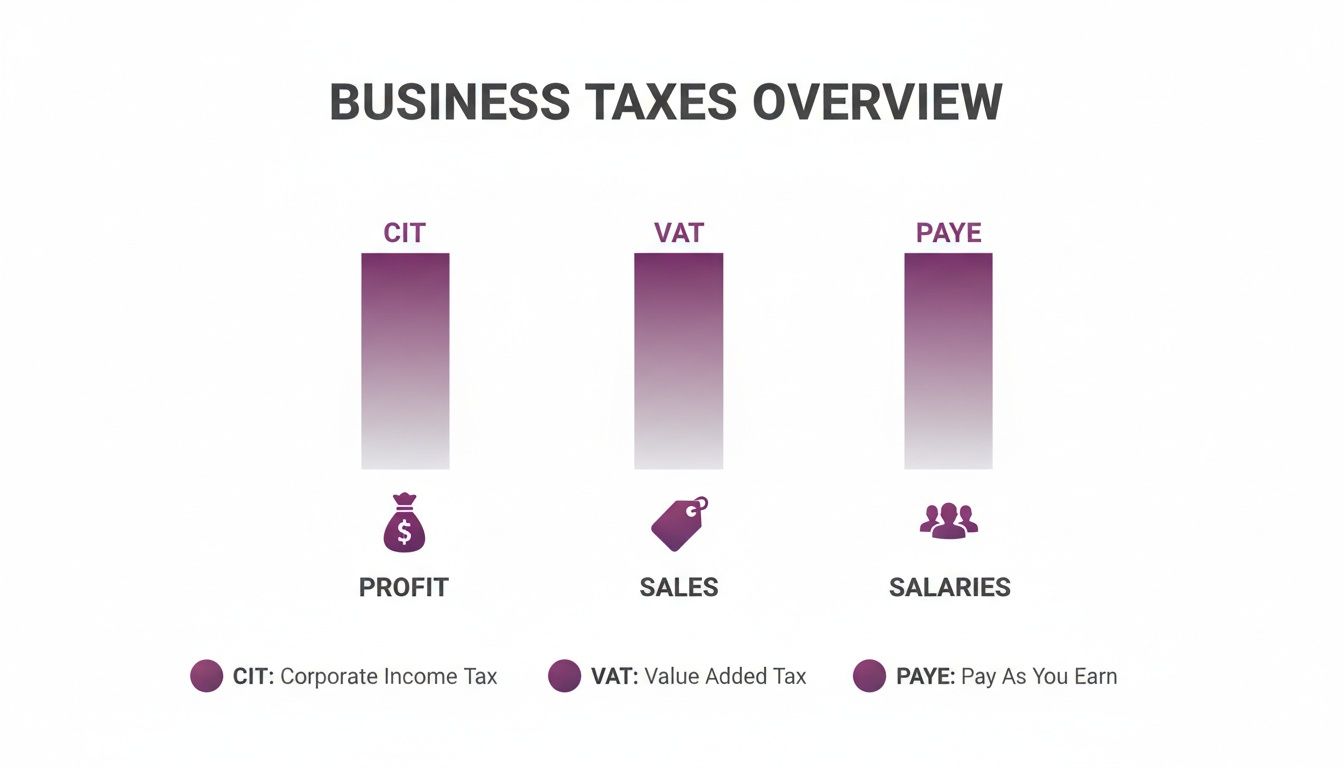
Each of these requires meticulous records and on-time payments, which feels next to impossible when your own income is all over the place.
Moving from Reactive to Proactive
Looking at the numbers, it's clear that a simpler tax form isn't the whole solution. The real problem starts much earlier, with messy financial data and a reactive, chaotic approach to getting paid. When your invoicing, payment chasing, and bookkeeping are all separate, manual tasks, you're basically running your finances on a prayer.
This is where having the right tools becomes non-negotiable. To truly solve the tax-time headache, you have to go to the source of the financial chaos. You need a system that brings order to your cash flow.
- Integrated Invoicing: Stop building invoices from scratch. Create and send professional ones in just a few clicks.
- Seamless Payment Collection: Make it easy for clients to pay you on the spot with options like mobile money.
- Automatic Reconciliation: Let the software match payments to invoices for you, killing off hours of manual data entry.
When you bring these jobs into one organised workflow, you shift from constantly putting out financial fires to being in control. Platforms like CRM Africa, Zoho, or HubSpot are designed to give you this exact structure. Once your financial data is clean, organised, and updated in real-time, preparing for your small business taxes stops being a dreaded annual event and becomes a simple, ongoing process.
Navigating South Africa’s Small Business Tax Maze
Getting your head around small business taxes in South Africa is the first real step towards sustainable growth. The good news is the government gets it. They know SMEs are the lifeblood of the economy, so the tax framework isn't a blunt instrument; it has specific provisions to give you a leg-up, especially when you're just starting out.
Instead of hitting everyone with the same flat rate, the system creates pathways that ease the burden on smaller businesses. By understanding these rules, you can make sure you're not leaving money on the table. Two options really make a difference for most small businesses: the Small Business Corporation (SBC) regime and the much simpler Turnover Tax.
The Small Business Corporation (SBC) Advantage
If your company ticks the right boxes to be classified as a Small Business Corporation (SBC), you unlock a much friendlier tax structure. This isn't something you get automatically; you have to meet a strict set of criteria from SARS. Think of it as a fast-track lane designed to keep more cash in your business right when you need it for operations and growth.
To get into this "VIP lane," your business needs to meet a few key conditions:
- All your shareholders must be actual people (natural persons), not other companies.
- Your gross income for the year can’t top ZAR 20 million.
- The business can’t be a "personal service provider," which has a specific legal definition.
Nail these requirements, and you get to use a progressive tax system. Your first slice of profit is taxed at a tiny rate, or even not at all.
This tiered system is a game-changer. It directly tackles the cash flow crunch that sinks so many startups, letting you hold onto more of your early profits when every rand counts.
Looking at the 2026 budget figures, the relief is substantial. For SBCs with a gross income under ZAR 20 million, the tax brackets are incredibly helpful. You pay 0% on your first ZAR 95,750 of taxable income. From there, it’s 7% on profits between ZAR 95,750 and ZAR 365,000, 21% up to ZAR 550,000, and the standard 27% only on profits above that. You can dig into the specifics of how the 2026 budget impacts SMEs to see the full picture.
A Simpler Route: The Turnover Tax
For the smallest businesses, even the SBC rules can feel like a lot of admin. That's exactly why SARS created an even simpler option: the turnover tax. This is what’s known as a presumptive tax, tailor-made for micro-businesses with an annual turnover of ZAR 1 million or less.
Forget tracking every last expense to calculate profit. With turnover tax, you simply pay a tiny percentage of your total revenue. The rates start at 0% and max out at just 3%. Yes, you give up the ability to deduct expenses, but the trade-off is radical simplicity. It takes the headache out of bookkeeping and tax returns, making small business taxes a straightforward task for sole traders and tiny companies.
How an All-in-One Platform Tames Tax Season for Good
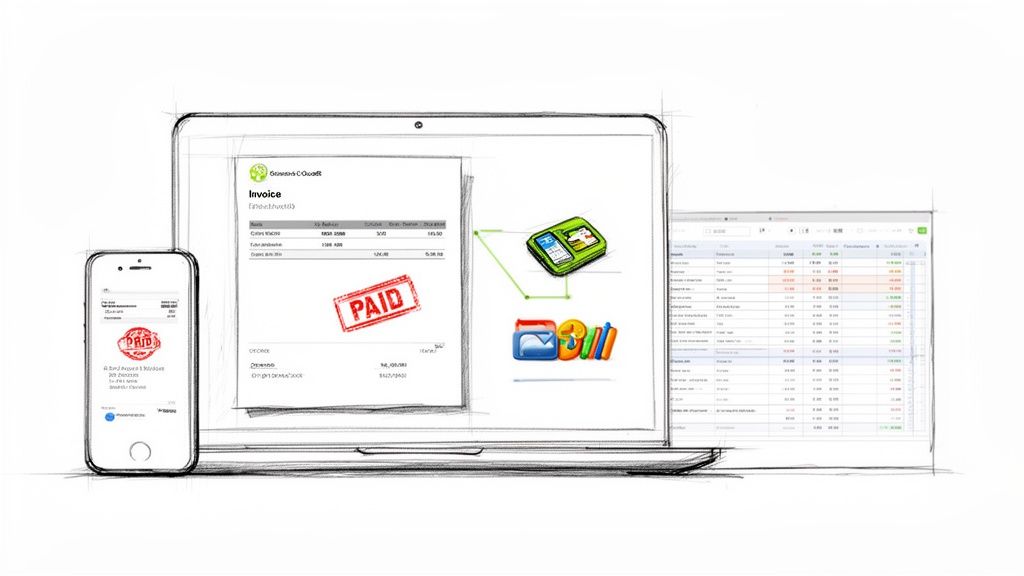
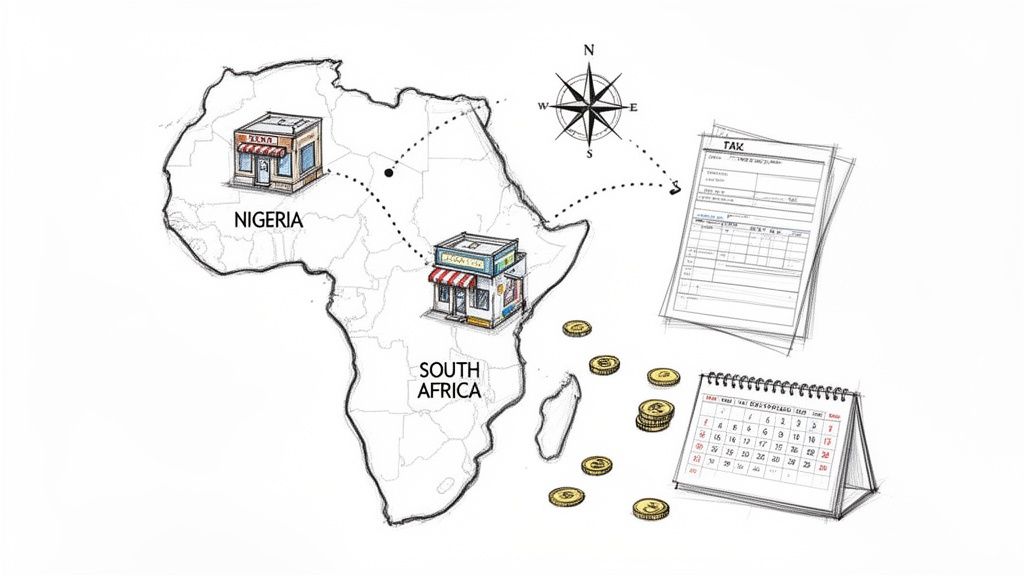
The secret to a stress-free tax season isn’t some magic trick; it’s having organised, real-time financial data at your fingertips. The image above says it all—when your invoicing and payment systems talk to each other, you bring order to the chaos. The goal is to stop the frantic, last-minute scramble and make tax prep a simple, continuous part of how you run your business.
Your small business taxes get a whole lot simpler when your day-to-day work automatically feeds into your books. Just imagine it: you create a professional invoice, send it off, and your financial records update themselves instantly. This is what happens when you finally ditch the scattered spreadsheets and manual data entry for good.
When you bring everything under one roof, you create a single source of truth for your finances. This doesn't just get you ready for tax deadlines. It gives you a crystal-clear, up-to-the-minute view of your company’s financial health, helping you make smarter decisions all year long.
Centralise Your Invoicing and Get Paid Faster
It all starts with how you bill your clients. If you’re juggling a messy mix of Word documents, email attachments, and PDFs, you’re practically inviting errors and lost information. Using an all-in-one platform completely transforms this.
You can whip up and send professional, branded invoices in minutes, not hours. These systems let you save client details, see who has paid and who hasn't, and even send out automated reminders. This cuts down on the headache of chasing late payments—a major pain point for 46% of small businesses.
This kind of organised invoicing instantly creates a clean, auditable trail for every cent of revenue your business earns. If you're curious to see how this works in practice, you can explore our free invoicing and CRM solutions.
By connecting your invoicing directly to your payment systems, you turn a tedious record-keeping task into a powerful tool for managing your cash flow. It’s no longer about just recording sales; it’s about making sure every rand, shilling, or naira is accounted for the moment it comes in.
Make Payments Effortless with the Right Integrations
The next piece of the puzzle is making it dead simple for customers to pay you. For anyone running a business in Africa, this means offering the payment options your clients actually use day-to-day. A platform built for the continent just gets this.
This is where smart payment integrations come in. A system like CRM Africa, for example, is built to connect directly with the gateways that matter:
- Pan-African Gateways: Support for big players like Paystack, Flutterwave, and Pesapal means you can accept card and bank payments seamlessly across the continent.
- Mobile Money: This is a big one. Integrations with services like M-PESA are essential for tapping into one of the most popular payment methods in markets like Kenya, Tanzania, and beyond.
- Global Options: Got international clients? Support for gateways like Stripe and PayPal ensures you can get paid from anywhere in the world, without a fuss.
When a client settles an invoice through one of these gateways, the system automatically marks the invoice as paid and reconciles the transaction. No more manual data entry, no more guessing games. Just an accurate, real-time picture of your cash flow. To get ahead of the game, it’s always a good idea to start early and check out a practical guide to preparing for tax season.
Give Your Accountant the Clean Data They Need
When tax time finally rolls around, the last thing your accountant wants is a shoebox full of crumpled receipts or a chaotic folder of files. What they really need is clean, organised, and complete data.
When you use an all-in-one platform, every single transaction—from the invoice you sent to the payment you received—is logged and categorised. For businesses operating across borders, multi-currency support automatically standardises your transactions, which is a lifesaver. And a good client dashboard gives you a transparent, auditable history of every interaction and payment, which is invaluable if you ever face an audit.
By centralising everything, you’re basically doing your bookkeeping as you go, all year long. So when your accountant asks for your books, you can hand over a perfect, comprehensive report with just a few clicks. This saves them time (which saves you money on their fees) and completely changes the game for managing your small business taxes.
Choosing the Right Business Tools for Tax Compliance
Picking the right software for your business is a huge decision. It directly shapes how you handle your money and, crucially, how you stay on top of your small business taxes. For SMEs across Africa, the options can feel overwhelming, but not all tools are built for the unique challenges we face. The key is to look past the flashy features and find a solution that genuinely makes your day-to-day work easier and gets you ready for tax season without the usual panic.
Many of us start by looking at the big international names—Zoho, HubSpot, or Salesforce. These platforms are beasts, no doubt about it. They offer an incredible suite of tools for marketing, sales, and customer service. But that power often comes with a hefty price tag, usually a per-user, per-month subscription that can quickly eat into your budget as your team expands. More importantly, they weren't necessarily designed with the financial realities of doing business in Africa in mind.
Comparing Your Options
This is where platforms built from the ground up for the African market really start to make sense. A solution like CRM Africa, for example, takes a completely different approach—one that’s tailored to our local business needs.
Let's break down what that really means:
- Global Giants (Zoho, HubSpot, Salesforce): These are feature-packed platforms with world-class CRM power. They’re fantastic for managing complex sales pipelines and huge marketing campaigns, but they can be expensive and often lack native integrations with the payment methods your customers actually use.
- Africa-Focused Platforms (CRM Africa): These tools are built for the continent. They prioritise what local SMEs need most to survive and thrive. CRM Africa starts with a free-forever plan for small teams, which removes that major cost barrier. And critically, it has built-in support for Pan-African payment systems, including mobile money like M-PESA, making it so much easier to get paid.
Choosing your business software is like picking a vehicle for a long road trip. A flashy sports car might be fast, but if you’re driving on local terrain with unpredictable roads, a tough, locally-adapted 4×4 is a much smarter bet. Your software should be the same—perfectly suited for your specific environment.
Features That Actually Matter for Tax Time
When you're weighing your options, cut through the noise and focus on features that directly simplify your small business taxes. Your goal should be to build a system where your financial data is always clean, organised, and ready to hand over to your accountant. An all-in-one platform that links your sales activity directly to your accounting is invaluable for this. For instance, a smooth WooCommerce QuickBooks integration can save you countless hours of mind-numbing manual work by connecting two critical systems.
Here are the features you should be looking for:
- Integrated Invoicing: The power to create, send, and track invoices all within the same system you use to manage your clients. No more switching between apps.
- Automatic Reconciliation: When a customer pays an invoice, the software should automatically match that payment to the right invoice. This one feature alone eliminates a massive data entry headache.
- Local Payment Integrations: This is non-negotiable for most businesses in Africa. You need built-in support for mobile money (like M-PESA) and popular regional gateways like Paystack and Flutterwave.
In the end, the best tool is the one that cuts down your admin work and gives you a clear, real-time picture of your financial health. By centralising invoicing, payments, and record-keeping, platforms like CRM Africa help turn tax compliance from a yearly nightmare into a simple, ongoing part of your workflow. If you want to see how this works in practice, take a look at our insights on a free accounting system designed for modern businesses.
Your Top Small Business Tax Questions, Answered
Let's be honest, figuring out your tax obligations as a small business owner can feel like you're trying to assemble furniture with the instructions in another language. To cut through the noise, we've tackled some of the most common questions we hear from entrepreneurs across the continent.
Think of this as a straight-talking guide to give you a bit more confidence when dealing with the taxman.
When Do I Actually Need to Register for VAT?
This is the big one for any growing business, and the answer changes depending on where you operate. Get this wrong, and you could be looking at some serious penalties.
It all comes down to your annual turnover. Once you cross a certain threshold, registration isn't optional—it's mandatory.
- In South Africa, you must register for VAT with SARS as soon as your taxable income tops ZAR 1 million within any 12-month window.
- Over in Nigeria, the magic number is an annual turnover of NGN 25 million. Once you hit that, the Federal Inland Revenue Service (FIRS) requires you to register.
The key is to not get caught by surprise. A good accounting system is your best friend here, as it can track your revenue in real-time and alert you before you cross that line.
What Records Do I Really Need to Keep for Tax Time?
Solid record-keeping is the bedrock of staying compliant. Most tax authorities, from the IRS in the US to your local revenue service, will want you to hold onto all your financial records for at least five years.
But this is about more than just stuffing receipts into a shoebox. It’s about building a clear, undeniable audit trail that proves every rand, naira, or shilling you earned and spent is legitimate. When you use a digital system, this becomes almost effortless.
Here’s the bare minimum you should be keeping tabs on:
- Every sales invoice you send out to a client.
- All your expense receipts and proof of purchase documents.
- Your official bank and credit card statements.
- A complete record of payroll for every person on your team.
This is where platforms like CRM Africa, Zoho, or HubSpot are a game-changer. By creating a digital archive of your invoices and payments automatically, they take most of this tedious work off your plate.
Can I Claim My Home Office as an Expense?
Yes, you often can, but you have to play by the rules—and they are incredibly strict. This isn't about claiming your whole house just because you answer emails from the sofa.
To make a claim, you need a dedicated workspace used exclusively and regularly for your business. If you meet that test, you can usually deduct a pro-rata portion of your home costs, like rent or mortgage interest, utilities, and internet bills.
Because the calculations can get fiddly, we always recommend having a chat with a tax professional. They’ll make sure your claim is by the book and won't raise any red flags that could trigger an audit.
Ready to stop stressing about small business taxes and focus on getting paid faster? CRM Africa pulls your invoicing, payments, and client management together into one simple platform. Schedule your free demo today and see just how easy it can be.