Egypt's move to a mandatory e-invoicing system is a huge shift, and if you're doing business there, you need to be on top of it. Basically, every single invoice must now pass through a central digital platform run by the Egyptian Tax Authority (ETA). Gone are the days of paper trails; we're now in a real-time, pre-clearance world where each invoice gets a digital thumbs-up from the ETA before it even lands with your customer. This is all about tax transparency, a move that the International Monetary Fund (IMF) has noted as a key component in modernizing Egypt's tax administration.
Decoding the Digital Leap to E Invoicing in Egypt
For businesses in Egypt, this isn't just a minor tweak—it’s a fundamental change in how financial records are managed. Think of the old way: paper invoices were like sending a letter. They were slow, a pain to track, and ripe for errors or even fraud. The new system is more like a certified digital courier. It zips every invoice straight to the ETA for instant verification and keeps a permanent record. This wasn't just a tech upgrade for the sake of it; the government is strategically tightening its grip on the economy to clamp down on tax evasion and build a more predictable business environment, a strategy highlighted by the Egyptian Ministry of Finance.
The core of this new world is the "pre-clearance" model. Getting your head around this concept is non-negotiable.
In a pre-clearance system, an invoice has zero legal weight until it's been fired off electronically to the tax authority and given the green light. This digital stamp of approval happens almost instantly, making sure every transaction is logged and compliant the second it's created.
The timeline below shows just how quickly Egypt rolled this out, moving from the big players to everyday B2C transactions in less than two years.
This structured approach shows they meant business, pushing the mandate across the entire economy with impressive speed.
Key Players in the New System
To get this right, you need to know who's who in the zoo. The e-invoicing Egypt framework really boils down to three main groups working in sync:
- The Egyptian Tax Authority (ETA): The big boss. They run the digital platform, validate every single invoice, and make sure everyone is playing by the rules.
- Businesses (Taxpayers): That’s you. Every registered company, from massive corporations to the smallest SME, has to issue their invoices through the ETA's system.
- Certified Solution Providers: These are the tech wizards. They offer the software and services that connect your existing accounting or ERP system to the ETA's portal, making the whole process work.
To help you pinpoint where your business fits into this timeline, we've broken down the major milestones of the nationwide implementation.
Key Phases of Egypt's E Invoicing Rollout
| Date | Phase/Milestone | Affected Businesses |
|---|---|---|
| Nov 2021 | Phase 1 Launch | A pilot group of 134 of Egypt's largest companies. |
| Apr 2023 | Nationwide B2B Mandate | All B2B transactions required to be processed via the ETA platform. |
| Jul 2023 | Paper VAT Invoices Obsolete | Paper VAT invoices no longer valid for tax deductions. |
| Mid-2025 | System Scalability Confirmed | Over 1.5 billion e-documents processed, proving the system's capacity. |
This table clearly shows the aggressive but organised schedule the ETA followed, leaving no room for businesses to fall behind.
The Phased Rollout and Its Impact
The journey started back in November 2021 with a small, manageable group of 134 large companies. This was just the beginning of a phased rollout that has since completely reshaped VAT compliance in Egypt. By April 2023, the ETA's goal was to have every single B2B invoice cleared through its government platform. They drove this home by making paper VAT invoices worthless for deductions after July 1, 2023, a deadline strictly enforced by the ETA.
The numbers are staggering—by mid-2025, the system will have processed over 1.5 billion e-documents, a testament to the sheer scale of this digital overhaul. For small and medium-sized businesses (SMEs), this reality means that finding a platform that syncs up with the ETA portals isn't just nice to have; it's essential for survival. It’s the key to automating compliance, slashing errors, and getting paid faster. If you want to dig into the nitty-gritty, you can find more details on Egypt's VAT e-invoice updates on vatcalc.com.
Ultimately, this mandatory shift is more than just another regulation to follow—it's an opportunity. For SMEs, choosing the right tools can turn a compliance headache into a real competitive edge, improving cash flow, cutting down on admin work, and setting the stage for solid digital growth.
Getting to Grips With the Technical and Legal Stuff
Making the switch to Egypt's e-invoicing system isn't just about understanding the idea; you've got to roll up your sleeves and get the technical and legal details right. It means translating confusing jargon into a clear, actionable plan for your business, making sure the digital nuts and bolts are secure while every invoice has exactly what the law requires.
Your first move is registering your company on the Egyptian Tax Authority (ETA) portal. This is the non-negotiable first step. It officially gets your business on the grid. If you need a hand with that, our guide on the e-invoicing portal in Egypt breaks it down step-by-step.
Once you’re registered, it’s time to secure your company’s digital identity.
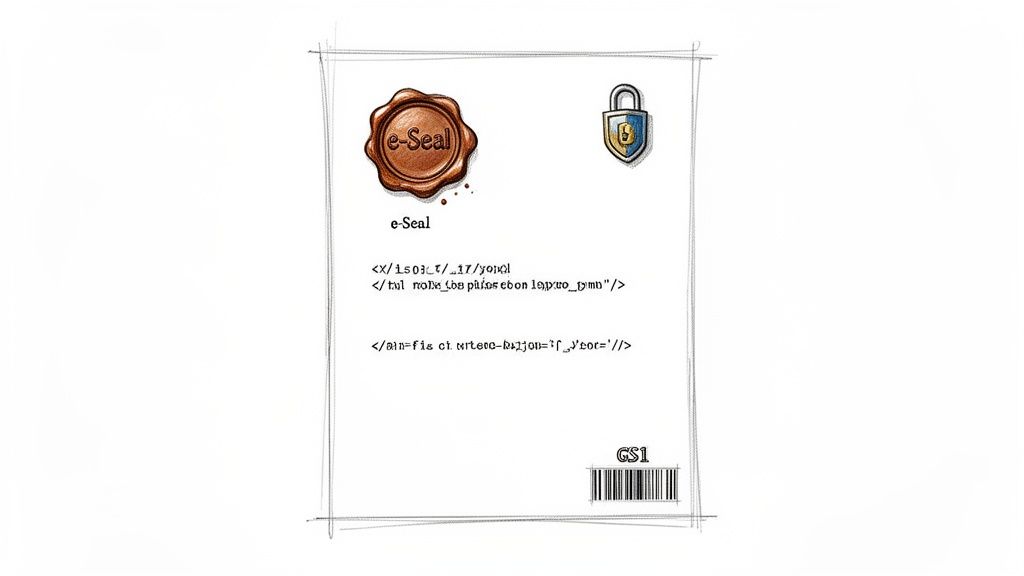
Getting Your Digital e-Seal
Think of the e-Seal as your company's official wax seal, but for the digital world. It's a unique digital signature that gets cryptographically stamped on every invoice you send. This little stamp does two crucial things: it proves the invoice genuinely came from you, and it guarantees no one has tampered with it along the way. It’s a cornerstone of the whole system's integrity.
To get one, you need to apply through one of the officially recognised Certificate Authorities in Egypt, such as Egypt Trust or EGY-TRUST. This e-Seal is then plugged into your invoicing software or ERP system, where it will automatically sign off on every invoice before it gets beamed over to the ETA for validation.
Simply put, without this digital signature, your invoices are invalid. As you get this sorted, it's also a smart move to tighten up your firm's cybersecurity and accounting practices to keep all that sensitive financial data safe and sound.
Standardising Your Product and Service Codes
Here’s another big technical hurdle: you need to standardise how you identify your products and services. The ETA insists that every single line item on an invoice has a specific code that their system can recognise. This creates consistency across the board and lets them accurately analyse economic data.
You have two main paths here:
- GS1 Global Standards: If you're already using the global GS1 barcode system for your products, you're in luck. You can keep using these codes, which is the go-to method for businesses in retail or international trade.
- EGS (Egyptian Goods and Services) Codes: For any items or services that don't have a GS1 code, you'll have to use the internal EGS coding standard. This system maps to the international GPC (Global Product Classification) system, so you'll need to categorise all your offerings accordingly.
Getting these codes right is absolutely critical. Mismatched or incorrect codes are one of the most common reasons the ETA system rejects an invoice, according to guidance from the ETA itself.
Key Takeaway: Every single thing you sell must have either a GS1 or an EGS code. This isn’t optional. Get this wrong, and your invoices will bounce, leading to compliance headaches.
Nailing the Legal and Formatting Requirements
Beyond the tech setup, each e-invoice has to follow some very strict formatting and legal rules. The content of the invoice is just as important as the digital signature and product codes. The ETA requires all e-invoices to be submitted in either XML or JSON format. These are structured, machine-readable formats—a plain old PDF just won't cut it anymore.
Every invoice must also include specific, mandatory information to be legally valid.
Mandatory Invoice Fields
- Seller Information: Your full name, address, and taxpayer registration number.
- Buyer Information: Their full name, address, and national ID or taxpayer number.
- Invoice Details: A unique invoice number, the date it was issued, and the document type (invoice, credit note, or debit note).
- Itemised Breakdown: A clear description of each good or service, its EGS or GS1 code, quantity, unit price, and the total amount.
- Tax Information: The VAT rate that applies and the total tax amount must be clearly stated.
Even making adjustments is tightly controlled. If you need to process a refund or correct a mistake, you must issue a credit note or debit note that directly references the original invoice's unique ID (UUID). This creates a clean, auditable trail linking the original transaction to any changes, keeping your financial records crystal clear.
Choosing the Right E-Invoicing Implementation Path
So, you understand the what and the why of e-invoicing in Egypt. Now comes the big question: how are you actually going to connect your business to the Egyptian Tax Authority (ETA) system? This isn't just a technical detail; it's a decision that will shape your costs, day-to-day workflow, and how much of a headache compliance becomes.
For most small and medium-sized businesses, there’s no single "best" answer. The right choice really boils down to your company's budget, technical know-how, and the software you're already using.
Let's walk through the three main ways you can get this done.
Direct API Integration
The most direct route is to build your own connection to the ETA's portal using an Application Programming Interface (API). Think of an API as a private, secure bridge that lets your accounting or invoicing software talk directly to the government's system. It's a completely automated way to send and receive invoice data.
This approach gives you total control and allows for deep customisation. The catch? It requires a skilled in-house development team or a hefty budget for outside developers. They’ll be responsible for building, testing, and, crucially, maintaining this connection, which means keeping up with any and all changes the ETA rolls out.
- Best For: Larger, tech-first companies that have developers on staff and need a highly tailored workflow.
- Pros: You get complete control over the entire process and could save on subscription fees in the long run if you have the internal talent.
- Cons: The upfront investment in time and money is significant, and you're on the hook for all future maintenance and updates.
Leveraging Your Existing ERP System
Many businesses are already running on an Enterprise Resource Planning (ERP) system to manage everything from finance to inventory. If that's you, you might be in luck. Most of the big ERP providers like SAP, Oracle, and Microsoft Dynamics now offer built-in modules or add-ons specifically for Egyptian e-invoicing.
This is often the path of least resistance. Instead of building something from scratch, you're essentially activating a feature that's already designed to work with your software. The ERP provider handles all the complex technical stuff behind the scenes, and your team just keeps using the system they know.
It's like adding a manufacturer-approved part to your car. It's designed to fit perfectly and work smoothly with the rest of the engine, saving you the trouble and risk of fabricating a custom piece.
Partnering with a Third-Party Service Provider
For many SMEs, this is the go-to option. It involves working with a company that specialises in bridging the gap between your business and the ETA. These providers offer software or a service that grabs your invoice data, puts it in the right format, adds the required e-Seal, and submits it for you.
Essentially, you're outsourcing the technical heavy lifting. This route is almost always faster to set up and requires very little technical expertise from your side. If you need a wider view on the available tech and best practices, it's often wise to chat with payment processing experts who can offer guidance on different integration options.
The demand for these services is exploding. According to a report by a market research firm, the Egypt e-invoicing market is expected to jump from USD 55.61 million in 2024 to USD 224.47 million by 2033. This isn't just a trend; it's a clear signal that businesses are flocking to solutions that make compliance simple.
This is where platforms like CRM Africa come in, offering a more integrated solution that bundles compliant invoicing with other business tools like project management and payment processing. This approach doesn't just solve your e-invoicing problem—it makes your entire workflow smoother. For businesses just starting out, exploring options like free invoicing software can be a great, cost-effective first step.
Comparing E Invoicing Implementation Methods
Choosing your path forward can feel overwhelming. To make it a bit clearer, here’s a straightforward comparison of the three methods we've just covered.
| Method | Best For | Pros | Cons |
|---|---|---|---|
| Direct API Integration | Tech-heavy companies with dedicated developers and unique workflow needs. | Total control, highly customisable, potentially lower long-term costs. | High initial cost, requires ongoing in-house maintenance and updates. |
| Existing ERP System | Businesses already using a major ERP that offers a compliance module. | Seamless integration, familiar user interface, reliable support from the provider. | Can be expensive, locks you into your ERP provider's ecosystem. |
| Third-Party Provider | SMEs with limited technical resources looking for a fast, hassle-free solution. | Quick setup, low technical barrier, cost-effective, outsources maintenance. | Adds a recurring subscription fee, you're dependent on a third party. |
Ultimately, the best method is the one that aligns with your operational capacity and budget. Take a close look at your internal resources and long-term goals to decide whether to build, buy, or partner.
A Step-by-Step E-Invoicing Compliance Checklist
Getting started with e-invoicing in Egypt can feel like a mountain of a task, but it’s really just a series of small, manageable hills. If you break it down, you can tackle it one step at a time. This checklist is your practical roadmap, guiding you through each critical stage from initial registration to final testing. Think of it like assembling flat-pack furniture—follow the instructions in order, and you'll end up with a sturdy, compliant system ready for action.
The journey kicks off with getting your company officially recognised by the new digital system. Without this first step, nothing else gets off the ground.
Stage 1: Register Your Company Profile
First things first: you need to create a digital profile for your company on the Egyptian Tax Authority (ETA) portal. This is the move that officially puts your business on the e-invoicing map. You’ll need to have your key company details handy, like your tax registration number and commercial registration info.
Once your profile is up and running, you can start bringing your team into the loop. The portal lets you invite other users from your organisation—think accountants or admin staff—to help manage things. You can also add your authorised tax representative, ensuring you have professional oversight from day one.
Stage 2: Acquire and Integrate Your E-Seal
With your company registered, the next critical piece of the puzzle is securing your digital identity. You must get an e-Seal certificate, which is essentially your company's official digital signature. It’s a cryptographic tool that proves every invoice you issue is authentic and hasn't been tampered with.
You can get this certificate from one of the government-approved Certificate Authorities. Once you have it, the e-Seal needs to be plugged into your ERP or whatever invoicing software you use. This integration is non-negotiable; it ensures every single invoice is automatically signed before being fired off to the ETA.
Think of it like the official stamp you'd use on company documents. Just as that physical stamp verifies a paper document, the e-Seal verifies your digital invoices, confirming they're legit and untouched.
Stage 3: Standardise and Map Product Codes
Before you can send out a single invoice, you need to make sure your products and services are speaking the ETA's language. Every item you sell has to be assigned a standardised code. This is how the tax authority categorises and analyses transaction data accurately across the entire economy.
You’ve got two ways to handle this:
- GS1 Codes: If your products already use the global GS1 barcode standard, you’re in luck. You can just keep using those existing codes.
- EGS Codes: For any items or services that don't have a GS1 code, you’ll need to map them to the Egyptian Goods and Services (EGS) coding system.
This step often involves some careful data cleanup and organisation on your end. It’s vital to get your codes right from the start, as incorrect coding is one of the top reasons invoices get rejected.
Stage 4: Test Everything in a Safe Environment
Now that the technical bits are in place, it’s time for a dress rehearsal. The ETA provides a "sandbox," or pre-production environment, which is a perfect replica of the live system where you can test your entire workflow without any real-world consequences.
This is your chance to send test invoices and make sure your software is communicating properly with the ETA's platform. You can iron out any integration bugs, formatting errors, or coding issues before they can mess with your actual business operations. A thorough testing phase is the secret to a smooth, error-free launch.
Once you’ve successfully completed these steps and can see your test invoices being processed correctly, you’re ready for the main event. You can officially start issuing legally compliant electronic invoices through the ETA system, confident that your business is fully aligned with Egypt's digital tax regulations.
Unlocking the Business Benefits of E-Invoicing
Let’s be honest, when you first hear about mandatory e-invoicing in Egypt, it's easy to see it as just another compliance headache. But focusing only on the obligation means you’re missing the bigger picture entirely. The real story here is the powerful business opportunity this digital shift creates. SMEs that are thinking ahead are already finding that this regulatory push is actually a fantastic catalyst for boosting efficiency, tightening up cash flow, and building a much stronger, more resilient business.
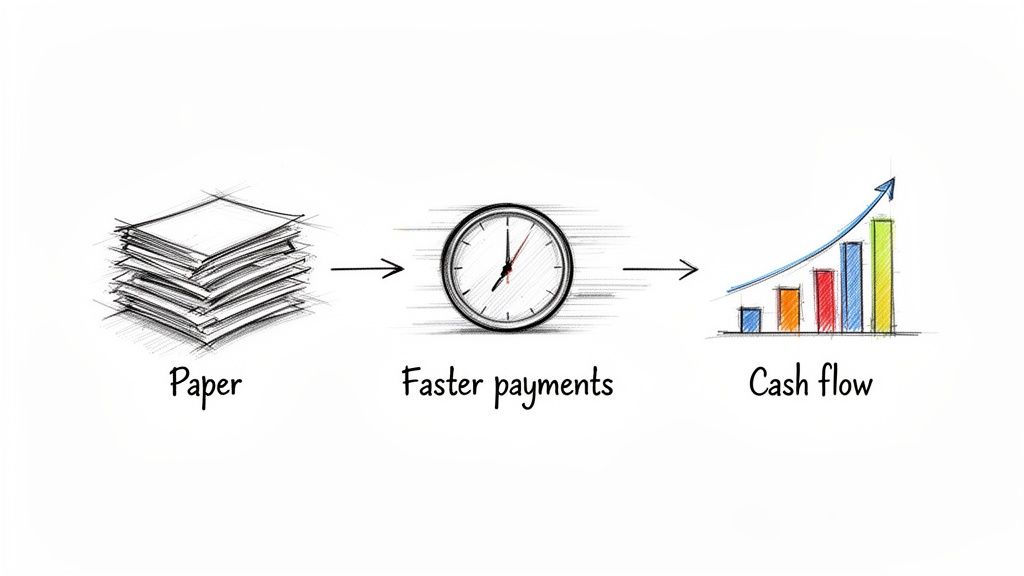
This isn’t just about following rules; it's about turning a requirement into a real competitive advantage. The perks go way beyond just keeping the Egyptian Tax Authority (ETA) happy.
Accelerate Your Payment Cycles
One of the first things you'll notice is how much faster you get paid. Traditional paper invoicing is inherently slow. It gets bogged down by printing, postage, manual delivery, and the all-too-common risk of an invoice getting lost somewhere along the way. E-invoicing wipes out these delays completely.
Your invoice gets validated and lands in your client's system almost instantly. When you pair that with integrated payment options, your clients can settle up with just a click. This dramatically shrinks the gap between sending an invoice and seeing the cash hit your bank account.
Drastically Reduce Administrative Overheads
Take a moment to think about the real cost of your team's manual invoicing tasks. We're not just talking about the obvious stuff like paper, ink, envelopes, and postage. It's also the staff hours spent printing, folding, mailing, and chasing. E-invoicing makes these expenses a thing of the past.
But it’s about more than just hard costs; you get valuable time back. A recent report by research group Billentis showed that U.S. businesses moving to e-invoicing save an average of $15.16 for every single invoice they receive, simply by automating the process. That's time your team can spend on core business activities instead of getting buried in administrative busywork.
The switch to e-invoicing transforms your finance department from a paper-pushing cost centre into a strategic, data-driven unit focused on financial health and growth.
This newfound efficiency frees up resources you can pour back into other areas of your business, whether that’s improving customer service or developing new products.
Gain Unprecedented Cash Flow Visibility
Manual invoicing creates serious blind spots in your financial data. One minute you think you know where you stand, the next you’re chasing payments you thought were coming. With e-invoicing, every single transaction is tracked in real time, from the moment it's issued to the moment it's paid. This gives you a crystal-clear, up-to-the-minute picture of your accounts receivable.
This real-time visibility is a total game-changer for financial planning. You can forecast your cash flow with far greater accuracy, spot potential payment delays before they escalate into problems, and make smarter strategic decisions based on solid, current data.
Minimise Errors and Simplify Tax Compliance
We’ve all been there—a typo on an invoice leads to payment delays and frustrating back-and-forth disputes. Manual data entry is a huge source of these costly errors. The e-invoicing system in Egypt automates data validation, catching mistakes before the invoice is even sent. This ensures accuracy right from the start and cuts down on the communication needed to fix discrepancies.
The benefits also extend directly to your tax processes.
- Simplified VAT Filing: Since the ETA already has a digital record of every transaction, preparing your VAT returns becomes significantly easier and more accurate.
- Smoother Tax Audits: The clear, auditable digital trail created by the system makes tax audits far less stressful and time-consuming.
Ultimately, by embracing the system, you're not just complying with regulations—you're building a more efficient, profitable, and future-proof business.
How CRM Africa Pulls Your Whole Workflow Together
Getting to grips with e invoicing in Egypt is one piece of the puzzle. The real win, though, is building your entire business process around it so that everything just flows. Too many Egyptian SMEs find themselves stuck juggling different tools—one for invoicing, another for managing projects, and a completely separate system for handling payments. It’s a recipe for disconnected data, wasted time, and costs that just don’t need to be there.
This is exactly the headache CRM Africa was built to solve. It’s not just another app you add to the pile. Think of it as the central hub for your entire client relationship, from the first hello to the final payment, all while keeping you perfectly compliant with the ETA. We built it for growing businesses that need powerful tools without the usual complexity or hefty price tag.
A Single Hub for Invoicing and Payments
At its heart, CRM Africa is engineered to create ETA-compliant e-invoices without you having to think twice about it. But that’s just where it starts. The platform plugs directly into major African payment gateways like Flutterwave and Paystack, so your clients can pay you instantly using methods they already know and trust, like mobile money. This one feature alone can dramatically speed up how quickly you get paid.
Suddenly, you have one clear, simple picture of your finances. When a client pays an invoice through their dedicated portal, the payment is automatically marked and reconciled right inside the CRM. Say goodbye to the soul-crushing task of manually matching bank statements to invoices. Instead, you get a live, accurate view of your cash flow.
Build Client Trust with Professional Portals
Great client relationships are built on transparency. CRM Africa gives you professional, client-branded portals where your customers can log in to see how their project is coming along, check all their past and present invoices, and make payments securely. It’s a self-service approach that puts them in control and frees up your team from constant admin queries.
When you give clients a dedicated space to track everything, you elevate the relationship beyond simple transactions. You're building a professional, transparent partnership that boosts trust and keeps them coming back.
Here's a look at our demo booking page. You can schedule a personalised tour to see these client portals and other features in action for yourself.
Booking a live demo is the best way to see exactly how these integrated features could fit into your own day-to-day workflow.
The Right Partner for a Growing Business
Trying to manage a patchwork of different software subscriptions isn’t just expensive; it's a huge drag on efficiency. We built CRM Africa’s pricing model for the reality of a growing SME. It includes a free-forever plan for up to 10 users, which means you can manage your leads, projects, and finances without worrying about costs creeping up as you bring more people onto the team. If you want to dig deeper into how this works, our article on free invoicing and CRM solutions breaks it down.
This all-in-one approach gives your team everything it needs to turn leads into clients, deliver work on time, and get paid faster. By bringing all your operations under one roof, CRM Africa helps you stop managing software and get back to what really matters—growing your business.
Got Questions About E-Invoicing? We’ve Got Answers.
Jumping into Egypt’s e-invoicing system for the first time? It’s completely normal to have a few questions. For most small businesses, this is new territory.
We’ve put together some quick, no-nonsense answers to the questions we hear most often from entrepreneurs just like you.
What Exactly Is an E-Invoice?
Think of an e-invoice as more than just a PDF you shoot over in an email. It’s actually a structured digital file (usually in XML or JSON format) packed with specific data fields.
This structure is the key. It allows the Egyptian Tax Authority’s (ETA) system to read and process it automatically, without anyone having to manually type in the details. As tax experts Avalara point out, this machine-readable format is what makes the whole system work so efficiently.
Is E-Invoicing Really Mandatory for My Business?
Yes, for virtually all registered businesses in Egypt, it's no longer optional. The government rolled it out in waves, starting with the biggest companies and working its way down to cover everyone else.
Since July 2023, old-school paper VAT invoices are no longer valid for claiming tax deductions. So, if you're involved in any B2B transactions, you have to be on the e invoicing Egypt system. It’s all part of a bigger plan for full digital oversight of the economy.
What’s This “Clearance” vs. “Post-Audit” Thing About?
Egypt uses what’s called a pre-clearance model. It's a form of Continuous Transaction Control (CTC), which sounds complicated but the idea is simple.
In a clearance system, you have to send every single invoice to the tax authority's platform for a real-time thumbs-up before you can send it to your customer. The ETA essentially acts as a gatekeeper, validating each transaction on the spot.
This is a world away from the post-audit models you might see in parts of Europe, where businesses invoice each other directly and the tax man reviews things later. As global provider Pagero explains, the clearance approach gives the authorities an immediate window into economic activity, helping to clamp down on tax fraud from the get-go.
Do I Need to Buy Any Special Hardware?
Good news—for B2B e-invoicing, you generally don't need any special physical devices. The whole system runs on software, connecting your ERP or invoicing platform directly to the ETA's portal.
The one piece of "digital hardware" you absolutely need is an e-Seal. This is a cryptographic signature that proves your company is who it says it is and keeps your invoice data secure. You’ll have to get one from an accredited provider in Egypt.
Tired of jumping between different tools to run your business? CRM Africa brings it all together. You get ETA-compliant invoicing, project management, and built-in payments in one simple platform. See how CRM Africa can simplify your workflow and help you get paid faster.