Think of a proforma invoice less like a final bill and more like a professional handshake before the deal is officially done. It’s essentially a preliminary bill of sale that clearly lays out the scope, cost, and terms of a potential transaction before any goods change hands. According to financial experts, this document is crucial for confirming all the details upfront, making sure both the buyer and seller are completely on the same page (Investopedia, 2023).
Unpacking the Proforma Invoice
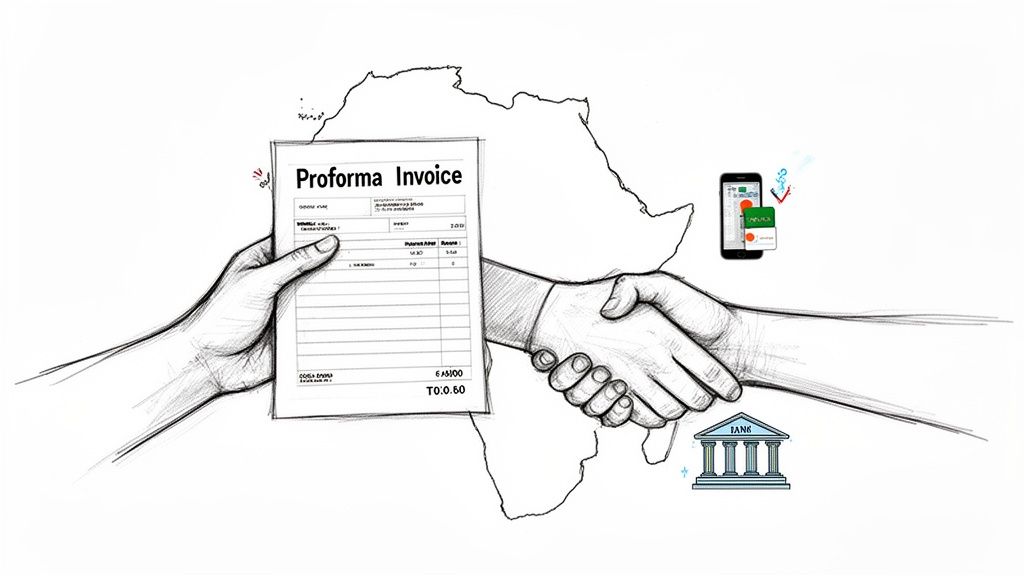
A proforma invoice is like a detailed dress rehearsal for the final transaction. For small and medium-sized enterprises (SMEs) all across Africa, it's a vital tool for setting clear expectations and getting a solid commitment from a buyer before dedicating time, money, and resources to an order (World Bank, 2021).
It serves as a good-faith agreement, allowing your business to present a complete picture of the proposed sale. This covers everything from detailed product descriptions and quantities to final pricing and payment terms. By getting this all sorted out at the beginning, you can sidestep expensive misunderstandings and manage your client’s expectations perfectly.
This document is especially useful for:
- Custom Orders: When you're creating something bespoke, a proforma ensures the client agrees to the exact specifications and price before you even think about starting production.
- International Trade: It’s often a requirement for customs officials and banks. They need it to help with import permits or to get financing arranged before the goods are shipped, as noted by the International Chamber of Commerce (ICC).
- Securing Deposits: It gives you a formal, professional basis for requesting an advance payment, which can be a massive help for your cash flow.
Distinguishing It From a Final Invoice
Here’s the critical part: a proforma invoice is not a legally binding demand for payment. You don’t record it in your accounting books as accounts receivable, and your client can't use it to claim VAT. Its real job is informational—it’s a confirmed quote that shows exactly what the final bill will look like once the deal is done. You can find out more about the key differences in our guide on what an invoice is.
Because it's non-binding, it gives you some wiggle room. If details need to be tweaked before the final sale, you can adjust them. This makes it a fantastic tool for negotiation and clarification (Harvard Business Review, 2022).
A proforma invoice helps a buyer arrange financing, secure import permits, or navigate currency exchange controls. It establishes a clear, documented understanding between parties before the actual transaction occurs.
Ultimately, getting comfortable with proforma invoices helps businesses in markets like Nigeria, Kenya, and South Africa make their sales process smoother. It makes you look more professional and helps build stronger client relationships grounded in transparency and trust (AfCFTA Secretariat, 2022).
Anatomy of a Professional Proforma Invoice
Putting together a proforma invoice that’s clear, professional, and actually gets the job done involves more than just throwing some products and prices on a page. Think of the format of a proforma invoice as the blueprint for the final sale; get it right, and you ensure every detail is understood and agreed upon from the start. For African SMEs, a sharp, well-structured document doesn't just build trust—it can seriously speed up the entire sales cycle (United Nations Economic Commission for Africa, 2020).
Let's walk through the essential parts, field by field, to build a proforma invoice that’s flawless every time. This is your practical checklist to make sure your documents are always up to scratch.
Core Header Information
The very top of your document sets the stage, so it has to be crystal clear. This is the first thing your client lays eyes on, and there’s no room for ambiguity.
- Clear Title: Your document absolutely must be labelled "Proforma Invoice". This one phrase is crucial. It immediately tells your client this isn't a casual quote or a final tax invoice, preventing any mix-ups about its purpose.
- Unique Document Number: Every proforma invoice needs its own unique ID number. This is non-negotiable for tracking the document, referencing it in emails, and eventually flipping it into a final invoice once the deal is done.
- Dates: You need two dates here: an Issue Date (when you create it) and an Expiry Date. That expiry date is a subtle but powerful tool. It creates a bit of urgency and protects you from price changes, making it clear your offer isn't open forever.
Seller and Buyer Details
Getting the contact information right is a must. A simple typo or a missing detail here can bring everything to a grinding halt.
Make sure your company's information is displayed prominently. We’re talking full business name, physical address, phone number, email, and any relevant registration or tax numbers. It’s all about reinforcing that you’re a legitimate, professional operation.
Likewise, you need the buyer’s full details: their company name, the right contact person, billing address, and the shipping address if it’s different. Taking a minute to double-check this info now can save you a world of headaches later.
The Heart of the Invoice: Detailed Line Items
This is where the magic happens—where you spell out exactly what you're offering. Vague descriptions are a recipe for disaster and disputes down the line, so precision is your best friend.
Each product or service needs its own line item with a clear, simple breakdown:
- Detailed Description: Don't just put "T-shirt." Be specific. Think model numbers, colours, sizes, or the scope of the service. The more detail, the better.
- Quantity: State the exact number of units for each item.
- Unit Price: List the price for a single item.
- Subtotal: Do the quick math for each line (Unit Price x Quantity).
Once all your items are listed, it's time for the grand total. Be transparent here. Clearly show any applicable taxes (like VAT), discounts, or shipping fees as separate lines before you present the Total Amount Due. No one likes surprise costs. If you want to see how this looks in practice, you can check out different samples of a proforma invoice to find a layout that suits your business.
According to international trade experts, a proforma invoice is often the first document a buyer uses to secure financing or arrange for import permits. A lack of detail can stall these critical pre-shipment activities (World Trade Organization, 2021).
A solid proforma is more than just a piece of paper; it's a tool for clear communication. To help you nail it every time, here’s a quick guide distinguishing the must-haves from the nice-to-haves.
Essential vs Optional Fields on a Proforma Invoice
| Field Name | Status | Purpose and Best Practice for African SMEs |
|---|---|---|
| "Proforma Invoice" Title | Required | Prevents confusion with quotes or final invoices. Make it bold and clear at the top. |
| Unique Invoice Number | Required | Essential for tracking and converting to a final invoice. Use a logical sequence (e.g., PRO-2024-001). |
| Issue & Expiry Date | Required | The issue date is for record-keeping; the expiry date creates urgency and locks in pricing for a set time. |
| Seller's Full Details | Required | Your business name, address, contact info, and tax ID. This builds trust and shows professionalism. |
| Buyer's Full Details | Required | Full name, address, and contact person. Double-check this to avoid delivery or payment delays. |
| Detailed Line Items | Required | Clear descriptions, quantities, and unit prices for each product/service. No room for ambiguity. |
| Total Amount Due | Required | The final figure, including a clear breakdown of taxes, shipping, and any discounts applied. |
| Payment Terms | Required | Specifies when payment is due (e.g., "50% upfront"). Manages cash flow expectations for everyone. |
| Payment Instructions | Required | Crucial for getting paid. Include bank details and mobile money options like M-PESA to make it easy. |
| Purchase Order (PO) Number | Optional | If the client provided a PO number, including it helps their internal accounting and speeds up payment. |
| Shipping Terms (Incoterms) | Optional | For cross-border trade, specifying terms like FOB or CIF clarifies who pays for shipping and when risk transfers. |
| Notes or Special Instructions | Optional | A great place for extra details, like delivery instructions or a thank you note to add a personal touch. |
While the "Required" fields are non-negotiable for a valid document, adding the "Optional" ones shows you’re thorough and makes the entire process smoother for your client.
Payment Terms and Instructions
This section might just be the most important part of the whole document. This is where you tell your client how and when you expect to be paid. If you're vague here, you're just asking for delayed payments.
State your payment terms clearly (e.g., “50% deposit required to confirm order, balance due upon delivery”). This sets expectations and helps you manage your cash flow.
Even more importantly, give them dead-simple instructions on how to pay you. In the African market, this means offering choices.
- Traditional Banking: Include your full bank account name, account number, branch code, and SWIFT code for any international payments.
- Mobile Money: To get paid faster, make mobile money an option. If you're in Kenya, for example, providing your M-PESA Paybill number and account details makes payment instant and incredibly easy for a massive part of the market (GSMA, 2023). The same goes for other popular platforms in your specific region.
By offering a mix of payment options, you remove any friction and make it as easy as possible for clients to say "yes" and send the money. And at the end of the day, that’s what helps you get paid faster.
Navigating Tax Rules for Proforma Invoices in South Africa
When you're running a business in South Africa, getting your head around local compliance isn't just a good idea—it's absolutely essential. You've got to keep your operations on the right side of the law, and the rules around the format of a proforma invoice are a perfect example. Get this wrong, and you could be staring down some serious accounting headaches and compliance issues with the South African Revenue Service (SARS).
At its heart, a proforma invoice is simply a good-faith estimate. Think of it as a preliminary quote that gives your buyer a clear picture of what a potential transaction will look like. But—and this is a big but—it is fundamentally different from a tax invoice. Understanding that distinction is critical.
The SARS Distinction: A Proforma vs. a Tax Invoice
In the eyes of SARS, a proforma invoice has no official standing when it comes to tax. It's a preparatory document, not a final record of a sale. This means your client can't use it to claim Value-Added Tax (VAT), and you can't use it to formally recognise revenue in your books. Its entire purpose is to get everyone on the same page before a deal is finalised.
A proforma invoice is a commitment to a price and terms, but it is not a demand for payment. It’s the confirmed game plan before the official action, which is the final tax invoice.
This separation is crucial for keeping your financial records clean and accurate. Because no goods or services have actually been supplied when you issue a proforma, no taxable event has taken place. Recording it as a sale would misrepresent your company's financial state and almost certainly lead to compliance trouble (SAICA, 2022).
This flowchart breaks down the typical structure, highlighting the key sections from top to bottom.
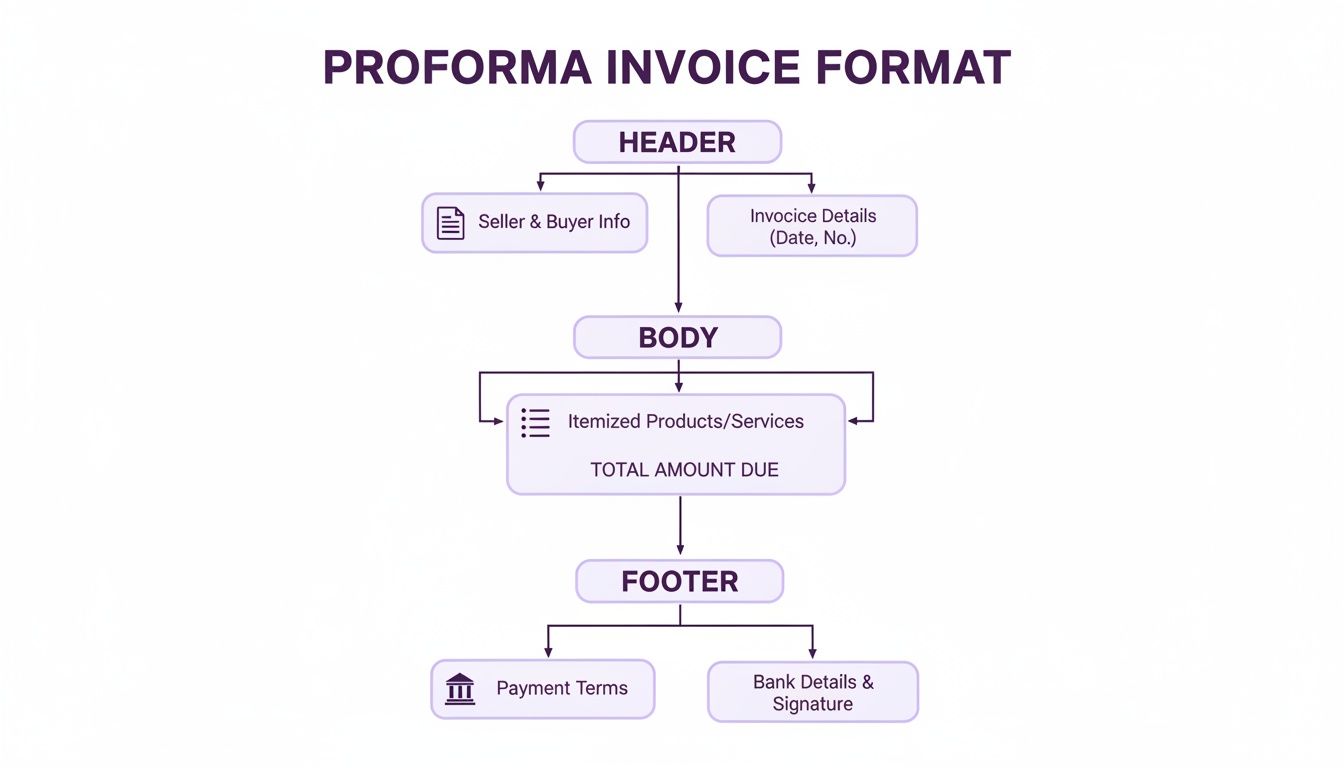
This visual layout reinforces a key point: while the document looks official, its role is purely informational until you generate the final tax invoice.
Legal Standing and Collecting Payment
So, if a proforma isn't a legally binding demand for payment, what good is it? Well, it plays a vital role in securing commitment. Many South African businesses use it to request a deposit or advance payment, particularly for large projects or custom orders. This is a perfectly normal and smart practice that can really help with cash flow.
Just remember, the transaction isn't officially done until you've delivered the goods or services. According to the South African Revenue Service (SARS), a tax invoice must be issued within 21 days from the time the supply was made. That final document is the only one SARS recognises for tax or VAT claims because it confirms that the deal is done and ownership has transferred.
This regulation gives businesses a clear, step-by-step process:
- Issue a Proforma Invoice: Use it to lock in the terms and maybe collect a deposit.
- Deliver the Goods/Services: Go ahead and fulfil your end of the bargain.
- Issue a Tax Invoice: Within 21 days of delivery, send the final, SARS-compliant invoice.
- Record the Transaction: Your accounting records should be based on the tax invoice, never the proforma.
Avoiding Common Compliance Traps
The single biggest mistake businesses make is treating a proforma like a final invoice. It’s an easy slip-up, but one that can cause serious errors in your financial reporting and attract unwanted attention from SARS.
To keep everything above board, make sure your whole team understands these key differences:
- VAT Claims: Never, ever suggest a client can use a proforma for VAT. Make it crystal clear that a proper tax invoice will follow.
- Accounting Records: Your bookkeeper or accountant should only record revenue and accounts receivable once a tax invoice has been issued.
- Clear Labelling: Always title the document "Proforma Invoice" in big, bold text. There should be absolutely no room for confusion.
By sticking to these guidelines, South African SMEs can use proforma invoices as the powerful sales tool they're meant to be—formalising negotiations and securing customer buy-in, all while keeping the books clean and compliant with SARS.
Using Proforma Invoices in Cross-Border Trade
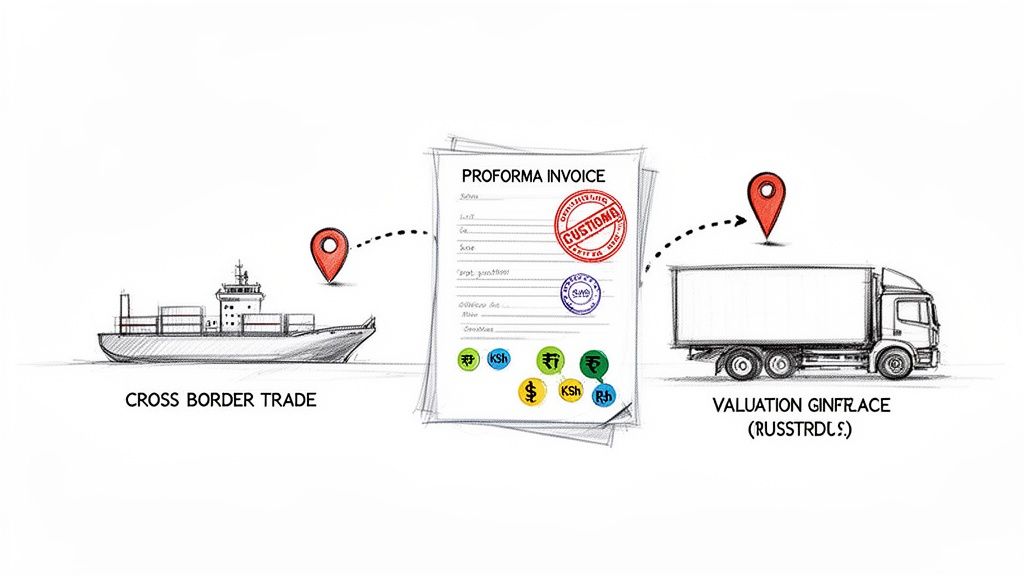
For businesses with ambitions that stretch beyond their own borders, the proforma invoice isn't just helpful—it's absolutely essential. When you’re moving goods across the continent, this document is far more than a preliminary bill. It’s a passport for your products, smoothing out the often-bumpy road of international transactions.
Think of it like this: international trade is a highly coordinated dance. The proforma invoice is the choreography that makes sure everyone—from you to your buyer, the banks, and the customs officials—knows their steps. Without it, you’re just asking for logistical chaos, delays, and costly mix-ups that can kill a promising deal before it even gets going.
A correctly structured format of a proforma invoice is especially critical for customs clearance. Before anything leaves your warehouse, customs officials need a clear and accurate valuation of the goods. A proforma provides this declaration, letting them assess duties and taxes in advance. This one step can dramatically speed up the entire process when your shipment finally arrives at the port.
Unlocking Imports and Financing
Beyond just clearing customs, a proforma invoice is the key that opens several administrative doors for your international buyer. Many African countries require import permits for certain goods, and the application for one nearly always demands a proforma invoice. This document proves the buyer’s intent to purchase and gives the authorities all the transaction details they need.
It's also the cornerstone for financing large international orders. Banks and financial institutions often require a proforma invoice to process a letter of credit or other trade finance instruments (International Trade Administration, 2023). It serves as the foundational agreement that gives them the confidence to release funds, assuring them that a legitimate deal is in the works.
In international trade, a proforma invoice acts as a universal translator. It communicates the value, nature, and terms of a shipment in a standardised format that customs officials, banks, and freight forwarders worldwide can understand and act upon.
This is especially true for South African businesses, who rely on these documents far more in international trade than in domestic sales. For them, the proforma is a crucial tool for helping clients prepare for customs valuation and secure the right import approvals before production even kicks off. It's a protective measure, making sure everyone is aligned when duties and financing come into play. You can find more insights on the role of proforma invoices in South Africa on inv24.co.za.
A Real-World Scenario
Let’s say a Kenyan company is exporting handcrafted leather goods to a distributor in Nigeria. The seller issues a detailed proforma invoice outlining the exact quantity, style, unit price, and total value in US Dollars. It also specifies the shipping terms—for example, CIF (Cost, Insurance, and Freight) Lagos.
This single piece of paper accomplishes several critical tasks all at once:
- The Nigerian buyer uses it to apply for an import licence from the Nigerian government.
- The buyer’s bank uses it to open a letter of credit, guaranteeing payment to the Kenyan seller once the goods ship.
- Kenyan customs officials review it before the goods are even cleared for export.
- Nigerian customs use it to pre-calculate import duties before the container ship even docks.
Without this clear proforma, that shipment could get stuck in customs for weeks, racking up storage fees and putting the whole deal in jeopardy.
The Importance of Currency and Incoterms
When you're trading across borders, two details on your proforma invoice format become non-negotiable: the currency and the Incoterms. Get these wrong, and you’re asking for trouble.
- Currency: Always state the currency of the transaction (e.g., USD, EUR, ZAR) to avoid any confusion from fluctuating exchange rates.
- Incoterms: These are globally recognised rules that define who is responsible for what. Terms like FOB (Free on Board) or CIF clarify who pays for shipping, insurance, and freight, and at what point the risk transfers from you to the buyer (International Chamber of Commerce, 2020).
Including these details isn't just a best practice; it's a critical defence against expensive disputes. A properly formatted proforma invoice is your first and best line of defence against the headaches of international trade, paving the way for smooth, successful, and profitable expansion across the continent.
How to Automate Your Proforma Invoicing Process
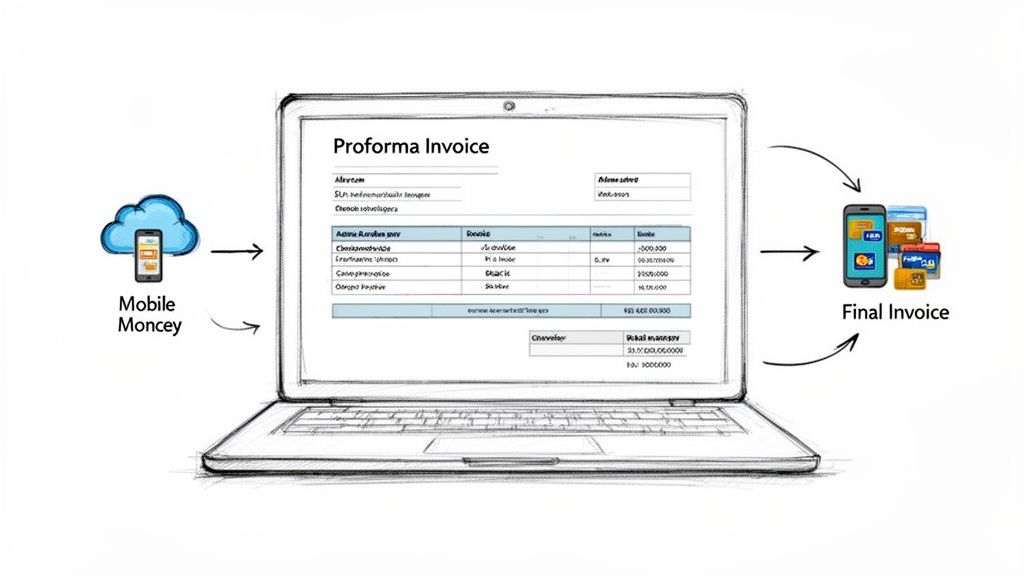
Let’s be honest: creating proforma invoices by hand is a massive time drain. It’s also a recipe for costly mistakes. A simple typo in a client’s details, an incorrect price, or using an old format of a proforma invoice can do real damage. These slip-ups don’t just look unprofessional; they can lead to payment delays, messing up your cash flow and slowing down the whole sales cycle.
Moving away from manual work isn’t a luxury anymore—it’s essential if you want to grow. Automating the process gets rid of these risks and, more importantly, gives you back your time. You can focus on closing deals and looking after clients instead of drowning in admin. The aim is to build a smooth, efficient system that runs from the first quote right through to the final payment.
This is where a dedicated platform like CRM Africa really changes the game for businesses across the continent. It turns the entire proforma workflow into a simple, automated process that saves hours of work and cuts out human error.
From Quote to Proforma in a Single Click
It all starts the moment a potential client shows interest. In CRM Africa, you can track every sales opportunity visually, watching it move from a lead to a qualified deal. Once you’ve agreed on the work, you can generate a professional quote straight from that deal record.
But when the client says "yes" to the quote, that’s when the magic happens. Instead of starting a new document and copying everything over, CRM Africa lets you convert that approved quote into a perfect proforma invoice with just one click.
That single action takes care of several things instantly:
- Pulls Client Data Automatically: It grabs all the buyer's details—name, address, and contact info—from their CRM profile and puts it right on the invoice. No more typos.
- Populates Line Items: Every product, service, quantity, and price from the original quote is carried over, so you know it’s accurate.
- Applies Your Branding: The proforma invoice is created using your customised, professional template, complete with your logo and company details.
Automation in invoicing isn't just about being faster; it’s about being consistent. A good system ensures every single proforma that goes out is accurate, professional, and legally sound, building trust with your clients from the very beginning.
This simple process eliminates nearly all manual data entry, which studies show is one of the main sources of business errors. For those looking to improve their internal systems without a full CRM, exploring general spreadsheet automation techniques can also provide some great ideas.
Handling Multi-Currency and Payment Gateways
Doing business across Africa often means juggling multiple currencies. CRM Africa makes this easy by supporting multi-currency invoicing. You can bill clients in their local currency while keeping your own books tidy. It’s a small touch, but it makes your business look more professional and makes life easier for your international clients.
Once the proforma is sent, the next step is getting paid—often a deposit. CRM Africa integrates directly with major African payment gateways like Paystack, Flutterwave, and Pesapal. This means your clients can pay right from the invoice with a click, using their preferred method, whether that’s a credit card or mobile money like M-PESA.
The Seamless Conversion to a Final Tax Invoice
After the client has accepted the proforma and you've delivered the goods or services, the last step is to issue the final tax invoice. This is another spot where automation saves a ton of time and keeps you compliant.
Inside CRM Africa, converting the accepted proforma into a final, legally compliant tax invoice is just as easy. The system automatically assigns a new, sequential invoice number but keeps all the original transaction details. This creates a crystal-clear, auditable paper trail from the initial quote all the way to the final payment.
The key here is that payment options are built right into the invoice, which drastically cuts down the time it takes to get paid. By automating this whole quote-to-cash cycle, you turn invoicing from a boring chore into a powerful tool for growing your revenue and giving your customers a great experience.
If you’re interested in looking at other options, you can learn more about free invoicing software in our detailed guide. An end-to-end system ensures every step is professional, tracked, and set up to get you paid faster.
Common Questions About Proforma Invoices
Working with business documents can feel like navigating a maze, especially when some look almost identical but serve completely different roles. Getting your head around the format of a proforma invoice and its specific purpose is key to clear client communication, staying compliant, and keeping your finances in order.
Let's clear up some of the most common questions African SMEs run into when using proforma invoices in their day-to-day business.
Is a Proforma Invoice a Legally Binding Contract?
In short, no. A proforma invoice isn’t a legally binding contract. Think of it more as a confirmed quote or a good-faith agreement. It lays out the seller's commitment to deliver specific goods or services at a set price, making everything clear upfront.
When your customer accepts a proforma invoice, they're showing a strong intention to buy. However, it doesn't lock either of you into the same rigid legal obligations as a final tax invoice or a formal sales contract. Its main job is to get everyone on the same page and smooth out administrative tasks, like securing finance or getting paperwork ready for customs.
Can I Use a Proforma Invoice for My Accounting Records?
Definitely not. You should never use a proforma invoice for your official books. Since it's a preliminary document—not an actual demand for payment—it doesn’t represent a completed sale or revenue you've actually earned.
Your accounts receivable and revenue should only be updated after you’ve delivered the goods or finished the service and issued a final, official tax invoice. In South Africa, for instance, South African Revenue Service (SARS) is very strict that proforma invoices don't count for tax or VAT. Using them in your formal accounting can lead to messy financial statements and serious compliance headaches.
What's the Difference Between a Proforma Invoice and a Quotation?
This is a great question because they do seem very similar. A quotation is usually the first step—an initial offer that’s often open to a bit of back-and-forth negotiation. It’s the document that kicks off the conversation about pricing and terms.
A proforma invoice comes in later, once the buyer has already signalled they want to go ahead. It’s a more formal document with details that look almost exactly like the final tax invoice. For anyone involved in international trade, it's worth noting that a proforma invoice carries a lot more weight for customs and financing than a simple quote ever will.
Think of it this way: a quote asks, "Are you interested at this price?" A proforma invoice confirms, "Here are the final details for the deal we've agreed upon."
The distinction really matters. While both outline costs, the proforma invoice marks a more committed stage in the deal, firming up the terms before the sale is finalised.
How Should I Handle Payments Made Against a Proforma Invoice?
It's pretty common—and great for your cash flow—to ask for a deposit or advance payment based on a proforma invoice. When that money comes in, you have to record it properly.
That payment should be logged as a liability, not as revenue. You could call it "Payment on Account" or "Unearned Revenue" in your books, in line with Generally Accepted Accounting Principles (GAAP). Why? Because you still owe the client the goods or services they've paid for.
Once you’ve delivered on your promise and sent out the final tax invoice, you can then:
- Recognise the Revenue: Go ahead and record the full sale amount in your accounts.
- Apply the Deposit: Credit the advance payment against the total amount due on the final invoice.
- Issue a Receipt: Always send a receipt for the payment. This keeps your financial trail clean and professional.
Following this two-step process keeps your financial records accurate, compliant, and gives you a true picture of your business's health.
Ready to stop wasting time on manual invoicing and start getting paid faster? CRM Africa provides an all-in-one platform to automate your entire proforma and tax invoicing process. Create, send, and collect payments through integrated gateways like M-PESA, Paystack, and Flutterwave with just a few clicks. Transform your quote-to-cash cycle today at https://crm.africa.