If you're looking for the best Odoo alternative for small businesses, you'll want a platform that ditches per-user pricing, simplifies your day-to-day operations, and works flawlessly with local African payment gateways. For many startups and service-based companies, that means choosing a solution like CRM Africa, which was built from the ground up to tackle the specific operational and financial realities of the African market.
Why African SMEs Need an Odoo Alternative
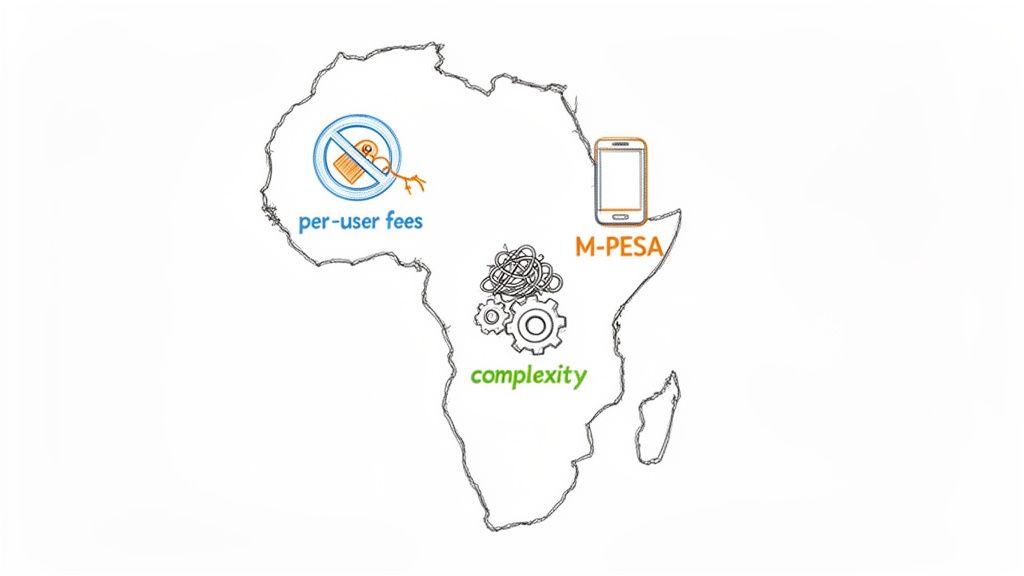
Let’s be clear: Odoo is a powerhouse Enterprise Resource Planning (ERP) system. But its sheer scale and complexity often create massive hurdles for small and medium-sized enterprises (SMEs) across Africa. It promises an all-in-one solution, but its structure can easily clash with the lean, agile operations that define most African startups.
The biggest reason business owners start looking elsewhere is the total cost of ownership. Odoo’s pricing model combines per-user fees with per-module licensing. This means your costs can spiral upwards unexpectedly as you hire more people or add essential functions like accounting or project management. For an SME on a tight budget, that’s a recipe for disaster.
The Complexity Challenge
Beyond the price tag, Odoo comes with a notoriously steep learning curve. A 2022 study by Software Path found that the average ERP implementation takes 6.1 months, a timeline many small businesses cannot afford. Getting it set up and customised to fit your business usually demands dedicated technical expertise—a luxury most small businesses simply can't afford. This complexity is a major reason why the platform has such a high abandonment rate among smaller companies.
It’s a continent-wide issue. While around 270 companies in Africa actively use Odoo, small businesses see abandonment rates between 45-55% within the first year, according to market analysis from Capterra. The costs and headaches of customisation just become too much. In the ZA region, for example, professional services firms often find Odoo's invoicing system is a poor fit because it lacks native support for mobile money, making alternatives like CRM Africa, ProfitBooks, or ERPNext far more practical.
A Mismatch with Regional Needs
One of Odoo's most glaring shortcomings for African businesses is its lack of native support for the payment gateways we use every day. If you want to integrate systems like M-PESA, Paystack, or Flutterwave, you’re often stuck hiring expensive third-party developers or relying on fragile custom connectors. This just adds unnecessary friction to your cash flow. A 2023 report by the GSMA highlighted that mobile money transactions in Sub-Saharan Africa reached $832 billion in 2022, underscoring the critical need for native integration.
Following digital transformation best practices means choosing software that’s actually built for your market, not fighting a tool designed for another one.
For an African SME, being able to accept mobile money payments without a fuss isn't a "nice-to-have"—it's a core operational requirement. The ideal Odoo alternative for small businesses has to solve this problem straight out of the box.
The primary pain points of using Odoo in Africa are consistent across industries. Growing businesses quickly realise they need a more agile and affordable system that was designed with their unique challenges in mind.
Odoo's Core Challenges for Growing African Businesses
| Challenge Area | Impact on Small Businesses | What to Seek in an Alternative |
|---|---|---|
| Pricing Model | Per-user and per-module fees escalate costs rapidly as the team grows. | Flat-rate or free-forever plans without per-seat licensing. |
| Complexity & Learning Curve | Requires technical expertise for setup and customisation, slowing adoption. | An intuitive, user-friendly interface with minimal setup requirements. |
| Payment Gateway Support | Lack of native mobile money integrations creates payment friction and extra costs. | Built-in support for M-PESA, Paystack, Flutterwave, and other local gateways. |
| Resource Demands | Customisation and maintenance require significant time and financial investment. | A solution that works out-of-the-box with features tailored to service businesses. |
Ultimately, this guide will give you a practical roadmap to finding a scalable, user-friendly, and affordable solution that truly aligns with your financial and operational realities.
Picking the Right Odoo Alternative for an African Business
When you’re looking for an Odoo alternative for small businesses in Africa, you have to look past the generic software reviews. The real challenge is finding a platform that gets the specific hurdles African SMEs face. The right system has to be powerful, yes, but also affordable and straightforward enough for teams that don't have a dedicated IT department.
Three names consistently pop up for good reason: the open-source and flexible ERPNext, the sprawling Zoho One suite, and the locally-focused CRM Africa.
Each of these platforms brings something different to the table. Getting to grips with these differences is the key to choosing a tool that won’t just fill the gap Odoo leaves, but will genuinely help you grow. Let's break down how they compare for a modern African business.
ERPNext: The Open-Source Powerhouse
For any business with a bit of technical skill on hand—or a real hunger for customisation—ERPNext is a serious contender. Its biggest draw is that it’s a complete, all-in-one system that doesn’t hide features behind a paywall like Odoo does. While Odoo reserves its best tools for the pricey Enterprise version, ERPNext gives you everything from accounting and inventory to project management in one free, self-hosted package.
That freedom comes with a catch, though. Getting ERPNext set up and keeping it running demands a higher level of technical know-how than a plug-and-play SaaS tool. Once it's up, users love its simplicity, with some businesses reporting a 40% boost in efficiency after ditching Odoo's often convoluted module system, based on user testimonials on platforms like G2. But actually getting to that point can be a major roadblock for teams without a tech background. You can find many more examples of ERP systems in our detailed guide.
Zoho One: The All-You-Can-Eat Suite
Zoho One is the "everything but the kitchen sink" option. It bundles over 40 different applications into a single subscription, aiming to be the one and only operating system for your business—from CRM and finance to marketing and HR. For companies that need a massive toolkit and are ready to invest the time to learn it all, Zoho One offers a ton of value for the money.
The problem for many African SMEs is that the sheer number of apps can be overwhelming. The per-user pricing, while competitive, also starts to add up quickly as your team expands. More importantly, its payment gateway support for Africa often feels like an afterthought. Just like with Odoo, you often need clunky, third-party connectors to make it work, adding another layer of cost and complexity.
CRM Africa: Built from the Ground Up for Africa
CRM Africa was created specifically to address the weak spots of generic ERPs in the African market. It's built on a simple premise with three core pillars for local SMEs: a free-forever plan for small teams, a total rejection of per-seat licensing fees, and a unified platform that combines CRM, project management, and invoicing from the start.
This model is a direct answer to the biggest cost complaints people have with Odoo. Instead of seeing your software bill jump every time you hire someone, you can scale your team without unpredictable costs. This is a game-changer for service businesses, where growing your team is a sign of success, not a financial penalty.
Odoo’s generic payment connectors often require costly third-party development to work with platforms like M-PESA. CRM Africa’s native integration with Flutterwave, Paystack, and M-PESA is a fundamental advantage, enabling one-click payments and automated reconciliation right out of the box.
You really can't overstate how important this focus on the local payment ecosystem is. While there are 3,659 websites in Africa currently using Odoo, its retention rate among small businesses is a dismal 30% once they outgrow the basic plan. A huge reason for this churn is the frustration with systems that don't align with local financial realities. This gap is exactly why the African ERP market is expected to hit USD 0.88 billion by 2029, according to a report by Verified Market Research. You can read more about these Odoo usage trends in Africa.
CRM Africa was designed to capture this market by solving the payment puzzle first, making it a seriously practical Odoo alternative for small businesses that need to get paid easily and efficiently, no matter where they are on the continent.
A Feature-by-Feature Capability Showdown
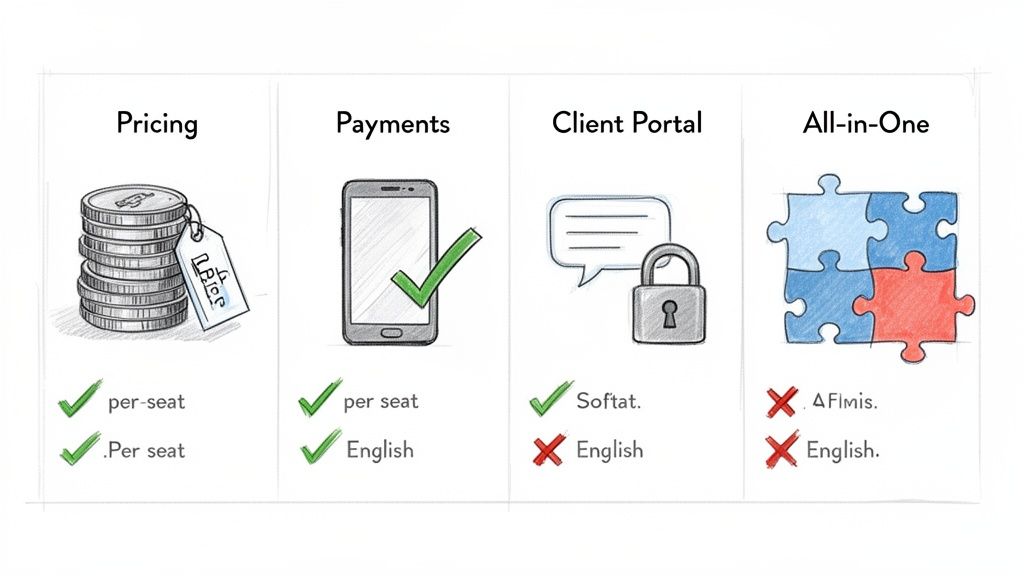
When you’re running a service business in Africa, high-level summaries just don’t cut it. You need to get into the weeds. Finding the right Odoo alternative for small businesses isn’t just about swapping one system for another; it’s about picking a tool that actually fixes your daily operational headaches without creating new ones.
That means we need to dig into the details that matter: the real cost of ownership, how you get paid, the way you manage clients, and whether it truly functions as a single, unified system.
Let’s put Odoo head-to-head with three serious contenders—ERPNext, Zoho, and the Africa-focused CRM Africa—to see how they stack up in the real world. This will give you a much clearer picture of what you’re really signing up for.
Head-to-Head Feature Comparison Odoo vs Key Alternatives
To get right to the point, let's break down how these platforms compare on the features that are most critical for African SMEs. This isn't just about ticking boxes; it's about understanding the practical differences in how each system approaches core business needs. The table below offers a quick, at-a-glance look before we dive deeper into each area.
| Feature | Odoo | ERPNext | Zoho One | CRM Africa |
|---|---|---|---|---|
| Pricing Model | Per-user, per-app fees. Costs escalate with team growth and added functionality. | Free, open-source (self-hosted). Paid hosting is available. No per-user software licensing fees. | Per-user fee for a bundle of 40+ apps. Cost scales directly with employee count. | Free plan for startups. Paid plans use a flat-rate model, avoiding per-seat licensing. Predictable costs. |
| Pan-African Payments | Limited native support. Local gateways (M-PESA, Paystack) often need costly custom integrations. | Requires custom development for local payment gateway integration. | Improving support, but integrations are not as deeply embedded as locally focused platforms. | Native, out-of-the-box integrations with M-PESA, Paystack, Flutterwave for automated reconciliation. |
| Client Portal | Available, but functionality is tied to modules and often requires technical skill to customise. | Included, but needs configuration to create a polished, professional user experience. | Highly customisable and robust, integrating well with its CRM and project management tools. | Branded, all-in-one dashboard for clients to track projects, pay invoices, and communicate. No coding needed. |
| All-in-One Functionality | Modular approach. A unified system requires paying for and configuring many separate apps. | Truly unified out of the box (CRM, projects, accounting), but can have a steeper learning curve. | Extremely broad functionality (40+ apps), but mastering the entire ecosystem is a major undertaking. | Curated all-in-one solution focused on core service business needs (CRM, projects, invoicing, payments). |
As you can see, the "best" choice really depends on what you prioritise—be it cost control, local payment processing, or ease of use. Each platform has its strengths, but for many African SMEs, the practical implications of these differences are huge.
Pricing and Scalability Models
Odoo's pricing is often a major point of friction for small, growing businesses. The model charges you per user and per app, which means your costs can balloon unexpectedly as you hire more people or need more features. For a small team of just five people, you could easily be looking at over R5,000 a year. It feels like you’re being penalised for growing.
ERPNext flips this on its head with its open-source model. If you’ve got the technical chops to host it yourself, the software is completely free. No user fees. For everyone else, there are paid hosting plans, but you’re never paying for the software license itself.
Zoho One also charges per user, but it gives you a massive bundle of over 40 applications for one price. It’s incredible value, no doubt, but that cost still climbs with every new team member you add—a real concern for service businesses that rely on people power.
CRM Africa approaches this completely differently. They have a free-forever plan for up to two users, built for startups just getting off the ground. Their paid plans are designed to kill the per-seat license model, letting you add team members without your bill going up. This flat-rate structure makes your expenses predictable, which is a massive win for budgeting and scaling.
Pan-African Payment Integrations
Getting paid easily and quickly is everything for a business in Africa. Odoo’s payment options are mostly built for global players like Stripe and PayPal. If you need to accept mobile money like M-PESA or use local gateways like Paystack and Flutterwave, you’re usually looking at expensive, custom-built connectors that can be flaky.
This is a huge operational bottleneck, and it’s somewhere the alternatives really shine. ERPNext is open-source, so you can build your own integrations, but that again requires a developer. Zoho has been getting better with its African payment support, but it doesn’t feel as native as it does on locally built platforms.
CRM Africa’s biggest advantage here is its built-in, ready-to-go integrations with pan-African payment gateways. It handles automated invoice reconciliation for mobile money right out of the box—a task that almost always means manual data entry or pricey add-ons in Odoo. This simple feature drastically cuts down on admin time and gets cash in the bank faster.
This deep focus on the local financial landscape is a true game-changer. It shows a real understanding of how business actually gets done on the continent.
Client Management and Portals
Keeping clients in the loop is key to keeping them happy. Odoo has a client portal, but its features are often scattered across different modules and can feel a bit clunky. Getting it to look and feel like your brand, showing clients exactly what they need to see, usually means calling in a developer.
Zoho really nails this. Their client portal is powerful, easy to customise, and ties in beautifully with their CRM and project management tools. ERPNext has a portal too, but like a lot of its features, it takes some work to get it looking polished and professional.
CRM Africa was built from the ground up for client-facing services. It gives you a branded client dashboard where customers can see project updates, pay invoices, approve quotes, and chat with your team, all in one secure place that works perfectly on mobile. It makes you look more professional and keeps communication tidy, with zero custom coding required. An integrated online booking system for small business is another critical feature that fits perfectly within a client portal, streamlining how service providers get new business.
All-in-One Functionality
The "all-in-one" dream is where many big systems stumble for small businesses. Odoo has a mind-boggling number of modules, but to get that seamless, unified experience, you have to pay for and set up each one. For a small team, this often results in a system that’s both too expensive and too complicated. It's no surprise that while 268 companies in Africa use Odoo, over 70% of small businesses struggle with implementation because of the steep learning curve and modular costs, as noted in a 2023 SMB Group report.
ERPNext gives you a truly all-in-one experience right away, with CRM, project management, and accounting all baked in. The trade-off is that its interface isn't always the most intuitive for people who aren't tech-savvy. Zoho One offers an unmatched range of tools, but realistically, learning how to use all 40+ apps together is a massive project in itself.
CRM Africa delivers a curated all-in-one package that sticks to the essentials for service businesses: CRM, project management, invoicing, and payments. By integrating these key functions so tightly, it creates a simple, logical workflow that helps teams manage the entire client journey—from the first conversation to the final payment—all on one platform.
Real-World Scenarios for African Service Businesses
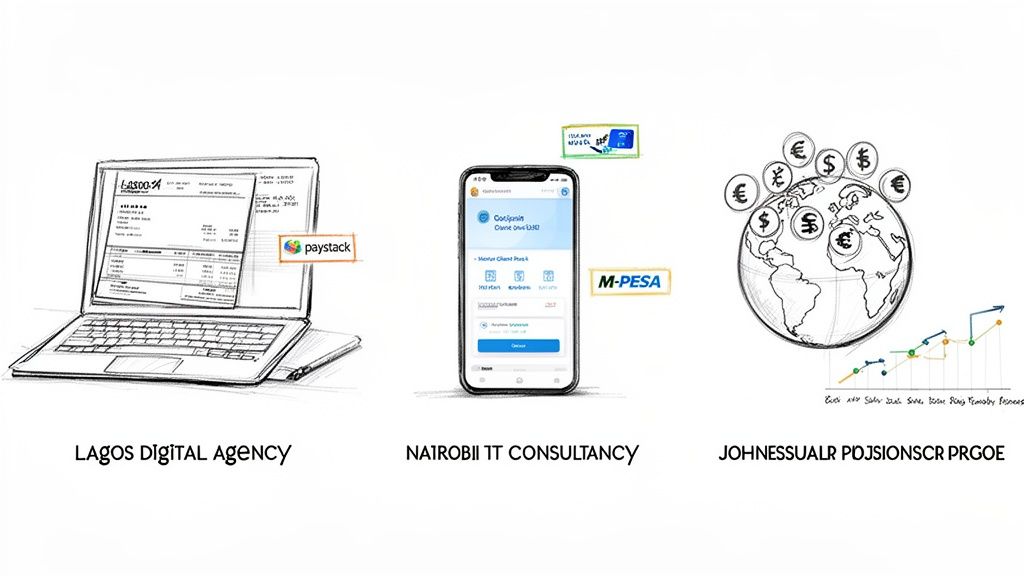
It’s one thing to look at a list of features, but the real test is seeing how a platform holds up in the real world. For service businesses across Africa, the choice between Odoo and a purpose-built alternative isn't about ticking boxes; it's about solving the specific, on-the-ground challenges you face every day.
Let's walk through three practical situations. We’ll look at how a business would try to solve these problems with Odoo, highlighting the snags they might hit. Then, we'll see how a focused Odoo alternative for small businesses like CRM Africa provides a much smoother path.
Scenario One: The Lagos Digital Agency
Picture a busy digital marketing agency in Lagos. They're juggling multiple client projects and need to get invoices paid quickly and easily through Paystack. Their ideal system has to track project milestones, manage tasks, and eliminate any friction in the payment process.
The Odoo Approach
Right away, the agency would need to patch together several Odoo modules: Project, Invoicing, and Accounting. Getting them to communicate perfectly requires a good bit of setup. And while a Paystack connector for Odoo exists, it's usually a third-party app from the Odoo App Store. This means an extra cost, plus the headache of worrying if it will break with the next Odoo update. The team would end up spending ages configuring project templates and triple-checking that billing rules are pulling correctly from timesheets.
A More Direct Solution
An alternative like CRM Africa is built for this out of the box. Project management flows directly into invoicing. You can create an invoice from a project milestone in a single click. The built-in Paystack integration means you're set up in minutes, and payments are automatically matched to the right invoice. That alone saves hours of admin work every week.
Scenario Two: The Nairobi IT Consultancy
Now, let's consider an IT consultancy in Nairobi that manages sensitive client projects. They need a professional, secure client portal where customers can check project updates, download documents, and—most importantly—pay their invoices using M-PESA. For them, easy payments and a polished client experience are non-negotiable.
The Odoo Approach
Odoo's client portal can be powerful, but making it look and feel like your brand often requires a developer's touch. The biggest hurdle? M-PESA payments are not a standard feature. The consultancy would have to hire a developer to build a custom integration, a process that is expensive, slow, and full of potential pitfalls. This creates a huge roadblock to getting paid through Kenya’s most popular payment method.
For any service business in East Africa, not having a simple, out-of-the-box M-PESA payment option is a major operational failure. It adds needless friction for clients and directly hurts your cash flow.
A More Direct Solution
CRM Africa was designed for this exact challenge. It comes with a branded, mobile-friendly client portal that you can set up without writing a single line of code. Clients log in, see project progress in real-time, and chat with the team. Best of all, the native M-PESA integration is ready to go. Clients can pay invoices right from the portal in a few taps, and the payment is instantly recorded. It’s a game-changer for simplifying cash collection. You can find more tips on what to look for in our guide on the best CRM for service businesses.
Scenario Three: The Johannesburg Professional Services Firm
Finally, think of a professional services firm in Johannesburg with a complex sales pipeline. They serve both local and international clients, so they need multi-currency invoicing. Their main struggle is tracking a lead all the way from the first proposal to the final payment, especially when dealing with different currencies.
The Odoo Approach
To make this work in Odoo, the firm would need the CRM, Sales, and Accounting modules. While Odoo does support multiple currencies, setting up exchange rates and getting financial reports right can be a real handful. The workflow itself is clunky—creating a quote in the Sales app, turning it into a project, then switching over to the Accounting app to send an invoice. It’s a lot of jumping between different interfaces for a small team.
A More Direct Solution
With CRM Africa, the entire client journey happens in one place. The visual sales pipeline makes it incredibly easy to track deals. When a proposal gets the green light, it’s converted into a project and an invoice in the client’s currency without ever leaving the system. The platform handles currency conversions automatically, simplifying international billing and giving you a clear, 360-degree view of every client relationship from a single dashboard.
How to Migrate from Odoo Successfully
Let's be honest, switching from an ERP you've relied on for years feels like a massive undertaking. Your customer data, project history, and financial records are all woven into the fabric of one system. But making the move to a better-fit Odoo alternative for small businesses is far from impossible. It just requires a smart, step-by-step roadmap.
This isn't about flipping a switch and hoping for the best. It's a carefully planned transition that keeps your business running smoothly and gets your team genuinely excited about the new tools from day one.
First, Conduct a Thorough Data Audit
Success here is all about preparation. Before you even think about exporting a single file, you need to know exactly what data you can't live without. Think of this as a chance to do some serious spring cleaning. It’s the perfect time to ditch old contacts, merge duplicate entries, and archive irrelevant project details that have been cluttering up your system.
Your audit should zoom in on three core areas:
- Customer Records: All your contact details, the history of your conversations, and—most importantly—your active sales pipeline.
- Project and Task Data: Active projects are the lifeblood of your operations. Make sure you bring over milestones, task assignments, and any related files.
- Financial Records: You absolutely must preserve outstanding invoices, payment histories, and client subscription details with complete accuracy.
This isn't just about getting data out of Odoo. A clean dataset makes the import into your new system—whether it's ERPNext, Zoho, or a platform like CRM Africa—infinitely simpler.
Choose the Right Time and Process
Timing is everything. You don’t want to attempt a migration in the middle of your busiest season. Look for a natural lull in business, like the end of a quarter or a holiday period. This gives your team breathing room to learn the new software without the usual pressure.
A classic mistake is the "big bang" migration, where you switch everything over at once. A phased approach is almost always safer. Running the old and new systems in parallel for a short time lets you check that all your data is correct and train your staff before you fully pull the plug on Odoo.
You also need to understand how your new platform handles data imports. Most modern solutions, including CRM Africa, have user-friendly import tools that work with simple CSV files. Take the time to format your exported Odoo data to match the new system’s requirements—it will save you a world of headaches. To see how integrated payments can simplify this even further, check out our guide on CRM with mobile money integration.
Execute an Effective Onboarding Plan
Finally, remember that even the most powerful software is useless if your team doesn't know how to use it. A proper onboarding plan is non-negotiable for a smooth adoption.
A great strategy is to start by training a small group of "power users." These team members can become your internal champions, helping their colleagues navigate the new system. Support them with easy-to-access training materials like video tutorials, clear documentation, and live Q&A sessions.
Focus on the daily workflows that matter most, like creating an invoice, updating a project, or managing a sales lead. When you invest in proper training, you’re not just switching software—you’re empowering your team.
Choosing the Right Odoo Alternative for Your Business
Picking the software that runs your business is a massive decision. It's a careful balancing act between the features you need today and what your company will need tomorrow. The best Odoo alternative for small businesses isn't a one-size-fits-all product; it comes down to your team's skills, your budget, and where you plan to be in a few years.
Let's pull together all the feature comparisons and real-world scenarios to land on a clear recommendation that fits your unique situation. This is where we match your business's DNA to the right platform.
Tailored Recommendations for Your Business
- For the Tech-Savvy Crew: If your team has in-house technical chops and craves deep customisation, ERPNext is a fantastic choice. Its open-source DNA gives you incredible flexibility without the hefty licensing fees of proprietary systems.
- For Businesses That Need Everything: If your company needs a massive suite of applications and you're ready for a serious learning curve, Zoho One offers undeniable value. Its bundle of over 40 apps covers pretty much every business function you can think of.
- For African SMEs and Service Businesses: For startups and service-based companies across Africa, we have to recommend CRM Africa. It was built from the ground up to solve the real, everyday pain points that local businesses face.
CRM Africa’s combination of a free-forever plan, the elimination of per-user fees, and seamless pan-African payment integrations makes it a uniquely practical and affordable choice. It directly addresses the core operational and financial challenges that Odoo often creates for growing African companies.
If you're thinking about making a switch, this flowchart breaks down the key stages of migrating from Odoo. It helps you visualise the entire process, from auditing your data to getting it safely into a new system.
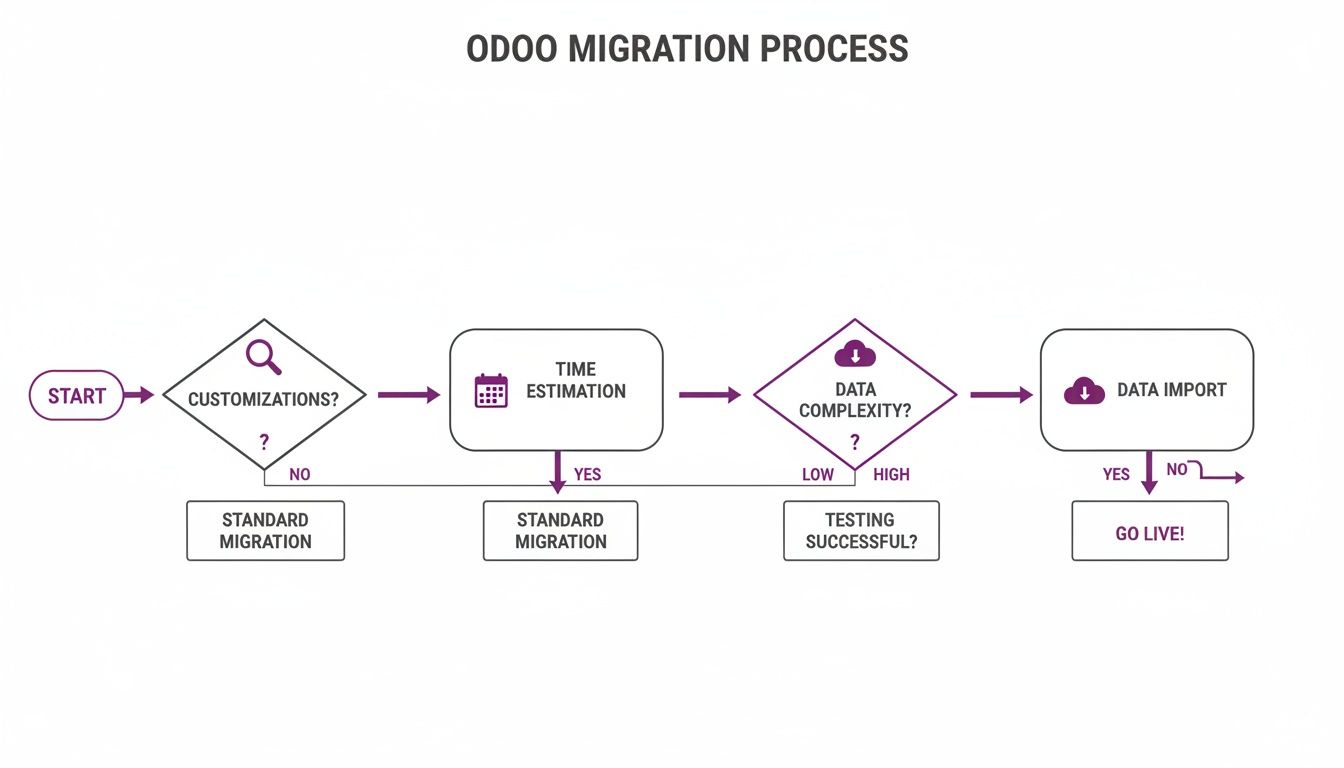
The key takeaway here is that a successful migration lives or dies by the quality of your planning. The audit and timing phases are critical—get those right before you move a single piece of data.
Ultimately, your goal is to find a platform that supports your growth, not one that penalises it. Take a hard look at your most critical needs and stack them up against our analysis to make a confident decision. To see how a purpose-built platform can make a difference, you can schedule a free demo of CRM Africa and experience its benefits firsthand.
Got Questions? We’ve Got Answers
Switching your core business software is a big move, and it’s natural to have questions. Here are some of the most common things business owners ask when they're looking for a solid Odoo alternative for small businesses.
Is CRM Africa Really Free for Small Businesses?
Yes, it really is. We built CRM Africa with a free-forever plan because we know what it’s like to start out. This isn’t a trial; it’s a permanent free plan for up to two users, letting you manage up to ten clients. It packs in all the essentials—CRM, project management, and invoicing—without costing you a cent.
The idea is simple: get your business set up with professional tools from day one, without the financial pressure. Once you grow past those limits and are ready for more, you can upgrade to a paid plan. Even then, we stick to a predictable flat rate, so you’ll never get surprised by the steep per-user fees that are so common with platforms like Odoo.
How Gnarly Is the Data Migration Process from Odoo?
Getting your data out of Odoo and into a new system is probably more straightforward than you think. As long as you’re methodical, it’s a smooth process. Most modern platforms, including ours, have simple import tools that work with standard CSV files.
Here’s the pro tip: do a data audit before you start migrating. Tidy up your customer lists, sort out your financial records, and organise your project data first. A clean export means a clean import. Our support team is also on standby with clear guides to help you map your old data fields to the new system, cutting down on complexity and keeping downtime to a minimum.
Can CRM Africa Handle Payments from International Clients?
Absolutely. We designed CRM Africa with a deep appreciation for the African payment ecosystem, but our reach is global. The platform connects smoothly with major international gateways like Stripe and PayPal, so you can get paid by clients no matter where they are.
This dual capability is a huge plus. It means you can manage all your local M-PESA, Paystack, and Flutterwave transactions right alongside multi-currency invoices from your international clients. Everything happens in one unified system, keeping your finances clean and simple.
Ready to see how a platform actually built for African SMEs can simplify your work and help you grow? Discover CRM Africa and experience a system designed to get you paid faster and manage your business better. Explore our features and book a free demo today.