
Moving from a high-level strategic vision to daily, productive action is a major challenge for Small and Medium-sized Enterprises (SMEs) across Africa. Effective operational planning is the bridge that closes this gap, turning ambitious goals into measurable results. It is the engine that drives efficiency, customer satisfaction, and sustainable growth. This article breaks down eight proven operational planning examples, providing a practical framework specifically for African agencies and SMEs.
A crucial first step in this process involves identifying discrepancies between your current performance and future goals. Using a practical gap analysis template can serve as a foundational roadmap, helping you pinpoint precise areas for improvement before implementing a new plan.
We will explore each model’s objectives, key performance indicators (KPIs), and step-by-step implementation. Throughout, we will demonstrate how a platform like CRM Africa can centralise these efforts, from managing task pipelines and issuing invoices with mobile money payments to offering professional client portals and generating insightful reports. These examples are designed to be adaptable, providing actionable blueprints to help you build a more resilient and profitable organisation. Each section offers the clarity needed to transform strategy into tangible, day-to-day success.
1. Lean Manufacturing/Operational Planning
Lean manufacturing is a systematic operational planning method focused on eliminating waste (muda), optimising processes, and maximising value for the customer. Originating from the Toyota Production System (TPS), this approach is grounded in the principles of continuous improvement (kaizen) and respect for people. For African SMEs, adopting lean principles means producing more with fewer resources, which is a significant competitive advantage in resource-constrained environments.
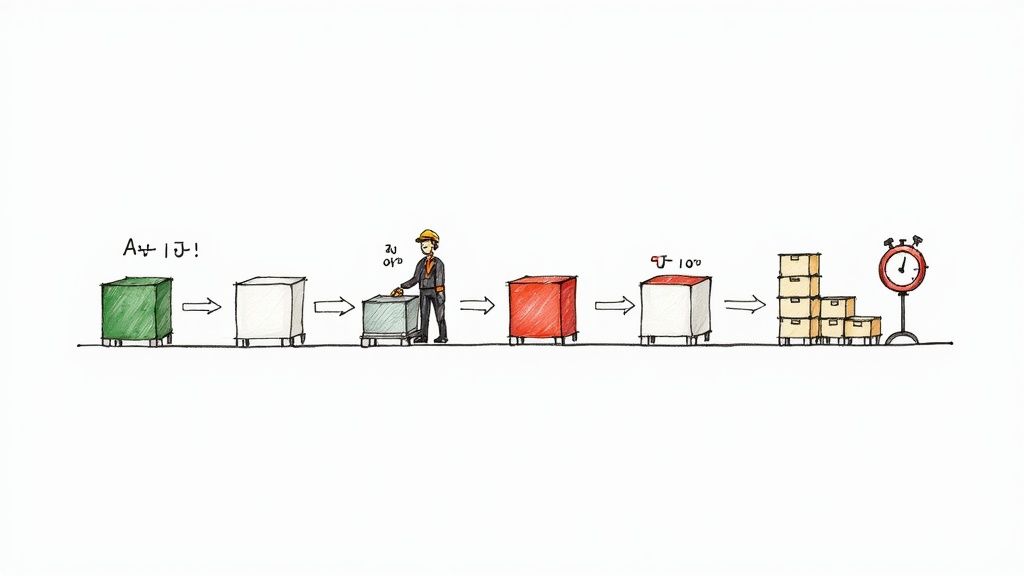
This methodology stands out among operational planning examples because it is not a one-time fix but a cultural shift towards efficiency. Famous implementations include Toyota’s own system, which revolutionised car manufacturing, and Dell’s made-to-order model, which dramatically reduced inventory waste. By focusing on what the customer values, businesses can streamline every step of their operation, from sourcing raw materials to final delivery and invoicing.
Actionable Tips for Implementation
To apply this to your business, begin by visually mapping your processes. Creating a detailed process map or a data flow diagram can expose hidden bottlenecks and areas of waste.
- Engage Frontline Staff: Your employees on the ground have the most intimate knowledge of daily processes. Involve them in identifying problems and brainstorming solutions.
- Focus on Quick Wins: Start with small, manageable changes that deliver visible results. This builds momentum and secures buy-in from your team for larger initiatives.
- Measure Everything: Use clear KPIs such as cycle time, defect rate, and inventory levels to track progress. A tool like CRM Africa can help you monitor these metrics through its reporting dashboards.
- Foster Continuous Improvement: Lean is a journey, not a destination. Encourage a mindset where every team member is constantly looking for ways to improve their work. As noted by James Womack and Daniel Jones in “Lean Thinking,” the goal is to create a self-sustaining cycle of improvement.
2. Six Sigma Operational Planning
Six Sigma is a disciplined, data-driven operational planning methodology focused on eliminating defects and reducing process variation. Its core objective is to improve process quality to the point where there are no more than 3.4 defects per million opportunities. For African SMEs, this translates to a powerful framework for delivering consistently high-quality products and services, which is crucial for building trust and a strong brand reputation in competitive markets.
This approach is one of the most rigorous operational planning examples because it relies heavily on statistical analysis and structured problem-solving. Famously championed by Jack Welch at General Electric, where it reportedly saved the company billions, and originally developed by Motorola, Six Sigma provides a clear path to process excellence. By focusing on measurable data, businesses can pinpoint the root causes of problems rather than just treating the symptoms, leading to more sustainable improvements.
Actionable Tips for Implementation
To implement Six Sigma, your business must commit to a data-first culture. The DMAIC (Define, Measure, Analyse, Improve, Control) framework is the standard roadmap for executing projects.
- Define High-Impact Projects: Start by identifying projects that directly align with strategic goals, such as reducing production errors or improving customer service response times. Ensure executive sponsorship is secured to champion the initiative.
- Invest in Training: Six Sigma requires specialised knowledge. Invest in training your team on its methodologies and statistical tools. Certification (e.g., Green Belt, Black Belt) provides a structured learning path.
- Utilise Statistical Tools: Leverage software like Minitab or even advanced spreadsheet functions to analyse process data accurately. This statistical rigour is what separates Six Sigma from other quality improvement methods.
- Focus on the Customer: Use the framework to understand and eliminate defects that matter most to your clients. This directly impacts customer satisfaction, a key metric you can learn more about by understanding how to measure customer satisfaction. As Mikel Harry, a key architect of the methodology stated, the goal is to create “virtually error-free business performance.”
3. Agile Operational Planning
Agile operational planning is an iterative, flexible approach that prioritises adaptive responses to change, continuous delivery, and cross-functional collaboration. Originally from the software world, as outlined in the 2001 Manifesto for Agile Software Development, this methodology is now used across various industries to manage operations in fast-paced environments. For African SMEs, adopting an agile mindset means being able to pivot quickly to market demands and deliver value to customers faster than larger, more rigid competitors.
This methodology is a powerful addition to any list of operational planning examples because it replaces rigid, long-term plans with short, adaptive cycles called “sprints.” Famous implementations include Spotify’s engineering culture, which uses autonomous “squads,” and ING Bank’s complete agile transformation to improve customer service and operational efficiency. The core idea is to break large projects into small, manageable tasks that can be completed and reviewed in short, regular intervals.
Actionable Tips for Implementation
To apply this to your business, focus on creating a culture that embraces change and collaboration. Start with a single team or project to pilot the methodology before considering a wider rollout.
- Start with a Pilot Team: Choose a small, cross-functional team to test agile principles on a specific project. This limits risk and allows you to learn what works for your organisation.
- Invest in Training: Agile methodologies like Scrum or Kanban have specific roles and ceremonies. Provide training and coaching to ensure everyone understands the framework and their part in it.
- Maintain a Clear Vision: While sprints offer flexibility in execution, the overall product or service vision must remain clear to guide the team’s efforts.
- Use Collaborative Tools: Employ project management tools like Trello, Jira, or the task pipelines within CRM Africa to manage backlogs, track sprint progress, and enhance team transparency. A well-organised CRM with a client portal can also facilitate customer feedback loops, which are vital for agile processes.
- Foster Psychological Safety: Create an environment where team members feel safe to experiment, fail, and voice concerns without fear of blame. This is critical for the continuous improvement central to agile.
4. Business Process Management (BPM) Operational Planning
Business Process Management (BPM) is a systematic operational planning approach that focuses on designing, modelling, executing, monitoring, and optimising end-to-end business processes. It aims to align all aspects of an organisation with the wants and needs of clients, improving efficiency and operational agility. For African SMEs, BPM offers a structured way to enhance service delivery and scale operations effectively by treating processes as valuable assets.
This methodology is a standout among operational planning examples because it promotes a continuous cycle of improvement, moving beyond siloed departmental thinking to create a holistic, customer-centric view. Famous implementations include UPS optimising its package handling routes for maximum efficiency and Citibank streamlining its loan application workflows to reduce processing times. By focusing on process excellence, businesses can deliver consistent value and adapt quickly to market changes.
Actionable Tips for Implementation
To apply BPM, start by identifying a high-impact process that directly affects customer satisfaction or revenue generation. Analysing and improving one key workflow can provide a powerful case study for broader implementation.
- Map ‘As-Is’ and ‘To-Be’ States: Before making changes, map your current process (As-Is) to understand its flaws. Then, design the ideal future state (To-Be) that eliminates those inefficiencies.
- Involve Process Participants: Engage the employees who execute the process daily. Their hands-on insights are invaluable for accurate process mapping and designing practical improvements.
- Establish Clear Process KPIs: Define specific metrics to measure success, such as cycle time, cost-per-transaction, and error rate. The reporting dashboards in CRM Africa can help track these performance indicators.
- Implement and Train: Roll out the new process gradually and provide thorough training to all stakeholders involved. As highlighted by experts like Tom Davenport, successful process innovation is as much about managing change as it is about technology.
5. Theory of Constraints (TOC) Operational Planning
The Theory of Constraints (TOC) is an operational planning philosophy that posits every complex system has at least one constraint that limits its ability to achieve its goal. Developed by Eliyahu M. Goldratt, TOC focuses on systematically identifying this single weakest link and restructuring the entire operation around it to improve throughput. For an African SME, this means pinpointing the primary bottleneck, whether it’s a machine, a department, or a policy, and leveraging it to boost overall performance without significant capital investment.

This methodology is one of the most powerful operational planning examples because it provides a highly focused approach to improvement. Instead of spreading resources thinly across multiple areas, it directs all efforts to the one place that will make the biggest impact. As popularised in Goldratt’s seminal business novel, “The Goal,” the entire system’s output is dictated by its constraint. Famous applications include bottleneck reduction in hospital emergency departments and managing critical paths in software development to accelerate project delivery.
Actionable Tips for Implementation
To apply TOC, you must follow Goldratt’s “Five Focusing Steps,” a cyclical process for managing constraints. Start by mapping your workflow to find what is slowing everything down.
- Identify the Constraint: Use process maps and performance data to find the part of your system with the least capacity. This is your bottleneck.
- Exploit the Constraint: Squeeze every bit of productivity from the constraint without spending money. Ensure it is never idle, only works on quality parts, and performs only the tasks it is uniquely capable of.
- Subordinate Everything Else: Adjust all other non-constraint processes to support the bottleneck. This may mean slowing other parts of the system down to ensure the constraint is never starved of work or overwhelmed.
- Elevate the Constraint: If the constraint still limits your system’s output after exploitation and subordination, then consider investing to improve its capacity. This could involve new equipment, extra staff, or better training.
- Repeat the Process: Once a constraint is broken, a new one will emerge elsewhere. The cycle of improvement is continuous, so you must return to the first step and identify the new bottleneck. You can use CRM Africa’s task pipelines to visualise workflow and track cycle times to spot these constraints in real-time.
6. Balanced Scorecard Operational Planning
The Balanced Scorecard (BSC) is a strategic operational planning framework that translates an organisation’s vision into a set of measurable performance objectives. Developed by Robert Kaplan and David Norton, it moves beyond purely financial metrics to provide a comprehensive view of business health across four key perspectives: financial, customer, internal business processes, and learning and growth. For an African SME, this ensures that short-term financial goals do not overshadow long-term value creation.
This method is a powerful addition to any list of operational planning examples because it creates a clear link between daily tasks and high-level strategy. Famous implementations include Samsung, which used the BSC to align its diverse business divisions, and Federal Express, which deployed it to create a robust performance measurement system. By balancing these four areas, a business can ensure it is not just profitable but also building customer loyalty, improving efficiency, and developing its team’s capabilities.
Actionable Tips for Implementation
To apply the BSC, start by defining your strategic objectives for each of the four perspectives. Then, identify the key performance indicators (KPIs) that will measure your progress towards these objectives and set clear targets.
- Keep it Focused: Limit your scorecard to 15-25 critical metrics in total. Too many can create confusion and dilute focus, making the plan difficult to manage.
- Establish Cause-and-Effect Links: Ensure your metrics are interconnected. For example, improved employee training (Learning & Growth) should lead to better internal processes, which in turn enhances customer satisfaction and boosts financial results.
- Engage Your Entire Team: The BSC should be a shared tool, not just a management report. Communicate the strategy and the scorecard throughout the organisation to ensure everyone understands their role in achieving the objectives.
- Automate and Visualise: Use dashboard tools to track your KPIs in real time. A platform like CRM Africa can be configured to monitor customer satisfaction scores, project completion rates (internal processes), and sales figures (financial), providing a live view of your strategic performance.
- Review and Adapt Regularly: The business environment is dynamic. As stated by Kaplan and Norton in “The Balanced Scorecard: Translating Strategy into Action,” the BSC should be a living document, reviewed and updated regularly with input from key stakeholders to remain relevant.
7. Total Quality Management (TQM) Operational Planning
Total Quality Management (TQM) is a comprehensive organisational approach to operational planning that places quality at the heart of all business activities. It is a management philosophy dedicated to continuous improvement, customer satisfaction, and total employee involvement. For African SMEs, TQM offers a framework to build a reputation for excellence, reduce defects, and enhance customer loyalty in competitive markets.
This methodology is a powerful example of operational planning because it integrates quality principles into the very fabric of an organisation’s culture. Pioneered by thinkers like W. Edwards Deming, it shifts the focus from inspecting finished products to preventing defects from occurring in the first place. Famous examples include Motorola, which used TQM as a foundation for its Six Sigma programme, and Xerox, which underwent a major quality transformation to regain market share.
Actionable Tips for Implementation
To apply TQM, your leadership must be fully committed to creating a culture where quality is everyone’s responsibility. This is not a short-term project but a long-term transformation of how the business operates.
- Secure Executive Commitment: Leadership must visibly champion the TQM philosophy. This involves providing resources, setting clear quality goals, and leading by example.
- Invest in Employee Training: Equip your team with the knowledge and tools for quality improvement. Training on problem-solving techniques, statistical process control, and customer service is essential.
- Create Cross-Functional Teams: Establish quality improvement teams that bring together employees from different departments. This fosters collaboration and helps solve systemic problems.
- Establish Clear Quality Metrics: Define and track key performance indicators (KPIs) related to quality, such as defect rates, customer complaints, and on-time delivery. Tools like CRM Africa can help monitor these metrics in real-time.
- Integrate Quality with Suppliers: Work closely with your suppliers to ensure their materials and components meet your quality standards. As noted by Joseph M. Juran in his work Quality Control Handbook, managing the entire supply chain is critical to final product quality.
8. Integrated Planning and Forecasting (IPF/S&OP) Operational Planning
Integrated Planning and Forecasting, often known as Sales and Operations Planning (S&OP), is a collaborative management process that aligns various business functions. It integrates sales forecasts with operational capabilities to create a unified plan that supports strategic objectives. For African SMEs, this approach breaks down internal silos, ensuring that marketing, sales, operations, and finance teams are all working from the same playbook to meet market demand efficiently.

This methodology is one of the most powerful operational planning examples for achieving organisational alignment and agility. Global giants like Procter & Gamble and Coca-Cola use it to synchronise their vast supply chains with fluctuating consumer demand. The core idea, popularised by practitioners like Tom Wallace and Bob Stahl, is to balance supply and demand at the aggregate level, making the business more resilient and profitable.
Actionable Tips for Implementation
To apply this to your business, start by establishing a recurring monthly S&OP meeting with key stakeholders from each department. To further enhance your understanding of the Integrated Planning and Forecasting (IPF/S&OP) Operational Planning approach, consider exploring various relevant resources on types, examples, and methods of demand forecasting to refine your strategic insights.
- Establish Clear Roles: Define who is responsible for providing sales forecasts, production capacity data, and financial inputs. Clear accountability is crucial for success.
- Use Standardised Templates: Create consistent templates for reporting demand, supply, and financial data to ensure everyone is comparing like-for-like information.
- Conduct Monthly Reviews: Hold a structured monthly meeting with a fixed agenda. This disciplined routine, as advocated in “Sales and Operations Planning: The How-To Handbook” by Wallace and Stahl, drives continuous alignment.
- Leverage Visibility Tools: Use a platform like CRM Africa to create dashboards that show planned versus actual performance. This allows for real-time monitoring and quicker, data-driven decisions.
9. Operational Planning: 8 Approaches Compared
| Operational planning method | Implementation complexity | Resource requirements | Expected outcomes | Ideal use cases | Key advantages |
|---|---|---|---|---|---|
| Lean Manufacturing/Operational Planning | Medium–High (cultural change, process redesign) | Moderate–High (training, value-stream mapping, kanban systems) | Lower waste, faster cycles, reduced inventory, consistent quality | Repetitive manufacturing, warehouses, assembly lines | Cost reduction, improved flow and inventory management |
| Six Sigma Operational Planning | High (statistical methods, structured projects) | High (data infrastructure, statistical tools, certified belts) | Measurable defect reduction, improved process capability, ROI | Quality-critical processes in manufacturing and services | Data-driven problem solving, strong measurable ROI |
| Agile Operational Planning | Medium (team coaching; rapid pilotable adoption) | Low–Moderate (cross-functional teams, collaboration tools) | Faster delivery, higher adaptability, continuous feedback | Software, product development, uncertain or changing requirements | Rapid responsiveness, incremental value delivery |
| Business Process Management (BPM) Operational Planning | High (end-to-end modeling, system integration) | High (BPM tools, automation, process analysts) | Greater process visibility, standardization, compliance | Complex cross-functional processes, digital transformation | End-to-end optimization, governance and analytics |
| Theory of Constraints (TOC) Operational Planning | Low–Medium (focused analysis and discipline) | Low–Moderate (process analysis, monitoring, scheduling) | Increased throughput, lower WIP, shorter lead times | Environments with clear bottlenecks (manufacturing, EDs) | Focuses improvements on highest-impact constraint |
| Balanced Scorecard Operational Planning | High (strategic translation and metric design) | Moderate–High (performance systems, reporting tools) | Aligned strategy and operations, balanced KPIs, accountability | Strategic planning, multi-unit organizations | Links strategy to measurable operational objectives |
| Total Quality Management (TQM) Operational Planning | High (long-term cultural transformation) | High (training, quality systems, cross-functional teams) | Organization-wide quality improvement, higher customer satisfaction | Organizations seeking pervasive quality and reputation | Comprehensive quality culture and continuous improvement |
| Integrated Planning & Forecasting (IPF / S&OP) | High (cross-functional coordination and cadence) | High (forecasting tools, planners, data integration) | Better forecast accuracy, aligned supply/demand, lower inventory | Companies with complex supply chains and many SKUs | Integrated decision-making, demand‑supply alignment and scenarios |
10. Centralising Your Operations for Growth
Throughout this guide, we have explored a diverse range of operational planning examples, each offering a unique framework for achieving business excellence. From the waste-elimination principles of Lean Manufacturing to the strategic alignment of the Balanced Scorecard, the core lesson is clear: a well-defined operational plan is the blueprint for sustainable growth. These models are not just theoretical concepts; they are practical toolkits designed to solve real-world challenges faced by African SMEs and agencies every day.
The journey from planning to execution, however, is where many strategies falter. As we’ve seen, success depends on consistent implementation, meticulous tracking, and the ability to adapt to changing market conditions. The most effective operational plans are those that are alive within the organisation, integrated into daily workflows rather than confined to a static document.
From Theory to Action: The Power of a Unified System
A common thread connecting methodologies like Six Sigma, Agile, and Business Process Management (BPM) is the critical need for data-driven decision-making and seamless collaboration. Manually tracking KPIs across disparate spreadsheets, managing projects through email chains, and reconciling payments from different platforms creates friction and obscures vital insights. This is where centralisation becomes a strategic imperative.
To truly bring these operational planning examples to life, you need a single source of truth. Consider the key takeaways from the models we examined:
- Visibility: Frameworks like the Theory of Constraints (TOC) and Integrated Planning and Forecasting (IPF) rely on having a clear, end-to-end view of your processes to identify bottlenecks and forecast accurately.
- Measurement: Total Quality Management (TQM) and Six Sigma are fundamentally about continuous improvement driven by precise performance metrics and customer feedback.
- Agility: Agile planning requires dynamic task management, transparent progress tracking, and rapid feedback loops to iterate effectively.
A centralised platform like CRM Africa is designed to be the engine that powers these frameworks. It transforms your operational plan from a static document into a dynamic, actionable system. By unifying task management, client communication, invoicing, and reporting, you create an environment where strategic objectives directly connect to daily activities. This integration ensures that every action taken by your team is measured, visible, and aligned with your overarching goals, enabling you to not only execute your plan but to refine it with real-time intelligence for sustained competitive advantage.
Ready to turn your operational plans into measurable results? Discover how CRM Africa can centralise your workflows, from project management to mobile money payments, providing the unified platform you need to grow. Get started for free and build a more efficient, data-driven business today at CRM Africa.