If you’re running a small business, chances are you're juggling your finances with a patchwork of spreadsheets. You're definitely not alone. So, what exactly is a free accounting system? Think of it as a cloud-based platform that takes the manual grunt work out of invoicing, expense tracking, and financial reporting—all without the hefty price tag of traditional software. It’s like finally ditching a tattered paper map for a live GPS that shows you exactly where your business stands financially.
Why Your SME Needs More Than Just Spreadsheets

Moving on from spreadsheets is a huge step for any growing business. We all know them, and they feel comfortable, but they quickly become a liability. They’re a breeding ground for costly typos, they swallow hours of your time with manual data entry, and they offer zero real-time insight into your cash flow.
That's where a dedicated free accounting system comes in. It’s built from the ground up to solve these exact problems, transforming that messy spreadsheet data into a clear, organised dashboard that you can actually use to make decisions.
To put it simply, here’s how the two stack up.
Manual Spreadsheets vs Free Accounting System
| Capability | Manual Spreadsheets (e.g., Excel) | Free Accounting System |
|---|---|---|
| Invoicing | Manual creation; prone to errors and looks unprofessional. | Automated, professional, branded invoices sent in clicks. |
| Data Entry | 100% manual; time-consuming and high risk of mistakes. | Mostly automated; bank feeds and receipt scanning reduce input. |
| Reporting | Requires complex formulas; reports are static and outdated. | Instant, real-time reports (P&L, Balance Sheet) on demand. |
| Collaboration | Difficult; leads to version control chaos ("Final_v2_final"). | Secure, multi-user access from anywhere for your team or accountant. |
| Security | Low; files can be easily corrupted, lost, or shared insecurely. | High; cloud-based with regular backups and data encryption. |
The difference is night and day. One keeps you stuck in the weeds, while the other gives you the bird's-eye view you need to steer the ship.
Automate and Professionalise Your Operations
One of the first things you'll notice is the power of automation. Forget about building invoices from scratch every single time. A proper system lets you fire off professional, branded invoices in a couple of clicks. This doesn't just save you a ton of time; it makes your business look sharp and helps you get paid faster.
A professional image is crucial for building client trust. Automated, accurate invoicing signals that your business is organised, reliable, and serious about its operations.
This shift away from manual drudgery is more important than you might think. A study by Capital One found that a staggering 82% of small business owners still lean on spreadsheets for their finances. That's a huge number of businesses running on a system that wasn't built for the job, highlighting a massive opportunity for free cloud tools to make a real difference.
Build a Foundation for Growth
Beyond the daily tasks, a free accounting system lays down the tracks for your business to grow. It puts all your financial data in one place, making it dead simple to:
- Track Income and Expenses: Get a clear, live picture of your cash flow without having to wrestle with endless cells and formulas.
- Generate Financial Reports: Instantly pull up reports like a Profit & Loss statement to see what's working and what isn't.
- Improve Collaboration: Because it's in the cloud, you, your team, or your accountant can all access the same up-to-date information securely, from anywhere.
For many businesses across Africa, the next logical step is to tie customer management into their finances. It’s worth exploring how a free CRM for African businesses can bring your sales and financial data together into one unified platform. By putting these systems in place now, you're building a business that's ready for whatever growth comes your way.
Core Features Every Free Accounting System Should Offer
Let’s be honest, not all free software is created equal. When you're sizing up a free accounting system, you have to look past the shiny "free" sticker and see what’s really under the bonnet. A system that’s genuinely going to help your business needs a specific set of tools to automate the grind and give you a crystal-clear picture of your financial health.
Think of these features as your non-negotiables. Without them, you’re not really using an accounting system—you're just using a glorified spreadsheet that happens to live online. A good platform should be an active partner in managing your money, not just a place to park numbers.
Automated and Professional Invoicing
First on the list, and arguably the most critical, is automated invoicing. Manually knocking together invoices is a slow, error-prone process that can make your business look unprofessional. A solid system lets you generate and fire off professional, branded invoices in just a few clicks.
But this is about more than just looking good; it's about getting paid faster. Some platforms, like FreshBooks and CRM Africa, even let you pop one-click payment buttons directly onto your invoices. This simple addition can drastically slash the time it takes for money to hit your account, turning your invoicing from a chore into a reliable cash collection machine. You can find out more about how a CRM with invoicing and project management built-in can completely change how you operate.
Localised Payment Gateway Integrations
For any business working in Africa, getting paid shouldn't be a mission. A top-tier free accounting system has to integrate with the payment gateways your customers actually use every day. This isn't just a nice-to-have; it's a make-or-break feature.
You need to look for platforms that seamlessly connect with:
- Mobile Money: Direct integration with services like M-PESA is absolutely essential for markets in Kenya and its neighbours.
- Pan-African Gateways: Support for giants like Flutterwave and Paystack is a must for doing business in Nigeria, Ghana, and across the continent.
- Card and Bank Transfers: And of course, the system must handle traditional card and bank payments without any fuss.
By integrating with local payment solutions, a free accounting system removes friction right at the point of sale. It meets customers where they are, making it incredibly easy for them to pay you and cementing your place in the market.
Automatic Bank Reconciliation
Ah, bank recs. That dreaded, soul-crushing task of matching your bank statements to your books. It's a massive time sink for any business owner. This is where automatic bank reconciliation comes in to save the day. The feature securely links to your business bank accounts and automatically pulls in all your transaction data.
Instead of manually ticking off transactions one by one until your eyes glaze over, the system does the heavy lifting. It matches deposits to invoices and payments to expenses for you. Platforms like Xero and Wave have made this a core part of their offering, saving business owners countless hours of admin work every single month. This isn't just about saving time—it dramatically improves the accuracy of your financial records.
Multi-Currency Support for Expansion
Finally, if you have any plans to operate beyond your own borders, multi-currency support is non-negotiable. Your accounting system must be able to handle transactions in various currencies, whether it's the South African Rand (ZAR), Kenyan Shilling (KES), or Nigerian Naira (NGN).
This means you can invoice your international clients in their own currency and the system will automatically track any gains or losses from exchange rate fluctuations. This kind of functionality, found in systems like Zoho Books, is vital for presenting a professional face to a global clientele and takes the headache out of international trade.
How to Choose the Best Free Accounting System
Choosing a free accounting system is a bigger decision than it sounds. It’s not just about finding software that doesn't cost anything; it’s about finding a real partner for your business's financial health. You need a way to cut through all the marketing noise and find a platform that will actually help you grow, not trap you later.
Think of it like choosing the foundation for a new building. A cheap or poorly matched foundation will create endless headaches and structural problems down the line. But get it right, and you've built a stable base you can expand on for years. A smart evaluation starts by asking the tough questions right from the beginning.
Building Your Evaluation Checklist
To make the right call, you need a checklist that focuses on what truly matters. It's easy to get distracted by flashy features you'll probably never touch. Instead, zoom in on these core pillars.
Scalability and Limits: What are the hard limits of the free plan? Dig into the fine print. Pay close attention to any caps on clients, invoices, users, or transactions. A system that feels generous today could become a cage tomorrow if its limits are too tight for your growth plans.
Integration Capabilities: Does it work with the other tools you already use every day? You need it to connect seamlessly with everything from your pan-African payment gateways to your email marketing software. Good integrations stop data from getting stuck in silos and save you countless hours of manual data entry.
Data Security and Compliance: This one’s a big deal. How is your sensitive financial data being protected? For any business operating in South Africa, compliance with the Protection of Personal Information Act (POPIA) is non-negotiable. Look for providers that are completely transparent about their security measures, encryption, and data policies.
Quality of User Support: Picture this: it’s month-end, something has gone wrong, and you need help. Now. How fast can you get a real person to help you? Many free plans push you towards community forums and knowledge bases. Decide if that’s enough, or if you need the peace of mind that comes with knowing real customer service is just a call or email away.
To put this into practice, we’ve created a simple checklist. Use it to score the options you’re considering. Be honest about what’s most important for your business by assigning a weight to each criterion.
Free Accounting System Evaluation Checklist
| Evaluation Criterion | Weight (1-5) | CRM Africa Score | Wave Score | Zoho Books Score |
|---|---|---|---|---|
| User & Transaction Limits | ||||
| Payment Gateway Integration | ||||
| POPIA/Local Compliance | ||||
| Customer Support Quality | ||||
| Built-in CRM/Project Tools |
This framework helps you move beyond a simple feature comparison and make a choice based on true business value.
Comparing Top Contenders
Several platforms are popular with small businesses, and for good reason. Wave is often praised for its genuine free accounting and invoicing, making it a simple, no-cost starting point. Zoho Books, on the other hand, offers a powerful set of features as part of a much larger ecosystem of business applications.
However, for businesses operating in the African market, a solution built with local realities in mind often has a clear edge. CRM Africa, for instance, doesn't just offer accounting; it combines it with a full CRM and project management suite. Critically, its free plan includes native integrations with essential gateways like Paystack and Flutterwave right out of the box.
As you weigh your options, it's helpful to see what the leading accounting software solutions for small businesses offer. This gives you a benchmark to understand what’s possible and what compromises you might be making with a free tool.
The image below breaks down the core functions that any modern accounting system must nail to make a real difference in your day-to-day operations.
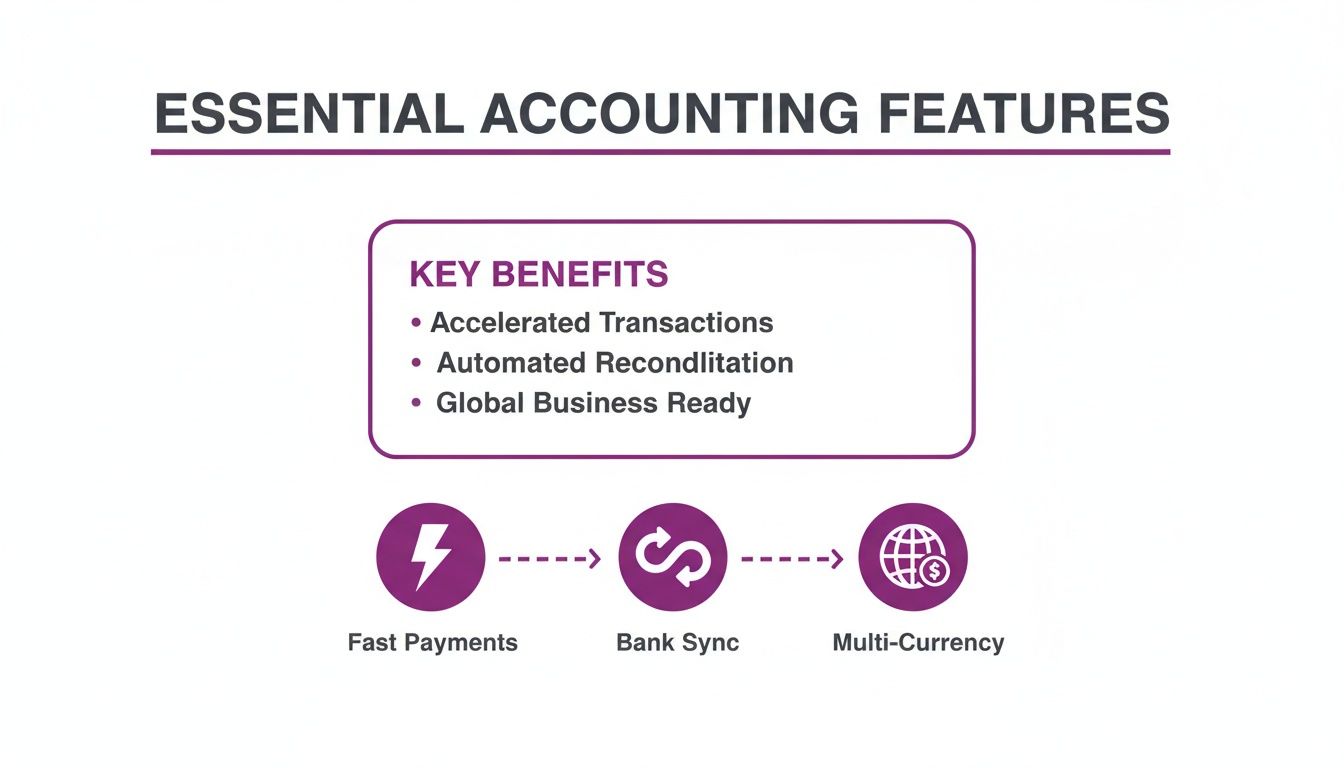
These three elements—fast payments, automatic bank reconciliation, and multi-currency support—are the engine of an efficient business. Get these right, and you're already ahead of the game.
“Choosing an accounting system is less about what it costs today and more about what it will enable you to do tomorrow. The right platform becomes a growth accelerator, not just a record-keeper.”
This way of thinking is backed by hard numbers. Recent research on South African SMEs found that "App Adopters"—businesses that strategically use digital tools—are seeing incredible 67% revenue and 62% profit growth. By picking a free system that integrates tools like sales pipelines and analytics, businesses across Nigeria, Kenya, or Egypt can start turning that potential into reality. You can dig into the research behind these SME growth findings to see the full impact of going digital.
Understanding the Limits and Hidden Costs of Free Software
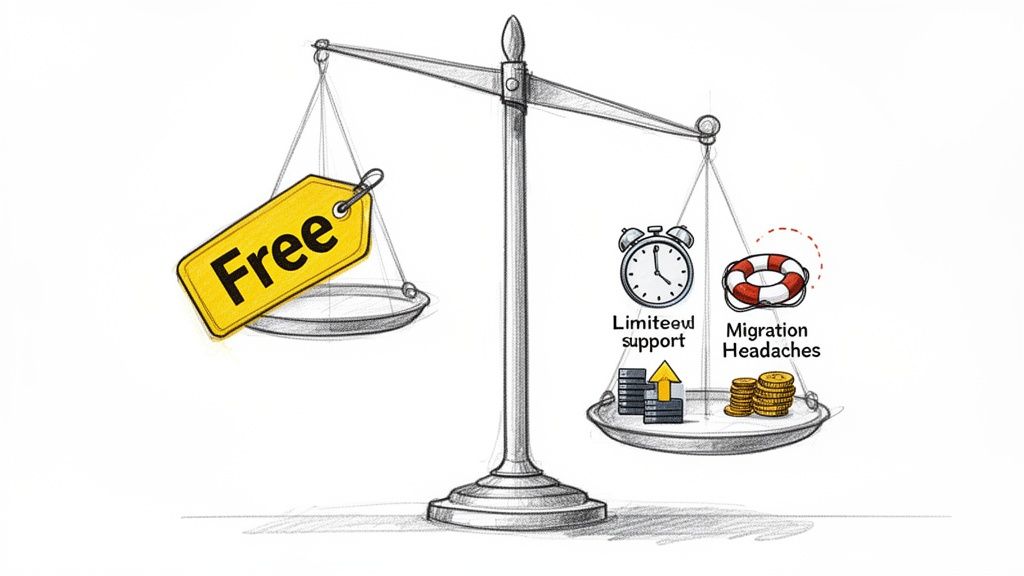
The word ‘free’ is probably the most powerful magnet in marketing. But when it’s attached to something as critical as a free accounting system, it pays to be a bit sceptical. These platforms can be a brilliant launchpad for a new business, but they almost always run on a "freemium" model.
What does that mean? The free version is a strategically designed front door, meant to get you inside and comfortable before you eventually run into a wall that only a paid plan can break down.
It’s not a bait-and-switch; it's just smart business. The goal is to give you just enough functionality to see the value and get your data into the system. When you hit the inevitable limits, upgrading feels a lot easier than starting over somewhere else. Great tools like Wave are famous for their generous free plans, but even they charge for essential services like payroll and payment processing.
The Inevitable Caps and Restrictions
Sooner or later, you'll hit a ceiling. Software companies have to draw a line in the sand between their free and paying customers, and they usually do it by capping your usage.
You'll almost certainly run into limits like these:
- Client or Contact Limits: You might only be able to manage a handful of clients before the system tells you to upgrade.
- Invoice Caps: Many free tiers cap the number of invoices you can send each month.
- User Restrictions: Often, you’re the only one who can access the system. As soon as you need to add a team member, you’ll have to pay up.
- Feature Gaps: The really good stuff—like automated workflows, in-depth reports, or project management—is almost always locked behind a paywall.
Think of these limits as a ticking clock. As your business finds its footing and your client list expands, you will outgrow the free plan. That’s why you have to look past the free offer and scrutinize the provider's entire pricing structure from day one. If adding team members is on your roadmap, it’s also worth understanding how per-seat fees can slow down growing teams.
Uncovering the Hidden Costs
Beyond the obvious restrictions, the true cost of "free" often sneaks up on you in ways that don't show up on a bill. These hidden costs hit your most valuable resource: your time. They can quietly throttle your efficiency and stall your growth.
The real cost of a free tool isn’t what you pay for it, but the time you lose working around its limitations. A system that creates administrative headaches is never truly free.
What happens when a bank feed breaks or an invoice won't send? Free users are typically pointed toward a community forum or a help library. You’re left to troubleshoot urgent issues on your own while paying customers get to jump the queue for dedicated support.
And then there's the migration nightmare. Once you outgrow the system, getting your years of financial data out and into a new platform can be a massive headache, costing you countless hours or forcing you to hire an expert. When you are ready to move on, comparing options like the best accounting software for small business in Australia can help you see what a proper, paid solution should offer.
This is where choosing a platform like CRM Africa makes a difference. Its robust free-forever plan lets you start without any cost, but it’s designed to scale with you, giving you a clear growth path without the threat of a painful migration down the line.
How Real SMEs Win With a Free Accounting System
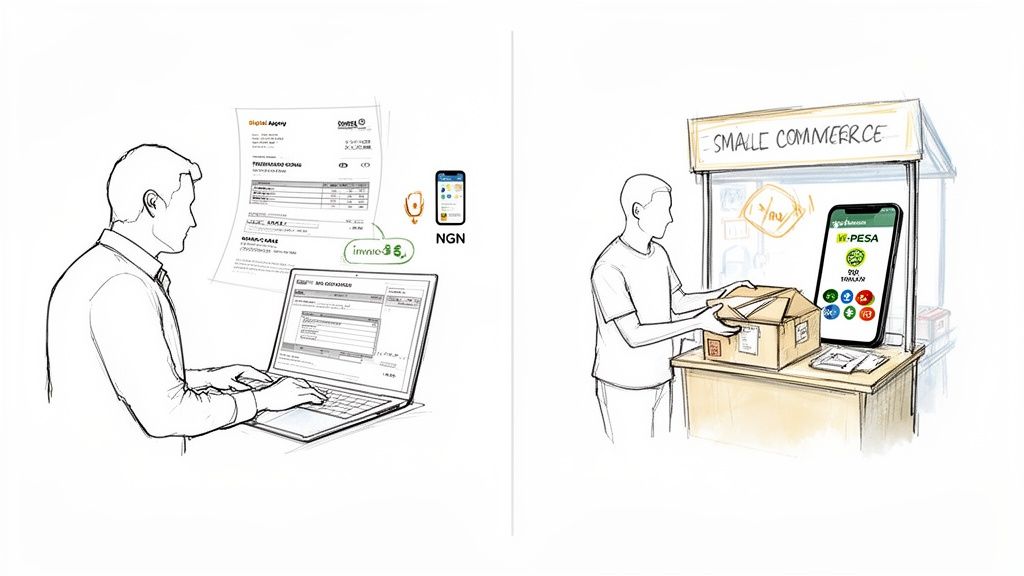
It’s one thing to talk about features, but it’s another to see how a free accounting system actually performs in the real world. Let's step away from the theory and look at how small businesses are using these tools to fix genuine problems, get cash in the bank faster, and build stronger relationships with their clients—all without spending a single rand on software.
When you find the right tool, financial admin stops being a chore and starts becoming a secret weapon. It’s all about centralising your operations in one place that’s both powerful and genuinely easy to pick up and use.
This isn’t just a hunch; it’s backed by research into how South African SMEs adopt FinTech. The two biggest factors driving adoption are usefulness and ease of use. For the 40% of SMEs who are unbanked or underbanked, a free system that is obviously helpful and simple to navigate can slash admin costs by up to 50%. You can dig deeper into these insights on SME FinTech adoption in South Africa.
Case Study A Digital Agency in Nigeria
Picture a small digital agency in Lagos. They’re juggling five clients on monthly retainers, and their "system" is a chaotic mess of spreadsheets. They create invoices manually, save them as PDFs, and spend half their time chasing payments. Sound familiar?
When they finally made the switch to a free accounting system, everything changed.
- Professional Invoicing: They now send out branded, professional invoices straight from the platform. Better yet, each invoice has a simple, one-click Paystack link to get it paid.
- Serious Cash Flow Boost: Getting paid used to take around 30 days. Now, it’s less than a week. The system automatically reconciles payments as they come in, so they always know exactly where their cash stands.
- Real Project Profitability: They can now track time and expenses against each client’s project. This means they can see, at a glance, which retainers are making them money and which ones are a drain on resources.
This wasn't just about saving time. It gave them the professional polish of a much bigger agency and the hard data they needed to make smarter business decisions.
A single, central system that ties invoicing to project management gives you an undeniable edge. It turns your financial numbers into real intelligence, letting even the smallest team operate with big-firm efficiency.
Case Study An E-Commerce Store in Kenya
Now, let's head over to Kenya and look at an e-commerce store selling handmade crafts. They ship to customers both locally and internationally, which created two big headaches: managing different currencies and accepting all the ways people want to pay.
A solid free platform with a built-in CRM was the perfect fit.
- Multi-Currency Sales: The system seamlessly handles sales in both Kenyan Shillings (KES) and US Dollars (USD), taking care of the exchange rate calculations automatically.
- Mobile Money Ready: Crucially for the local market, it connects directly with M-PESA. This allows Kenyan customers to pay instantly from their phones, a key feature in platforms like CRM Africa.
- Stronger Customer Relationships: With an integrated CRM, the owner can see a customer's entire purchase history, group them for targeted marketing, and encourage repeat business.
For this shop, the free system became the heart of the business—handling sales, payments, and customer management. It created a smooth, modern buying experience for customers and gave the owner a powerful control centre to run everything from.
Your Next Step Toward Financial Clarity
We’ve covered a lot of ground. By now, you should see that a free accounting system is much more than just a way to save a few bucks. It’s a real engine for automating your work, looking more professional, and building a business that lasts. We've gone from the must-have features to the fine print on limitations, showing what these tools can really do for ambitious SMEs in Africa.
Think of choosing the right platform like picking a business partner. You need one who gets your market, understands your struggles, and is genuinely invested in your growth. Plenty of big names like QuickBooks or Xero have powerful tools, but they were built for businesses in other parts of the world and their subscription costs add up. Even some "free" options like Wave eventually put essential services behind a paywall, according to expert reviews.
Look for a Platform Built for Growth
So, as you weigh your options, think beyond just managing today's numbers. The best tool won’t just handle your finances; it will pull every part of your business together, from the first client chat to the final project delivery.
A few solid platforms are out there, each with its own strengths:
- Zoho Books: A strong contender with a wide range of tools, sitting inside a much larger ecosystem of business apps.
- FreshBooks: A favourite among freelancers, praised for its straightforward invoicing and time tracking.
- CRM Africa: Stands out by combining accounting, project management, and a full CRM into one place, all under a generous free-forever plan designed for our market.
Your financial system shouldn't just be a rearview mirror showing where you've been. It should be a dashboard that helps you navigate what's ahead. An all-in-one platform provides the clarity to make smarter, faster decisions.
With its built-in support for pan-African payment gateways and a feature set that grows with you, CRM Africa offers a perfect starting point for any business ready to leave spreadsheets behind. It brings your operations under one roof so you can get back to what you do best: delivering fantastic work and making sure you get paid for it.
When you're looking at something labelled "free," it's natural to have a few questions. Trust, hidden costs, and whether it actually works for a South African business are usually top of the list. We get it.
Let's tackle some of the most common questions SME owners ask about free accounting systems.
Common Questions About Free Accounting Systems
Here are the straightforward answers to the questions we hear most often.
| Question | The Short Answer |
|---|---|
| Can I trust a free system? | Yes, if you stick with well-known names. They have a reputation to protect. |
| Will they force me to upgrade? | Eventually, yes. The "free" part is designed to get you started, not to run an empire. |
| Does it handle SA taxes? | It gets you ready for tax time, but it won't file your VAT returns for you. |
Diving a little deeper, here’s what you really need to know.
Can I Trust a Free System With My Financial Data?
Absolutely, but you have to do your homework. Handing over your financial data isn't something to take lightly.
Established players like CRM Africa, Wave, or even the starter tiers of platforms like Xero invest heavily in security. They use the same kind of data encryption your bank does to keep your information safe. The real test is transparency. Look for providers that are open about their security measures and, crucially for us here, are compliant with South Africa’s POPIA regulations.
Will I Eventually Be Forced to Upgrade?
Let's be honest: yes, probably. Very few things are free forever without some kind of catch. Most of these platforms run on a "freemium" model.
Think of it like a free trial that never ends, but has boundaries. You might be limited to a certain number of invoices, clients, or users. Once your business starts hitting those limits—which is a good problem to have!—you’ll be prompted to move to a paid plan. The trick is to find a system where the free plan is genuinely useful for the long haul, and the paid plans are priced sensibly for when you're ready to grow. As one expert review of bookkeeping software points out, even the most generous free plans will keep some key features behind a paywall.
Can a Free System Handle South African Taxes?
For the basics, yes. A free system is fantastic for getting all your ducks in a row. It tracks your income and expenses, which is the foundation of any tax return. You'll have all the numbers your accountant needs, neatly organised.
However, don't expect it to automatically calculate and file your VAT returns or handle other complex tax submissions. That’s usually a feature reserved for paid, localised accounting packages.
The biggest win here is organisation. When tax season rolls around, you can export your financial reports for your accountant or for use with SARS-compliant software. No more digging through shoeboxes of receipts.
Flexibility is a good sign. Platforms like QuickBooks are built to be configured for different tax environments, which shows what a more advanced, integrated system can do.
Ready to centralise your operations and get paid faster? CRM Africa combines invoicing, project management, and CRM tools into a single platform with a free-forever plan built for ambitious businesses.