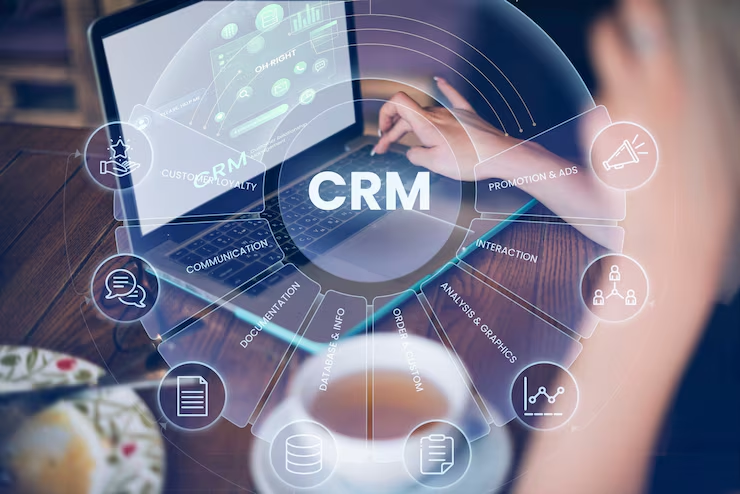
Think of a free invoicing and CRM system as a single piece of software that handles two of your most critical jobs: managing customer relationships (CRM) and handling your invoicing and payments. It’s one central place for both your client conversations and your cash flow, so you can stop jumping between different apps to get things done.
1. Understanding Your Business Command Centre
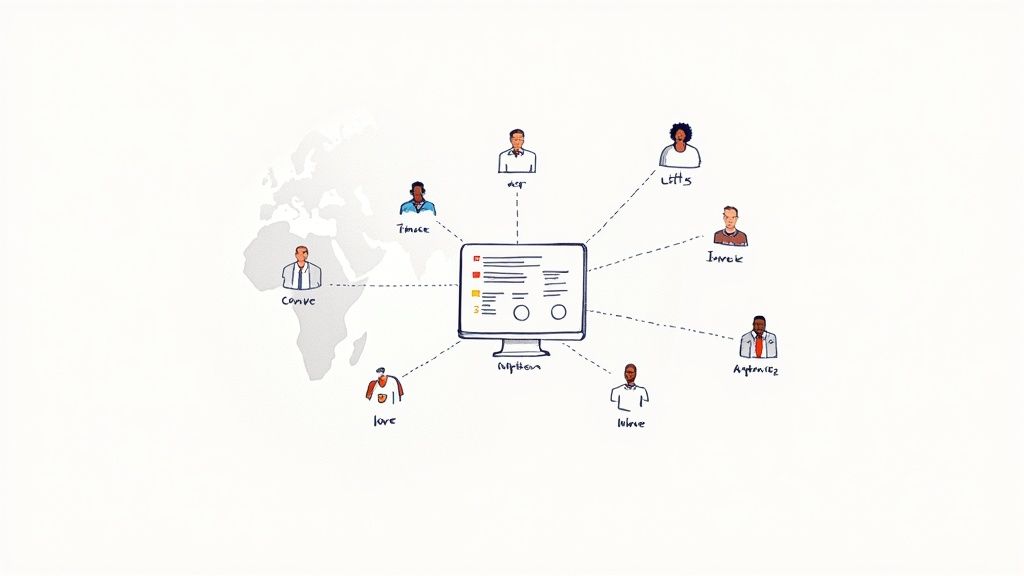
Imagine your business has a digital nervous system. A free invoicing and CRM is that system—it’s the command centre where every customer email is directly tied to every payment they make. This goes way beyond just sending out bills; it becomes a tool for seeing the complete story of each client.
Instead of keeping customer notes in one spreadsheet and building invoices in another document, this integrated approach actually connects the dots. You can see a client’s entire history—their past emails, previous purchases, and any outstanding invoices—all on a single screen.
The Power of a Unified View
This single, unified view is a massive advantage for Small and Medium Enterprises (SMEs). When your sales information lives right next to your financial data, you start to see patterns you’d otherwise miss. According to a report by Nucleus Research, integrating CRM with other applications can increase sales productivity by up to 15%.
For instance, you can spot your most profitable clients in seconds or see which services are constantly bought together. This isn’t just about being organised; it’s about making smarter, data-driven decisions that actually fuel your growth.
For African SMEs, looking professional and organised is absolutely essential for building trust. An integrated system helps you nail this by making sure every interaction, from the first proposal to the final payment reminder, is consistent, professional, and on time.
What Does ‘Free’ Actually Mean?
It’s fair to ask what “free” really means here. Most providers offer a solid free-forever plan to get you started. This isn’t just a 14-day trial; it’s a permanent plan designed to help you launch and grow without needing a budget for software.
A free plan gives new businesses the power to set up professional systems from day one. It levels the playing field, giving startups access to tools that used to be only for big companies with deep pockets.
This model lets you manage your clients and get paid without spending a cent upfront, making it the perfect launchpad. You only need to think about upgrading to a paid plan once your business scales and you need more advanced tools.
This growth-friendly approach is especially vital in emerging markets. Across the Middle East and Africa, CRM adoption is on the rise as SMEs in countries like Egypt embrace affordable tools to manage customer relationships and push their digital growth. You can learn more about this trend by exploring regional CRM adoption to see how the landscape is changing.
2. Why Combining Invoicing and CRM Unlocks Growth
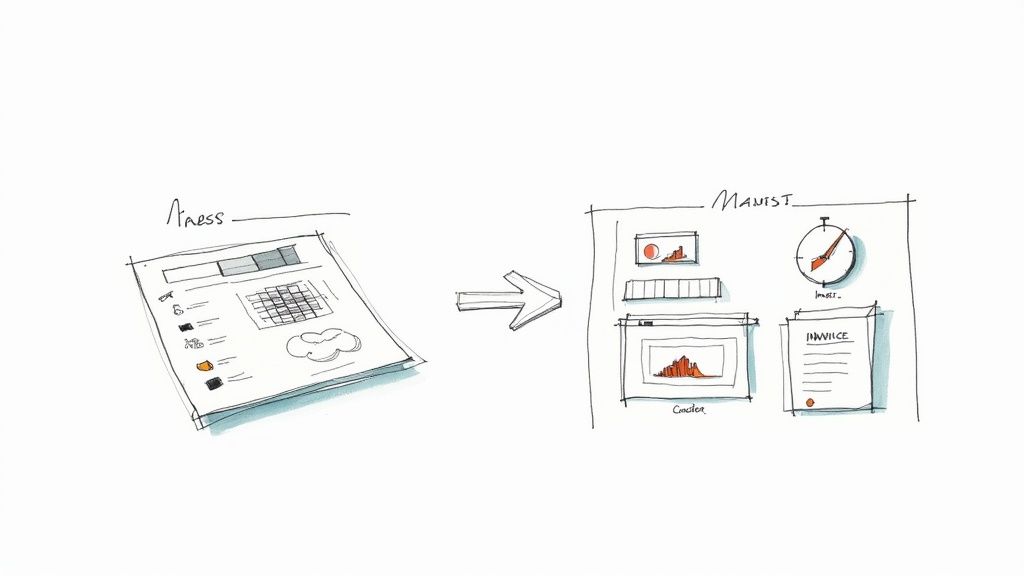
For so many growing businesses in Africa, the day-to-day can feel completely disjointed. Sound familiar? You’re probably tracking customer details in one spreadsheet, juggling projects in another, and firing off invoices from a tired, old template. This kind of scattered approach isn’t just an administrative headache—it’s actively costing you time and money.
Chasing down payments, trying to match them to the right invoice, and scrambling to remember key client details before a follow-up call… these are all symptoms of a broken system. Each task lives in its own little world, completely cut off from the others. This makes it impossible to see the full picture of your client relationships or your financial health. This is where a free invoicing and CRM platform completely changes the game.
Creating a 360-Degree Client View
Bringing these two functions together is like giving your business a memory. Suddenly, every single interaction is linked to every transaction. You’re no longer looking at just an invoice number; you’re seeing the entire client story behind it. The initial proposal, the project notes, the complete payment history—it’s all there.
This complete, 360-degree view lets you shift from just reacting to problems to proactively building relationships. For instance, before you call a client about a late payment, a quick glance shows you their entire history. Maybe they’re a loyal, long-term customer who simply forgot. That insight allows for a much more personal and understanding conversation.
A unified system transforms scattered data points into a clear narrative. It stops you from just processing transactions and empowers you to manage relationships, which is the true key to sustainable growth and client loyalty.
Turning Data into Decisions
This unified approach does more than just get you organised; it helps you make genuinely smarter business decisions. When you connect sales data directly to payment information, you unlock powerful insights that can steer your entire strategy.
Here’s how an integrated free invoicing and CRM system makes a real impact on your bottom line:
- Improved Cash Flow: The moment a project is approved, you can create and send the invoice. This simple step dramatically shortens the payment cycle. Add automated reminders for overdue payments, and you’ll spend far less time chasing money and more time earning it.
- Enhanced Customer Service: With all client information in one spot, you can offer a truly personalised service. This builds the kind of trust and loyalty that turns one-time customers into repeat business for years to come.
- Massive Time Savings: Automating all those repetitive admin tasks frees up countless hours. According to Salesforce, sales reps can spend up to 66% of their day on administrative tasks, a figure that automation drastically reduces. This is time you can pour back into sales, marketing, or simply making your services even better. For lean startups, this focus on efficiency is everything. You can even learn more by reading about how a smart invoice can even sell for you.
This combination of tools is especially critical for small businesses across Africa, where finding cost-effective solutions is essential to stay competitive. A free platform empowers entrepreneurs to manage their sales pipeline and professionalise their invoicing without a big upfront investment—a massive advantage in any market.
3. What to Look For in a Free Invoicing and CRM Solution
When you start shopping for a free invoicing and CRM platform, it’s easy to get overwhelmed by endless feature lists. But for small and medium businesses across Africa, some features aren’t just “nice-to-haves”—they’re absolutely critical for survival and growth. You need a tool that feels like it was built with your specific market, challenges, and opportunities in mind.
It’s all about looking past the shiny marketing and asking the tough questions. Does this software actually get how business is done on the ground here? Can it handle the mix of payment methods your customers use, or will it just create more headaches for them? A generic, one-size-fits-all solution from another continent simply isn’t going to work when you’re dealing with the realities of regional trade and local customer habits.
This means you’ve got to focus on features that solve real problems. From mobile money integration to multi-currency support, the platform you choose can either be a powerful engine for your business or a constant source of frustration.
To help you cut through the noise, we’ve put together a checklist of the absolute must-have features. Think of this as your guide to finding a tool that will truly work for your business, not against it.
Must-Have Features in a Free Invoicing and CRM Platform
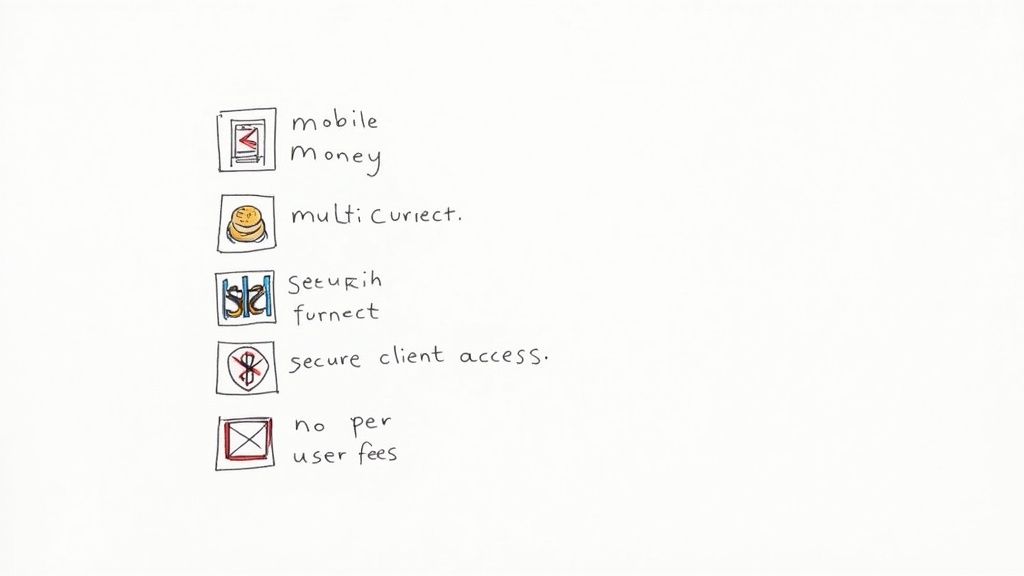
| Feature | Why It Matters for Your Business | What to Look For |
|---|---|---|
| Integrated Payments | Getting paid quickly is everything. Your system must support the payment methods your customers actually use, like mobile money and local card schemes. | Look for direct integrations with M-PESA, MTN Mobile Money, and Pan-African gateways like Flutterwave, Paystack, and Pesapal. |
| Multi-Currency Support | If you do business across borders, you need to invoice in your clients’ local currencies. It’s professional and makes it way easier for them to pay you. | The ability to create, send, and track invoices in multiple currencies (e.g., KES, NGN, ZAR, GHS, USD) is non-negotiable. |
| Automated Reconciliation | Manually matching payments to invoices is a huge time-waster and prone to errors. Automation gives you back your time and provides a clear view of your cash flow. | A system that automatically marks invoices as paid when a payment comes through the integrated gateway. No more guesswork. |
| Secure Client Portal | A professional portal where clients can view their history, download invoices, and make payments builds immense trust and reduces your admin workload. | A branded, self-service hub that gives your clients 24/7 access to their account information. |
| Scalable (No Per-Seat Fees) | “Free” tools that charge you for every team member you add are a trap. They punish you for growing your business. | Look for a generous free tier that includes multiple team members. Your software should support your growth, not penalise it. |
Choosing a platform with these core features sets a strong foundation. It ensures that your invoicing and client management system isn’t just a cost centre, but a strategic tool that helps you operate more efficiently and professionally, no matter where your clients are.
Payments, Portals, and Pricing Models That Actually Work
Let’s dig a bit deeper into a few of those points. Getting paid easily is the lifeblood of any business. In Africa, where a staggering 70% of internet users depend on mobile payments, according to a report by the GSMA, you absolutely cannot ignore this reality. Your chosen free invoicing and CRM must have:
- Mobile Money Gateways: Look for direct integrations with services like M-PESA and MTN Mobile Money. This lets clients pay an invoice with a tap on their phone, which means you get your money faster.
- Pan-African Payment Rails: Support for platforms like Flutterwave or Paystack is crucial for accepting payments smoothly across different countries.
- True Multi-Currency Invoicing: If you have clients in Kenya, Nigeria, and South Africa, you need to bill them in shillings, naira, and rand. It’s a simple sign of professionalism that builds trust.
Automating these payment processes does more than just speed up cash flow; it cuts down on manual errors and gives you a crystal-clear, real-time view of who has paid and who hasn’t. For more on this, there’s some great guidance on choosing AR automation software that digs into optimising these financial workflows.
Beyond payments, the best platforms help you build stronger client relationships and grow your team without surprise costs. A secure, branded client portal is a total game-changer for looking professional and being transparent.
A branded client portal gives your customers a secure, self-service hub to view project progress, access invoices, and make payments. This simple feature elevates your brand and builds the lasting trust that turns clients into advocates.
Just as important is the pricing model. So many “free” tools have a hidden catch: they hit you with steep per-user fees the moment you try to grow. Look for a platform with a generous free tier that allows for several team members, so you can add staff without adding costs.
It’s also a massive advantage to have a system that keeps chugging along even when the internet is patchy, a topic we cover in our guide on building a business that runs even when you’re offline. By prioritising these specific, practical features, you can find a tool that genuinely supports your day-to-day operations and your long-term ambitions.
4. Real-World Scenarios in the African Market
Theory and feature lists are one thing, but the true power of a free invoicing and CRM platform comes alive in the day-to-day grind of running a business. Let’s look at how different businesses across the continent are using these tools to solve very real challenges and spark growth. These aren’t just abstract ideas; they’re practical fixes for everyday operational headaches.
Picture a busy digital marketing agency in Cairo. They’re juggling a dozen clients, each with a monthly retainer plus a few one-off projects. Before, the first week of every month was a nightmare of manually creating invoices and then chasing payments—a process so full of errors and delays it was seriously hurting their cash flow.
Now, with an integrated system, that entire routine is on autopilot.
- Recurring Invoices: Those monthly retainers go out automatically on the first, no questions asked.
- Project Tracking: As soon as a project is marked “complete” in the CRM, an invoice is generated with a single click.
- Client History: The team has a complete view of every client’s payment status and conversation history, which makes follow-ups quicker and much more personal.
This simple shift has saved them over 20 hours a month in admin work. That’s time their team now spends focused on what they do best: delivering fantastic results for their clients.
Powering Startups and Cross-Border Trade
Let’s head over to Lagos, where a tech startup is getting its new mobile app off the ground. They need to manage a fast-growing list of beta testers and early adopters, keep track of feedback, and handle payments for premium access. A free invoicing and CRM is the backbone of their entire operation.
They use the CRM to neatly segment their user base, separating free beta testers from their first paying customers. When a user decides to upgrade, an invoice is sent directly from the platform, letting them pay instantly through local gateways. It’s a smooth workflow that helps them turn user interest into revenue without missing a beat.
For a startup, speed and organisation are everything. A unified system provides a single source of truth for user data and revenue, allowing founders to make quick, data-backed decisions without juggling multiple tools.
Finally, think of a freelance business consultant with clients in both Kenya and South Africa. For her, managing multi-currency payments used to be a constant source of stress. Invoicing a client in Nairobi in Kenyan Shillings and another in Johannesburg in South African Rand meant two different processes and a lot of accounting gymnastics.
Her integrated platform solved this overnight. Now, she can set a client’s preferred currency right in their CRM profile and send out invoices in KES or ZAR as needed. This simple feature not only makes her business look more professional but also makes it far easier for her clients to pay, strengthening her business relationships across borders.
5. Spotting the Common Pitfalls Before You Stumble
Taking the leap to a new free invoicing and CRM platform feels like a major win for your business. But let’s be honest, the path is rarely as smooth as we hope. A successful switch is about more than just picking a tool; it’s about having a smart strategy to sidestep the common traps that can trip you up before you even get going.
One of the biggest mistakes is getting lured in by a “free” tool that’s secretly designed to box you in. Many platforms dangle a free plan with tight restrictions, practically engineered to frustrate you into a paid upgrade. All of a sudden, you’ve hit a contact limit you didn’t know existed or you can’t add a key team member. A genuinely useful free platform should give you room to grow from day one, not hold your progress for ransom.
Don’t Overlook Data Security and Migration
Another landmine is underestimating data security and the sheer hassle of moving your information over. You’re not just adopting software; you’re entrusting your entire client and financial history to a new system. That’s a huge deal. With studies showing that 43% of cyberattacks are aimed squarely at small businesses, according to Accenture’s Cost of Cybercrime Study, security isn’t just a feature—it’s everything. Any provider worth your time will be upfront about their security measures, like data encryption, even on a free plan.
“Moving from the comfort of spreadsheets or even WhatsApp is a massive operational shift. Where many businesses fall down is not prepping their data properly. This leads to a messy, incomplete setup that defeats the whole purpose of trying to get more efficient in the first place.”
Before you even think about switching, you need a solid plan for getting your data across. That means cleaning up your spreadsheets and getting your client info organised into a format that makes sense. A lot of us also lean on informal tools for talking to clients. It’s critical to recognise the risks of this, which we break down in our guide on escaping the WhatsApp trap for your business. Pulling those valuable conversations into a proper CRM is a non-negotiable part of the process.
The Hidden Price of Bad Training and Zero Support
Finally, the most powerful software in the world is completely useless if your team has no idea how to use it. It’s easy to assume that a slick interface means you can skip the training. This is a classic mistake. Research from the Project Management Institute shows that poor user adoption is a primary reason for technology project failure. It almost always leads to your team quietly going back to their old, inefficient ways because it’s what they know. The hidden cost here is a massive drain on productivity and a ton of missed opportunities.
Here’s how to avoid that mess:
- Start with a small pilot group. Let a few people test the waters and iron out the kinks before you push it out to the whole company.
- Focus on the basics first. Get everyone comfortable with core features like managing contacts and sending a simple invoice before you introduce the more advanced stuff.
- Find a provider that offers real support, even to their free users. Knowing you can get a quick answer when you’re stuck is priceless for making the transition feel less daunting.
By thinking ahead about these challenges—the real cost of “free,” the critical role of data security, and the absolute need for good training—you can navigate the adoption process like a pro. This isn’t just about avoiding headaches; it’s about making sure your new free invoicing and CRM truly becomes an engine for your growth.
6. When to Upgrade From a Free Plan
Think of a free invoicing and CRM platform as the perfect launchpad for your new business. It gives you all the essential tools to look professional and manage those early days of growth without costing you a thing. But as your company finds its feet and starts to really take off, you’ll hit a point where the free plan just can’t keep up.
This isn’t a problem; it’s a milestone. Hitting the limits of a free plan is a sign of success, showing that your business is ready for its next big chapter. Knowing when to make the leap is a strategic move—it’s about investing in the power you now need to scale properly.
The global push towards e-invoicing is massive, with a projected compound annual growth rate of 15.4%. This isn’t just a trend; governments across the Middle East and Africa are actively encouraging digital invoicing to modernise their economies. This puts more pressure on small businesses to adopt these tools. You can dig deeper into the global e-invoicing market to see just how fast things are changing.
Key Triggers Signalling an Upgrade
So, how do you know it’s time to move on? You’ll start to feel it. The system will creak under the strain, and little frustrations will pop up more and more often. These are the tell-tale signs that you need more power under the bonnet.
Upgrading your system isn’t just another expense; it’s a calculated investment in your own efficiency and growth. It’s the moment you decide to give your business the tools it needs not just to run, but to truly compete and lead.
Keep an eye out for these classic growing pains:
- You need better analytics. Basic reports aren’t cutting it anymore. You need to dive deep into sales performance, customer lifetime value, and revenue forecasts to make smarter decisions.
- Your workflows are getting complex. You’re dreaming of automating multi-step processes, like sophisticated email follow-ups or assigning internal tasks based on what a client does. The free version just can’t handle that level of logic.
- You need to connect your tools. Your free invoicing and CRM is becoming an island. You desperately need it to talk to your accounting software, marketing platforms, or project management apps without manual workarounds.
- Your subscription model is growing. As your subscriber base expands, the limitations of a free tool become obvious. You might start looking at the best recurring billing software to find features that are critical for keeping that growth engine running smoothly.
7. A Few Common Questions
Jumping into new business software always brings up a few questions. Let’s tackle some of the most common ones we hear from business owners who are thinking about a free invoicing and CRM platform. Getting these answers straight will help you move forward with confidence.
Are These Platforms Actually Free, or Is There a Catch?
It’s a fair question. Most reputable providers operate on what’s known as a “freemium” model. Think of it like this: the core engine of your car—everything you need to get from A to B—is completely free. For your business, this means the essentials like creating and sending invoices or keeping track of your client details don’t cost you a thing.
This approach is a lifesaver for startups and small businesses just getting off the ground. You only start paying when you need the high-performance upgrades, like sophisticated workflow automation or adding more seats for a rapidly expanding team. As a study from Zapier points out, the best free tools give you a powerful core feature set without a ticking clock. Just be sure to glance over any provider’s pricing page to see exactly where the free plan’s boundaries are before you dive in.
How Safe Is My Business Data on a Free Platform?
Any provider worth their salt puts security front and centre, whether you’re on a free plan or a top-tier one. Your data is your business’s lifeblood, and they know it.
Even on the free tiers, you should expect industry-standard security measures like data encryption to keep your information locked down. Before you sign up for any service, it’s always a smart move to quickly review their privacy policy and see what security certifications they have. A quality platform will never cut corners on data safety, ensuring your sensitive client and financial details are protected from day one.
What if I Want to Switch Platforms Later? Can I Get My Data Out?
Absolutely. In fact, this should be a deal-breaker. Any good free invoicing and CRM tool will let you export your data without a hassle, usually in a standard format like CSV that you can take anywhere. This is crucial—it keeps you from getting locked into one system.
Your data is one of your most valuable business assets. Having the ability to easily export it gives you the freedom to choose the best tools for your business as it evolves, without being held hostage by a single vendor.
This feature is your guarantee that you stay in the driver’s seat. Your business information belongs to you, giving you the agility to adapt your toolkit as your needs change and grow.
Ready to bring your operations together and get paid faster? CRM Africa offers a powerful, free-forever plan for teams of up to 10, combining invoicing, project management, and a full CRM with integrated Pan-African payments. Schedule your free demo today!