

Before you can even think about handling pressure at work, you have to know exactly what you’re up against. It’s easy to feel a general sense of being overwhelmed, but that’s not something you can fight. The first real step is to pinpoint the specific tasks, situations, or even people that are causing the strain.
Once you have a clear target, you can start making a plan.
1. Pinpointing Your Pressure Triggers at Work
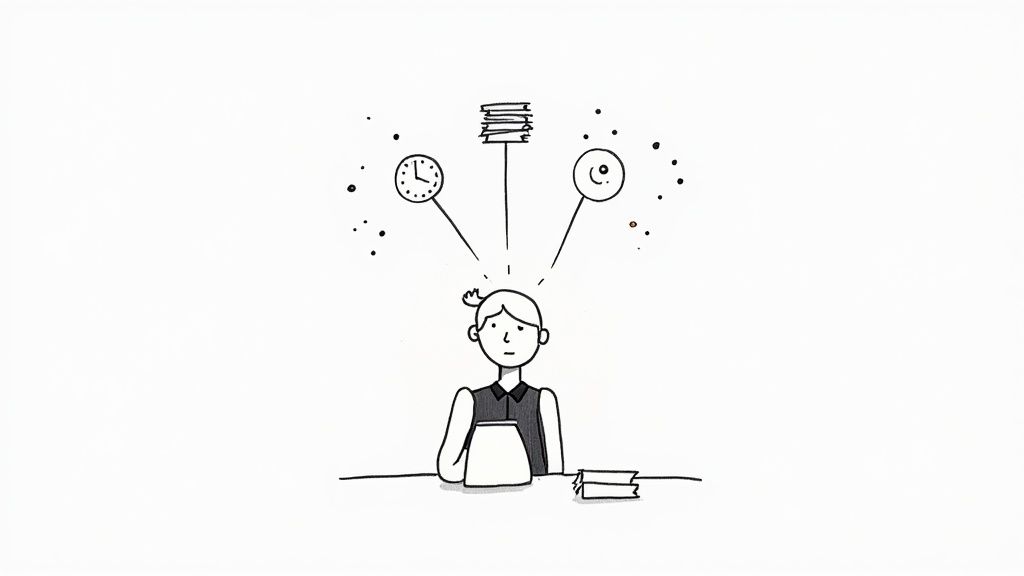
A vague feeling of stress is almost impossible to tackle. But a specific, named trigger? That’s something you can manage. Think of it like a doctor trying to treat an illness—you can’t just prescribe random medicine; you need a proper diagnosis first.
Workplace pressure isn’t a single thing. It’s a messy collection of different stressors, and they look different for everyone. For you, it might be the constant ping of notifications demanding an instant reply. For your colleague, it could be the crushing weight of an unrealistic project deadline or a tense relationship with a manager. According to the American Institute of Stress, the primary causes of workplace stress are workload (46%), interpersonal issues (28%), and juggling work/personal lives (20%).
These things often build up quietly, almost unnoticed, until one day you feel like you’re completely underwater.
Recognising the Common Culprits
The trick to identifying your personal triggers is simple awareness. Just start paying attention. Notice the moments during your day when your shoulders tense up, your breathing gets shallow, or your mood suddenly drops.
Most workplace stressors fall into a few common buckets:
- Workload Demands: This is the classic “too much to do, not enough time.” It includes impossible deadlines, ridiculously long hours, or simply an unsustainable volume of work. A recent study on South African professionals confirmed that workplace pressure is a major stressor, especially in demanding fields like healthcare and education. You can dig into the findings in the 2024 Profmed Graduate Professionals Stress Index.
- Lack of Control: Feeling like you have no say over your tasks, your schedule, or your job security is a massive source of stress. It’s the feeling of being a passenger in your own career. Research from Indiana University Kelley School of Business found that employees in high-demand jobs with low control were 15.4% more likely to die compared to those in low-demand jobs.
- Interpersonal Conflict: Let’s be honest, navigating difficult relationships with colleagues or bosses can drain more mental and emotional energy than the actual work itself.
- Role Ambiguity: If you’re not entirely sure what you’re supposed to be doing or how your performance is being measured, it creates a constant, low-level hum of anxiety.
A great way to start is by keeping a “stress diary” for a week. It doesn’t have to be fancy. Just jot down when you felt pressured and what was happening at that moment. You’ll quickly start to see patterns emerge, and that simple act of observation is the first step toward getting back in control.
To give you a clearer picture, here’s a breakdown of common stressors and how they might show up in your day-to-day life.
Common Workplace Pressure Points and Their Symptoms
| Stressor Type | Example | Common Symptoms |
|---|---|---|
| High Workload | Constantly staying late to meet deadlines; having more tasks than hours in the day. | Physical exhaustion, headaches, poor sleep, making more mistakes than usual. |
| Lack of Autonomy | Being micromanaged on every task; having no input on project direction. | Feeling unmotivated, disengaged, or resentful. A sense of helplessness. |
| Interpersonal Issues | A passive-aggressive colleague; a manager who only gives negative feedback. | Dread going to work, social withdrawal, increased irritability, anxiety. |
| Role Confusion | Vague job description; conflicting instructions from different managers. | Procrastination, feeling insecure about your performance, constant worry. |
This table isn’t exhaustive, of course, but it highlights how specific work situations can lead to real, tangible symptoms. Recognising these connections in your own life is a game-changer.
Listening to Your Body’s Signals
Sometimes, your body knows you’re under pressure long before your conscious mind admits it. These physical and emotional signals are early warning signs, and if you listen to them, you can act before stress spirals into full-blown burnout. A report by the World Health Organization estimates that depression and anxiety disorders cost the global economy US$ 1 trillion each year in lost productivity.
These clues can be subtle. Maybe you’re finding it harder to fall asleep at night, or you’re snapping at your family over small things. Perhaps you’re procrastinating on tasks that used to be easy, or that sense of dread starts creeping in earlier and earlier on a Sunday evening.
Don’t ignore these signals. They are valuable data points telling you where your personal limits are. Paying attention is how you start building real, sustainable resilience.
2. Immediate Tactics to De-escalate Stress
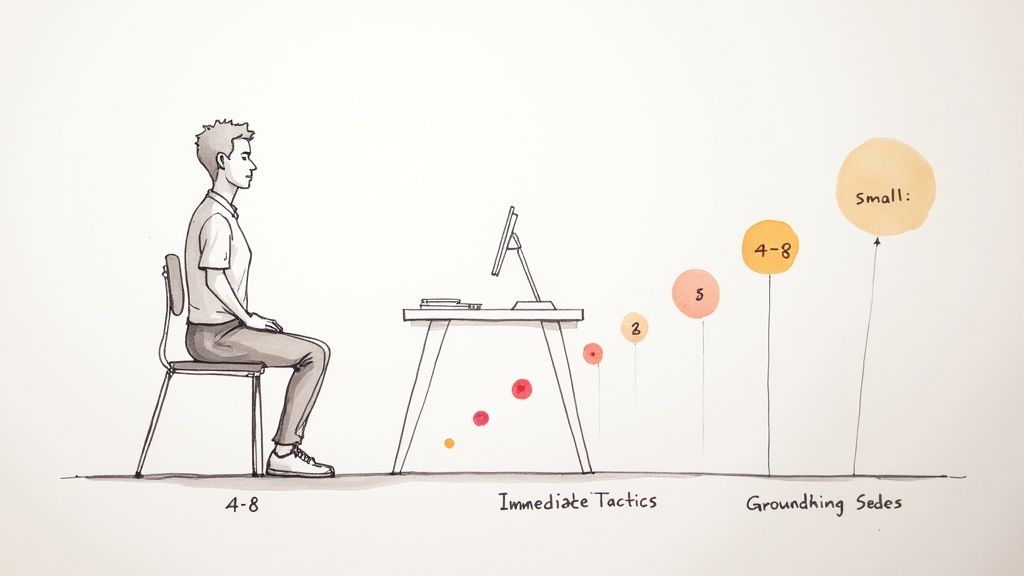
When you feel that all-too-familiar knot of pressure tightening in your chest, long-term strategies are useless. You need a mental first-aid kit. Simple, effective techniques that work right now to calm your nervous system and help you regain your cool, right at your desk.
Think of these tactics as a circuit breaker for your body’s “fight-or-flight” response. High-pressure situations can trigger a flood of stress hormones that cloud your judgment. Research from Yale University has shown that chronic stress can actually shrink the prefrontal cortex, the part of the brain responsible for memory and learning. Interrupting that physical reaction is your first step to thinking clearly again.
One of the most powerful and discreet tools you have is your own breath. When you’re stressed, your breathing becomes shallow and rapid. By intentionally slowing it down, you send a direct signal to your brain that the danger has passed and it’s safe to stand down.
Master the 4-7-8 Breathing Method
This technique is incredibly effective for quickly lowering your heart rate and calming that rising tide of anxiety. The best part? It’s simple enough to do during a tense meeting or before a difficult phone call without anyone even noticing. Developed by Dr. Andrew Weil, it is rooted in the ancient yogic practice of pranayama.
Here’s the drill:
- Exhale completely through your mouth with a quiet whoosh.
- Close your mouth and inhale slowly through your nose for a count of four.
- Hold your breath for a count of seven.
- Exhale completely through your mouth, making that whoosh sound again, for a count of eight.
Repeat this cycle three or four times. The real magic is in the long, controlled exhale, which is especially good at activating your body’s relaxation response. This isn’t just a mental trick; it’s a physiological reset button.
Ground Yourself with the 5-4-3-2-1 Technique
When your thoughts are racing and you feel overwhelmed, your mind is probably stuck in a loop of future worries or past mistakes. A grounding technique like this one forcefully yanks your attention back to the present moment and your immediate physical surroundings.
This method works by engaging all your senses to interrupt anxious thought patterns. Instead of trying to fight the anxiety, you gently redirect your focus to the tangible world around you. It helps anchor your mind when it feels like it’s about to float away.
Find a quiet corner, or just stay put at your desk, and silently identify:
- Five things you can see (your monitor, a pen, a plant on the windowsill).
- Four things you can feel (the texture of your desk, the fabric of your chair, your feet flat on the floor).
- Three things you can hear (the hum of the air conditioner, distant traffic, the clicking of a colleague’s keyboard).
- Two things you can smell (the aroma of your coffee, the faint scent of paper).
- One thing you can taste (the lingering flavour of your morning tea or just the neutral sensation in your mouth).
The goal isn’t to judge what you observe, but simply to notice. By the time you get to one, you’ll often find your mind is clearer and the initial wave of intense pressure has subsided. This gives you the mental space you need to handle whatever the workplace is throwing at you with a more focused and rational mindset.
3. Building Proactive Resilience to Stress
Dealing with pressure isn’t just about lurching from one crisis to the next. That’s a recipe for burnout. The real secret is building a strong, resilient foundation that readies you for challenges long before they show up. It’s a complete mindset shift—moving away from reactive, panicked fixes to creating proactive, long-term habits that genuinely support your wellbeing.
The idea is to start seeing challenges as chances to grow, not as threats that will take you down. This mental reframe is incredibly powerful. As defined by the American Psychological Association, resilience is the process of adapting well in the face of adversity, trauma, tragedy, threats, or significant sources of stress.
Set Firm Boundaries to Prevent Burnout
One of the fastest routes to chronic pressure is letting the lines between your work and personal life dissolve into a blurry mess. When that happens, your brain never gets a chance to switch off, which leads directly to exhaustion.
Setting firm boundaries isn’t a sign of weakness; it’s one of the smartest strategic moves you can make to protect your energy and focus.
This might look like:
- Defining your work hours and actually sticking to them. No more “just checking one more email” late at night.
- Creating a physical separation for work, which is critical if you’re working from home. It signals to your brain that it’s time to disconnect.
- Learning to say “no.” It’s a complete sentence. If your plate is already overflowing, you have to turn down non-essential requests.
This kind of proactive boundary-setting is absolutely vital in demanding work environments. The cost of not doing it is huge. It’s a key reason we’re seeing a rise in occupational burnout across South Africa. Research paints a stark picture: 36% of the workforce faces excessive stress every single day, and a massive 71% feel disengaged from their jobs. You can read more about the real costs of burnout in the workplace to see just how deep the problem runs.
“True resilience is built during the calm, not in the storm. The small, consistent habits you practice daily are what determine your capacity to handle pressure when it inevitably arrives.”
This proactive approach means you’re not starting from an empty tank when a high-stakes project or a brutal deadline lands on your desk.
Leverage Your Professional Support Network
Trying to muscle through intense pressure all on your own is a terrible idea. It simply doesn’t work. Your colleagues, mentors, and even your manager can be your biggest allies when things get tough. A Gallup poll found that having a best friend at work not only boosts engagement but also improves performance and wellbeing.
A trusted colleague can give you a much-needed reality check when you’re feeling completely overwhelmed. A good mentor can offer guidance drawn from their own battles. And don’t shy away from having a frank conversation with your manager about your workload. If you frame it collaboratively—like asking for help with prioritisation—it shows you’re engaged and proactive, not that you can’t cope.
Prioritise Physical and Nutritional Health
Your mind and body are not separate entities. Your ability to manage stress hormones is directly connected to your physical health. Consistent exercise and good nutrition aren’t just “nice-to-haves”; they are fundamental building blocks for mental resilience.
Regular physical activity is one of the best ways to burn off excess cortisol (the main stress hormone) while releasing endorphins that lift your mood. Studies published in the Journal of Occupational Health Psychology confirm that even moderate exercise can significantly buffer the negative impacts of work stress. You don’t need to sign up for a marathon. A quick 20-minute walk during your lunch break can make a world of difference to how you handle the afternoon slump.
What you eat also has a massive impact. A diet full of highly processed foods and sugar sends your energy levels on a rollercoaster, making it incredibly difficult to manage your emotions. On the other hand, a balanced diet filled with whole foods provides the steady, stable energy your brain needs to stay focused and calm. These small, consistent efforts are what truly stack up over time to change how you experience and respond to pressure at work.
4. Regaining Control of Your Time and Tasks
That sinking feeling when you look at your to-do list? It’s a huge source of workplace pressure. When every single task feels urgent and the list just keeps growing, it’s all too easy to slip into a reactive, fire-fighting mode that leads straight to burnout.
The only way out of this cycle is to take back control. It’s about making a conscious shift from letting your day run you, to running your day with intention. By using some proven strategies for prioritisation and focus, you can start tackling what truly matters, not just what’s shouting the loudest.
This infographic breaks down a simple mental model for the moment you start to feel that pressure building.
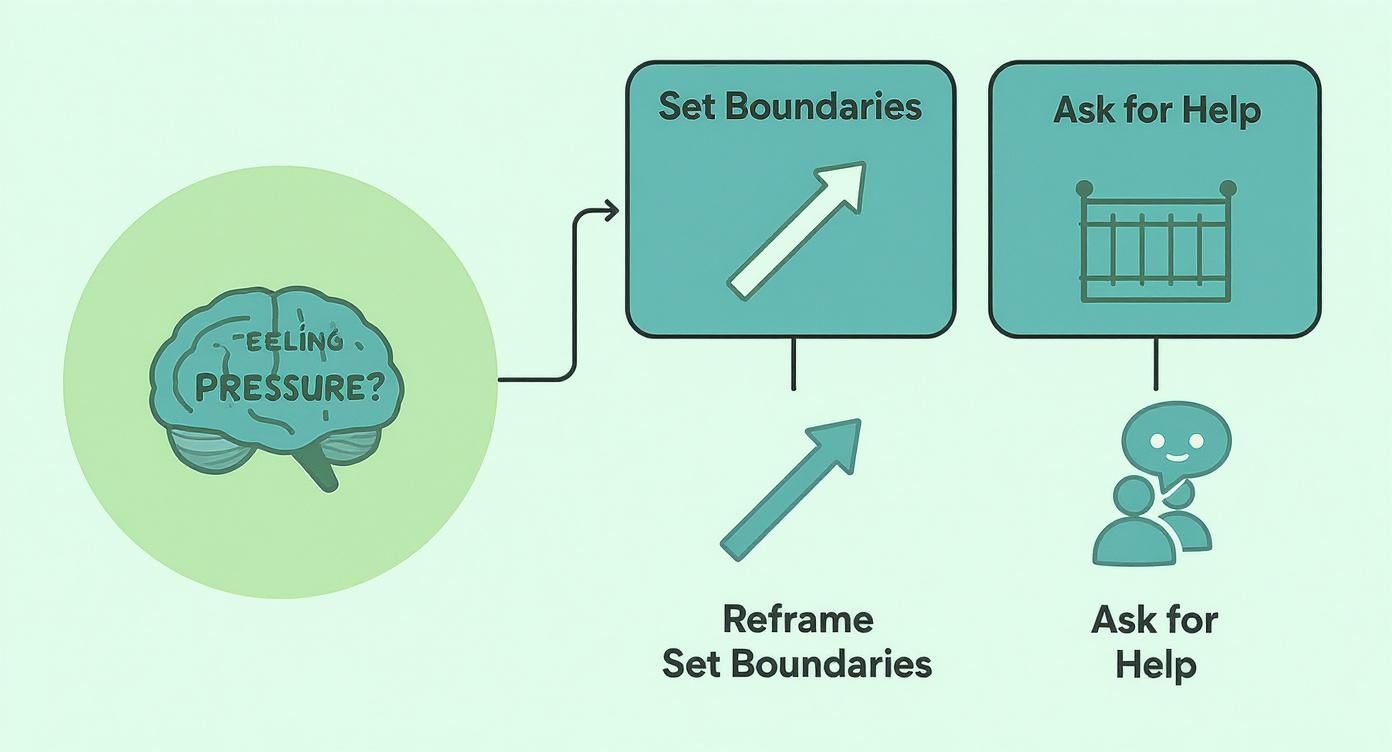
As the visual shows, your first move is always a mental one. You have to decide whether you’re facing a threat or a challenge. That single choice dictates whether you spiral or start taking constructive action, like reframing your thoughts or asking for help.
Master Prioritisation With the Eisenhower Matrix
Here’s a hard truth: not all tasks are created equal. The Eisenhower Matrix is a brilliantly simple tool that forces you to separate tasks based on their genuine importance, not just their perceived urgency. It is attributed to Dwight D. Eisenhower, who famously said, “I have two kinds of problems, the urgent and the important. The urgent are not important, and the important are never urgent.”
It works by making you categorise everything on your plate into one of four boxes. For anyone feeling overwhelmed, this is a total game-changer.
- Urgent & Important: These are your fires and your non-negotiable deadlines. Do them immediately.
- Important & Not Urgent: This is where the magic happens. Think strategic planning, relationship building, and long-term projects. Schedule dedicated time for these.
- Urgent & Not Important: Most interruptions live here. They feel important but do little to move you towards your goals. Delegate them if you can.
- Not Urgent & Not Important: These are the time-wasters. Be ruthless and eliminate them.
Using this framework helps you pour your energy where it will have the biggest impact. It stops the noisy, low-value tasks from hijacking your entire day. You can find more great advice from the experts at Calm.com who share stress management tips on their blog.
The goal isn’t to get more done, but to get the right things done. By consciously deciding where to put your attention, you take back the driver’s seat of your workday.
Defend Your Focus With Time Blocking
Once you know what your priorities are, you have to fiercely protect the time you need to actually do them. This is where time blocking comes in.
It’s a simple method where you schedule appointments with yourself in your calendar for your most important tasks. Instead of working from a vague to-do list, your calendar becomes your concrete plan for the day. This technique is championed by productivity experts like Cal Newport, author of “Deep Work.”
For example, you might block out 9:00 AM to 10:30 AM for “Draft Project Proposal.” During that block, you close your email, silence your phone, and give that one task your complete, undivided attention. It’s an incredibly powerful way to shut down the constant stream of distractions that fuel so much workplace pressure.
Choosing the right technique often comes down to personal preference and the nature of your work. Here’s a quick comparison of a few popular methods to see which might be the best fit for you.
Comparing Time Management Techniques
| Technique | Best For | Key Benefit |
|---|---|---|
| Eisenhower Matrix | Strategic thinkers and leaders who need to prioritise high-level tasks and delegate effectively. | Provides a clear framework for decision-making, ensuring focus on what truly drives long-term success over short-term “emergencies”. |
| Time Blocking | People who get easily distracted or work on complex, deep-work projects requiring sustained concentration. | Creates a structured, proactive schedule that protects your focus and prevents multitasking. |
| The Pomodoro Technique | Those who struggle with procrastination or find it hard to start large, intimidating tasks. | Breaks work into manageable, 25-minute intervals, making it easier to build momentum and maintain focus without burnout. |
Ultimately, whether you use the Eisenhower Matrix, Time Blocking, or another method, the goal is the same. Mastering your workload and learning how to communicate your capacity are fundamental skills for handling pressure at work. These strategies empower you to move from feeling constantly overwhelmed to feeling confidently in control.
5. Communicating Effectively When Under Pressure
When the pressure cooker environment of a modern workplace starts to hiss, your communication style can either pour petrol on the fire or calmly put it out. The way you speak during these high-stakes moments is a skill. And like any skill, it gets sharper with practice.
Poor communication under duress is easy to spot—it often sounds like blaming, making flimsy excuses, or just shutting down completely.
Effective communication, on the other hand, is about being clear and honest. It’s about protecting professional relationships, even when everything feels like it’s going sideways. You’re not just reacting to your work environment; you’re actively shaping it.
This is a massive deal in demanding professional cultures. Take South Africa, for instance, which is known for its long-hours work culture that contributes to sky-high stress levels. The country consistently ranks among the highest in the world for annual working hours, creating an intense environment where burnout is a very real threat. You can dig deeper into the link between long work hours and employee wellbeing in South Africa to see the full picture.
Using Professional Phrases to Manage Expectations
Ever felt your mind go blank in a tense meeting? Having a few pre-prepared, professional phrases in your back pocket can be a total lifeline. They act as a script when your brain is racing, helping you respond thoughtfully instead of just reacting.
Think of them as your go-to toolkit for tricky conversations, allowing you to hold your ground without sounding incompetent or confrontational.
- When you need to say no to a new task: Instead of a blunt, “I don’t have time,” try framing it differently. “My current focus is on delivering [Project X] to a high standard. To take this on, which of my current priorities should we adjust?” This shifts the conversation from your capacity to a strategic decision about priorities.
- When you need to push back on a deadline: “This deadline is impossible,” is a dead end. Instead, try, “To ensure I deliver the quality of work you expect, I’ve mapped out the steps, and it looks like a more realistic timeline would be [New Date]. Can we discuss this?”
- When you need to ask for help: Avoid vague cries for help like “I’m overwhelmed.” Get specific and be solution-focused. “I could really use a second pair of eyes on this data to make sure it’s spot on before the client presentation. Do you have 20 minutes to spare this afternoon?”
The trick is to shift the conversation from a problem (your stress) to a collaborative solution (managing the workload). This positions you as a proactive, responsible team member who’s committed to getting the job done right.
The Power of Assertive and Calm Communication
Let’s clear something up: assertive communication is not the same as being aggressive. It’s about expressing your needs and boundaries clearly and respectfully. It’s about being honest about your capacity and standing up for your own professional wellbeing. Research from Columbia University has found that assertiveness is negatively correlated with work stress; the more assertive individuals are, the less stress they tend to report.
When a stakeholder is pushing for an unrealistic outcome, your calm and assertive response is your best defence.
Take a deep breath. Keep your tone neutral. Stick to the facts. A response like, “I understand the urgency of this request, and I want to help. Let’s look at the resources we have available to see what’s achievable within this timeframe,” keeps you in control and makes the conversation productive.
By mastering these skills, you’re not just surviving the pressure; you’re learning how to handle it by actively managing expectations, protecting your time, and keeping your professional relationships intact.
6. Your Top Questions About Workplace Pressure, Answered
When you’re in the thick of it, workplace pressure can throw up some really specific, tricky situations. It’s easy to feel stuck or unsure how to react.
Let’s break down some of the most common questions professionals ask when they’re learning to get a handle on pressure. Think of this as your go-to guide for those tough moments.
What Should I Do the Moment I Feel Overwhelmed?
Stop. Seriously, just pause. Don’t try to muscle through it or fire off a reactive email.
Step away from your desk. Even two minutes is enough to break the stress cycle that’s starting to build. This tiny action creates a sliver of mental space. Use it to take three slow, deep breaths. This simple act stops you from making a panicked decision and lets you come back to the problem with a much clearer head.
Pausing isn’t a sign of weakness; it’s a strategic move. It halts the flood of stress hormones and gives your rational brain a chance to catch up and take back control.
How Do I Tell My Manager I Have Too Much on My Plate?
The key here is to frame the conversation around proactive problem-solving, not just your personal limits. Simply saying, “I have too much work,” can come across as a complaint. You want to position yourself as a strategic partner who cares about quality and priorities.
Try a different approach. Something like: “To make sure I deliver the best quality on our key priorities like [Project A], could we take a look at my current task list? I want to be certain my focus is exactly where it needs to be.” This shows you’re engaged and responsible, not just drowning in work.
Is It Normal to Feel Intense Pressure All the Time?
No. While intense periods are normal in any demanding job, feeling relentless pressure all the time is a huge red flag. That constant state of “on” is a direct pipeline to burnout, not a sign of a healthy, high-performance culture. The World Health Organization officially recognized burnout as an “occupational phenomenon” in the 11th Revision of the International Classification of Diseases (ICD-11).
A sustainable work environment has cycles. You’ll have periods of high intensity, but they should be followed by periods of recovery and a normal workload. If the pressure never lets up, it’s a clear signal that the expectations, resources, or the workload itself is unbalanced and needs a real, systemic fix.
Can Just Changing My Mindset Actually Make a Difference?
Absolutely. Look, changing your mindset won’t magically make an impossible deadline disappear. But it is an incredibly powerful tool for managing your response to it. Your perspective has a direct, physical impact on your body’s reaction to stress.
Think about reframing a “threat”—like a surprise project with a crazy turnaround—as a “challenge.” This could be an opportunity to show off your efficiency or problem-solving skills. That mental shift can fundamentally change your body’s stress response. Research from Harvard University shows that individuals who learn to view their stress response as helpful (e.g., a racing heart preparing them for action) are less anxious and more confident. It’s not about ignoring the pressure. It’s about taking back your sense of control over how you react, which is vital for building resilience. Shifting your perspective is one of the key recommendations from experts at Calm.com for managing work stress.
Struggling to manage client projects, invoices, and payments all at once? CRM Africa brings everything into one place. Our all-in-one platform helps you centralise your workflows, convert more leads, deliver projects on time, and get paid faster—all for free for teams up to 10 users. See how it works at https://crm.africa.