Think about how you currently manage your clients. Is it a tangled web of back-and-forth emails, missed calls, and constant "just checking in" messages? It can feel chaotic, and honestly, a bit unprofessional.
Giving your clients a branded dashboard changes the entire game. It’s not just about adding a fancy feature; it’s about giving them a secure, private digital office where everything they need is in one place. This instantly replaces the clutter of scattered communication with a single, organised hub for projects, invoices, and updates. A 2021 study by Salesforce found that 88% of customers say the experience a company provides is as important as its products or services, underscoring the need for such professional tools.
Why a Branded Dashboard Is Your New Competitive Edge
Let's be real. For many SMEs and agencies in Africa, competing with larger, more established firms can be tough. They often have entire teams and expensive software just for client management. A branded dashboard is your way to level that playing field, and fast.
Instead of your clients digging through their inbox for that one file you sent last Tuesday, they log into their space. A space with your branding. It immediately builds trust and makes your business look like the professional operation it is. We've all been on the client side of a messy project—it doesn't inspire confidence. Research from companies like Adobe shows that modern B2B customer journeys are getting more complex, and a dashboard is the perfect tool to bring some much-needed clarity.
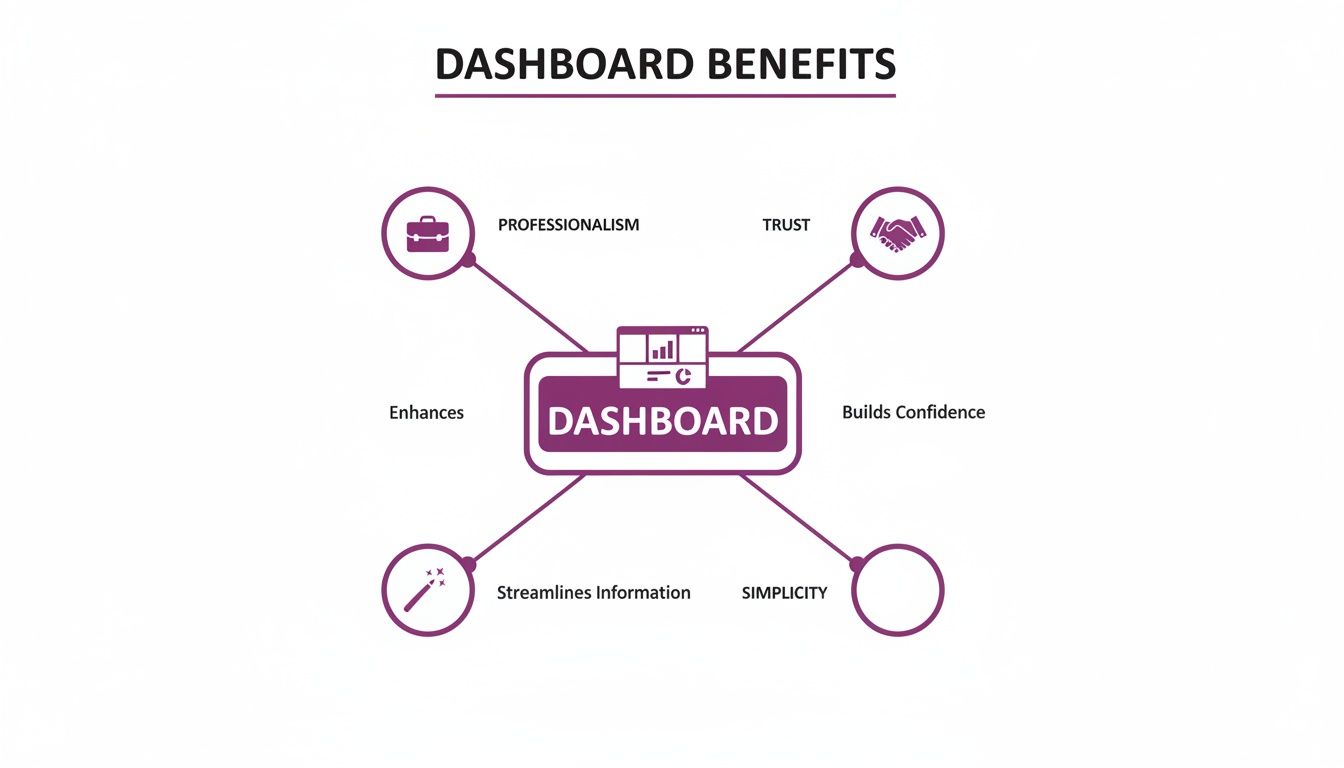
The best part? These benefits all feed into each other. A professional-looking interface that’s easy to use naturally makes clients trust you more. According to PwC, 35% of consumers cite a bad experience with a website or app as a reason to stop doing business with a company. A positive, streamlined dashboard experience creates a virtuous cycle that does wonders for your client relationships and, ultimately, your retention rates.
The Shift from Fragmentation to Centralisation
The old way of doing things is a headache. You've got project updates in one email chain, invoices sent from different software, files living in a random shared folder, and payment reminders sent via SMS. It's fragmented, confusing, and creates unnecessary friction for both you and your client.
Let’s look at a quick comparison to see just how big of a change this is.
Branded Dashboard vs Traditional Communication Methods
| Feature | Traditional Method (Email, Calls, SMS) | Branded Dashboard (e.g., CRM Africa) |
|---|---|---|
| Information Access | Scattered across multiple platforms; hard to find | All project files, invoices, and messages in one place |
| Project Visibility | Client has to ask for status updates | Real-time project progress is always visible |
| Communication | Reactive; constant back-and-forth for clarification | Centralised messaging keeps everyone on the same page |
| Professionalism | Can appear disorganised and inconsistent | Polished, branded, and builds immediate trust |
| Payments | Manual follow-ups; disconnected from project | Integrated invoicing with clear payment status and options |
See the difference? It’s a move from reactive communication to proactive, organised client management.
A branded dashboard pulls everything together. It puts an end to the "Did you get my email?" dance. Instead, platforms like CRM Africa, HubSpot, or Zoho move all those interactions into one controlled, professional environment. As Laura DeGomez of Well Traveled notes in a Hootsuite guide, showcasing progress and proof points in one place is incredibly powerful:
"No one tells our story better than our members."
When clients can see progress and access information effortlessly, they don't just feel more informed—they feel more confident in their decision to work with you. For any service business trying to scale efficiently and stand out, this isn't just a nice-to-have; it's a fundamental shift in how you build and maintain great client relationships.
Build Unbreakable Trust Through Radical Transparency
Let’s be honest, first impressions are everything. When a new client logs into a portal and sees your logo and your brand colours, it sends an immediate, powerful message. It says you’re organised, professional, and serious about how you do business. It's not just a cosmetic touch; it’s a psychological cue that they’re in good hands.
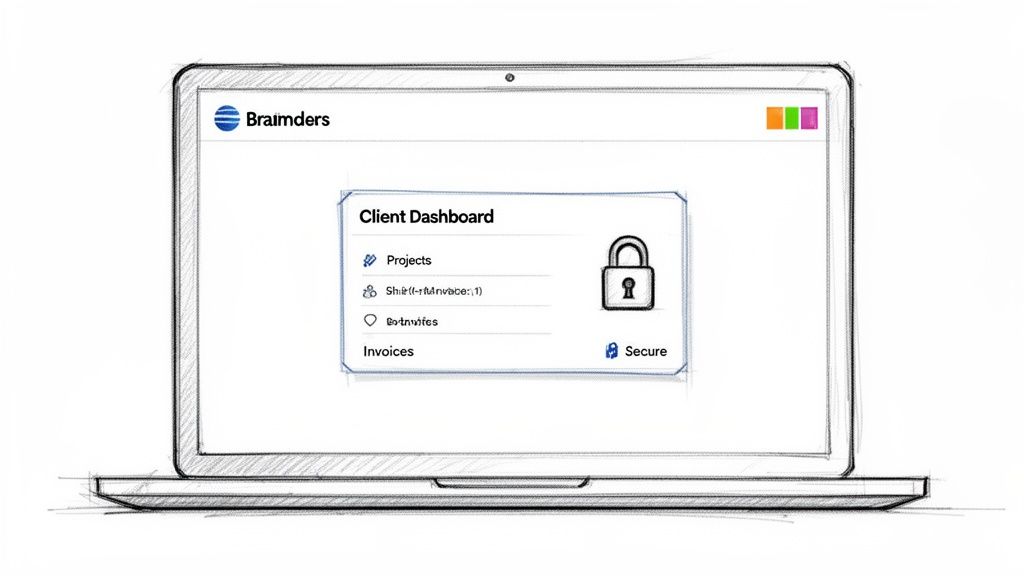
Think of it like this: would you rather meet a potential partner in a polished, well-kept office or a chaotic backroom? One inspires confidence, the other… not so much. A branded dashboard is your digital handshake, giving clients a clean, dedicated space to see everything related to their project. This aligns with findings from Deloitte that 62% of companies view customer experience delivered by contact centers as a competitive differentiator.
This kind of transparency is a game-changer for building trust. Instead of clients digging through emails for an old invoice, wondering about project status, or second-guessing if you got their last message, you give them one single source of truth.
Put Your Clients in the Driver’s Seat
Nothing kills a client relationship faster than uncertainty. A branded dashboard gets rid of that nagging feeling by putting all the critical information right at their fingertips, often answering questions before they even have a chance to ask them. This simple shift immediately reduces client anxiety and cements your role as a reliable partner.
Just think about the usual points of friction you deal with every day:
- Project Progress: Clients can see real-time status updates on tasks and milestones without having to chase you for a check-in.
- Historical Data: Every past invoice, payment receipt, and signed contract is filed away neatly in one secure, easy-to-find spot.
- Centralised Communication: A single message centre means no conversation gets lost in a crowded inbox. It’s a clear, unified record of every discussion.
This level of openness is what modern customer experience is all about. A study published in the Journal of Service Research found that empowering customers with control and transparency significantly boosts trust and satisfaction. When you give clients clear, accessible information, it’s been shown to directly increase satisfaction and long-term loyalty. A client who feels informed and in control is a client who trusts you to deliver.
Show You Mean Business
Adopting tools like client portals also says a lot about your business's sophistication. This is especially true for small and medium enterprises (SMEs) trying to punch above their weight. For instance, recent research on South African SMMEs discovered that the adoption of business intelligence tools with performance dashboards accounted for a massive 88% of the variation in technology adoption patterns. That tells you just how critical dashboards are seen for getting a competitive edge. You can discover more insights from the research on business intelligence adoption in South Africa.
By providing a client-facing dashboard, you are not just managing a project; you are curating a professional experience. You are showing clients that you invest in the tools necessary to serve them effectively, which in turn builds their confidence in you.
At the end of the day, one of the benefits of offering clients a branded dashboard is that it moves your relationship beyond a simple transaction and into a true partnership. Platforms like CRM Africa, HubSpot, and Zoho make this happen by giving you a secure, branded space where transparency becomes your most powerful asset for building unbreakable trust.
Get Paid Faster with Integrated Payments
Let's be honest, cash flow is everything for a small or medium business. According to a U.S. Bank study, 82% of business failures are due to poor cash flow management. One of the single biggest wins of giving clients their own branded dashboard is the ability to bake payments right into the experience. This isn't just a small tweak; it completely changes how quickly money moves from your client's account to yours.
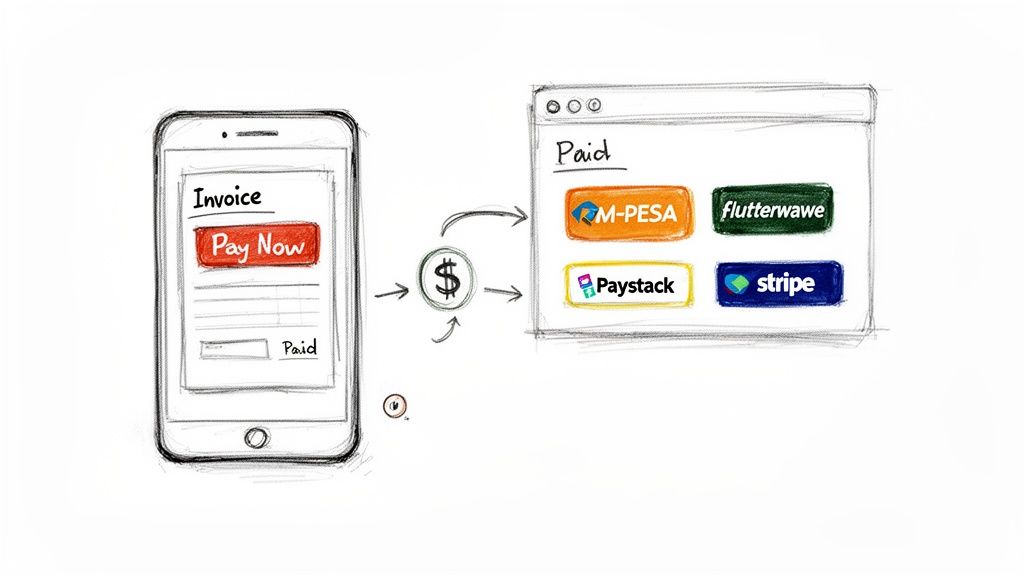
The days of emailing a PDF invoice and then waiting (and hoping) for a manual bank transfer are over. With a modern client portal, your client gets a notification, logs into their space, sees the invoice, and can pay it on the spot. It's clean, professional, and removes all the usual delays and excuses that come with old-school billing.
Make It Easy for Your Clients in Africa to Pay You
If you're doing business across the continent, you know that how you get paid is just as important as the work you do. Offering the right payment methods isn't a nice-to-have; it's fundamental to getting paid on time. This is where a branded dashboard really shines.
Think about it. Your client in Kenya can settle up instantly using M-PESA. Your customer in Nigeria can pay you through Flutterwave or Paystack without a second thought. And these local, trusted options can sit right alongside global ones like Stripe. You’re meeting every client exactly where they are, whether they prefer mobile money, a card, or a bank transfer.
When you offer a payment method someone knows and trusts, you eliminate that moment of hesitation. Easy payments are fast payments.
This is a huge deal, especially in markets where the informal economy plays a big role. Research on South Africa's informal MSMEs found that while businesses want to use tech to grow, digital payment delays of 2 to 60 days were causing massive cash flow headaches. A branded dashboard with real-time payment visibility solves this. It gives you instant, transparent confirmation that the money is there, closing the gap between wanting digital tools and fearing the delays they might bring. You can read more about these challenges and their impact on SMEs.
From "Invoice Sent" to "Cash in the Bank"
But it’s not just about giving clients more ways to pay. When you use a system like CRM Africa, HubSpot, or Zoho, you're also automating the entire accounts receivable headache. Here’s what that actually looks like:
- One-Click Payments: Your client sees a "Pay Now" button right on the invoice inside their dashboard. No fuss.
- Automatic Reconciliation: The moment a payment goes through, the system marks the invoice as "Paid" and updates your books. This alone saves countless hours of tedious admin work.
- Real-Time Alerts: You get a notification the second a payment is made, giving you a crystal-clear, up-to-the-minute picture of your cash flow.
You're not just making it easier for clients; you're making life easier for yourself. By cutting out the manual follow-ups and making the whole process smooth, you turn outstanding invoices into cash in hand faster than ever. It’s a simple change that strengthens your finances and frees you up to focus on what actually matters: doing great work for your clients.
Here is the rewritten section, crafted to sound completely human-written and natural, following all the provided instructions.
Cut Down on Support and Keep Project Updates Flowing
"Just checking in on the status of my project."
How many times a day does your team get that email or call? Each one seems harmless enough, but they add up, pulling your people away from the actual work that moves projects forward. This constant back-and-forth is a huge time sink. Research from McKinsey shows that the average employee spends about 28% of their workweek on email, a significant portion of which is chasing information.
A branded dashboard changes all of this. Think of it as a dedicated, self-service hub for your clients, massively cutting down on all that administrative noise.
It’s a central spot for everything project-related. When a client can log in whenever they want and see exactly what’s been done, what’s happening now, and what’s next, those "just checking in" calls simply stop. This kind of transparency doesn't just keep them happy; it gives your team back their most valuable resource: time.
Put Your Project Communication on Autopilot
One of the best things about a client dashboard is that it gets everyone on the same page, almost without you trying. You're no longer managing expectations through a jumble of email threads and WhatsApp messages; the dashboard handles the heavy lifting.
This clarity is more important than ever. The modern B2B customer journey is a long and winding road with tons of touchpoints. According to Adobe, having a shared, single view of the project is vital for creating a cohesive experience. A dashboard provides that single source of truth.
A good client portal pulls this off with a few key features:
- Live Task Lists: Clients see a clean checklist of deliverables, clearly marked as “To-Do,” “In Progress,” or “Complete.” It instantly answers the question, "what are you working on right now?"
- One Place for All Files: All the important stuff—from the initial brief to the final designs—lives in one, organised spot. No more digging through old email attachments.
- A Single Message Thread: Every conversation about the project happens right there in the dashboard. This creates one searchable, official record of communication.
Think of your dashboard as a 24/7 project manager. It patiently answers your clients' most common questions, which frees up your human team to solve tricky problems and produce amazing work.
An Example from a Digital Agency
Let’s say you run a marketing agency in Johannesburg. A client logs into their portal, maybe one you’ve built with a tool like CRM Africa, HubSpot, or Zoho.
Right away, they see the "Initial Social Media Ad Creatives" task is marked "Complete." They can click and download the files for review on the spot.
Next, they glance at the project timeline and see that "Client Feedback on Ads" is the next step. It’s a simple, visual update that gives them total clarity. Nobody had to send an email or pick up the phone. This isn’t just a time-saver; it empowers your clients, builds their confidence in your process, and lets your agency focus on the high-value work that actually gets results.
Demonstrate Your Value with Performance Dashboards
Let's be honest. The conversation about billable hours is exhausting for you and uninspiring for your client. A branded performance dashboard flips that script entirely. It's no longer about the time you've spent; it’s about the results you've delivered.
Picture this: your marketing client logs into their private portal and sees live campaign metrics ticking upwards. Or a financial consulting client watches their portfolio growth in real-time. You're not just telling them you’re doing a good job anymore. You’re showing them, with cold, hard data, presented beautifully. This is how you move from being just another vendor to an indispensable partner and justify your retainer without a fight.
From Data Points to Proof of Performance
Clients hire you to get something done. A performance dashboard is the most straightforward way to show them you’re delivering the goods. Instead of burying wins in a massive email attachment that no one reads, you give them dynamic visuals they can actually understand at a glance.
Platforms like CRM Africa, Zoho, or HubSpot are brilliant for this, letting you build out dashboards that show exactly what matters to each client. This creates a single source of truth for progress, which is absolutely critical for keeping everyone on the same page. As the experts at Adobe point out, having a shared view of the customer journey is key to aligning teams and clients around the right goals.
Suddenly, your communication changes. You can draw a straight line from your team's daily grind to the numbers your client actually cares about, like:
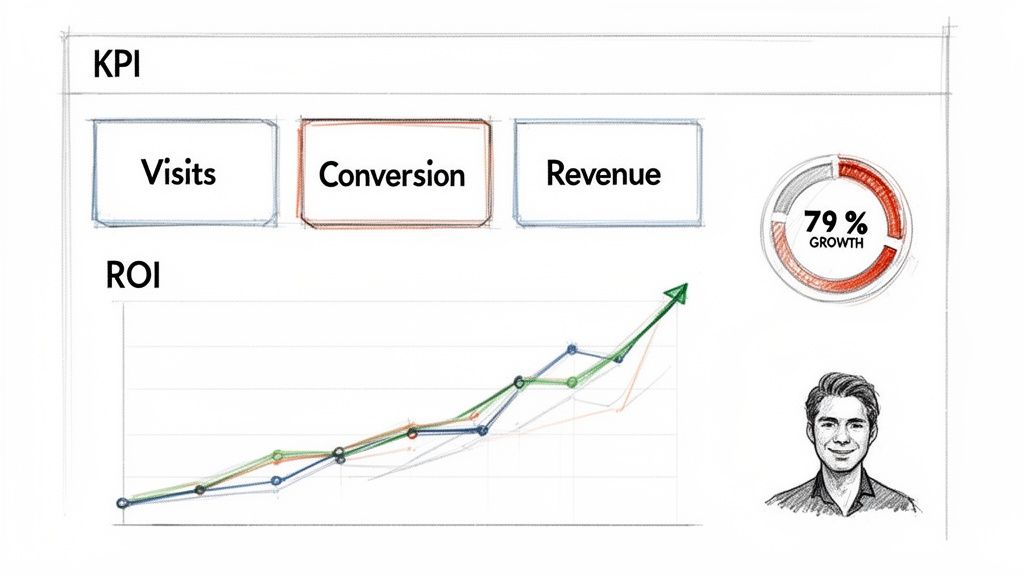
- Key Performance Indicators (KPIs): Crystal-clear charts showing lead generation, website traffic, or sales conversion rates.
- Return on Investment (ROI): A simple graph that answers the big question: "Is what you're doing making us money?"
- Project Milestones: Visual timelines that don't just show what's done, but connect those tasks to actual business outcomes.
Think about it this way: you're not just managing an account; you're proving your worth every single time the client logs in. It’s a powerful way to build confidence and lock in that long-term loyalty.
Customise Metrics for Different Industries
The real magic of a good dashboard is that it’s not one-size-fits-all. The numbers that get a marketing agency's client excited are completely different from what a business consultant's client needs to see. A great dashboard lets you tailor that view.
For a marketing agency, you might put website conversion rates and social media engagement front and centre. For a business consultant, maybe you’re tracking operational efficiency gains or cost savings. That level of customisation proves you're not just going through the motions; you genuinely understand their business. A survey by Accenture revealed that 91% of consumers are more likely to shop with brands who recognize, remember, and provide relevant offers and recommendations. Tailoring dashboards achieves a similar effect in a B2B context. This kind of proactive reporting is easily one of the biggest benefits of offering clients a branded dashboard—it’s a constant, gentle reminder of why they hired you in the first place.
How to Implement Your Branded Dashboard
Diving into new technology can feel like a massive undertaking, but here’s the good news: modern platforms have made setting up a branded client dashboard surprisingly simple. You don't need a team of developers or a huge budget. All you really need is the right all-in-one tool. The whole process is designed to get you up and running fast.
The first step is picking a platform that actually includes this as a core feature. Trust me, an integrated approach is miles easier than trying to duct-tape several different tools together—that road usually ends in a technical and financial headache. Look for a solution where the client portal feels like a natural extension of the system, not an afterthought.
Getting Started with Setup and Customisation
Once you have your platform, the customisation part is where you really make the dashboard yours. This is usually a straightforward, user-friendly process. The goal is simple: make the portal feel like it’s part of your company.
Key setup steps usually boil down to this:
- Uploading Your Logo: This is your non-negotiable first step for brand recognition. It’s the first thing clients will see when they log in.
- Setting Your Brand Colours: Adjusting the portal’s colour scheme to match your brand identity creates a seamless, professional experience. It just feels right.
- Configuring Your Custom Domain: Many platforms let you host the portal on a subdomain of your website (like
clients.yourbusiness.co.za). This is a powerful move that seriously reinforces your brand's credibility.
After the branding is sorted, you just invite your clients. This is typically as easy as typing in their email address. They get an invitation to set up their secure account, and just like that, they have their own private digital space with you.
This kind of intuitive layout means clients can find what they need without having to ask you for help, which is a huge part of reducing your support workload.
Choosing the Right Platform for Your Business
There are some excellent platforms out there that offer client portals. Systems like HubSpot, Zoho, and Monday.com have robust features, but their costs often scale per user. For smaller businesses, that can quickly become a real barrier.
For many growing businesses, the ideal starting point is a platform that removes financial friction. This makes technology adoption a matter of strategy, not budget.
This is especially true in South Africa, which is home to over 2.5 million micro-enterprises, with an estimated 72% operating informally. For these businesses, high costs and complexity are major obstacles. A branded dashboard that simplifies invoicing and project tracking can be a game-changing tool for professionalisation. You can learn more about the findings on South Africa's MSME landscape and their urgent need for support.
For SMEs and agencies across Africa, CRM Africa offers a compelling alternative. It provides its entire all-in-one platform—including a branded client dashboard—completely free for growing teams. This makes it one of the most practical ways to start enjoying the benefits we've talked about without any upfront investment.
Got Questions About Branded Dashboards? We’ve Got Answers.
When you’re thinking about bringing a branded dashboard into your client relationships, a few common questions always seem to pop up. It's only natural. You're wondering about security, whether clients will actually use the thing, and how much technical heavy-lifting is involved.
Let's tackle these head-on.
"Is My Client's Data Secure?"
This is always the first, and most important, question. And the short answer is: yes, absolutely. Protecting sensitive information isn’t just a feature of a good client dashboard; it’s the entire point. Established platforms like CRM Africa, HubSpot, and Zoho have built their reputations on ironclad security. In fact, a 2022 Gartner report emphasized that security is a top priority for 88% of Boards of Directors, viewing it as a business risk rather than just a technology problem.
Think of it this way: they’ve invested millions in keeping data safe so you don’t have to. You’re tapping into enterprise-grade security that includes:
- Data Encryption: This scrambles your information, making it unreadable to anyone without authorised access, both when it's being sent and when it's stored.
- Secure Logins: Only the right people get in. Period.
- Role-Based Access: This is a big one. You get to play gatekeeper and decide exactly who sees what, ensuring financial details are kept private while project updates are shared.
"Will My Clients Actually Use It?"
This is where the rubber meets the road. Client buy-in all boils down to one simple question: does this make their life easier? When your dashboard becomes the single source of truth for everything—project timelines, invoices, important files, and communication—it stops being a novelty and starts being essential.
High adoption happens when the portal solves real problems. Easy access to payment links, clear project visibility, and a central file repository transform the dashboard from a "nice-to-have" feature into an essential tool for both you and your clients.
It becomes the place they automatically go to find an invoice or check on progress, instead of digging through their inbox or sending you yet another email. The key is to demonstrate value. Research from Forrester shows that a well-designed UX can raise customer conversion rates by up to 400%, and the principle applies here: an easy-to-use, valuable portal will see high adoption.
"Do I Need to Be a Tech Whiz to Set This Up?"
Not in the slightest. The beauty of modern CRM platforms is that they’re built for business owners and managers, not developers. The goal is to get you up and running quickly, without needing to write a single line of code.
Systems like CRM Africa have made this incredibly simple. You can upload your logo, select your brand colours, and start inviting clients in just a few clicks. The whole experience is designed to be intuitive. You'll be reaping the rewards of a professional, branded client experience without the headache of a complicated setup.
Ready to elevate your client experience and streamline your operations? CRM Africa provides a free, all-in-one platform that includes a fully branded client dashboard, integrated payments, and project management tools. Start building stronger client relationships today. Get started for free at https://crm.africa.