
Every business owner has said this:
“I’ll follow up later.”
“I’ll invoice them later.”
“I’ll update the client later.”
“I’ll add it to the system later.”
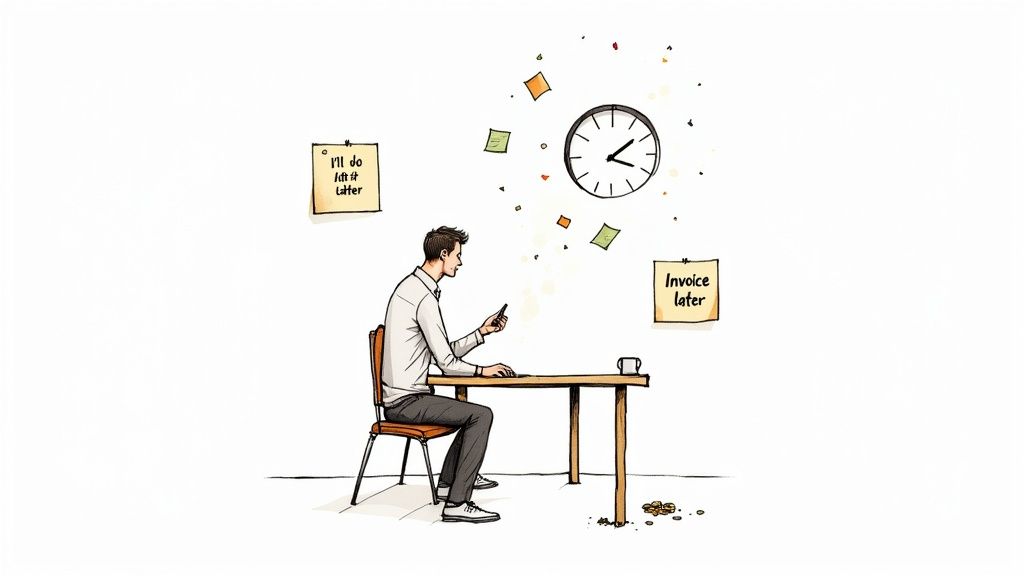
But “later” is the quiet source of lost clients, missed payments, forgotten tasks, project mistakes, low retention, and poor cash flow. The good news? Automation turns “later” into “done.” That simple four-letter word is a quiet drain on your business, and without a doubt, the most expensive word in business.
The Hidden Costs of Putting Things Off
Let’s talk about Aisha. She runs a growing digital marketing agency in Cairo, and her days are a whirlwind of client calls, team huddles, and looming deadlines. To keep her head above water, she often pushes aside tasks that aren’t screaming for her immediate attention.
A hot new lead comes in? She makes a mental note: “Follow up later.” A big project is complete? “I’ll send the invoice later.” A client has a small question? “Update them later.”
These little postponements feel harmless. Necessary, even. It’s just how you manage a packed schedule, right? But underneath the surface, this habit of “later” is quietly eating away at her business. A study published in the Journal of Marketing found that a mere five-minute delay in following up with a web lead can result in a 10x decrease in the odds of making contact. Each delayed follow-up is a potential sale walking out the door. Every postponed invoice creates a gap in her cash flow, putting a strain on everything from payroll to new investments. And every late client update chips away at the trust and satisfaction that keeps customers coming back.
Procrastination Is a Financial Liability
This isn’t just about poor time management; it’s a direct hit to your bottom line. Business procrastination isn’t a personality quirk—it’s a real, measurable liability that quietly compounds over time. Research from DePaul University’s Center for Sales Leadership shows that over 50% of buyers choose the vendor that responds first.
Don’t just take my word for it. The latest speed to lead statistics show just how critical a quick response is. Waiting just one hour to reply to a new inquiry can cause conversion rates to plummet. That’s a real financial cost.
“Later” is where opportunities go to die. It’s the space between intention and action where revenue is lost, relationships weaken, and growth stalls. The real cost isn’t just the task undone; it’s the momentum forfeited.
To truly understand how these small delays add up, let’s break down the specific ways procrastination quietly sabotages your success.
How ‘Later’ Quietly Damages Your Business
The habit of delaying tasks doesn’t just create a messy to-do list; it triggers a chain reaction of negative financial and operational consequences across your entire business. According to a report by the Project Management Institute (PMI), poor communication is a contributing factor in 56% of project failures.
| Delayed Action | Immediate Negative Impact | Long-Term Business Cost |
|---|---|---|
| Sales Follow-Up | A warm lead goes cold. | Lost revenue; lower conversion rates. |
| Sending Invoices | Payment cycles are delayed. | Poor cash flow; financial instability. |
| Client Updates | Client trust and satisfaction decrease. | Higher churn; negative word-of-mouth. |
| Paying Suppliers | Late fees; strained supplier relationships. | Damaged reputation; loss of key partners. |
| Project Handoffs | Internal confusion and missed deadlines. | Decreased team morale; project failures. |
As you can see, the ripple effect is significant. What starts as a minor delay quickly escalates into a major business problem, impacting everything from your bank account to your brand reputation.
1. How Delayed Actions Erode Your Profit
That seemingly harmless idea of doing something “later” quickly becomes a very real, very expensive problem once you look at its effect on your sales and cash flow. Procrastination isn’t just a bad habit for an entrepreneur; it’s a direct leak in your revenue pipeline. With every hour that slips by, potential profit is draining away.
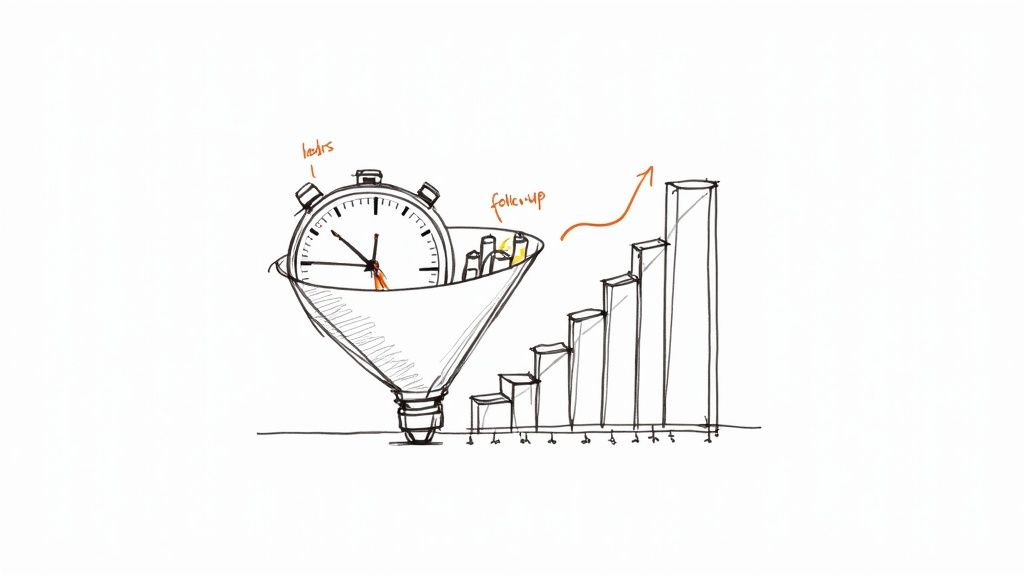
You can see this erosion most clearly in sales. Study after study shows a dramatic drop-off in lead conversion rates for every hour you wait. Research by Harvard Business Review found that companies that tried to contact potential customers within an hour of receiving a query were nearly seven times as likely to have a meaningful conversation with a key decision-maker as those that tried to contact them even an hour later. A lead that’s red-hot at 9 AM can be completely cold by lunchtime if you decide to “follow up later.” The initial excitement vanishes, a competitor gets there first, or the prospect simply moves on.
Let’s put some numbers on it. Imagine a small consulting firm in Lagos that generates 20 new leads a month. Each closed deal is worth, on average, ₦450,000. If they jump on those leads immediately and convert 30%, they bring in ₦2,700,000. But if they delay and that conversion rate drops to just 15%, their monthly revenue is slashed in half to ₦1,350,000.
That single decision—to act now versus “later”—can cost the business over ₦1,350,000 a month. That is the real, quantifiable price of procrastination.
The Cash Flow Crisis Caused by Delay
Beyond just losing sales, delaying simple actions like invoicing directly suffocates your company’s financial health. The best way to understand this is through the cash conversion cycle—that’s the time it takes for your business to turn its investments (in services or inventory) back into actual cash in the bank. When you invoice “later,” you’re deliberately making that cycle longer. According to a study by Xero, late payments are a significant issue for over half of small businesses, severely impacting their cash flow.
A longer cycle puts a huge strain on your day-to-day operations. It means you have less cash on hand to:
- Pay your staff and suppliers on time.
- Invest in new equipment or marketing campaigns.
- Handle unexpected expenses without going into debt.
This delay creates a domino effect. Pushing back one invoice by a week might not seem like a big deal. But when you multiply that across dozens of clients, it can create a serious cash flow gap that puts your ability to operate and grow at risk.
The High Cost of Postponing Innovation
This isn’t just about daily tasks; it applies to big strategic decisions, too. The cost of putting off investments and innovation is especially high in rapidly growing economies. For example, in the first nine months of 2021, venture capital funding in the Middle East, including Egypt, hit a record-breaking $2 billion, according to Magnitt, the MENA-based venture data platform.
Delaying entry into these capital-heavy sectors until “later” means missing a critical window of opportunity and giving up your competitive edge. You can discover more insights about Egypt’s expanding entrepreneurial landscape and see how acting decisively is crucial for capitalising on growth.
In every part of your business, from a single sales call to a major strategic move, “later” is the most expensive word you can possibly use.
2. Adopting the ‘Automate It Forever’ Mindset
The constant battle against “later” isn’t won by working harder or logging longer hours. It’s won by changing the rules of the game entirely.
This means a fundamental shift in how you think—from manually grinding through repetitive tasks to building systems that handle them for you. The guiding principle is simple but powerful: Do it now once, automate it forever.
Think about your personal finances for a second. Chances are, you have automatic payments set up for utilities or subscriptions. You don’t have to remember to pay them each month; the system just works. This is the exact mindset that can reshape your business operations.
Instead of manually chasing every single invoice, imagine a system that automatically sends out reminders. Instead of trying to remember to follow up with every new lead, picture a workflow that instantly sends a welcome email and pops a task onto your team’s to-do list. This is the heart of the ‘Automate It Forever’ mindset.
Turning Intention into Automated Action
That leap from manual effort to automated systems is precisely where a Customer Relationship Management (CRM) platform becomes indispensable. A good CRM acts as the central hub for your business, turning your best intentions—like “I’ll follow up later”—into immediate, automated actions that run in the background, 24/7.
It’s the digital equivalent of hiring a perfectly reliable assistant who never forgets a task, ever. The CRM doesn’t get busy or distracted; it just executes the workflows you’ve designed. This systematic approach guarantees critical actions are never pushed aside, directly fighting the hidden costs of delay. To get a better handle on this, you can explore some proven strategies to boost business efficiency with automation.
By setting up automated workflows, you build a business that runs on systems, not just on your personal energy and memory. This is how you ensure that your 2026 self will thank you for the foundations you lay today.
Freeing Up Your Most Valuable Resource
But let’s be clear: the ultimate goal here isn’t just about getting more tasks done. It’s about reclaiming your most valuable and finite resource: your time and mental energy. A McKinsey report suggests that as much as 45% of current paid activities can be automated by today’s technology, freeing up employees to focus on higher-value work.
When you’re not bogged down by administrative busywork, you can redirect your focus to what actually drives growth.
Think about the high-value activities that so often get sacrificed:
- Building stronger client relationships: Going beyond quick transactional updates to have meaningful conversations.
- Developing long-term strategy: Stepping back from the day-to-day chaos to actually plan your company’s future.
- Innovating your services: Thinking creatively about how you can deliver even more value to your customers.
Automating the routine stuff—follow-ups, invoicing, client updates—doesn’t just get rid of the dangerous word “later.” It systematically creates the space you need to lead your business forward, building a more resilient, scalable, and ultimately more profitable organisation.
3. Practical Automation Workflows You Can Build Today
Embracing an “Automate It Forever” mindset is a great start, but the real magic happens when you put it into practice. That’s how you eliminate the crippling cost of saying “later.” The best part? You don’t need a huge IT department to get going. Modern CRMs are built to make powerful, business-changing workflows surprisingly straightforward.
So, let’s get our hands dirty and move from theory to action. Here are some real-world examples of automated workflows any small business can set up right now. Think of these less as ideas and more as blueprints for turning good intentions into reliable, money-making systems.
The process flow below captures the core idea perfectly: taking a repetitive manual task and turning it into a permanent, automated system that just works.
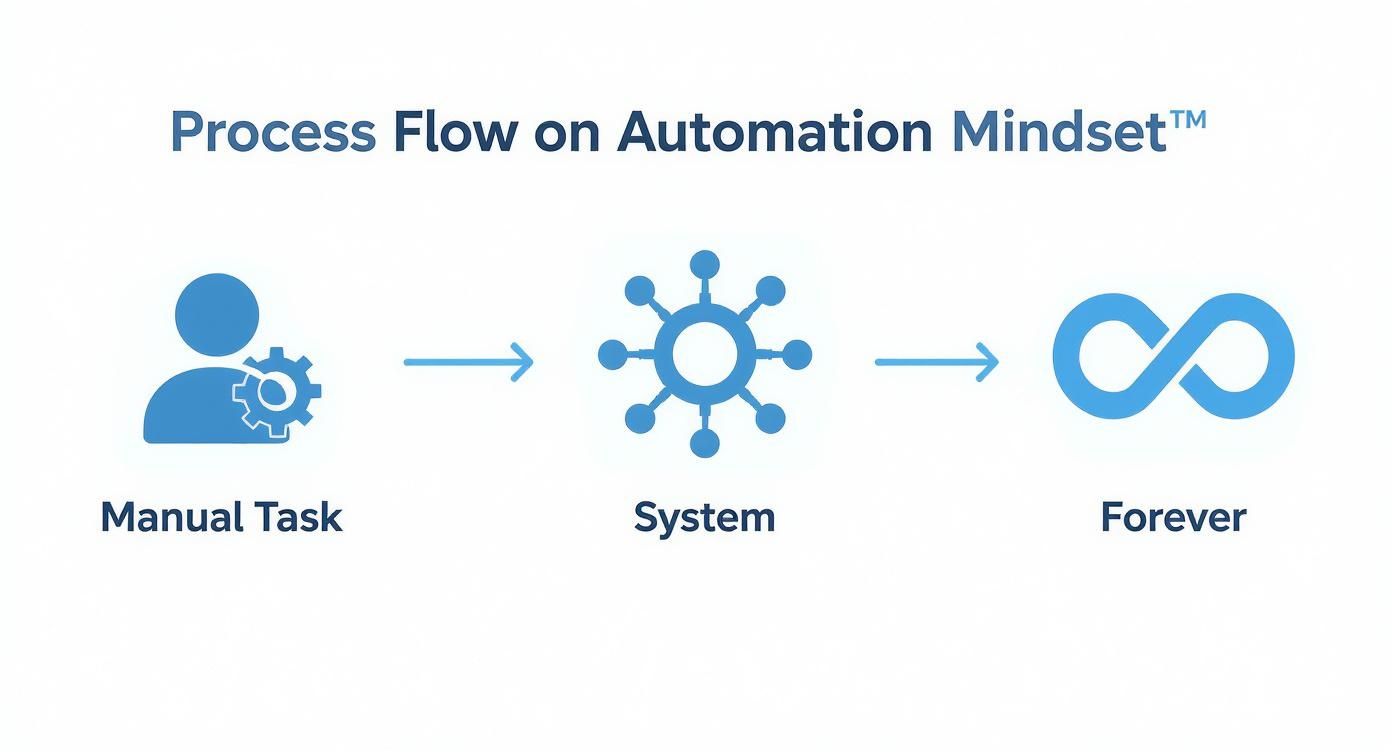
This visual shows the journey from a single, manual action to a system that handles tasks for you forever, freeing you up to focus on what really matters.
Automated Sales Follow-Up Sequence
Let’s be honest: lost leads are often just forgotten leads. An automated follow-up sequence is your safety net, ensuring every single prospect gets immediate and consistent attention. This alone can dramatically boost your conversion rates. Statistics from the Annuitas Group show that businesses using marketing automation to nurture prospects experience a 451% increase in qualified leads.
- Trigger: A new lead fills out a form on your website. Simple enough.
- Immediate Action: The system instantly sends a personalised welcome email. It acknowledges their enquiry and gives them some useful initial info. No delay.
- Internal Action: At the same time, a task is created and assigned to a sales team member with a clear deadline to make a personal call.
- Conditional Follow-Up: If the lead hasn’t replied after three days, the system automatically sends a friendly follow-up text. Just a gentle nudge to keep your business top-of-mind.
This simple workflow means “I’ll follow up later” is instantly replaced with “Done.” Every time.
Automated Invoicing and Payment Reminders
Poor cash flow is a silent killer for many businesses, and it often starts with something as simple as delayed invoicing. This workflow automates the entire cycle, from generating the invoice to chasing payment, so you get paid faster. If you’re curious about how information moves through systems like this, it helps to understand the basics of a data flow diagram.
- Trigger: A project milestone is marked “Complete” in your CRM.
- Action 1: An invoice is automatically generated and emailed straight to the client.
- Action 2: The system sends a polite reminder email seven days before the payment is due.
- Action 3: On the due date, an SMS goes out with a direct mobile money payment link, making it incredibly easy for the client to settle up on the spot.
Automated Client Onboarding Sequence
You only get one chance to make a first impression, and it’s absolutely critical for long-term client retention. Automating your onboarding ensures every new client feels valued and supported from the moment they sign up, setting the stage for a brilliant relationship.
By systematising your welcome process, you eliminate the risk of crucial steps falling through the cracks. This consistency builds client trust and reduces early-stage churn, which has a direct impact on your bottom line. Research by Bain & Company shows that increasing customer retention rates by just 5% can increase profits by 25% to 95%.
A solid onboarding workflow might include steps like:
- Sending a welcome packet with key information and contacts.
- Automatically scheduling an introductory call with their new account manager.
- Assigning internal tasks for your team to set up their account or project files.
Each of these workflows directly tackles a common point of procrastination. They replace the expensive habit of “later” with the profitable action of “now.”
4. Measuring the True ROI of Beating Procrastination
Switching to automated systems isn’t just about clawing back a few hours in your week; it’s a direct investment in your bottom line. When you finally shift from “later” to “done,” you create a tangible return on investment (ROI) that shows up clearly in your most important business numbers.
The real value of ditching procrastination is right there in the data.
Once you replace manual delays with automated workflows, the improvements become undeniable. Key metrics like lead response time, lead-to-customer conversion rates, customer retention, and Days Sales Outstanding (DSO) for invoices all start trending in the right direction. Each number tells a story of how getting things done now directly boosts your financial health and stability.
This isn’t just theory. The cost of delay has real economic consequences. Just look at what happened during recent geopolitical instability in the Middle East. Businesses in Egypt that put off implementing solid continuity plans faced massive productivity losses. It was a harsh lesson that procrastination on a strategic level carries a heavy price. A study by the Aberdeen Group found that businesses with well-defined operational continuity plans were able to reduce downtime costs by an average of 90%.
From Manual Delays to Automated Gains
To really bring this home, let’s look at a typical small service business. Before they got serious about their systems, their processes were manual and constantly falling into the “I’ll get to it later” trap.
After bringing in a CRM with automated workflows, the change was night and day.
This data isn’t just about being more efficient; it’s about survival and growth. Every percentage point you gain in conversions or retention is real money—capital you can pour back into the business. If you want to see just how powerful your existing data can be, check out our guide on what if the key to business growth was hiding in your customer data.
Automation transforms vague intentions into concrete financial outcomes. It closes the gap between knowing what needs to be done and actually getting it done, turning potential revenue into realised profit.
The table below gives a clear before-and-after snapshot. It perfectly quantifies the powerful ROI you get when you finally conquer procrastination in your business.
Impact of Automation on Key Business Metrics
Here’s a look at how key metrics can shift when a business moves from manual, delay-prone processes to automated CRM workflows.
| Metric | Before Automation (Manual Process) | After Automation (CRM Workflow) | Percentage Improvement |
|---|---|---|---|
| Avg. Lead Response Time | 24 Hours | 5 Minutes | 99% |
| Lead Conversion Rate | 12% | 20% | 67% |
| Days Sales Outstanding | 45 Days | 18 Days | 60% |
| Customer Retention Rate | 65% | 80% | 23% |
These numbers prove that the most expensive word in business, “later,” can be replaced by a far more profitable one: “done.”
5. Building a Business Your Future Self Will Thank You For
Every decision you make to act now instead of “later” is a direct investment in your future. Think of it this way: the systems you build today are the foundations that will either support your business’s growth or crumble under the pressure.
We’ve seen it time and time again—how procrastination quietly eats away at profits, puts a chokehold on cash flow, and slowly damages client relationships. The cost is real, and it compounds with every task you push to tomorrow.
But the solution is just as powerful: do it now once, automate it forever.
This simple shift in mindset moves you away from the endless grind of manual, repetitive work. Instead, you start building reliable systems that hum along quietly in the background. It’s about creating a business that isn’t solely dependent on your constant energy, but is instead powered by smart, automated processes. This is how you build a more scalable, valuable, and future-proof organisation—one where “later” is finally replaced by “done.”
Building a resilient business is all about making proactive choices. When Bill Gates reflected on his own legacy, he decided to accelerate his giving, noting, “There are too many urgent problems to solve for me to hold onto resources that could be used to help people.” Your business’s future is just as urgent.
Taking that first step towards systematic growth is everything. By putting clear workflows in place now, you’re not just solving today’s problems; you’re ensuring stability and paving the way for success for years to come. For more on how to structure these systems, have a look at our guide on operational planning examples. Your 2026 self will thank you for it.
6. Got Questions About Automation? We’ve Got Answers.
Jumping from the idea of automation to actually putting it to work can bring up a few questions. That’s completely normal. You might be wondering about the complexity, the cost, and what it really does for a small business like yours. Let’s get straight to it and tackle some of the most common concerns.
Is Setting Up Business Automation Complicated?
Not anymore. Forget the old days of needing a dedicated IT team. Modern platforms are built for small businesses, with simple interfaces and plans that won’t break the bank.
You can get critical workflows up and running—like sales follow-ups and invoice reminders—in just a few hours using ready-made templates. Honestly, the cost is often a fraction of the revenue you’d lose from just one missed client, making the return on investment a no-brainer.
Will Automation Make My Customer Interactions Feel Robotic?
This is a big one, but good automation actually does the opposite. Think about it: by letting the system handle the repetitive admin tasks (like sending welcome emails or chasing late payments), you free up your own time. That’s more time for genuine, high-value conversations with your clients.
The real point of automation is to handle the logistics so you can focus on building the relationship. You can even use personalisation tokens to automatically include a client’s name or other details, keeping every message personal and human.
Can Automation Be Customised to My Unique Process?
Absolutely. While the templates are great for getting started, the real magic is in making it your own. You can build workflows based on specific triggers, conditions, and actions—anything from sending an SMS after a meeting to assigning a task to a team member when a deal stage changes.
A flexible CRM lets you map your exact business process into an automated system that works the way you do. It’s designed to make sure that no matter how your business runs, you can finally build a system that gets rid of that expensive habit of saying “I’ll do it later.”
Ready to turn “later” into “done” and build a business that runs itself? CRM Africa provides all the tools you need to automate workflows, manage projects, and get paid faster—all on one platform that’s free forever for up to 10 users.